
- Release Year: 2012
- Platforms: Macintosh, Windows
- Publisher: Lace Mamba Global Ltd.
- Developer: Red Redemption Ltd.
- Genre: Compilation, Educational, Simulation
- Perspective: Top-down
- Game Mode: Single-player
- Gameplay: Business simulation, Managerial
- Setting: Global, Modern
- Average Score: 69/100
Description
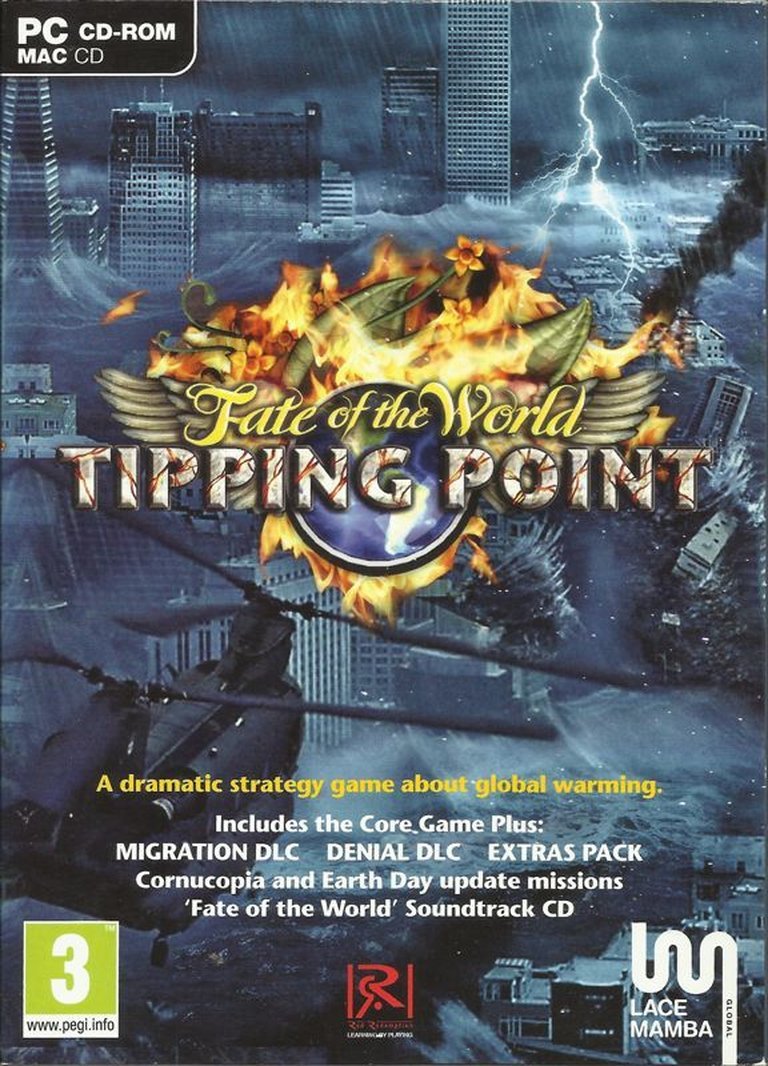
Fate of the World: Tipping Point is a comprehensive compilation bundle that combines the original global strategy simulation with its downloadable content (Denial, Migration, and Extras Pack), offering players the role of a world organization leader tasked with navigating critical ecological and sociological challenges. This educational game uses a card-driven system to represent actions and impacts, set in a realistic global environment where decisions shape the planet’s future, featuring enhanced gameplay mechanics like a redesigned UI, tech tree, and adjustable difficulty modes.
Gameplay Videos
Where to Buy Fate of the World: Tipping Point
PC
Fate of the World: Tipping Point Patches & Updates
Fate of the World: Tipping Point Mods
Fate of the World: Tipping Point Reviews & Reception
metacritic.com (69/100): A wonderfully detailed and terrifying sim. Expanded and slightly improved, but still an opaque and cruel game.
pcgamer.com (69/100): A terrifically detailed and appropriately terrifying sim. Expanded and slightly improved, but still an opaque and cruel game.
gaminglives.com : the stabilisers fall off your bike and you crash head first into a giant wall with ‘difficulty curve’ written on it in big letters.
gamingnexus.com : Other than the poor grammar, one might wonder why the game was not released as it was meant to be played in the first place.
toptiertactics.com : The premise of Fate of the World is fairly simple: The world is in danger of royally getting itself screwed up by the evil trinity of fossil fuels, money, and man…
Fate of the World: Tipping Point: Review
1. Introduction
In an industry often dominated by bombastic explosions and high-octane action, Fate of the World: Tipping Point stands as a stark, sobering anomaly. Released in 2012 by British studio Red Redemption, this turn-based global warming simulation dares to confront one of humanity’s most pressing existential crises—not through cinematic spectacle, but through spreadsheets, policy cards, and the cold calculus of consequence. As the president of the fictional Global Environmental Organization (GEO), players are thrust into a 200-year struggle to balance ecological collapse, political unrest, and economic upheaval across 12 world regions. Tipping Point is more than a game; it is a digital sandbox for grappling with the interconnectedness of global systems, a testament to the potential of video games as tools for serious, data-driven education. Yet, its legacy is a paradox: a brilliantly ambitious simulation crippled by its own opacity, leaving players exhilarated by its complexity yet frustrated by its execution. This review deconstructs Tipping Point as a landmark in serious games, examining its audacious vision, its systemic brilliance, and its flaws, to determine its place in the annals of gaming history.
2. Development History & Context
2.1 The Vision of Red Redemption
Red Redemption, a small UK-based developer founded by Gobion Rowlands and Klaude Thomas, emerged from a desire to merge activism with interactive entertainment. Their 2011 debut, Fate of the World, was a niche passion project aimed at translating climate science into gameplay. Backed by respected institutions—Oxfam, TckTckTck, TakingITGlobal, and the University of Oxford—it sought to model the socio-ecological feedback loops driving global warming. The studio’s ethos was clear: games could be both entertaining and pedagogically transformative.
2.2 Scientific Rigor and Technological Constraints
The game’s scientific foundation was its greatest strength. Climate prediction models were crafted by Professor Myles Allen, head of the Climate Dynamics group at Oxford, ensuring a data-driven simulation grounded in real-world research. Yet, this ambition clashed with the technological constraints of the era. Built on the OGRE engine, Tipping Point ran on Windows and Mac platforms with minimal 3D rendering, prioritizing functional over flashy visuals. The turn-based structure, with each turn representing five years, was a pragmatic choice to manage complex calculations, but it limited dynamism. The 2011–2012 gaming landscape, dominated by mainstream AAA titles, offered little patience for such a niche, text-heavy simulation. As PC Gamer noted, it was “a worthy and handsome effort, but frustratingly badly explained,” a reflection of the chasm between its academic ambitions and commercial viability.
2.3 The “Tipping Point” Compromise
Tipping Point was not merely an expansion but a reimagining of the original. Bundling the base game with DLC (Denial, Migration) and an Extras Pack (soundtrack, designer notes), it added UI tweaks, a new tech tree, and an “Easy Mode” to soften its infamous learning curve. Critically, the retail packaging was eco-friendly—recycled materials, compostable discs—aligning with the game’s themes. Yet, as Gaming Nexus observed, this was “a better game than the original, but also more expensive, so it comes out in the wash.” The studio’s closure in 2015 underscored the challenges of sustaining serious games, though rights were later acquired by Soothsayer Games for a failed multiplayer sequel, Fate of the World Online.
3. Narrative & Thematic Deep Dive
3.1 Scenarios of Survival and Ruin
Tipping Point’s narrative unfolds through scenarios that are less stories than simulations of possible futures. In “Migration,” players manage climate refugees, with regions like Africa flooding and Europe closing borders. “Denial” strips away climate change, forcing players to grapple with finite resources and growth-at-all-costs economics. Each scenario—whether preventing 4°C warming or boosting Africa’s Human Development Index (HDI)—is a microcosm of global interdependence. The GEO’s role as a transnational quasi-government creates constant ethical dilemmas: imposing unpopular carbon taxes risks bans from regions (and lost revenue), while covertly sterilizing populations or funding terrorist coups (via “Black Ops” cards) offers ruthless short-term solutions. As one player review noted, “It’s a good thing to remember it is just a card game after all” when depopulating Europe to save the planet.
3.2 Characters: The Absent Face of Power
The game lacks traditional characters, but its “characters” are the regions themselves—North America’s consumerism, India’s industrialization, the Middle East’s instability. Their needs and reactions are conveyed through news feeds: “India blames GEO for unemployment,” or “North America revolts against fossil fuel bans.” This abstraction heightens the sense of managing faceless systems, where populations are metrics (HDI, emissions) and political approval is a fragile resource. The absence of protagonists or antagonists reinforces the theme: humanity is a collective entity, and its fate rests on systemic choices, not individual heroics.
3.3 Themes: Interconnectedness and the Weight of Time
The core theme is the butterfly effect of policy. A card like “Commit to Renewables” in Europe might lower emissions but spike energy costs in India, triggering famine. As ZTGameDomain argued, the game’s “most important educational achievement is to make players actively consider the next 200 years, rather than just the next election cycle.” Themes of sacrifice and compromise permeate: saving one region may doom another, and “winning” often means mitigating disaster rather than achieving utopia. The Denial DLC, in particular, explores the hubris of unchecked growth, mirroring real-world climate denialism.
4. Gameplay Mechanics & Systems
4.1 The Card-Based Engine: A Symphony of Complexity
At its heart, Tipping Point is a card game played on a global scale. Each turn, players deploy agents (1–6 per region) to “play” cards—policies like “Ban Fossil Fuels” or “Implement One-Child Policy.” Cards cost money (funded by regional taxes) and have durations: some are instant, others lock funds for decades. The system deceptively simple, but its depth lies in cascading consequences. Banning coal in North America might lower emissions but anger industrialists, reducing funding for African aid.
4.2 Global Management: The Juggling Act of Twelve Worlds
The game’s scope is its defining feature. Twelve regions (e.g., North America, India, Oceania) demand simultaneous attention. Players must balance HDI, emissions, political stability, food security, and resource scarcity. A single turn can involve:
– Playing “Enhanced Water Infrastructure” in drought-ridden Africa.
– Funding “Covert Sterilization” in overpopulated India.
– Suppressing rebellion in the Middle East via “Martial Law.”
Each action impacts global metrics tracked through graphs and telemetry. Yet, as Gaming Lives lamented, “the tutorial only puts you in charge of two regions… then the stabilisers fall off your bike.” The jump to managing twelve regions is brutal, exacerbated by a UI that buries critical data under layers of menus.
4.3 Systems Feedback: The Opaque Machine
Fitting Point’s greatest flaw is its feedback loop. Cards lack clear cause-and-effect labels; “Commit to Renewables” doesn’t specify how much it reduces emissions. Players rely on external wikis or trial-and-error, as the game fails to contextualize its own systems. Public opinion is a black box—banning a region might trigger an assassination, as one reviewer discovered “on easy mode.” The addition of “Easy Mode” in Tipping Point alleviates some frustration but dilutes the simulation’s rigor, turning a complex model into a simplified sandbox.
4.4 Innovation and Flawed Execution
The card-based system is innovative, blending board-game strategy with simulation depth. Yet, the UI remains a labyrinth. Scrolling through hundreds of cards with vague descriptions is tedious, and the telemetry interface, while redesigned, still overwhelms. As a Metacritic user summarized, “the game puts just way too much data in front of you, and this data isn’t clear or fun to operate with.”
5. World-Building, Art & Sound
5.1 Setting: Earth as a Character
Tipping Point’s world is a stark, data-drawn Earth. Regions are color-coded on a map, with icons denoting crises (e.g., a flame for wildfires, a factory for pollution). The scale is macro: no cities, no individuals, just regional trends. This abstraction is intentional, emphasizing systemic forces over personal narratives. The game’s “world” is its climate model, a web of inputs and outputs that players must navigate.
5.2 Visual Design: Functional but Uninspired
The art style is utilitarian. The OGRE engine renders static maps, graphs, and card interfaces without flair. Carla Rylance’s artwork is competent but sterile, lacking the personality of games like Civilization. The eco-friendly packaging—recycled paper, compostable discs—stands in stark contrast to the game’s digital bleakness, a rare instance where the physical product embodied the theme more than the game itself.
5.3 Sound: Atmosphere Through Ambiance
Richard Jacques’ soundtrack is a highlight—haunting, ambient tracks that underscore the gravity of global collapse. However, sound effects are minimal, and repetition sets in during long sessions. As one critic noted, the music is “functional, but lacks style,” a microcosm of the game’s overall aesthetic: technically sound but emotionally distant.
6. Reception & Legacy
6.1 Launch: A Mixed Bag
Tipping Point received “mixed or average” reviews (Metacritic: 69%). Critics lauded its ambition but lamented its execution. Gamer Limit awarded it 90%, calling it “a beautifully designed card game” that dives into real-world issues “without climbing atop a soapbox.” PC Gamer countered that it was “opaque and cruel,” praising detail but criticizing its impenetrability. Eurogarmer deemed it “never anything less than compelling,” while Gaming Lives admitted it was “one of the hardest games I’ve ever had to play.” Players echoed this divide, with a 7.3/10 user score on Metacritic, praising its educational value but bemoaning its steep learning curve.
6.2 Evolution of Reputation
Over time, Tipping Point gained respect as a cult classic. Its reputation shifted from “broken” to “bravely flawed,” celebrated for prescient themes. As EarthGames noted in 2017, it “offers a challenging puzzle for everyone,” though its complexity limits appeal. The game’s failure to find mass commercial success (MobyGames: #17,482 of 27K games) underscored the niche market for serious games.
6.3 Legacy and Influence
Tipping Point paved the way for climate-focused games like SimCity spin-offs and Ubisoft’s Anno 2070. Its legacy lies in demonstrating games’ potential as educational tools. The Oxford collaboration set a benchmark for scientific rigor in simulators. Yet, its influence is muted; few developers have attempted such systemic complexity, deterred by its accessibility issues. The failed Fate of the World Online Kickstater (2017) highlighted the financial fragility of serious games, though the genre persists in titles like Frostpunk.
7. Conclusion
Fate of the World: Tipping Point is a game of exquisite contradictions. It is a triumph of simulation design, weaving climate science into a compelling, if punishing, experience. Yet, it is shackled by UI flaws and an unforgiving learning curve, turning its greatest strength—depth—into a barrier. As a serious game, it succeeds in educating players about the interconnectedness of global crises, forcing them to confront ethical trade-offs and long-term consequences. As entertainment, it is a niche product, best suited to patient strategists and data enthusiasts.
In the pantheon of gaming history, Tipping Point occupies a unique space: a flawed masterpiece that dared to ask players to save the world, one spreadsheet at a time. Its legacy is not in perfection but in ambition—a reminder that games can be more than diversion. They can be mirrors to our world’s most pressing challenges. For that, it deserves not only our respect but our gratitude. As PC Gamer concluded, it is “an ugly compromise—but given the choices we have to make as a species, maybe that’s only appropriate.”
Final Verdict: 7.5/10. A landmark in serious games, essential for educators and strategy enthusiasts, but impenetrable for casual players. Its flaws are significant, but its vision remains unparalleled.