
- Release Year: 2023
- Platforms: Nintendo Switch, PlayStation 4, PlayStation 5, Windows
- Publisher: Koei Tecmo America Corp., Koei Tecmo Games Co., Ltd.
- Developer: Koei Tecmo Games Co., Ltd.
- Genre: Role-playing (RPG)
- Perspective: Behind view
- Game Mode: Single-player
- Gameplay: Action RPG, Hack and Slash, Musou, Territory control
- Setting: Fantasy, Futuristic, Japan, Modern
- Average Score: 68/100
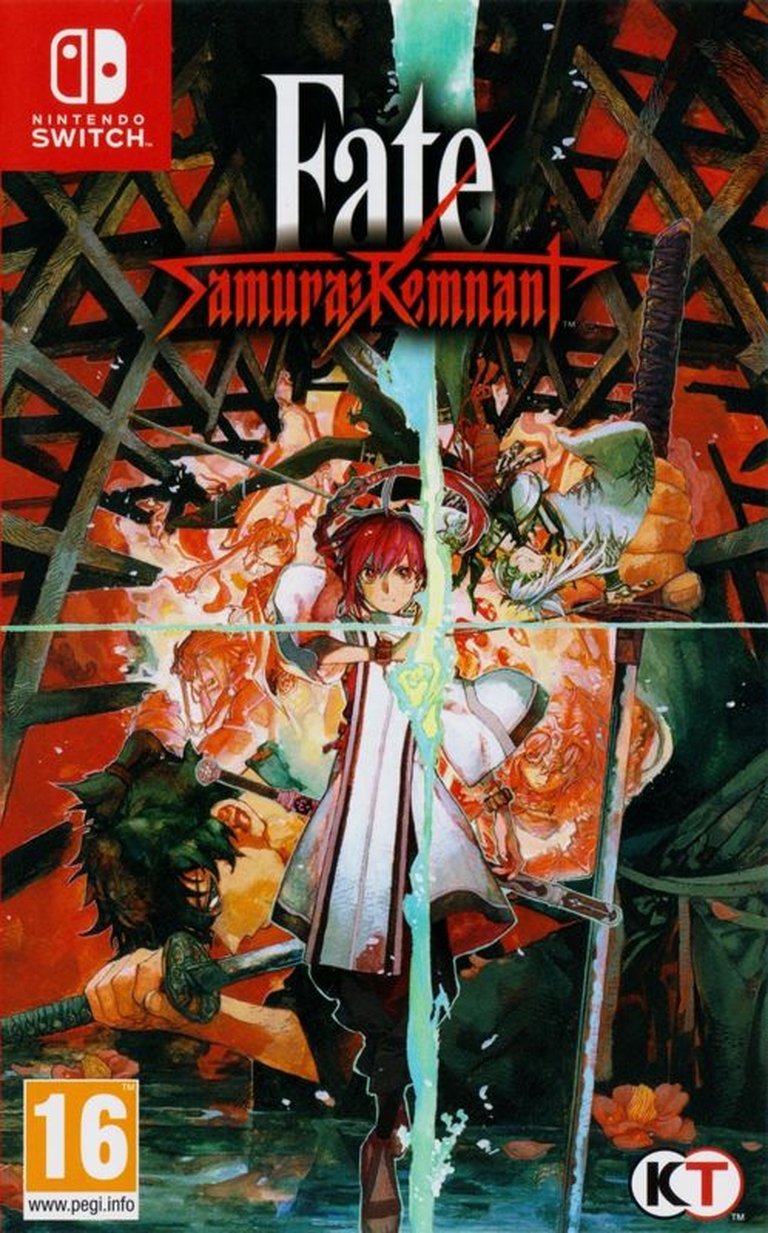
Description
Fate/Samurai Remnant is an action role-playing game set in a modern and futuristic Japan, blending fantasy elements with the Holy Grail War central to the Fate series. Players take on the role of a Master, commanding Servants inspired by historical and mythological figures—including samurai—in intense battles that unfold with a behind-the-camera perspective and vibrant anime-style visuals.
Gameplay Videos
Where to Buy Fate/Samurai Remnant
PC
Fate/Samurai Remnant Free Download
Fate/Samurai Remnant Patches & Updates
Fate/Samurai Remnant Mods
Fate/Samurai Remnant Guides & Walkthroughs
Fate/Samurai Remnant Reviews & Reception
metacritic.com (80/100): Strong in every stance, Fate/Samurai Remnant is an all-around hit, giving everything you’d expect from a good Fate game and then some.
metacritic.com (70/100): Fate/Samurai Remnant makes its mark with a strong story and setting, though the gameplay isn’t quite enough to make the most of it.
metacritic.com (10/100): I liked this game, the combat is fun and the characters and story are very good!
metacritic.com (10/100): I love this games action it reminds of persona 5 strikers. I like the multiple endings too, adds replayability.
metacritic.com (5/100): This game was a huge disappointment.
opencritic.com (70/100): Fate/Samurai Remnant is an enjoyable entry in the Fate universe.
opencritic.com (70/100): Performance issues aside, Fate/Samurai Remnant is a hugely enjoyable action RPG that showcases a strong evolution of the very familiar Musou formula.
opencritic.com (80/100): Fate/Samurai Remnant has a range of combat mechanics that lead to intense and enjoyable combat, and features a cool story at its heart.
opencritic.com (80/100): A highly recommended game for Fate fans, despite some flaws and excessive verbosity.
opencritic.com (75/100): Fate/Samurai Remnant is easy to recommend to Fate newcomers who will have no problem jumping into the game.
opencritic.com (100/100): Fate/Samurai Remnant is the best game in the franchise. It’s a perfect blend of Fate worldbuilding and faithfulness to the Edo-period Japanese setting.
opencritic.com (80/100): Despite its few shortcomings, Fate/Samurai Remnant is a great addition to the Fate media empire that can be enjoyed by hardcore Fate fans and newcomers alike.
opencritic.com (80/100): Fate/Samurai Remnant really leaves a mark with its character-driven story.
opencritic.com (80/100): All in all, Fate/Samurai Remnant is a great exploration of the weight of history, the price of a wish, and how much a person can be willing to sacrifice for their dreams.
opencritic.com (80/100): The Holy Grail War kicks off what I hope to be a continuing run for the Fate franchise. Fate/Samurai Remnant tells a good story with plenty of well-written characters and twists and turns.
Fate/Samurai Remnant Cheats & Codes
PC (Steam)
Run the trainer and press the specified Numpad keys.
| Code | Effect |
|---|---|
| Numpad 1 | immortality |
| Numpad 2 | unlimited health |
| Numpad 3 | high valor scale |
| Numpad 4 | high affinity scale |
Fate/Samurai Remnant: A Masterful Tapestry of Steel, Myth, and Legacy
In the ever-expanding cosmos of the Fate franchise, where Holy Grail Wars and Servant battles have become a cornerstone of modern gaming, Fate/Samurai Remnant emerges not merely as another entry, but as a landmark achievement. Developed by Omega Force and Kou Shibusawa in collaboration with Type-Moon and Aniplex, this action RPG transports players to the bustling, politically charged streets of 1651 Edo Japan, weaving a narrative that is simultaneously self-contained within the Fate multiverse and boldly redefines its core tenets. As a game that meticulously balances accessibility for newcomers with layered depth for veterans, Samurai Remnant stands as a testament to the enduring power of the Fate series and the artistic heights it can reach when unshackled from familiar constraints. This review will dissect its creation, narrative brilliance, mechanical intricacies, atmospheric design, and enduring legacy to argue why this is not just another Fate game, but one of the most significant in its two-decade history.
Development History & Context: Forging a New Blade
The genesis of Fate/Samurai Remnant is a story of ambition and strategic vision. Development began at Koei Tecmo’s Omega Force studio in 2018, a unit renowned for the Dynasty Warriors and Samurai Warriors musou series. However, rather than resting on laurels, director Ryota Matsushita and his team embarked on a collaborative odyssey with Type-Moon and Aniplex, the spiritual custodians and licensors of the Fate universe. This partnership was formalized in late 2022, with the project leveraging Koei Tecmo’s proprietary “Katana Engine” – the same power behind SAMURAI WARRIORS 5 – to render the detailed, semi-open districts of Edo with remarkable fidelity.
The technological constraints were significant. The game aimed for a simultaneous release across PlayStation 4, PlayStation 5, Nintendo Switch, and PC, demanding meticulous optimization to maintain performance across varied hardware. The Katana Engine proved capable, delivering vibrant environments and fluid character animations, though the Switch version faced notable performance dips, as noted in several reviews. Matsushita’s vision was clear: to create a “Holy Grail War experience” that emphasized the “harshness” and “overwhelming difference in power between Masters and Servants,” a core tenet of the franchise, while offering a fresh narrative standalone from Fate/stay night or Fate/Grand Order. This ambition was fueled by Koei Tecmo CEO Yōichi Erikawa’s personal fandom with Fate/Grand Order, bridging the gap between Koei Tecmo’s action expertise and Type-Moon’s intricate lore.
Released on September 28, 2023, Samurai Remnant entered a fiercely competitive gaming landscape. It arrived amidst a deluge of major AAA releases, yet its unique blend of historical authenticity, Fate mythology, and refined musou-action carved a distinct niche. The development team, including veteran Fate writers like Hikaru Sakurai (Fate/Extra) and Yuichiro Higashida (Fate/Apocrypha), ensured the script resonated with both neophytes and lore masters. Kinoko Nasu’s oversight as Story General Supervisor guaranteed thematic consistency with the broader series, while Rei Wataru’s character illustrations breathed life into the Edo setting. The result was a game that felt both timeless and timely, a product of meticulous collaboration that pushed the boundaries of what a licensed property could achieve.
Narrative & Thematic Deep Dive: The Waxing Moon and its Echoes
Fate/Samurai Remnant distinguishes itself through a narrative that is as much a character study as it is a high-stakes conflict. The central premise, the “Waxing Moon Ritual,” is a fascinating reimagining of the Holy Grail War, born from incomplete records of Abe-no-Seimei. Set in 1651 Edo during the reign of Shogun Ietsuna, the ritual pits seven Masters and their Servants against each other for control of a wish-granting vessel. The protagonist, Miyamoto Iori, is a ronin and the adopted son of the legendary Miyamoto Musashi, embodying the theme of being “born in the wrong era.” His peaceful existence in Asakusa is shattered when he inadvertently summons Saber, whose True Name is revealed as Yamato Takeru – a tragic, lonely conqueror from ancient Japan whose spirit became a swan. This initial dynamic – the grounded, duty-bound swordsman and the impetuous, otherworldly hero – forms the emotional core of the game.
The narrative unfolds through branching paths, primarily dictated by a pivotal choice in Chapter 4: whether to pursue the scheming overseer Tsuchimikado Yasuhiro or aid Dorothea Coyett against her corrupted Assassin. This choice leads to dramatically divergent endings:
– Flames of Resentment: Choosing Tsuchimikado results in his death by Lancer’s hand, but Dorothea sacrifices herself to stop Assassin. Chiemon, survivor of the Shimabara Rebellion and fueled by vengeance, absorbs the Waxing Moon, transforming into a monstrous “Waxing Moon Monster” in Edo Castle. The climax is a brutal battle where Saber sacrifices herself to destroy the vessel, leaving Iori to return to a broken world.
– A Ray of Light: Choosing Dorothea leads to her survival and Tsuchimikado’s mysterious death. Zheng Chenggong, the Ming loyalist known as Koxinga, betrays the alliance, partnering with Caster/Hieda-no-Are to steal the vessel and summon the demigod Yasomagatsuhi. The final battle sees Iori use a Command Seal to destroy the vessel at great cost, with Saber and Shousetsu perishing, while Zheng vows to find another path for his homeland.
– Entreat the Darkness: Unlockable in New Game+, this darker path sees Iori, corrupted by power and his desire to plunge Japan back into war, refuse to destroy the vessel. He duels Saber, who kills him to prevent his catastrophic wish, epitomizing the tragic cost of Iori’s unfulfilled potential.
The supporting cast is equally rich and complex. Takao Dayu, a high-ranking courtesan in Yoshiwara, seeks to alleviate the suffering of the poor, her motivations deeply human despite her partnership with the wild, Berserker-class Musashi. Yui Shousetsu, a homunculus warrior, represents the ideological struggle against a “crooked world,” her Rider/Ushi Gozen a terrifying manifestation of that rage. Zheng Chenggong’s dual identity as a military commander and magus, torn between duty and ambition, adds geopolitical weight. Dorothea Coyett, the Swedish Clock Tower mage navigating a foreign land, and Chiemon, the child of rebellion shaped by trauma, provide poignant commentary on historical cycles of violence and persecution.
Thematically, the game is a masterclass in exploring the weight of history and the nature of desire. The “born in the wrong era” motif permeates Iori’s arc, his wish in Entreat the Darkness to spark war a dark reflection of Musashi’s belief that true mastery can only be forged in conflict. The Waxing Moon itself is a potent symbol: a flawed imitation of the Holy Grail, capable of selfish, immediate wishes (like Archer’s self-destruction to protect his friend) but unable to grant grand, altruistic desires like Shousetsu’s utopia. The game constantly asks: what is the cost of a wish? Is peace worth preserving even if it stifles greatness? The narrative ultimately argues against selfish ambition, favoring connection and sacrifice, epitomized by Saber’s bond with Iori and Musashi’s final duel with her student. This is a story about legacy, not just of swords, but of ideals passed between generations, making it profoundly resonant within the broader Fate tapestry.
Gameplay Mechanics & Systems: The Dance of Steel and Spirit
Fate/Samurai Remnant’s gameplay is a sophisticated fusion of action-RPG depth and the accessible, crowd-pleasing mechanics of the musou genre. At its core is the dynamic between Miyamoto Iori and his Servant, Saber. Players primarily control Iori, a master swordsman wielding dual katanas, whose combat is defined by a system of five stances inspired by Miyamoto Musashi’s Book of Five Rings:
– Fire (Ka): Aggressive, high-damage stance with explosive finishers.
– Water (Mizu): Balanced, fluid stance with wide area attacks and strong combo potential.
– Earth (Chi): Defensive stance with a guard that regenerates stamina, ideal for holding positions.
– Wind (Fu): Swift, evasive stance focused on mobility and quick strikes.
– Void (Kū): A stance unlocked later, offering powerful, unique abilities and a finisher that consumes the entire Affinity Gauge.
Each stance has its own skill tree, allowing deep customization as players unlock new abilities and passive buffs. This system encourages adaptability, forcing players to switch stances based on enemy types – crowds of low-level foes are best handled with Water or Fire, while shielded or high-damage enemies require the defensive Earth stance or precise Wind techniques.
The true innovation lies in the Affinity Gauge, a central resource that governs Saber’s involvement. Dealing damage to enemies fills the gauge, which can then be expended for Affinity Techniques – powerful, coordinated attacks between Iori and Saber. These range from Saber launching Iori into a devastating aerial plunge to creating water waves that augment Iori’s slashes. At full gauge, players can seamlessly switch control to Saber (or other allied Servants encountered during “Digressions”), who possesses overwhelming power against high-value targets like other Servants or large monsters. This mechanic brilliantly embodies the Master-Servant dynamic: Iori is the persistent, adaptable fighter, while Saber is the game-changing force, a “glass cannon” whose raw power can turn the tide but whose effectiveness is limited by the gauge. Allied Rogue Servants (like Cu Chulainn or Gilgamesh) become playable in specific story segments, offering variety but often lacking Iori’s access to recovery items, making them situational powerhouses.
Beyond combat, the game features the Leyline Conflict mini-game, a strategic layer where players capture and defend nodes across the Edo map. These nodes provide buffs, resources, and story progression, adding a light real-time strategy element that breaks up the action. Customization extends to Iori’s katanas, with four parts (scabbard, guard, wrapping, decoration) that can be swapped to alter damage types and effects. The progression system is robust, with experience, currency, and materials earned through combat and exploration fueling character growth and equipment upgrades.
However, the system is not without flaws. The combat, while initially satisfying, can become repetitive against the hordes of generic enemies that populate levels. The timing for ripostes – a crucial defensive maneuver that allows Iori to counterattack and stagger foes – is inconsistently responsive, often feeling more reliant on luck than skill. This is exacerbated by flashy enemy animations that can obscure telegraphed attacks, leading to frustrating deaths. While the branching narrative and multiple endings provide significant replay value, the core combat loop lacks the sustained depth of genre benchmarks. Yet, these are minor blemishes on a system that excels in its clarity, customization, and the sheer spectacle of Servant Noble Phantasms turning the tide of battle. The balance between Iori’s human vulnerability and Saber’s divine power creates a unique tension that remains engaging throughout the 40-50 hour campaign.
World-Building, Art & Sound: A Living Edo, Brought to Life
Fate/Samurai Remnant’s greatest triumph lies in its immersive recreation of 17th-century Edo, a world rendered with breathtaking detail and palpable atmosphere. The game is not set in a generic fantasy Japan, but in a meticulously researched historical period. The districts of Asakusa, Yoshiwara, Kanda, and Akasaka are not merely backdrops; they are living, breathing characters. Asakusa’s vibrant marketplaces, Yoshiwara’s cherry-blossom-drenched pleasure quarters with its oppressive underbelly of exploitation, Kanda’s scholarly tranquility, and Akasaka’s strategic importance are all captured with astonishing authenticity. The bustling crowds, the architecture, the subtle social hierarchies – all contribute to a sense of place rarely achieved in games. This world-building is enhanced by the Logbook, an in-game codex that provides rich lore on characters, locations, and historical events, rewarding player curiosity and deepening immersion.
The art direction, overseen by Rei Wataru, is a masterful blend of historical fidelity and vibrant anime aesthetics. Character designs are expressive and distinct, from Iori’s rugged practicality to Saber’s androgynous elegance and the wild intensity of Musashi. The environments are painterly, with warm lighting, dynamic weather, and a color palette that shifts from the bustling, warm hues of Yoshiwara by day to the cool, shadowy tones of its alleys at night. This visual storytelling is complemented by the game’s exceptional sound design. The score, composed by Keita Haga (Tsukihime, Melty Blood) and Daisuke Shinoda (Wild Hearts), is a sublime fusion of traditional Japanese instruments (shamisen, shakuhachi, taiko) with orchestral grandeur. It elevates every scene, from the melancholic loneliness of Saber’s theme to the thunderous intensity of boss battles. The voice acting, delivered entirely in Japanese, is universally superb. Kengo Kawanishi (Iori) and Hibiku Yamamura (Saber) anchor the performances, capturing the evolving dynamic from antagonism to profound camaraderie. The supporting cast, including Ami Koshimizu (Takao Dayu) and Maaya Sakamoto (Lancer/Jeanne d’Arc Alter), brings nuance and gravitas to their roles. Sound effects are equally meticulous, the shink of drawn steel, the clash of steel on steel, and the ambient sounds of the city streets all contributing to the sensory immersion.
This synergy of art and sound creates an atmosphere that is both fantastical and grounded. The contrast between the serene beauty of Edo’s streets and the brutal, supernatural violence of the Waxing Moon Ritual is stark and effective. When the Waxing Monster corrupts Edo Castle in Flames of Resentment, the visuals shift from historical grandeur to fleshy, grotesque horror, a visual manifestation of the narrative’s themes. Even the smaller touches, like the ability to pet cats and dogs for health restoration, add to the sense of a lived-in, reactive world. This is not just a game set in Edo; it is an experience of Edo, a virtual tour that makes the familiar strange and the mythical tangible.
Reception & Legacy: Forging a New Path in the Fate Multiverse
Upon its release in September 2023, Fate/Samurai Remnant was met with widespread critical acclaim, cementing its status as a high point in the franchise. On Metacritic, it holds a score of 81/100, indicating “Generally Favorable” reviews, while Famitsu awarded it a respectable 36/40. Critics lauded its narrative depth, character development, and the unique integration of Fate lore with a fresh, historical setting. RPG Site declared it “a pretty small blemish on the face of a work that might be the best Fate game to emerge in a long while,” praising its ability to “grasp and elevate the fundamentals of the Fate series.” Siliconera highlighted its accessibility for newcomers, noting it could “convert you to a fan by the end of it.” The combat, while occasionally repetitive, was often described as “kinetic,” “addictive,” and “rewarding,” with particular praise for the Affinity system and Servant control. The world-building and art direction were almost universally celebrated, with multiple outlets noting the “virtual tourism” quality of exploring Edo.
However, criticism was not absent. Some reviewers found the early game pacing slow due to extensive lore dumps and dialogue, and the Nintendo Switch version’s performance issues were frequently noted. The combat’s simplicity compared to deeper action-RPGs was a common point of contention, as was the sometimes-unreliable riposte timing. Despite these minor flaws, the overall reception was overwhelmingly positive, with an average critic score of 83% on MobyGames based on 38 reviews. Commercially, the game proved successful, selling 410,000 units globally by April 2024, a strong performance for a niche franchise title.
Fate/Samurai Remnant‘s legacy is already taking shape. It is widely regarded as one of the most accessible entries in the Fate series, a perfect starting point for newcomers drawn by its standalone story and historical intrigue, while offering enough fan service and thematic depth to satisfy veterans. Its success has proven the viability of a new narrative direction for the franchise beyond the established Fate/stay night and Fate/Grand Order continuities. The subsequent DLC – Record’s Fragment chapters – have expanded the universe, exploring “What If?” scenarios that further enrich the world and its characters. Its impact is also seen in the crossover with Fate/Grand Order, bringing characters like Miyamoto Iori and Yui Shousetsu to the mobile game, demonstrating the game’s contribution to the broader Fate mythos. More importantly, Samurai Remnant has set a new benchmark for licensed games, proving that deep respect for source material combined with innovative design can yield results that transcend the limitations of the license. It stands as a testament to Omega Force’s ability to evolve beyond the musou template and Type-Moon’s capacity for creative reinvention, ensuring that the legend of the Holy Grail Wars, and the warriors who fight for them, will continue to captivate for years to come.
Conclusion: The Enduring Resonance of the Blade
Fate/Samurai Remnant is more than just a video game; it is a cultural artifact, a love letter to both the rich lore of the Fate universe and the historical tapestry of Edo-period Japan. It succeeds where many licensed games fail by creating an experience that is simultaneously integral to its franchise and entirely self-contained. The narrative, with its branching paths and deeply human characters grappling with divine power, offers emotional weight and philosophical depth rarely seen in the action-RPG genre. The gameplay, built on the elegant dance between Iori and Saber, provides accessible yet satisfying combat that captures the essence of the Master-Servant bond. The world, rendered with stunning artistry and immersive sound design, is a character in its own right, making the fantastical feel tangible.
While minor flaws in combat repetition and pacing prevent it from absolute perfection, they are insignificant compared to the game’s towering achievements. It stands as a high-water mark for the Fate series, a title that honors its legacy while boldly charting a new course. For newcomers, it is the perfect gateway into a vast and complex universe. For veterans, it is a fresh, compelling chapter that reaffirms the series’ core themes of legacy, sacrifice, and the enduring struggle between peace and conflict. Fate/Samurai Remnant is, unequivocally, a masterpiece – a game that proves that even the most storied franchises can find new life when they dare to remember the past while forging a new blade. Its legacy will undoubtedly endure, a shining example of how respectful adaptation and ambitious design can create something truly extraordinary.