
- Release Year: 2010
- Platforms: Windows
- Publisher: Ferrari S.p.A.
- Developer: KUNOS Simulazioni S.r.l.
- Genre: Driving, Racing, Simulation
- Perspective: First-person, Behind view
- Game Mode: Hotseat
- Gameplay: Simulation, Time Trial
- Setting: Circuit
- Average Score: 73/100
Description
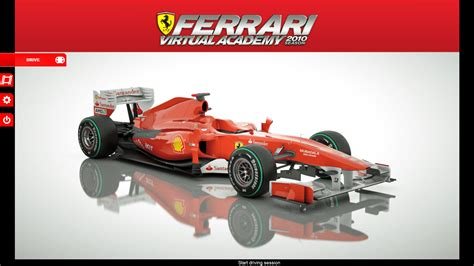
Ferrari Virtual Academy 2010 Season: Basic Pack is a simulation racing game released by Ferrari in 2010, focusing exclusively on hot lap challenges where players race the Ferrari F10 Formula One car around Fiorano Circuit to achieve the fastest lap times. The game features a global ranking system where top performers win Ferrari-themed prizes, including an exclusive one-day driving course at Fiorano for the top three. It is a commercial download simulation with no real-time opponents, playable offline via server patch after the original servers closed in 2015.
Gameplay Videos
Ferrari Virtual Academy 2010 Season: Basic Pack Patches & Updates
Ferrari Virtual Academy 2010 Season: Basic Pack Guides & Walkthroughs
Ferrari Virtual Academy 2010 Season: Basic Pack Reviews & Reception
gamesystemrequirements.com (65/100): Mixed reception among users.
Ferrari Virtual Academy 2010 Season: Basic Pack: Review
Introduction
In the annals of sim racing, few titles embody the intersection of technological ambition and niche exclusivity quite like Ferrari Virtual Academy 2010 Season: Basic Pack. Released on September 8, 2010, this Windows-exclusive simulation emerged from a groundbreaking collaboration between Italian developer Kunos Simulazioni and Scuderia Ferrari. It promised not merely entertainment but a portal into the hyper-technical world of Formula One, offering players the chance to pilot the iconic Ferrari F10 on its Fiorano test track. While its initial reception was polarized, FVA has since ascended to cult status, revered for its uncompromising physics and historically significant role in bridging the gap between professional-grade simulators and consumer gaming. This review dissects FVA’s legacy—a product defined by its audacious vision, rigorous development, and bittersweet obsolescence—to argue that despite its limitations, it stands as a landmark achievement in racing simulation.
Development History & Context
Ferrari Virtual Academy emerged from Kunos Simulazioni’s ambition to translate Ferrari’s internal F1 driver training simulator into a consumer product. The Italian studio, fresh from the critical success of netKar Pro (2006), partnered directly with Scuderia Ferrari engineers and drivers, including Fernando Alonso, Felipe Massa, and Giancarlo Fisichella. This collaboration yielded unprecedented access to telemetry data, aerodynamic models, and chassis dynamics.
Development consumed 12,000 man-hours by a 15-person team, deploying cutting-edge technologies rarely seen in 2010 gaming:
– Laser scanning of the Fiorano Circuit to replicate millimeter-accurate track surfaces.
– Motion capture of drivers to simulate G-forces and neck strain in the helmet-cam view.
– A 1000 Hz physics engine calculating forces every millisecond for real-time responsiveness.
The technological landscape of 2010 favored arcade racers like Need for Speed: Shift and Gran Turismo 5, while hardcore sims (iRacing, rFactor) demanded significant financial commitment. FVA positioned itself as a premium “digital ambassador” for Ferrari, priced at €14.90—a bold move for a product with minimal content. Its unveiling at the 2010 Italian Grand Prix underscored its roots in professional motorsport, with Ferrari executives touting it as the “first online virtual driving academy.” Yet this exclusivity would later become its Achilles’ heel, as its always-online requirement rendered it obsolete by 2015.
Narrative & Thematic Deep Dive
FVA eschews traditional narratives in favor of a thematic exploration of precision and perfection. Its “plot” is the player’s solitary quest to master the Fiorano circuit, echoing the relentless practice regimens of F1 drivers. The game’s structure—two modes, Free Practice and Hot Lap—reinforces this ethos:
– Free Practice serves as a sandbox for experimentation, allowing aids like traction control and visible racing lines. Fuel loads are customizable, mirroring real-world pit strategies.
– Hot Lap strips away all assistance, enforcing purity in competition. Players race against ghost data from benchmark laps set by Felipe Massa, fostering a personal rivalry with elite drivers.
The global leaderboard system amplifies this narrative. Top performers won tangible rewards—Ferrari merchandise and, for the top three, an all-expenses-paid Ferrari Driver Academy course at Fiorano. This gamification of excellence turns each lap into a chapter in a larger story of dedication. The lack of AI opponents or dynamic events underscores FVA’s thematic focus: perfection is achieved alone, through repetition and data-driven refinement. Even the absence of damage models or tire wear mechanics (purely visual) reinforces the idea that FVA is a sterile laboratory for honing craft, not a chaotic arena of sport.
Gameplay Mechanics & Systems
FVA’s gameplay is a masterclass in simulation purity, albeit one with systemic constraints:
– Core Physics: The F10’s handling is modeled on Ferrari’s telemetry, with meticulous attention to aerodynamic downforce, tire grip, and engine braking. The 1000 Hz physics engine ensures nuanced feedback, such as how slight throttle adjustments affect mid-corner stability.
– Control Schemes: While keyboard/gamepad support exists, FVA prioritizes wheel peripherals. Official compatibility with the Thrustmaster Ferrari F1 Wheel Integral T500 provides force feedback calibrated to replicate steering resistance and road surface nuances.
– Progression: There is no traditional leveling. Advancement is measured in milliseconds shaved off lap times. The leaderboard system, though defunct, created asynchronous competition with players worldwide.
– Flaws: The always-online mandate—even for solo play—was controversial. Without server authentication (shut down in 2015), FVA was unplayable until community patches emerged. The single-car, single-track Basic Pack also limited replayability, addressed only later via the 2011 Adrenaline Pack (adding the F150 Italia, 458 Challenge, Mugello, and Nürburgring).
Hot Lap mode, the heart of FVA, is both its greatest strength and greatest limitation. By eliminating distractions, it forces players to confront their own limitations, creating a uniquely demanding experience. Yet the absence of dynamic weather, day/night cycles, or multiplayer underscored its narrow focus—a critique often levied by reviewers like The Games Machine (72%), which praised its physics but lamented its “lack of content.”
World-Building, Art & Sound
FVA’s world-building is minimalist yet meticulously realized. The Fiorano Circuit, laser-scanned for authenticity, is rendered with obsessive detail: kerb textures, elevation changes, and runoff areas mirror their real-world counterparts. The environment is static and sterile—no crowds, no weather, no time-of-day shifts—reflecting its purpose as a private test track. This austerity heightens immersion, as players concentrate solely on the car’s interaction with the surface.
The art direction prioritizes functional realism over spectacle. The F10’s cockpit is a tour de force of authenticity, with functional steering wheel displays, toggle switches, and a helmet-cam view that subtly sways under lateral G-forces. Motion-captured driver movements add visceral weight to high-speed maneuvers. The 458 Challenge, added in the Adrenaline Pack, demonstrates Kunos’s versatility, translating a GT car’s distinct balance and feedback into the same framework.
Sound design is equally precise. The F10’s V8 engine note was calibrated using real telemetry, with pitch and volume shifting based on RPM and gear. Tire squeals and brake dust sounds provide auditory cues for grip levels, though force feedback remains the primary sensory conduit. The result is a world less “alive” than Gran Turismo’s but more tactile—a place where every vibration, engine rumble, and steering resistance feels purposeful.
Reception & Legacy
FVA’s launch reception was a study in contrasts. Italian publications like Giochi per il mio computer (8.5/10) hailed it as the “best F1 simulator ever made,” lauding its physics and force feedback. Level (9/10) similarly celebrated its “quality of simulation” and laser-scanned accuracy. However, broader criticism centered on its scarcity of content and steep price. The Games Machine (72%) noted the “lack of dynamic race conditions,” while forums like Guru3D debated the ethics of charging €14.90 for a single track and car.
Commercially, FVA found its audience among hardcore sim enthusiasts, but its lifespan was cut short. In January 2015, Ferrari discontinued server support, rendering the game unplayable. Yet its legacy endures:
– Influence on Assetto Corsa: Kunos directly ported FVA’s laser-scanning and physics tech into Assetto Corsa (2014), cementing its reputation as a precursor to modern sim racing.
– Community Preservation: Abandonware sites like MyAbandonware and the Internet Archive host patched versions, ensuring its survival. A server patch allows offline play with random credentials reviving the spirit of its leaderboard competition.
– Cultural Impact: FVA remains a benchmark for fidelity. As Eurogamer noted, it “set the stage for sim racing’s renaissance,” proving that niche, developer-led projects could rival AAA studios in technical ambition.
Its obsolescence, paradoxically, enhances its historical significance—a relic of an era where simulations prioritized authenticity over accessibility.
Conclusion
Ferrari Virtual Academy 2010 Season: Basic Pack is a flawed masterpiece, a product of its time yet ahead of it. Its genius lies in its unrelenting focus on simulation purity, leveraging Ferrari’s engineering prowess to create an experience unmatched in its tactile accuracy. The scarcity of its initial release and its untimely demise due to server shutdowns are undeniable failings, yet they underscore its niche appeal. FVA was never meant to be a blockbuster; it was a love letter to sim racing’s purists, a digital key to Maranello’s inner sanctum.
In the pantheon of racing games, FVA occupies a unique space: it is both a historical artifact and a touchstone for modern simulations. While Assetto Corsa would later refine its innovations, FVA’s legacy is etched in its audacity—to democratize F1 training, to demand perfection, and to prove that the pursuit of speed is, above all, a solitary science. For sim racing historians, it remains not just a game, but a time capsule of ambition in an industry increasingly dominated by spectacle. Verdict: An essential, if austere, chapter in the evolution of virtual motorsport.