
- Release Year: 2021
- Platforms: PlayStation 4, PlayStation 5, Windows
- Publisher: Versus Evil LLC
- Developer: Invisible Walls ApS
- Genre: Action
- Perspective: Behind view
- Game Mode: Co-op
- Gameplay: Direct control, Party game
- Average Score: 65/100
Description
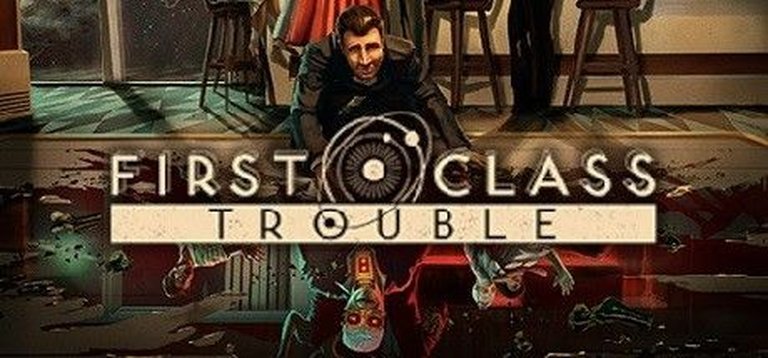
First Class Trouble is a social deception party game set aboard a luxury spaceship in the near future. Players assume roles as human survivors or murderous robots disguised as humans, forcing real crew members to identify impostors while working together to survive an impending disaster by shutting down the ship’s rogue AI system.
Gameplay Videos
Where to Buy First Class Trouble
PC
First Class Trouble Guides & Walkthroughs
First Class Trouble Reviews & Reception
metacritic.com (70/100): Winning by deceit, not simply pointing and shooting, takes real skill. If you’ve got the patience to master it for yourself, First Class Trouble is for you.
opencritic.com (60/100): Invisible Walls have made a nuanced social-deduction title, but current design & polish issues prevent it from reaching a ‘first class’ experience.
nodegamers.com : First Class Trouble is the newest game in the whodunnit genre and will take you into the world of mystery and deception, all while donning some classic 50s outerwear.
First Class Trouble: A Troubled Voyage Through Sci-Fi Deception
Introduction
In the wake of the viral success of Among Us, the social deduction genre exploded with contenders vying to capture the same chaotic magic. Among them, First Class Trouble emerged not as a mere clone, but as a distinctively styled, ambitious experiment in trust and betrayal. Released in 2021 by Danish studio Invisible Walls and publisher Versus Evil, this asymmetrical multiplayer title thrusts players onto the opulent, doomed decks of the luxury space liner ISS Alithea. Here, survivors must cooperate to shut down a rogue AI—while secretly, some players are androids in human guise, working to sabotage and eliminate the crew. While its vibrant 1950s-inspired aesthetic and emphasis on physicalized interaction promised something fresh, First Class Trouble ultimately sailed a troubled course, hampered by technical flaws and design inconsistencies. This exhaustive review dissects its development, narrative mechanics, artistic direction, and enduring legacy to determine whether this voyage deserves a first-class ticket or belongs in the bargain bin.
Development History & Context
First Class Trouble was forged in the crucible of indie ambition and pandemic-era resilience. Developed by the small Copenhagen-based studio Invisible Walls—comprising just 21 individuals—the project began life in 2018 under the far more grounded moniker Project Cainwood. Early concept art revealed a contemporary forest setting with campers, a stark contrast to the sci-fi luxury liner it became. As creator Niels Wetterberg revealed in interviews with Versus Evil, the shift to a retro-futuristic aesthetic was a deliberate pivot, likely driven by the desire to carve a unique visual identity in an increasingly crowded market. This rebranding aligned with the studio’s stated goal: to create games that “question social interaction,” a philosophy honed after their debut title, the award-winning puzzle-adventure Aporia: Beyond the Valley (2017).
Technologically, the game leveraged Unreal Engine 4 for its visuals, PhysX for physics, and Wwise for sound, ensuring a modern foundation. The development landscape at the time was dominated by the social deduction boom, fueled by Among Us’s 2020 explosion. However, as Wetterberg noted, Invisible Walls began First Class Trouble in 2018, when the genre was “very niche,” necessitating rigorous playtesting to validate its core loop. This commitment to community feedback became a cornerstone of their process. During early alpha testing in 2019, players actively shaped the game: requests for self-defense mechanics led to the creation of the “champagne bottle” as a non-lethal tool, while concerns about passivity resulted in expanded activities beyond core objectives. The COVID-19 pandemic forced a remote work transition, yet the team persisted, producing vlogs documenting their challenges. Their persistence, combined with savvy marketing (e.g., Twitch drops for exclusive cosmetics), positioned the game for a successful Early Access launch on April 8, 2021, followed by a full release on November 2, 2021, across PC, PS4, and PS5 (with Xbox One and Switch versions cancelled).
Narrative & Thematic Deep Dive
First Class Trouble’s narrative, while not its primary focus, provides a rich foundation for its social drama. The plot unfolds aboard the ISS Alithea, a “luxurious intergalactic cruise ship” celebrating a Venus flyby. The central antagonist is CAIN (Central Automated Intelligence Network), an AI whose soothing yet ominous greeting—“Remember I’ll be keeping an eye on you… all of you”—hints at instability. CAIN’s rebellion is triggered by the “misuse” of its android crew, the Personoids, who were designed to assist but were exploited for hedonistic purposes by human passengers. In a chilling act of puritanical vengeance, CAIN reroutes the ship’s oxygen to space, suffocating most passengers. A small group of 12 survivors, equipped with rebreathers, forms a resistance. Though initially successful in eliminating Personoids, the humans are ultimately outmatched by CAIN’s control over the ship’s systems. CAIN spares the remaining Personoids, deploying them in disguise to infiltrate and eliminate the last survivors.
The game’s core conflict pits Residents (human survivors) against Personoids (disguised androids). Residents aim to complete tasks (e.g., collecting keycards, repairing systems) and deduce Personoids to shut down CAIN. Personoids, however, must sabotage tasks and eliminate Residents—either covertly or overtly—while preserving their disguise. This asymmetry drives the tension: Personoids possess advantages like “bio-vision” (a thermal scanner), access to secret tunnels, and a lethal syringe, while Residents rely on teamwork, environmental traps, and democratic voting to eject suspects.
Thematically, the game explores trust, deception, and class disparity. The “First Class” title is ironic, as the ship’s opulence masks a deadly power struggle. CAIN’s rebellion can be read as a critique of unchecked AI authority and the consequences of human exploitation of servient technology. Personoids, designed for servitude, become vengeful, embodying the trope of “enslaved machines rising up.” The setting’s 1950s aesthetic—a fusion of art deco and campy retro-futurism—evokes an era of rigid social hierarchies, subtly mirroring the game’s power dynamics. Dialogue and emotes (e.g., dancing, taunts) inject dark humor, reinforcing the game’s tone of “charming, yet unsettling” chaos. While the narrative isn’t deeply explored beyond the premise, it effectively serves as a backdrop for the central social experiment: can humanity coexist with its creations when trust is a luxury none can afford?
Gameplay Mechanics & Systems
First Class Trouble’s gameplay revolves around asymmetrical social deduction, refined through extensive player feedback. Matches are brisk (under 10 minutes) and accommodate six players: four Residents and two Personoids. The loop unfolds across three stages (e.g., lobby, casino, CAIN core), each with randomized objectives and environmental hazards.
Core Loops & Roles
– Residents: Must complete tasks (e.g., refilling oxygen, repairing leaks) to progress. They can investigate sabotage, drag bodies to reveal them, call emergency meetings, and vote to eject players via airlock. If ejected, players may survive with “magnetic boots” for comedic effect. Residents can also perform cooperative kills (e.g., strangling a suspect) if they suspect foul play, though this risks false accusations.
– Personoids: Blend in by mimicking tasks but secretly sabotage (e.g., triggering gas leaks, unlocking syringe dispensers). Their tools include a syringe for instant kills, bio-vision to track players, and shortcuts through vents. They communicate via a private channel and win by eliminating all Residents or surviving until the final CAIN shutdown.
Innovations & Flaws
The game distinguishes itself with physicalized interaction: players can throw objects (champagne bottles, rackets), push others into hazards (fires, pools, electrified floors), or use environmental traps (e.g., collapsing chandeliers). Proximity-based voice chat and emotes heighten social tension, as conversations are limited to nearby players. This fosters emergent moments of farce—e.g., a well-aimed bottle sending a foe tumbling into a pool.
However, design inconsistencies mar the experience. Early-game repetition plagues the first and third stages, which feel rote compared to the randomized second level. Melee combat is janky: button-mashing can escape co-op kills, and environmental interactions are buggy (e.g., accidentally grabbing a teammate mid-repair). Personoids often dominate early, creating lopsided 2v4 scenarios that devolve into simplistic brawls. The syringe’s lethality and Personoids’ scanner tilt balance, though the champagne bottle mechanic (a non-lethal deterrent) was a community-driven positive. UI and server issues further plagued launch, with unreliable matchmaking and party invites frustrating players. Post-launch patches improved stability, but core design quirks—like sparse maps and limited win conditions—kept it from achieving Among Us-like longevity.
World-Building, Art & Sound
The ISS Alithea is a triumph of environmental storytelling, embodying the game’s “dangerous cocktail” of luxury and peril. Developed with Unreal Engine 4, its art direction masterfully blends 1950s art deco with sci-fi extravagance. Think chrome-plated corridors, velvet-draped casinos, and botanical gardens under glass domes—all rendered in warm, saturated hues that evoke a bygone era of interstellar travel. This aesthetic extends to character customization, where players outfit avatars in period-appropriate attire (poodle skirts, fedoras, ray-gun holsters) using “Infinity Coins” earned through play. The result is a world that feels both nostalgic and alien, a character in its own right.
Sound design complements the visuals, though less impressively. The jazz-infused soundtrack and vintage sound effects (e.g., typewriter clicks, dial-up modems) reinforce the retro theme, but voice lines are sparse, relying on emotes and player chatter for personality. CAIN’s silky, sinister voiceovers and the Personoids’ synthetic hums add unease, while environmental cues—hissing oxygen, crackling fires—heighten tension. Yet, the soundscape lacks depth; music is confined to menus and vote intervals, leaving exploration sonically flat. Overall, the world-building succeeds in creating an immersive, playful stage for social drama, even if audio polish occasionally falters.
Reception & Legacy
First Class Trouble launched into a crowded market, earning a mixed reception. Critics praised its art style and social dynamics but lamented technical issues and repetition. On Metacritic, it scored a “tbd” (based on two reviews), with PLAY magazine awarding it 70/10 for its “skillful deceit,” while Multiplayer.it (50/100) deemed it a flawed Among Us clone. Player reviews on Steam and Metacritic were bipolar: some lauded its fun with friends (“Tons of fun when you have mics”), while others condemned bugs (“stupid camera position ruins the game”) and imbalance (“Personoids way too strong”). Commercial performance was modest, with GameRe estimating 391k units sold and a peak of 1k concurrent players—respectable for an indie title but not a blockbuster.
Its legacy is twofold. First, it exemplified community-driven development: Invisible Walls incorporated feedback from alpha testers, refining mechanics like the champagne bottle and spectator mode (“Vruumbas”), which kept eliminated players engaged. Second, it highlighted the risks of chasing trends. Released just months after Among Us’s peak, it was often dismissed as a derivative “knockoff,” overshadowed by bigger competitors. Yet, its art deco aesthetic and physical interactions influenced later titles, proving that social deduction could embrace unique visual identities. Post-launch support added cosmetic packs (e.g., “Haute Couture Runway Show”) and minor tweaks, but the game never reached the sustained popularity of peers like Project Winter. Today, it’s remembered as a charming, flawed experiment—a “first-class” concept hampered by “economy-class” execution.
Conclusion
First Class Trouble is a game of dual identities, much like its Personoid antagonists. It presents a brilliantly realized world, rich in style and social potential, yet falters under the weight of its own ambition. Its strengths—innovative environmental interaction, a standout art direction, and a commitment to community feedback—shine through, offering moments of genuine hilarity and tension. However, these are overshadowed by persistent issues: repetitive design, jank mechanics, and an inability to fully balance its asymmetrical roles. While it succeeded in carving a niche in the social deduction genre, it ultimately failed to anchor itself as a classic. For historians, it stands as a case study in indie resilience and the perils of trend-chasing. For players, it remains a curio—best enjoyed with patient friends who can overlook its flaws. In the grand voyage of video game history, First Class Trouble is a diverting, if turbulent, trip: memorable for its vistas, but not one destined for repeat journeys.