
- Release Year: 2000
- Platforms: Windows
- Developer: Jacobson Software Enterprises
- Genre: Fishing, Sports
- Perspective: Fixed / flip-screen
- Game Mode: Single-player
- Gameplay: Bonus fish rewards, Casting distance selection, Fishing log tracking, Fishing skill progression
- Average Score: 20/100
Description
Fisherman’s Delight 32 is a shareware fishing simulation game released in 2000 for Windows, where players control an angler using a mouse to fish across three distinct locations—warmwater, coldwater, and saltwater—targeting nine species of fish. The game features three skill levels, customizable casting distances, detailed fishing logs, and voice effects for both male and female avatars, with a unique ‘bonus fish’ mechanic that offers rebates on registration fees, rewarding skilled anglers.
Fisherman’s Delight 32 Reviews & Reception
myabandonware.com (20/100): Need a password to be unlock
Fisherman’s Delight 32: Review
Introduction
In the annals of video game history, where photorealism and explosive action often dominate, there exists a quiet corner dedicated to simulations of life’s simpler pleasures. Released in 2000 by Jacobson Software Enterprises, Fisherman’s Delight 32 stands as a testament to the shareware era—a period when passion projects, not blockbuster budgets, defined the PC landscape. While its contemporaries like Half-Life and Diablo II redefined gaming with cinematic narratives and complex mechanics, Fisherman’s Delight 32 offered something radically different: a meditative, mouse-driven fishing experience. This review posits that beneath its minimalist veneer, Fisherman’s Delight 32 is a fascinating artifact—a pure, focused simulation that captures the essence of angling through emergent storytelling and masterful audio design, securing its place as a niche yet historically significant title.
Development History & Context
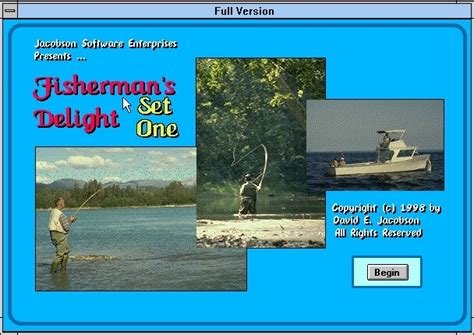
Fisherman’s Delight 32 emerged from the singular vision of David E. Jacobson, the sole proprietor of Jacobson Software Enterprises. Operating at a time when the gaming industry was rapidly consolidating around AAA productions, Jacobson embodied the spirit of the shareware scene—a lone creator distributing games via early internet portals and CD-ROM compilations. The game, an evolution of his 1998 title Fisherman’s Delight: Set One, was designed with accessibility in mind: it ran on Windows 95/98 with minimal hardware requirements, using static images and mouse controls to ensure broad compatibility.
Technologically, Fisherman’s Delight 32 was a product of deliberate constraint. Released during the sixth console generation—defined by the PlayStation 2, Xbox, and GameCube—it eschewed the era’s push toward 3D acceleration in favor of a “medium resolution static image” approach. This was pragmatic, targeting users with older hardware who craved accessible experiences. Within the broader gaming landscape of 2000, titles like The Sims and Counter-Strike were dominating PC sales, catering to casual and competitive audiences alike. Fisherman’s Delight 32, conversely, occupied a micro-niche: a hyper-realistic fishing simulator for enthusiasts of the sport. Its shareware model—where a free version could be unlocked with a registration fee—reflected the fading yet still viable distribution method of the late ’90s, bridging the gap between hobbyist development and commercial gaming.
Narrative & Thematic Deep Dive
Fisherman’s Delight 32 defies conventional narrative structures entirely, offering no scripted plot, characters, or dialogue. Instead, its story is emergent—a personal chronicle authored by the player through their actions. The “protagonist” is a blank slate, the player themselves, while the “antagonists” are the nine species of fish inhabiting the game’s three aquatic zones. The drama unfolds in moments of tension: the patient wait for a ripple, the frantic click to set the hook, the suspense as a fish fights the line. Thematically, the game is a meditation on patience and observation. It mirrors the real-world angler’s philosophy, where success hinges on stillness and anticipation, not reflexes or aggression.
The absence of explicit narrative forces players to project their own meaning onto the experience. The three fishing logs—one tracking the last fifty catches, another recording the best of each species—become a player’s personal logbook, a testament to their mastery of the game’s subtle systems. This minimalist approach aligns with the broader ethos of simulation games, where the process itself is the narrative. Even the “bonus fish”—tagged specimens that offer registration fee rebates—serve a thematic purpose: they reward persistence and reward dedication, reinforcing the game’s core loop of patient pursuit.
Gameplay Mechanics & Systems
The core gameplay loop of Fisherman’s Delight 32 is deceptively simple yet remarkably focused on simulating the key moments of angling:
1. Location and Tackle Selection: Players choose from three biomes—warmwater, coldwater, or saltwater—each offering distinct fish species. This is followed by selecting a rod, line, and lure, adding a layer of strategic choice despite the game’s constraints.
2. The Strike: The scene presents a static lakeshore image. Player agency shifts to observation, where spotting a subtle water ripple indicates a fish’s presence. This mechanic brilliantly compensates for the lack of animation, transforming passive waiting into active engagement.
3. The Hook and Reel: Upon a bite, players must swiftly press the “Set/Net” button to hook the fish. Hesitation results in escape. Once hooked, players “pound the reel” button to bring the fish closer, requiring a final timed press of “Set/Net” to secure the catch.
The game’s systems are designed for accessibility and replayability:
* Skill Levels: Three difficulty tiers adjust fish behavior and reaction windows, catering to both novices and veterans.
* Casting Distances: Allows players to influence where fish are located, adding depth to location selection.
* Voice Effects: A choice of male or female voice feedback personalizes the experience, a rare touch for a 2000 shareware title.
* Bonus Fish: These tagged specimens incentivize continued play, offering tangible rewards for persistence.
Critically, the gameplay hinges on mastery of timing and observation. The lack of animation, initially a limitation, becomes a strength: players must rely on visual cues alone, heightening tension. However, the repetitive nature of “pounding the reel” button can feel mechanical, a flaw born of the era’s technical constraints that limits long-term engagement despite the game’s serene premise.
World-Building, Art & Sound
Fisherman’s Delight 32 constructs its world through a series of static, medium-resolution backdrop images—fixed, flip-screen vistas that evoke the tranquility of fishing spots. While rudimentary by modern standards, the art direction prioritizes functional realism: each location feels distinct, from the sun-dappled shores of a warmwater lake to the churning waves of a saltwater coast. The absence of animation fosters a unique atmosphere; the stillness is punctuated only by the occasional butterfly or, crucially, the telltale ripples of fish. This minimalist aesthetic encourages introspection, turning the game into a digital zen garden where the player’s focus is the primary tool for interaction.
Sound design, however, elevates the experience from a mere simulation to an immersive meditation. Drawing from its predecessor’s acclaimed audio, the game features “true-to-life nature sounds”—chirping birds, rustling leaves, lapping water—that create a convincing auditory illusion of being outdoors. Coupled with a “very pleasant bit of acoustic guitar theme music” that bookends sessions, the soundscape compensates for the visuals’ simplicity. It envelops the player, transforming static screens into living environments and selling the fantasy of a solitary day by the water. This auditory mastery is the game’s greatest triumph, proving that atmosphere can thrive even within technical limitations.
Reception & Legacy
Upon release, Fisherman’s Delight 32 garnered little mainstream attention. Its shareware model and niche subject matter placed it outside the radar of major publications like GameSpot or IGN, and no critical reviews survive on aggregators such as Metacritic. Its reception was likely akin to that of its predecessor, Fisherman’s Delight: Set One, which received a positive 4/5 (80%) from ZDNet for its straightforward mechanics and effective audio. For its small audience, the game was likely regarded as a competent and charming diversion—a niche experience that delivered on its promise of accessible fishing simulation.
Its legacy, however, endures in the archives of abandonware and retro gaming communities. As a title preserved on sites like MyAbandonware, it serves as a time capsule of the shareware era, with user comments like “LOL – this is so adorable, like Grandpa’s first fishing game” capturing its status as a charming relic. The game’s influence is subtle but traceable: it sits in the genealogical tree of fishing simulations, alongside titles like Sega Bass Fishing (1998) and the later Rapala series. While those games expanded the genre with polygonal graphics and complex mechanics, Fisherman’s Delight 32 established a foundational loop of observation and timing—a template for more ambitious successors. Its developer, Jacobson Software Enterprises, released a handful of fishing-themed titles (Set One, Set Two, Saltwater Challenge), indicating a dedicated niche audience that sustained this quiet corner of gaming history.
Conclusion
Fisherman’s Delight 32 is not a game for those seeking cinematic spectacle or high-octane thrills. It is, however, a perfect encapsulation of a bygone era—one where a single developer’s passion could create a focused, evocative experience. Its minimalist design, stripped of animation and narrative, forces players to engage with its core mechanics: patience, observation, and the quiet satisfaction of the catch. While its technical limitations and repetitive gameplay may limit its appeal today, the game’s strengths lie in its authenticity and atmosphere. The serene visuals and masterful sound design create a meditative space that transcends its humble origins.
In the pantheon of video game history, Fisherman’s Delight 32 holds a unique place. It stands as a testament to the diversity of the medium—a reminder that gaming can offer not just escape, but reflection. It is a humble, honest simulation that captures the soul of fishing, proving that sometimes the most memorable experiences are the simplest. For historians and enthusiasts, it is a vital artifact of the shareware revolution; for players, it remains a tranquil relic of a digital age less hurried, more patient. Its verdict is clear: a niche curiosity, but a historically significant one, casting a quiet but persistent ripple in the vast lake of gaming.