
- Release Year: 2020
- Platforms: Windows
- Publisher: Fun Infused Games
- Developer: Fun Infused Games
- Genre: Action
- Perspective: Side view
- Game Mode: Single-player
- Gameplay: Arcade
- Setting: Futuristic, Sci-fi
- Average Score: 100/100
Description
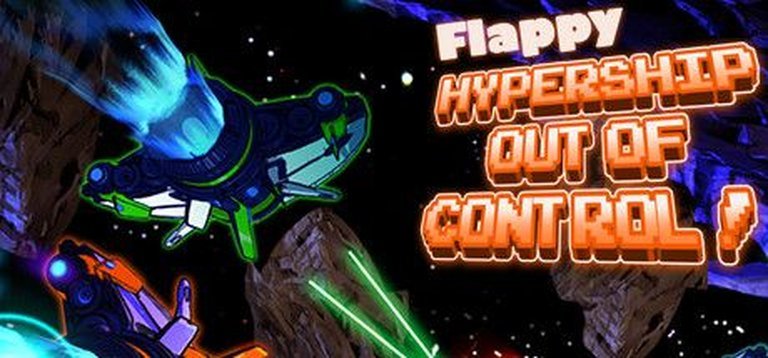
Flappy Hypership Out of Control! is a sci-fi arcade game where players pilot a malfunctioning starship stuck at maximum speed through a dangerous space filled with multicolored obstacles placed by ancient gods. Using simple controls, players must flap to dodge endless, randomized barriers while the game relentlessly increases in speed, challenging them to survive for high scores on competitive leaderboards in this humorous and unforgiving side-scrolling experience.
Where to Buy Flappy Hypership Out of Control!
PC
Flappy Hypership Out of Control! Patches & Updates
Flappy Hypership Out of Control! Mods
Flappy Hypership Out of Control! Guides & Walkthroughs
Flappy Hypership Out of Control!: Review
Introduction
In the vast, often derivative landscape of mobile-inspired indie games, Flappy Hypership Out of Control! stands as both a loving homage and a deconstruction of a specific subgenre. Released by solo developer Fun Infused Games on April 1, 2020, this Windows-only title is the latest entry in the developer’s long-running “Hypership Out of Control!” series, yet it diverges radically from its predecessors. While the series began as a classic shoot ’em up in 2010, this iteration transforms the concept into a minimalist, rage-inducing arcade experience. Its premise is absurd: pilot a “flappy” starship through a gauntlet of multicolored blocks placed by ancient gods to punish your future sins, all while your accelerator is stuck and your brakes are dead. The game’s brilliance lies in how it weaponizes its own ridiculous premise to deliver a pure, unadulterated test of reflexes and patience. This review will dissect its development, narrative depth, punishing mechanics, artistic minimalism, and surprisingly influential legacy, arguing that beneath its chaotic facade lies a masterclass in distilled arcade design.
Development History & Context
Flappy Hypership Out of Control! emerged from the fertile ground of the “Flappy Bird clones” phenomenon, a wave that followed the 2014 viral sensation. Developer Fun Infused Games, a solo entity without public details, leveraged this zeitgeist by merging it with their own established “Hypership Out of Control!” IP—a series dating back to 2010. This synthesis is key: the game is not just a clone but a deliberate, self-aware satire of both its source material and the broader arcade genre it invokes.
Technically, the game was built using MonoGame, a cross-platform .NET framework enabling efficient development for Windows without heavy graphical overhead. This choice reflects pragmatic constraints: the game’s visual style is intentionally sparse, focusing entirely on gameplay purity. The release date—April Fool’s Day—hints at the developer’s ironic awareness of the game’s premise, framing it as both a joke and a genuine challenge.
The 2020 gaming landscape was dominated by battle royales and narrative epics, making this microtransaction-priced ($0.99, often discounted to $0.49) arcade outlier a defiantly anachronistic statement. It arrived alongside a glut of similar “flap and dodge” titles, yet distinguished itself through its sci-fi framing and the developer’s history, positioning it as a parody of both viral trends and retro revivals. The absence of post-launch updates or platform expansions underscores its “one-and-done” philosophy—a complete, self-contained experience delivered with minimal fuss.
Narrative & Thematic Deep Dive
While ostensibly devoid of traditional narrative, Flappy Hypership Out of Control! weaves a rich, absurdist mythos through its lore and design. The official blurb introduces a darkly comedic universe: “Space is a dangerous placed for even the most seasoned and flappy starship pilot, full of multicolored floating blocks placed in your path by ancient gods to smite you for a life of sin that prophetically knew you would commit thousands of years later.” This premise reframes the entire game as a cosmic joke, where your failure isn’t due to skill but preordained divine retribution. The gods act as unseen antagonists, their “blocks” serving as both obstacles and symbols of fatalism.
The player’s ship embodies a paradox: it is simultaneously “flappy” and hyperspeed, with the accelerator stuck “to the floor” and brakes “out.” This duality—fragility in flapping, inevitability in velocity—mirrors the game’s thematic core: the futility of control in an accelerating, hostile universe. Each death is framed as “destined to add a new crater to the face of an unsuspecting wall,” transforming the player’s demise into a cosmic punchline. The inclusion of “horrible laughter that mocks your every death” externalizes this nihilism, making the game itself a sadistic deity, reveling in your failure.
Thematic subtext emerges through repetition and randomness. The “endless randomized levels” and “no run is ever the same” suggest a chaotic, indifferent universe where patterns are illusions. The “multiple different ships that provide no benefits” underscore the absurdity of choice in predetermined systems—cosmic dressing for a predetermined fall. It’s a bleak, yet darkly funny, meditation on free will, where the only variable is the length of your inevitable descent.
Gameplay Mechanics & Systems
The core loop is deceptively simple: press a button to flap your ship, avoiding multicolored blocks while your speed perpetually increases. Yet beneath this lies a ruthlessly precise system that demands mastery and rewards persistence.
-
Core Mechanics: The “flap” button provides a single, predictable upward thrust; gravity immediately pulls the ship downward. The challenge lies in timing flaps to navigate narrow gaps between blocks. Crucially, the ship’s horizontal speed is constant and ever-increasing, demanding split-second adjustments as obstacles approach faster over time. This creates a feedback loop where initial success breeds subsequent difficulty, embodying the “out of control” theme.
-
Progression and Scoring: There are no levels or traditional progression; survival is the only goal. Points are awarded for passing blocks, with the leaderboard tracking distance (or “score”). The “endless randomized levels” ensure no two runs are identical, though difficulty curves remain consistent. The “online leaderboards” enable global competition, but the game’s true progression is internal—learning to tolerate the frustration and refine muscle memory.
-
Innovations and Flaws: The game’s greatest strength is its purity. By stripping away power-ups, upgrades, or narrative distractions, it forces players to confront the raw mechanics. The randomized obstacle generation prevents pattern memorization, enhancing replayability. However, this minimalism is also a weakness. The lack of difficulty settings or accessibility options may alienate players struggling with the steep learning curve. The “cosmetic-only ships” feel like a missed opportunity; even minor gameplay variations (e.g., altered gravity) could have added depth without complicating the core loop. The “horrible laughter” sound, while thematically resonant, risks becoming grating during extended play sessions.
-
UI and Systems: The interface is minimalist, displaying only the score and high-score. The Steam integration seamlessly syncs leaderboards, though the achievement system (11 Steam Achievements) is superficial, rewarding basic milestones like “First Flap” rather than mastery. The absence of pause functionality heightens tension but also frustrates, as real-world interruptions can instantly doom a run.
World-Building, Art & Sound
Flappy Hypership Out of Control! crafts its world through stark contrast and implication. The sci-fi setting is rendered in a minimalist 2D scrolling style, with a color palette dominated by neon blocks against a vast, empty black space—evoking both the infinite void of space and the artificiality of the obstacles. The blocks themselves are abstract, multicolored geometric shapes, their randomness mimicking the chaos of divine intervention. The ship designs, while varied cosmetically, retain a simple, pixel-art aesthetic, emphasizing function over flash. This visual sparsity focuses the player’s attention entirely on the obstacles and their own ship, heightening the tension of near-misses.
Sound design amplifies the game’s themes. The “horrible laughter” is a cacophonous, distorted cackle that erupts upon death, serving as both a taunt and a reminder of the game’s cruel humor. The ambient soundtrack is absent, replaced by the relentless whoosh of the ship accelerating and the sharp thump of collision—sonic cues that make every moment feel urgent and precarious. This auditory landscape reinforces the sense of being trapped in an endless, hostile tunnel. The lack of music creates a vacuum of tension, making the player’s own breathing and reflexes the only soundtrack to their struggle. It’s a masterful use of negative space, turning silence into a tool for psychological pressure.
Reception & Legacy
At launch, Flappy Hypership Out of Control! received minimal critical attention, with Metacritic listing no critic reviews and only a handful of user scores (all positive, though sample size is too small for a meaningful aggregate). Its Steam reviews are similarly sparse (just 2 as of MobyGames data), but those that exist praise its addictive simplicity and dark humor. The game’s niche status stems from its hyper-specific appeal: it’s not a game for everyone but a cult hit among masochists and arcade purists. Its $0.99 price point and minimal marketing limited commercial impact, but its legacy has grown through word-of-mouth and its inclusion in the “Flappy Bird variants” group on platforms like MobyGames.
Influence-wise, it exemplifies the “one-button arcade” revival, emphasizing reflexes over complexity. It also expanded the “Hypership Out of Control!” series beyond its shoot ’em up roots, demonstrating how IPs can be radically reimagined. The Steam Community thread pointing out its connection to the original “Hypership Out of Control!” highlights its role in bridging retro and modern design philosophies. Though it didn’t spawn direct clones, it contributed to the broader zeitgeist of minimalist, high-score-driven indie games in the late 2010s/early 2020s. Its enduring presence on Steam and inclusion in “Flappy Bird” curations ensure it remains a reference point for developers exploring absurdity in game design.
Conclusion
Flappy Hypership Out of Control! is a paradox: a game of profound simplicity and unforgiving complexity, a joke with genuine challenge, and a fleeting experience with lasting impact. Fun Infused Games crafted a masterclass in distilled arcade design, using a ridiculous premise to explore themes of determinism and control. Its gameplay loop is both brutal and fair, demanding skill while mocking the very notion of mastery through its lore. While its minimalism limits accessibility and its humor may not land for all, its core brilliance lies in its refusal to compromise. In an era of bloated games, this tiny, $0.99 title stands as a defiant tribute to the purity of arcade rage—proof that the most memorable experiences often come wrapped in the most absurd packages. It may not be a “classic” by conventional metrics, but it is an essential footnote in the evolution of indie design, a glorious, self-aware folly that dares players to laugh at their own inevitable demise.