
- Release Year: 2021
- Platforms: Linux, Macintosh, Windows
- Genre: Adventure
- Perspective: 3rd-person
- Game Mode: Single-player
- Gameplay: Exploration
- Setting: Contemporary
Description
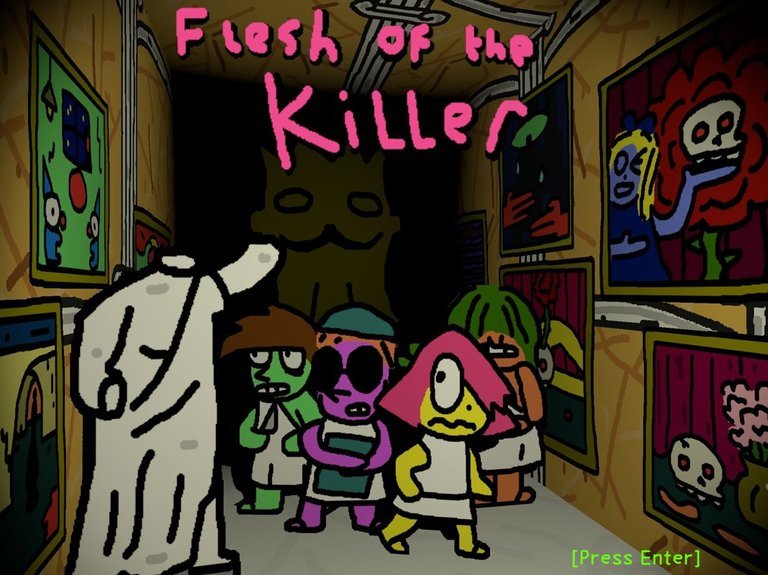
Flesh of the Killer is a short comedy-horror adventure game, the fifth in the ‘Of the Killer’ series, where protagonist BB and her college friends Max, Claude, and Ray sneak into the secretive, members-only Museum of Moral Art on the outskirts of a city to document its morality-themed artworks for a community college assignment. Featuring MS Paint-style graphics and third-person controls, players explore humid galleries filled with neo-moral pieces by artist M.T. Lott, encountering nightmarish entities like Lamassu, surreal painting transformations, and horrifying secrets lurking within the underground vaults.
Flesh of the Killer: Review
Introduction
Imagine stumbling into a clandestine art museum where the exhibits don’t just depict morality—they devour it, trapping intruders in canvases that warp reality into nightmarish moral fables. Flesh of the Killer, the fifth installment in thecatamites’ audacious “Of the Killer” series, thrusts players into this fever dream, piloting the ever-plucky zine journalist BB through a labyrinth of MS Paint-scrawled horrors. Released in 2021 as a freeware gem on Game Jolt, it stands as a cult beacon in indie gaming’s surreal underbelly, bridging the gap between Dadaist absurdity and gonzo horror. Amid a pandemic-era explosion of lo-fi experiments, this short adventure cements its legacy as a sly critique of art’s pretensions, wrapped in unrelenting comedy. My thesis: Flesh of the Killer is the series’ most thematically ambitious entry, transforming pedestrian college antics into a profound meditation on morality, authorship, and the grotesque inadequacies of representation—proving that true terror lies not in monsters, but in the mechanical mimicry of meaning.
Development History & Context
Flesh of the Killer emerged from the singular vision of thecatamites, the pseudonym of indie auteur Michael Freiheit (aka garmentdistrict), a developer renowned for pixelated psychedelia like Space Funeral. Self-published on June 27, 2021, for Windows, Linux, and Macintosh via Unity—a staple for accessible indie prototyping—this title arrived during a boom in browser-adjacent freeware, fueled by platforms like Game Jolt and itch.io. The early 2020s indie landscape was saturated with retro throwbacks and horror revivals (Doki Doki Literature Club echoes, Iron Lung‘s minimalism), but thecatamites carved a niche with deliberately “stupid” aesthetics: MS Paint scribbles evoking 2000s anglerfish Flash games, line-boiling animation that wobbles like a bad acid trip.
Technological constraints were self-imposed luxuries. Unity’s cinematic camera and direct-control interface enabled fluid 3rd-person exploration without budget for polish, mirroring the series’ ethos of imperfection as art. The game’s brevity (under an hour) reflects freeware’s episodic model, part of a nine-game saga spanning 2020-2024, culminating in the 2024 Anthology of the Killer. Contextually, it dropped amid real-world cultural reckonings—rising serial killer true-crime obsessions, NFT art bubbles, and institutional art scandals—positioning its Museum of Moral Art as a wicked satire. No big-studio backing meant pure auteurism: Freiheit handled coding, art, writing, and sound, channeling influences from surrealists (Max Ernst, Claude Cahun) into a post-Y2K digital zine culture. This DIY ethos not only constrained scope but amplified its punk rebellion against polished AAA narratives.
Narrative & Thematic Deep Dive
Plot Synopsis: From Sneak-In to Canvas Carnage
BB, the rainbow-skinned zine auteur from prior entries (Voice of the Killer onward), leads her community college crew—photographer Max (the himbo), art historian Claude (the nerd), and aesthetics skeptic Ray (the delinquent)—into the forbidden Museum of Moral Art. Disguised in a crate, they aim to document this members-only freeport amid XX City’s killer-plagued boom in “morality-themed” works. The plot unfolds in hallucinatory beats: splitting in humid galleries (strangers, elephants, clowns), BB uncovers a keycard, loses Max, reunites with Claude and Ray, ascends to bizarre M.T. Lott exhibits—neo-moralist’s canvases devolving into chaos—culminating in Lamassu, a mechanical lion embodying the “Morality Animal.”
Eaten and reborn as posed statues, the group navigates portal pictures: BB as a golden vase-bearer fleeing elephant phantasms, purple in Stranger caverns, amid self-moralizing portraits. Claude self-flogs for protection; they evade Lamassu via fliers revealing M.T. Lott’s lion-building madness (arrested for cannibalism, yet “teachable”). Climax: Trapped in a “realism” mega-canvas, they stage a morality play distracting the pattern-obsessed beast, enabling Ray’s head-stab. Escape yields irony—M.T. Lott’s influence endures, spawning Lamassu cartoons.
Characters: Archetypes as Art Victims
BB’s snarky narration (always on-screen) grounds the absurdity, her zine expertise framing events as “scene reports.” Friends embody the “art student trifecta”: Max’s brawny snaps, Claude’s pedantic lore (Lott’s hypocrisy), Ray’s brute rationality. Lamassu, driven mad translating morals into art, pursues via “mechanical pattern recognition”—blue-orange morality personified. No Killer appearance (first since Hands), but his murders fuel the art boom, with a statue cameo nodding continuity.
Themes: Art’s Moral Bankruptcy
This is peak thecatamites: art as inadequate violence. Paintings trap victims in “moral” poses, critiquing neo-moralism’s failure (Lott eats women, yet inspires). Surrealism abounds—Boschian bird-devourers, Rousseau’s Jungle With Lion pastiche—mocking inanimate “morals.” BB’s elephant phobia adds personal dread; post-escape, the museum thrives, implying art’s commodification devours truth. Comedy-horror dialectic shines: gore via scribbles, philosophy via quips (“Uh oh… ‘Realism'”). In series context, it probes authorship—BB’s zines vs. institutional capture—foreshadowing finales where history possesses puppets.
Gameplay Mechanics & Systems
Core loop: Pure exploration in a non-linear museum, WASD/direct control yielding tight 3rd-person navigation. Cinematic camera pans dramatically, emphasizing isolation amid wobbling environs. Dialogue system innovates: Persistent text (BB’s monologue, friends’ chatter) triggers on room entry/’eye’ icons, blending narrative with discovery—no voice, pure zine prose. Progression: Collect keycard, ascend balconies, trigger chases—Lamassu pursuits demand frantic running, Controllable Helplessness in painting traps (e.g., vase-holding immobility).
No traditional combat; climax’s morality play is genius: Hold moral icons to freeze Lamassu, Ray sneaks—Restraining Bolt via thematic insight. UI is minimalist: Borderless screen, constant text overlay (immersive, occasionally cluttered). Flaws: Repetitive chases lack checkpoints, brevity risks shallowness. Strengths: Intuitive, innovative triggers make every corner narratively alive, subverting adventure tropes into horror-comedy rhythm.
World-Building, Art & Sound
Setting & Atmosphere: Freeport Fever Dream
The Museum—a humid, unguarded vault—pulses with contemporary surrealism: Morality-Improving Mechanisms, M.T. Lott’s descent from pristine to smeared. Painting realms shift from scribble to “realistic” oils or photo-collages (Lion’s Garden), heightening uncanniness. XX City’s killer economy looms, tying to series’ Crapsaccharine World.
Visuals: MS Paint Mastery
Line-boil wobble animates everything—characters jitter, walls breathe—evoking feverish amateurism. Art shifts (painting realism) critique medium; elephant nightmare personalizes dread. Rainbow skins (BB green?) amplify cartoon violence.
Sound: Sparse Synergy
No full soundtrack noted, but implied ambient hums (humid galleries), chase stings, and text-driven “voiceover” via BB’s quips create tension. Dialogue’s deadpan delivery (implied silent reading) underscores comedy, sparse effects (eats, shrieks) punctuate horror. Collectively, they forge intimacy: Lo-fi visuals/sound immerse in BB’s psyche, making moral absurdity visceral.
Reception & Legacy
Launch reception: Muted critically—no Metacritic/MobyGames scores, zero critic reviews—but Backloggd’s 3.9/5 from 110 ratings signals niche acclaim (189 plays). Player praise lauds brevity, humor; forums/Game Jolt hail series loyalty. Commercially: Freeware success, bolstering anthology (Steam 2024).
Legacy evolves: Influenced lo-fi surrealists (Wrought Flesh kin), TV Tropes catalogs tropes (Portal Picture, Art Shift). Series’ continuity nods (friends return in Face) cement BB’s odyssey; anthology contextualizes as “evil metaphor for history.” Industry ripple: Critiques art commodification pre-NFT crash, inspires zine-like indies amid 2020s malaise.
Conclusion
Flesh of the Killer distills thecatamites’ genius: A 30-minute gut-punch blending zine-punk rebellion, surreal critique, and chase-fueled hilarity into gaming’s most mordant art essay. Flaws—pacing repetition, opacity sans series context—pale against innovations: Dialogue as mechanic, morality as monster. In video game history, it claims a vital niche among freeware legends (Yume Nikki, OFF), a testament to indie power. Verdict: Essential 9/10—play for the lion, stay for the laugh that sticks in your moral throat. Sincerely, your correspondent.