
- Release Year: 1999
- Platforms: Windows
- Developer: Undis Software, Inc.
- Genre: Card, Patience, Puzzle, Solitaire, Tile game
- Perspective: Top-down
- Game Mode: Single-player
- Gameplay: Cards, Point and select, Tiles
- Average Score: 98/100
Description
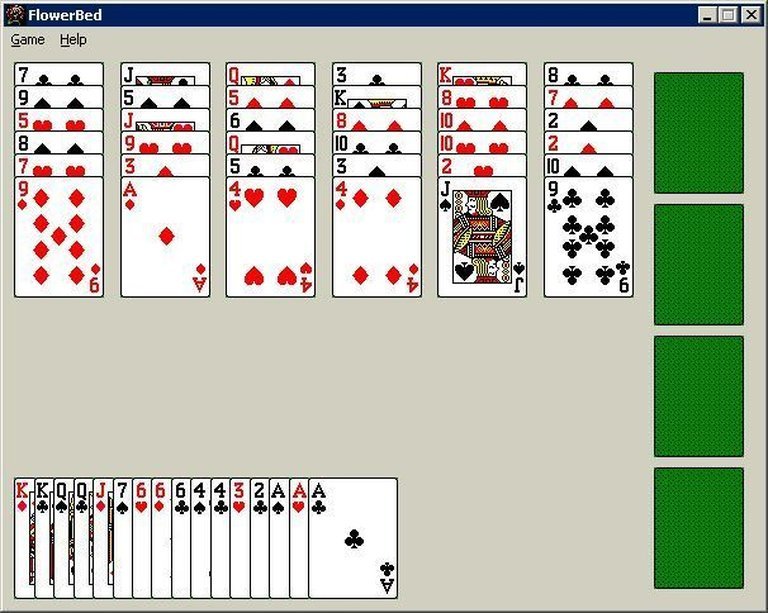
FlowerBed is a single-player, shareware solitaire game released in 1999 for Windows. The objective is to build up four foundations in ascending order from Ace to King, using cards from the hand, the top of columns, or the top of foundations. Played entirely with the mouse, it features a top-down perspective and a fixed/flip-screen visual style, offering a classic card game experience with simple point-and-select mechanics.
FlowerBed Reviews & Reception
metacritic.com (98/100): The greatest weapons-based fighter returns, this time on Sega Dreamcast.
gamerant.com : 1999 was particularly special, introducing enormously influential new IPs, fantastic sequels to well-known series, and much more.
FlowerBed: A Forgotten Gem in the Solitaire Landscape
Introduction
In the vast ocean of video games, some titles emerge as towering waves, crashing onto the shores of popular culture with unmistakable force. Others, however, are gentle ripples—subtle, unassuming, and often overlooked. FlowerBed, a 1999 solitaire game developed by Undis Software, Inc., is one such ripple. Released during a time when the gaming industry was undergoing seismic shifts—with the rise of 3D graphics, the birth of online multiplayer, and the dominance of blockbuster titles—FlowerBed carved out a quiet niche for itself. It is a game that, despite its simplicity, offers a unique glimpse into the late ’90s shareware scene and the enduring appeal of card games in the digital age.
This review aims to explore FlowerBed in exhaustive detail, examining its development history, gameplay mechanics, aesthetic choices, and its place in the broader context of gaming history. While it may not have the grandeur of EverQuest or the cultural impact of Sonic the Hedgehog 2, FlowerBed is a fascinating artifact of its time, deserving of recognition and analysis.
Development History & Context
The Shareware Scene of the Late ’90s
The late 1990s were a golden era for shareware games. With the internet still in its infancy and digital distribution platforms like Steam decades away, shareware served as a vital distribution model for independent developers. Games were often distributed freely, with players encouraged to pay for the full version if they enjoyed the experience. This model allowed small studios and even individual developers to reach a global audience without the need for a major publisher.
FlowerBed was developed by Undis Software, Inc., a studio that, like many of its contemporaries, operated in this shareware ecosystem. The game was created by Don Undis and Sandra Undis, a husband-and-wife team who embodied the indie spirit of the era. Their work on FlowerBed reflects the constraints and opportunities of the time: limited resources, a focus on accessibility, and a desire to create something enjoyable for a broad audience.
Technological Constraints
FlowerBed was released exclusively for Windows, a platform that was rapidly becoming the dominant force in PC gaming. The game’s technical specifications were modest by today’s standards, but they were perfectly suited to the hardware of the late ’90s. The game employed a top-down perspective with fixed/flip-screen visuals, a common approach for card and puzzle games of the era. This design choice allowed the game to run smoothly on the lower-end systems that many players owned, ensuring broad accessibility.
The game’s interface was designed around mouse input, a decision that aligned with the growing prevalence of graphical user interfaces (GUIs) in Windows. This focus on mouse control made FlowerBed intuitive and easy to pick up, even for players who were not deeply familiar with gaming. The simplicity of the controls—point and select—ensured that the game could be enjoyed by casual players and card game enthusiasts alike.
The Gaming Landscape in 1999
1999 was a pivotal year in gaming history. The industry was in the midst of a transition from 2D to 3D graphics, with games like Half-Life, Unreal Tournament, and Quake III Arena pushing the boundaries of what was possible in first-person shooters. Meanwhile, role-playing games (RPGs) were evolving with titles like Final Fantasy VIII and Planescape: Torment, which offered deep narratives and complex gameplay mechanics.
In the realm of online gaming, EverQuest had just been released, revolutionizing the MMORPG genre and setting the stage for future titans like World of Warcraft. The success of EverQuest demonstrated the growing appetite for persistent online worlds, a trend that would come to dominate the gaming landscape in the years to come.
Amidst this backdrop of innovation and ambition, FlowerBed stood as a quiet counterpoint. It was not a game that sought to redefine its genre or push technological boundaries. Instead, it was a modest, well-crafted solitaire game that offered a simple yet engaging experience. In many ways, FlowerBed represents the other side of the gaming spectrum—a reminder that not every game needs to be a blockbuster to be worthwhile.
Narrative & Thematic Deep Dive
The Absence of Narrative
FlowerBed is, at its core, a solitaire game, and as such, it does not feature a traditional narrative. There are no characters to meet, no dialogue to parse, and no overarching plot to unravel. Instead, the game’s “story” is implicit in its mechanics and aesthetics. The objective—building up the four foundations in ascending order from Ace to King—is a familiar one to solitaire players, and the game’s floral theme adds a touch of whimsy to the proceedings.
The lack of a narrative is not a flaw but rather a deliberate design choice. FlowerBed is not attempting to tell a story; it is attempting to provide a relaxing, meditative experience. The game’s focus on simplicity and accessibility means that it can be enjoyed by anyone, regardless of their familiarity with gaming or card games. In this sense, FlowerBed is a game that transcends language and cultural barriers, offering a universal experience that is easy to understand and enjoyable to engage with.
Themes of Order and Beauty
While FlowerBed may not have a traditional narrative, it is not devoid of thematic depth. The game’s central mechanic—building up the foundations in order—can be seen as a metaphor for the human desire to impose order on chaos. Solitaire, as a genre, is inherently about creating structure from randomness, and FlowerBed embraces this theme wholeheartedly.
The game’s floral aesthetic reinforces this theme, evoking images of carefully tended gardens and meticulously arranged bouquets. Flowers, with their delicate petals and vibrant colors, are symbols of beauty and transience, and their presence in FlowerBed adds a layer of poetic resonance to the gameplay. The act of arranging cards in FlowerBed becomes akin to arranging flowers in a vase—an exercise in patience, precision, and appreciation for the beauty of order.
The Solitaire Experience
Solitaire games have long been associated with solitude and introspection. They are games that can be played alone, at one’s own pace, without the pressure of competition or the need for social interaction. FlowerBed embodies this spirit, offering a solitary experience that is both engaging and soothing.
The game’s mechanics are designed to be accessible yet challenging, providing a sense of accomplishment when a particularly tricky arrangement is resolved. The absence of a timer or score system means that players can take their time, savoring each move and appreciating the gradual progression toward victory. In this sense, FlowerBed is not just a game but a form of digital meditation—a way to unwind and focus the mind in an increasingly hectic world.
Gameplay Mechanics & Systems
Core Gameplay Loop
At its heart, FlowerBed is a variation of the classic Klondike solitaire, with a few key twists that set it apart. The objective is to build up the four foundations in ascending order from Ace to King, using cards from the hand, the top of the columns, or the top of the foundations themselves. This core mechanic is simple to understand but offers a surprising amount of depth, as players must carefully consider each move to avoid painting themselves into a corner.
The game is played entirely with the mouse, a design choice that reflects the growing importance of graphical interfaces in the late ’90s. The point-and-select interface is intuitive and responsive, making it easy for players to pick up and play without needing to consult a manual or memorize complex controls.
Card Movement and Strategy
One of the key aspects of FlowerBed’s gameplay is the way it handles card movement. Unlike some solitaire games, which restrict movement based on suit or color, FlowerBed allows players to move any available card to a foundation, provided it follows the ascending order. This flexibility gives players more options and encourages strategic thinking, as they must decide which cards to move and when.
The game’s columns are another important element of its strategy. Players can move cards between columns, but only the top card of each column is available for movement. This restriction adds a layer of complexity, as players must plan several moves ahead to free up the cards they need. The ability to move cards from the hand—essentially a temporary holding area—further enhances the strategic depth, allowing players to set aside cards for later use.
The Role of Luck
As with all solitaire games, luck plays a significant role in FlowerBed. The initial deal of the cards can greatly influence the difficulty of a given game, with some deals being nearly impossible to win and others offering a straightforward path to victory. This element of randomness ensures that no two games of FlowerBed are exactly alike, adding to the game’s replayability.
However, FlowerBed is not purely a game of chance. Skilled players can often overcome unfavorable deals through careful planning and strategic card movement. The game rewards patience and foresight, making it a satisfying challenge for those who enjoy puzzles and strategy games.
User Interface and Accessibility
FlowerBed’s user interface is a model of simplicity and clarity. The game’s top-down perspective and fixed/flip-screen visuals ensure that the playing field is always visible, with no hidden cards or obscured information. The mouse-driven controls are responsive and intuitive, making it easy for players to interact with the game without frustration.
The game’s minimalist design extends to its visual presentation. The cards are clearly labeled, and the foundations are prominently displayed, ensuring that players can always see the state of the game at a glance. This focus on accessibility makes FlowerBed an excellent choice for casual players and those new to solitaire games.
Innovations and Flaws
While FlowerBed is not a revolutionary game, it does introduce a few subtle innovations that set it apart from other solitaire titles. The ability to move cards from the hand to the foundations or columns adds a layer of strategy that is not present in all solitaire variants. Additionally, the game’s floral theme and aesthetic choices give it a distinct identity, making it more memorable than many of its contemporaries.
That said, FlowerBed is not without its flaws. The game’s lack of a scoring system or timer means that there is no way to track progress or compete against oneself, which may limit its appeal to more competitive players. Additionally, the game’s simplicity may feel restrictive to those accustomed to more complex card games or solitaire variants with additional rules and mechanics.
World-Building, Art & Sound
The Floral Aesthetic
FlowerBed’s most striking feature is its floral aesthetic. The game’s title screen, card backs, and even the playing field itself are adorned with delicate floral patterns, evoking a sense of natural beauty and tranquility. This aesthetic choice is more than just decorative; it reinforces the game’s themes of order and beauty, transforming the act of playing solitaire into an exercise in digital gardening.
The game’s visual design is simple but effective. The cards are rendered in a clean, readable font, and the floral motifs are understated enough to avoid distracting from the gameplay. The overall effect is one of elegance and simplicity, making FlowerBed a pleasure to look at even during extended play sessions.
Sound Design and Music
FlowerBed’s sound design is minimalist, with subtle audio cues to accompany card movements and other actions. The game does not feature a full musical score, but the sound effects are pleasant and unobtrusive, adding to the game’s relaxing atmosphere.
The absence of music is a deliberate choice, one that aligns with the game’s meditative qualities. Unlike action-packed titles that rely on driving soundtracks to heighten tension, FlowerBed embraces silence, allowing players to focus on the gameplay without distraction. This design choice makes the game ideal for players who enjoy a quiet, introspective gaming experience.
Atmosphere and Immersion
Despite its simplicity, FlowerBed creates a surprisingly immersive atmosphere. The combination of its floral aesthetic, minimalist sound design, and straightforward gameplay creates a sense of calm and focus that is rare in modern gaming. The game does not seek to overwhelm the player with spectacle or excitement; instead, it offers a gentle, soothing experience that is perfect for unwinding after a long day.
The game’s atmosphere is further enhanced by its lack of pressure. There is no timer ticking down, no score to beat, and no opponents to defeat. Players are free to take their time, savoring each move and appreciating the gradual progression toward victory. In this sense, FlowerBed is less a game and more a digital retreat—a place to escape the chaos of the outside world and find a moment of peace.
Reception & Legacy
Critical and Commercial Reception
FlowerBed was released as shareware in 1999, a time when the gaming landscape was dominated by high-profile titles like EverQuest, Half-Life, and Final Fantasy VIII. As a result, the game received little attention from major gaming publications, and there are no recorded critic reviews on platforms like MobyGames. The game’s modest scope and niche appeal meant that it was unlikely to attract the same level of scrutiny as more ambitious titles.
Commercially, FlowerBed was a minor success, with a small but dedicated player base. The game’s shareware model allowed it to reach a wide audience, and its simplicity and accessibility made it appealing to casual players. However, the game’s lack of a scoring system or competitive elements limited its appeal to more hardcore gamers, and it never achieved the same level of popularity as other solitaire titles of the era.
Evolution of Reputation
In the years since its release, FlowerBed has largely faded into obscurity. The game is not widely discussed in gaming circles, and it is not considered a classic or a landmark title in the solitaire genre. However, the game has developed a small but devoted following among fans of retro and indie games, who appreciate its simplicity, elegance, and meditative qualities.
The game’s reputation has also benefited from the growing interest in preservation and documentation of older titles. Websites like MobyGames have played a crucial role in ensuring that games like FlowerBed are not forgotten, providing a platform for players to share their experiences and contribute to the game’s legacy.
Influence on Subsequent Games
While FlowerBed did not spawn a direct sequel or inspire a wave of imitators, its design philosophy has had a subtle influence on the solitaire genre. The game’s focus on accessibility, simplicity, and aesthetic appeal can be seen in later titles that prioritize relaxation and meditation over competition and high scores.
In particular, FlowerBed’s floral theme and minimalist design have inspired a number of indie developers to explore similar aesthetic choices in their own games. The idea of using solitaire as a form of digital meditation has also gained traction in recent years, with games like Solitaire Garden and Flower Solitaire embracing similar themes of tranquility and order.
Conclusion
FlowerBed is a game that defies easy categorization. It is not a blockbuster, nor is it a revolutionary title that redefined its genre. Instead, it is a quiet, unassuming game that offers a simple yet deeply satisfying experience. In an industry often obsessed with spectacle and innovation, FlowerBed stands as a reminder of the power of simplicity and the enduring appeal of well-crafted gameplay.
The game’s strengths lie in its accessibility, its elegant design, and its meditative qualities. It is a game that can be enjoyed by anyone, regardless of their gaming experience, and it offers a sense of calm and focus that is rare in modern titles. While it may not have the cultural impact of EverQuest or the nostalgic appeal of Sonic the Hedgehog 2, FlowerBed is a game that deserves to be remembered and appreciated for what it is: a small but perfectly formed gem in the vast landscape of video games.
In the grand tapestry of gaming history, FlowerBed may be a minor thread, but it is one that adds depth and texture to the overall picture. It is a game that embodies the indie spirit of the late ’90s, a time when small developers could create meaningful experiences with limited resources. And in an era where gaming is increasingly dominated by massive budgets and high-stakes competition, FlowerBed serves as a gentle reminder of the joy that can be found in simplicity.
For those willing to seek it out, FlowerBed offers a unique and rewarding experience—a chance to slow down, focus the mind, and appreciate the beauty of order in a chaotic world. And in that sense, it is a game that is as relevant today as it was in 1999.
Final Verdict: 7/10 – A charming and meditative solitaire experience that stands as a testament to the power of simplicity in game design.