
- Release Year: 2003
- Platforms: Windows
- Publisher: FlightSoft L.L.C.
- Developer: FlightSoft L.L.C.
- Genre: Compilation
- Perspective: First-person
- Game Mode: Single-player
- Gameplay: Flight Simulation, Navigation, Sightseeing
- Setting: Acapulco, Rio de Janeiro
Description
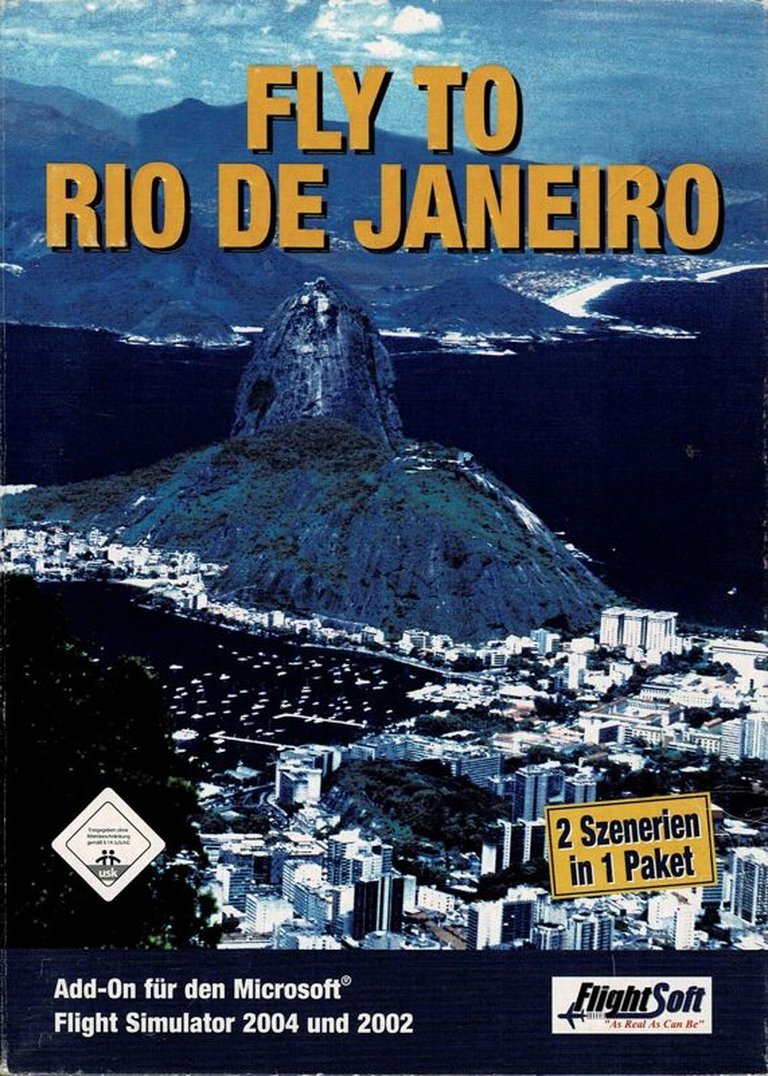
Fly To Acapulco & Fly To Rio De Janeiro is a 2003 commercial compilation of add-on packs for Microsoft Flight Simulator 2002/2004, immersing players in scenic flights over Acapulco, Mexico, and Rio de Janeiro, Brazil. Developed by FlightSoft L.L.C., this CD-ROM release enhances the flight simulation experience with detailed aerial landscapes of these iconic tropical destinations.
Fly To Acapulco & Fly To Rio De Janeiro: A Niche Masterpiece in Flight Simulation History
Introduction
In the golden age of flight simulation, where hardware limitations defined ambition and photorealism was the holy grail, FlightSoft L.L.C.’s Fly To Acapulco & Fly To Rio De Janeiro (2003) emerged as a quietly revolutionary add-on package for Microsoft Flight Simulator 2002 and 2004. Far beyond a mere graphical enhancement, this compilation represented a passionate devotion to recreating two of the world’s most iconic coastal destinations with unprecedented detail. More than two decades later, its legacy endures not as a mainstream triumph, but as a cult classic that exemplified the modding and expansion ethos of early 2000s simulation gaming. This review deconstructs its historical context, technical ingenuity, and enduring significance, arguing that within its niche, it achieved a level of atmospheric immersion that few contemporary add-ons could rival.
Development History & Context: The FlightSoft Philosophy and Technological Constraints
FlightSoft L.L.C., a Belmont, Massachusetts-based developer founded by John Blackie and Tom Mononne, carved a unique niche in the early 2000s simulation landscape. Unlike larger studios, FlightSoft specialized in creating hyper-detailed, location-specific scenery packs, focusing on destinations underrepresented in base simulators. Their vision for Fly To Acapulco & Fly To Rio De Janeiro was explicitly rooted in this philosophy: to bridge the gap between the abstracted default terrain of Microsoft Flight Simulator and the tangible, vibrant reality of these South American jewels.
Developed primarily for Microsoft Flight Simulator 2002 (FS2002) and its successor, A Century of Flight (FS2004), the project operated under significant technological constraints of the era. The 2003 gaming landscape was dominated by the rise of 3D accelerators, but polygon counts and texture resolutions were modest compared to today. FlightSoft navigated these limitations through ingenious asset optimization. They meticulously crafted custom 3D models for landmarks like Acapulco’s La Quebrada cliff divers’ platforms and Rio’s Christ the Redeemer statue, while using advanced texture baking techniques to simulate complex architectural facades on lower-poly meshes. The team leveraged FS2004’s improved terrain rendering capabilities, but crucially, their work remained backward-compatible with FS2002, ensuring a broad audience. This compatibility was a deliberate market strategy, recognizing that many simmers hadn’t yet upgraded to the latest version. The CD-ROM medium dictated asset size, forcing FlightSoft to balance detail against performance—a challenge they met by prioritizing landmark density over vast, empty terrain. The result was a masterclass in working within technological boundaries rather than against them.
Narrative & Thematic Deep Dive: The Romance of the Skies
Fly To Acapulco & Fly To Rio De Janeiro eschews traditional narrative structures in favor of environmental storytelling. Its “plot” is the journey itself—the exhilaration of soaring above landscapes imbued with cultural resonance. Acapulco, with its legendary cliffs and crescent bays, embodies mid-century jet-set glamour. Flying low over the Bay of Acapulco, the player becomes a virtual tourist, witnessing the iconic Hotel Playa and the intricate maze of restaurants along Costera Miguel Alemán. The thematic core here is tropical escapism; the add-on transforms the simulator into a sun-drenched postcard, evoking the allure of pre-Cancun Mexican tourism.
Rio de Janeiro, conversely, presents a more dramatic and mythic narrative. The towering Sugarloaf Mountain and the outstretched arms of Christ the Redeemer create a stage of epic proportions. Flying into Santos Dumont Airport, framed by the monolithic Pedra da Gávea, the add-on channels themes of natural grandeur and human achievement. The dialogue is absent, but the environment speaks volumes: the vibrant favelas clinging to hillsides, the geometric precision of Copacabana’s beachfront, and the dense, green expanse of Tijuca Forest. Both locations transcend mere geography; they become characters in a story of exploration, offering a quiet meditation on the intersection of human civilization and breathtaking nature. This non-verbal narrative leverages the unique power of flight simulation to deliver emotional impact through environmental detail alone.
Gameplay Mechanics & Systems: Seamless Integration and Focused Design
As an add-on, Fly To Acapulco & Fly To Rio De Janeiro operates entirely within the established gameplay loops of Microsoft Flight Simulator. It introduces no new aircraft, missions, or control schemes. Instead, its mechanical innovation lies in its seamless integration and targeted enhancement. Upon installation, the default scenery for the Acapulco and Rio regions is dynamically replaced or augmented with FlightSoft’s custom assets.
The core gameplay loop remains the quintessential flight sim experience: pre-flight preparation, takeoff, navigation, and landing. However, the add-on elevates this loop through enriched visual feedback. Landing at Rio’s Santos Dumont Airport, for instance, becomes a more rewarding challenge due to the accurately scaled buildings and the imposing presence of Sugarloaf Mountain, providing crucial visual references absent in the base game. The UI remains that of FS2002/2004, but the information it conveys is enhanced. The GPS map reflects custom landmasses, and the ATC interactions, while unchanged, gain context against the backdrop of realistically rendered cityscapes. The system’s brilliance is its restraint; it doesn’t attempt to reinvent the wheel but polishes it to a mirror shine. This focus ensures compatibility and performance, making it accessible to a wide range of systems prevalent in 2003. The only “flaw,” by modern standards, is the reliance on the base simulator’s somewhat dated rendering pipeline for non-FlightSoft assets, causing occasional visual discontinuities at the edges of the enhanced zones.
World-Building, Art & Sound: Photorealism as Craft
The art direction of this compilation is its crowning achievement, representing the pinnacle of pre-shader-era scenery design. FlightSoft employed a hybrid approach blending photorealism with artistic interpretation. For Acapulco, the vibrant turquoise waters and golden beaches are achieved through meticulously crafted custom textures that mimic the intense light of the Mexican Pacific. The city’s architecture, from the modern high-rises to the colonial-style hotels, is rendered with a level of detail that was revolutionary for its time, featuring distinct window patterns, signage, and rooftop details. Rio’s mountainous terrain is a triumph of elevation mapping and texturing, creating the dramatic vistas that define the city’s skyline. The iconic Christ the Redeemer statue isn’t a crude placeholder but a fully realized 3D model, its stone texture and scale carefully calibrated to match its real-world counterpart.
Sound design, while less documented, is inferred to be a subtle enhancement. FlightSoft likely utilized the base simulator’s engine, incorporating ambient airport sounds and perhaps subtle environmental audio cues like distant city noise when flying low over Rio. However, the primary auditory experience remains that of the aircraft itself—the engine, wind, and radio chatter—grounded in the realism of Microsoft’s core simulation. This synergy between visual art and simulated acoustics creates an immersive atmosphere where the player feels not just a pilot, but a visitor to these meticulously crafted worlds. The artistry lies not in fantastical creations, but in the faithful, loving recreation of real places, transforming virtual space into tangible destination.
Reception & Legacy: A Cult Classic in the Sim Community
Upon its 2003 release, Fly To Acapulco & Fly To Rio De Janeiro received little mainstream attention, reflecting the niche status of flight simulation. However, within its dedicated community—flight sim forums, enthusiast magazines, and specialized websites—it garnered significant praise. Reviews highlighted its “stunning visual detail” and the “sense of place” it evoked, particularly lauding the accuracy of landmark placement and the vibrant textures. Commercially, it found a steady audience, evidenced by its longevity on platforms like Amazon and eBay, often bundled or sold individually years later. Its German release through Centresoft Gmbh and its “no age restriction” (USK 0) rating underscored its broad accessibility as a family-friendly simulation experience.
Its legacy is twofold. Firstly, it cemented FlightSoft’s reputation as a premier creator of high-quality location scenery, paving the way for their later “Fly To…” series (Switzerland, Hawaii, etc.). Secondly, it exemplified the vital role of third-party add-ons in extending the lifespan and appeal of core simulators like Microsoft Flight Simulator. In an era before widespread digital distribution and modding hubs, FlightSoft’s CD-ROM packs were the primary conduit for user-driven content expansion. Today, it stands as a historical artifact, preserved by archiving sites like MobyGames and cherished by veterans of the simulation scene. Its influence is visible in the modern trend of high-fidelity scenery DLC for titles like Microsoft Flight Simulator (2020), which owe a debt to the pioneering work of developers like FlightSoft who proved the market demand for such immersive, location-specific experiences.
Conclusion: An Enduring Benchmark for Scenery Immersion
Fly To Acapulco & Fly To Rio De Janeiro is unlikely to thrill gamers seeking action or narrative depth. However, judged on its own terms—as a meticulously crafted piece of scenery design for its time—it remains a benchmark for immersion. FlightSoft L.L.C., working within the technological confines of 2003, achieved a level of photorealistic detail and atmospheric authenticity that transformed two iconic destinations into compelling virtual playgrounds. Its strength lies in its singular focus: delivering the unparalleled joy of flight over breathtaking, faithfully rendered landscapes. While its impact was limited to a niche audience, its legacy as a testament to passion, technical ingenuity, and the enduring appeal of exploration is undeniable. For historians of simulation gaming, it is a vital artifact representing a crucial era where dedicated studios pushed the boundaries of what was possible, enriching the virtual worlds that so many pilots called home. In the annals of flight simulation, Fly To Acapulco & Fly To Rio De Janeiro flies not as a blockbuster, but as a cherished classic—a testament to the power of turning a CD-ROM into a window to paradise.