
- Release Year: 1997
- Platforms: DOS, Windows 16-bit, Windows
- Publisher: Empire Interactive Entertainment, Empire Interactive Europe Ltd., Strategy First, Inc.
- Developer: Rowan Software Ltd.
- Genre: Simulation
- Perspective: 1st-person, 3rd-person
- Game Mode: Single-player
- Gameplay: Bombing missions, Combat flight, Dogfighting, Flight Simulation, Realism settings
- Setting: Historical events, World War I
- Average Score: 82/100
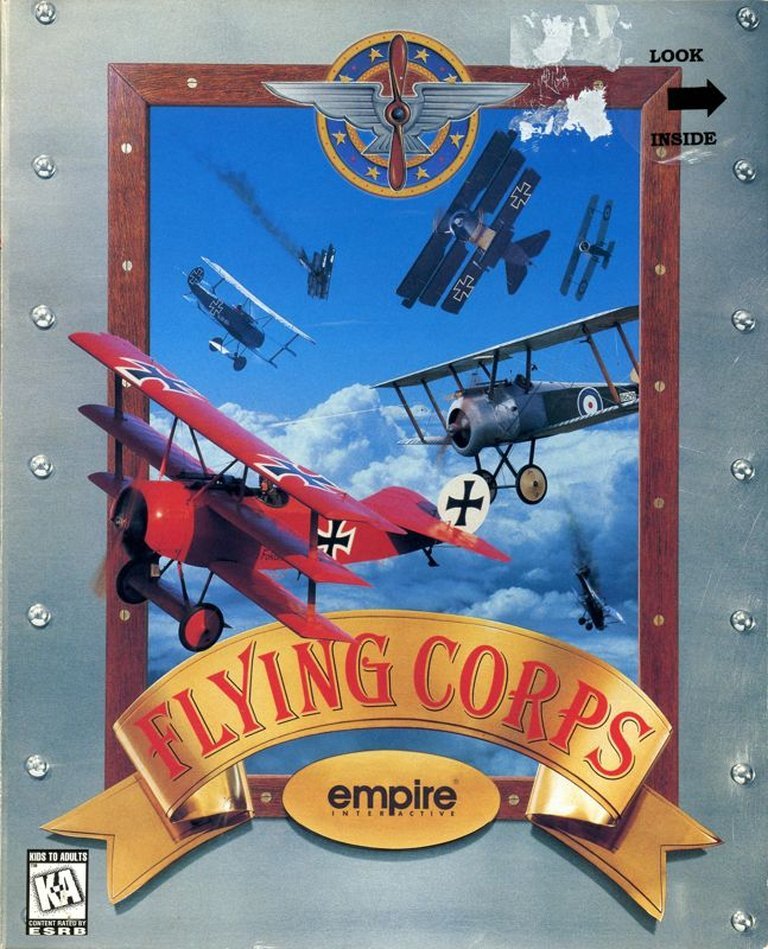
Description
Flying Corps is a World War I flight simulation game where players pilot historically accurate aircraft like the Sopwith Camel and Fokker Dr.I through four distinct campaigns set in European battlefields. Missions vary from patrol flights to aggressive combat attacks, with adjustable realism settings catering to both novices and simulation experts. The game features authentic landscapes, detailed flight mechanics, and included resources such as terrain maps and a vintage flying manual, with later versions adding Direct3D support and multiplayer options.
Gameplay Videos
Where to Buy Flying Corps
PC
Flying Corps Free Download
Flying Corps Reviews & Reception
mobygames.com (82/100): Fantastic WW1 flight simulation.
Flying Corps Cheats & Codes
PC
Press ‘u’ during gameplay
| Code | Effect |
|---|---|
| u | 500 feet altitude |
Flying Corps: A Definitive Review of the Great War’s Most Authentic Dogfight Simulator
Introduction: The Sky Writ Large
In the mid-1990s, as the flight simulation genre raced toward increasingly complex jet fighters and Beyond-Visual-Range combat, a quiet revolution was taking shape over the misty battlefields of France. Flying Corps, developed by the venerable British studio Rowan Software and published by Empire Interactive in 1997, was not merely another game; it was a deliberate, scholarly, and deeply passionate recalibration of what a combat flight sim could be. It stripped away the radar screens and missile warnings, replacing them with the raw, visceral, and terrifying reality of aerial warfare in a time of wood, wire, and fabric. This review argues that Flying Corps stands as a pivotal, if imperfect, masterpiece—a game whose obsessive historical accuracy and groundbreaking (for the time) 3D technology created an unmatched immersion into the aerial duels of World War I, cementing its legacy as the genre’s most credible homage to the “knights of the air” even as its technical limitations and niche appeal prevented mainstream breakthrough.
Development History & Context: The Rowan Touch and the Dawn of 3D
Rowan Software, the developer behind such respected titles as Dawn Patrol (its spiritual predecessor) and Mig Alley, was already a byword for meticulous, historically-grounded simulation. Development on Flying Corps began in the summer of 1994, a period of immense technological flux. The team was navigating the transition from DOS-based software rendering to the emergent world of 3D accelerators like the 3Dfx Voodoo and Rendition V1000. This ambition is evident in the game’s troubled but fascinating release history.
The original 1997 launch was a DOS title, but Rowan and Empire released a staggering approximately 20 patches to address performance and compatibility. This iterative process was a direct response to the rapidlyPlayer hardware landscape. The culmination of this effort was the Flying Corps: Gold edition later in 1997, which added crucial Direct3D support for Windows 95/98, solidifying the game’s future. This Gold version also introduced the Fokker D.VII, a new campaign, a full mission editor, and (buggy) multiplayer support. The core development vision, as hinted in interviews from the era, was to create a simulation that felt less like a video game and more like a historical document you could pilot. They succeeded in this aim by prioritizing the feeling of flight over abstract systems, a philosophy that set it apart from contemporaries like Sierra’s Red Baron series.
The gaming landscape of 1997 was dominated by WWII sims (Jane’s WWII Fighters) and the rise of the jet age (F-22 Raptor). Flying Corps’s choice to focus on WWI was both a refreshing novelty and a commercial risk. It targeted a dedicated niche—the “hardcore” simulation enthusiast and the history buff—rather than the broader action audience. This context explains its critical adoration but also its relatively modest commercial footprint.
Narrative & Thematic Deep Dive: The Poetry of the Dogfight
Flying Corps eschews a traditional, character-driven narrative in favor of an emergent, systemic storytelling rooted in historical campaigns. The plot is not a scripted saga but the player’s own experience within four rigorously researched operational settings:
1. “The Flying Circus” (1917): Following Manfred von Richthofen’s infamous Jagdgeschwader 1, this campaign immerses the player in the apex of German fighter tactics.
2. “Battle of Cambrai 1917”: A massive British tank offensive, providing missions focused on ground attack and reconnaissance.
3. “German Spring Offensive” (1918): The desperate, final German push, featuring intense defensive and interdictory sorties.
4. “Hat In The Ring” (1918): The American entry into the air war, culminating in the Meuse-Argonne offensive.
The narrative theme is the terrifying, beautiful, and brutally unfair nature of early aerial combat. There are no epic super-weapons or lone-wolf save-the-day missions. Instead, the story is one of survival, attrition, and technological parity. The game’s documentation—including the legendary, physically included “Complete Course of Flying Instruction” (a full 1918 reprint)—reinforces this theme. You are not a hero; you are a pilot,Stats show that “wimpy” guns require precise deflection shooting, and a single well-placed bullet from a Sopwith Camel or Fokker Dr.I can end your mission (and pilot career) instantly. The theme of “the machine as an extension of the pilot’s will and frailty” is paramount. The flight models communicate the aircraft’s character: the Sopwith Camel is a vicious, torque-ridden handful that rewards expertise but punishes error, while the SPAD S.XIII is a stable, fast gun platform. The game posits that the pilot’s relationship with his inherently unstable machine is the core narrative.
Gameplay Mechanics & Systems: The Crucible of Realism
The heart of Flying Corps is its configurable flight model and mission structure, which form a compelling dual-loop.
1. The Flight Model & Physics Core: The game’s most lauded feature is its propeller-based aerodynamics. It simulates slipstream, torque, gyroscopic precession, and stall/spin characteristics. As a critic from PC Action noted, these planes are “fliegende Kisten” (flying crates)—nervous, responsive, and physically demanding. The player feels the “wood and wire” through subtle control inputs and visual cues. The ability to granularly adjust realism settings (“blackout” effects from G-forces, wind susceptibility, damage modeling) is masterful, allowing a newbie to take off and a veteran to wrestle with a Camel at its limits. This is not an arcade sensation; it is a kinetic puzzle.
2. Mission & Campaign Design: The four campaigns provide structure, but the game’s true longevity lies in its deep squadron management. Players can assume the role of a Flight Commander, assigning pilots (with individual stats and morale) to missions, choosing aircraft loadouts (bombs, cameras), and planning tactics. Missions are diverse: fighter sweeps, balloon busting, ground strafing, photographic reconnaissance, and * bomber escort. This systemic depth creates emergent narratives—a pilot might be injured and grounded for days, or a rookie might ace his first mission. The only noted omission, cited by *PC Player (Germany), is a lack of dedicated ** Zeppelin interception missions, a curious gap given the period.
3. Combat & Systems: Gunnery is a skill-based art. The absence of a lead-computer reticle means players must “sense” the bullet cone and lead a moving target—a process the Croatian Hacker magazine beautifully described as embodying the “Richthofen method” of patient observation and ruthless pounce. Damage is localized: wings can be shot off, engines can be set ablaze. The AI, while praised for its aggressiveness, has a known quirk: enemy planes can sometimes “warp” or glitch during severe frame-rate drops caused by CD-based landscape streaming, a major technical flaw highlighted by the player community. This “warping” in a dogfight is jarring and breaks immersion.
4. User Interface & Presentation: The cockpit and external views are rendered in software 3D (upgradable via patches/3Dfx). The first-person cockpit is functional and authentic, though some critics (PC Player) noted “quirky views” where distant targets could disappear into “waberndem Pixelgetümmel” (waving pixel fog) due to limited draw distance. The HUD is minimal and period-appropriate. The in-game map is a literal, beautiful color terrain map included in the physical box—a fantastic piece of physical bonus content that enhances strategic planning.
World-Building, Art & Sound: A Scholarly Simulation
Flying Corps’s commitment to authenticity extends far beyond its flight model into every sensory detail.
Visuals & Atmosphere: The 3D landscape was groundbreaking for a WWI sim, using texture-mapped terrain to render the scarred battlefields of Verdun, the Somme, and Cambrai. While primitive by today’s standards, the sense of place—mud-filled trenches, shell-cratered no-man’s land, warped forests—was profound for 1997. The aircraft models are accurately rendered, with visible control surface movements and damage states. Weather effects (fog, rain) and time-of-day cycles dramatically alter combat conditions, from the golden-hour “Dance of Death” to the perilous night landings. The PC Team review captured this, calling it “le plus beau” (the most beautiful) WWI sim.
Sound Design: This is where the game achieves near-perfection. The engine sounds are meticulously sampled and vary with RPM and distance. The crack of machine guns, the thwack of bullets hitting airframe, the splutter of a dying engine, and the horrific, human screams of wounded pilots (a feature mentioned in Power Play) create an unflinchingly grim soundscape. The music is spare and dramatic, swelling during mission briefings and certain combat cues. It’s not just audio; it’s aural history.
Production Values & “Luxury” Packaging: The game’s physical release was a event. The box included full-color tactical maps of the campaign theaters and the aforementioned 237-page 1918 pilot’s manual. This wasn’t just a manual; it was a primary source artifact, instantly establishing a scholarly tone and making the player feel part of a storied tradition. PC Gamer UK‘s famous line about tasting “corned beef and dry biscuits” speaks to this total environmental storytelling.
Reception & Legacy: The Critical Darling That Couldn’t Conquer the Sky
Critical Reception: Flying Corps was met with widespread and near-unanimous acclaim. It holds an 82% average on MobyGames from 17 critics. It was a runner-up for Computer Gaming World‘s 1996 “Simulation Game of the Year” (losing to Jane’s AH-64D Longbow), with editors praising its “perhaps the best flight models ever seen on a prop-based sim.” PC Gamer UK named it the #14 best PC game ever in 1997. Scores ranged from 74% to 94%, with most landing in the 80-90% bracket. Praise was universally directed at its historical accuracy, immersive flight feel, mission depth, and production quality. Criticisms were consistent: high system requirements for the time (a fast Pentium and 3D card recommended), the CD-streaming pause/warping glitch, a lack of variety in single missions beyond campaigns, and buggy multiplayer in the Gold edition.
Commercial & Long-Term Legacy: Despite critical praise, Flying Corps remained a cult classic. Its niche subject matter and steep learning curve limited its audience. Its most significant legacy is as the pinnacle of the WWI flight sim genre for its era, setting a bar for realism that later titles like Red Baron 3D and Wings of Honour would chase. Its influence is seen in the emphasis on physical cockpit sensation and historical verisimilitude in later sims, regardless of era. The Gold edition, with its Direct3D support and mission editor, ensured the game remained moddable and playable on modern Windows systems long after the DOS version faded. Its recent re-release on Steam (though reportedly the original, not Gold version) is a testament to its enduring fanbase.
Its legacy is twofold: as the definitive hardcore WWI sim of the 1990s, and as a cautionary tale about the tension between obsessive simulation design and technical pragmatism. The “warping” glitch remains its most infamous flaw—a reminder that even the most authentic simulation can be broken by a mundane hardware limitation.
Conclusion: A Turbulent but Triumphantly Grounded Masterpiece
Flying Corps is not a flawless game. Its technical hiccups, demanding hardware needs, and occasionally frustrating AI quirks are indelible parts of its identity. Yet, to judge it solely on these points is to miss its monumental achievement. Rowan Software and Empire Interactive didn’t just make a game about flying biplanes; they meticulously reconstructed an experience. They understood that the terror of a triplane diving on your tail, the gut-wrenching lurch of a spin, the satisfaction of a perfectly judged deflection shot, and the grim beauty of a World War I landscape were the true rewards.
In the pantheon of flight sims, Flying Corps occupies a unique and hallowed position. It is the antidote to the sanitized, gadget-focused air combat of later decades. It is the game that makes you feel the raw, human vulnerability and artistry of early aviation warfare. For the patient pilot willing to wrestle with its quirks and learn its deep systems, it offers an unmatched portal to the past. It may not have won the “Simulation of the Year” award, but as Computer Gaming World itself conceded, it was “arguably the best World War I flight simulator in existence“—a title it arguably still holds. It is a demanding, scholarly, and ultimately breathtaking monument to a brief, brilliant, and bloody chapter in aerial history, forever flown in the uneasy skies between groundbreaking simulation and technical compromise. It is, in every sense, a classic.
Final Verdict: 9/10 – A historically unparalleled simulation with significant technical flaws. Essential for genre devotees and WWI historians; fascinating but frustrating for the casual pilot. The Gold Edition is the definitive way to experience this turbulent masterpiece.