
- Release Year: 1987
- Platforms: NES, Wii U, Windows
- Publisher: Culture Brain Inc., Culture Brain USA, Inc.
- Developer: Culture Brain Inc.
- Genre: Action
- Perspective: Side view
- Game Mode: Single-player
- Gameplay: Fighting
- Setting: Martial arts
- Average Score: 64/100
Description
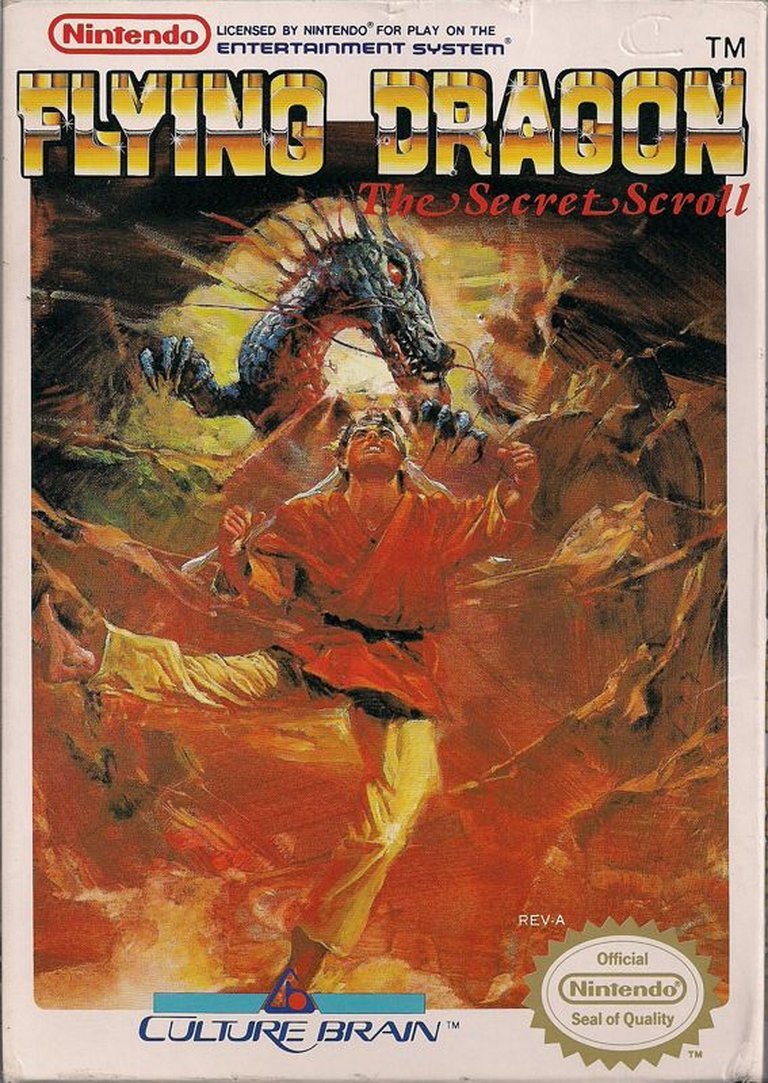
In ‘Flying Dragon: The Secret Scroll’, you play as Ryuhi, a martial artist entrusted with the last remaining scroll of the legendary Hiryu-no-Ken technique after his master, Juan, is robbed by the Tusk Soldiers. Six years later, Ryuhi enters the ‘World Tournament of Contact Sports’ to reclaim the stolen scrolls and avenge his master. The game blends side-scrolling action with one-on-one fighting, where Ryuhi must defeat enemies, collect power-ups, and face off against minibosses to progress through the tournament.
Gameplay Videos
Flying Dragon: The Secret Scroll Guides & Walkthroughs
Flying Dragon: The Secret Scroll Reviews & Reception
mobygames.com (52/100): Average score: 52% (based on 5 ratings)
en.wikipedia.org (70/100): Famitsu rated the game 28 out of 40.
nintendolife.com : Flying Dragon: The Secret Scroll is an ambitious game. While the back story is inspiring, the two gaming concepts meshed together do not work in harmony.
honestgamers.com (70/100): Innovative but Lacking Game; 7/10
Flying Dragon: The Secret Scroll Cheats & Codes
NES
Enter these letters at password screen.
| Code | Effect |
|---|---|
| H X W Y D + Z + 7 R | 1st Warrior Tournament |
| END | View Ending |
| BAAA | World championship tournament |
| HFBT | Elimination mode |
| AASO | Training mode |
NES (Game Genie)
Enter these codes using the Game Genie device.
| Code | Effect |
|---|---|
| VEKLTAKZ | Start with infinite lives |
| GXEEEPVG | Start with infinite time |
| PANATALA | Start with 1 life |
| TANATALA | Start with 6 lives |
| PANATALE | Start with 9 lives |
| TAOXULLA | Start with double KO power |
| 0029:40 | Infinite Energy |
| 00C1:FA | Infinite Time |
| 002A:00 | Easy Win |
| 00E9:0F | Walk Through Enemies |
| 0300:09+0301:09+0302:09+0303:09+0304:09+0305:09+0306:09+0307:09 | Max Score |
| 0029:42 | Infinite Health |
| 00C1:FF | Infinite Time |
| 0021:09 | Infinite Lives |
| 0093:05 | Infinite Magic Water |
| 031C:05 | Always have all items |
Flying Dragon: The Secret Scroll: A Flawed but Fascinating Martial Arts Hybrid
Introduction
In the pantheon of NES classics, Flying Dragon: The Secret Scroll (1987) occupies a peculiar niche—a game that dared to blend side-scrolling action with one-on-one fighting mechanics long before the genre conventions of the 1990s solidified. Developed by Culture Brain, a studio known for its ambitious but often uneven experiments, Flying Dragon is a title that oscillates between brilliance and frustration. It’s a game that, despite its flaws, remains a fascinating artifact of its era, offering a glimpse into the creative risks taken during the NES’s golden age.
This review will dissect Flying Dragon: The Secret Scroll in exhaustive detail, exploring its development history, narrative depth, gameplay mechanics, artistic choices, and lasting legacy. By the end, we’ll determine whether this game is a forgotten gem or a well-intentioned misfire.
Development History & Context
The Studio Behind the Game: Culture Brain’s Ambitions
Culture Brain, a Japanese developer and publisher, was no stranger to innovation. Founded in 1980, the studio carved out a reputation for blending action with role-playing elements, often drawing inspiration from martial arts and Chinese folklore. Their Hiryū no Ken series (Flying Dragon in the West) was a cornerstone of this philosophy, with Flying Dragon: The Secret Scroll serving as the second entry in the franchise.
The game’s development coincided with a period of rapid evolution in the fighting game genre. While Street Fighter (1987) was still in its infancy, Culture Brain sought to differentiate itself by integrating a narrative-driven side-scrolling adventure with tournament-style combat. This hybrid approach was ambitious, especially given the NES’s hardware limitations.
Technological Constraints and Design Challenges
The NES was not built for fluid, fast-paced fighting games. Its limited sprite capabilities and processing power made smooth animations and responsive controls a constant struggle. Flying Dragon attempted to circumvent these limitations by splitting its gameplay into two distinct modes:
1. Side-scrolling “Journey” levels, where players navigated environments, fought enemies, and collected items.
2. One-on-one “Tournament” battles, which adopted a target-based combat system reminiscent of Culture Brain’s earlier arcade title, Shanghai Kid (1985).
This duality was both a strength and a weakness. On one hand, it offered variety; on the other, it diluted the game’s focus, leading to a disjointed experience.
The Gaming Landscape of 1987
By 1987, the NES had firmly established itself as the dominant console in North America. Games like The Legend of Zelda, Metroid, and Castlevania had set high standards for action-adventure titles, while Mike Tyson’s Punch-Out!! demonstrated the potential of one-on-one combat. Flying Dragon arrived in this competitive environment, attempting to carve out its own identity by merging these two popular styles.
However, the market was not yet ready for a game that demanded mastery of two distinct playstyles. Many players found the side-scrolling sections tedious and the tournament battles clunky, leading to mixed reception.
Narrative & Thematic Deep Dive
Plot Summary: A Tale of Revenge and Mastery
Flying Dragon: The Secret Scroll follows Ryuhi, a young martial artist trained by his master, Juan, in the art of Hiryu-no-Ken (the “Fist of the Flying Dragon”). When Juan is ambushed by the nefarious Tusk Soldiers and robbed of the sacred scrolls containing the ultimate kung-fu techniques, he entrusts the final scroll—the Shingan No Sho (Book of the Mind’s Eye)—to Ryuhi. With his dying breath, Juan sends Ryuhi to the Shorinji Temple, where he is taken in by Bishop Gengai.
Six years later, Ryuhi receives a challenge from the Tusk Soldiers, who have organized the “World Tournament of Contact Sports.” Determined to avenge his master and reclaim the stolen scrolls, Ryuhi enters the tournament, setting the stage for a journey that blends personal vendetta with the pursuit of martial arts mastery.
Themes: Discipline, Revenge, and the Path to Enlightenment
At its core, Flying Dragon is a story about the duality of martial arts: the discipline required to master its techniques and the temptation to use those skills for vengeance. Ryuhi’s journey mirrors the classic wuxia (martial hero) narrative, where physical prowess is intertwined with spiritual growth.
- Discipline vs. Vengeance: Ryuhi’s training under Gengai emphasizes patience and control, but his quest is fueled by anger. The game subtly questions whether his motives are pure or tainted by hatred.
- The Scrolls as Symbols: The stolen scrolls represent more than just techniques; they embody the legacy of Ryuhi’s master and the responsibility he must shoulder.
- The Tournament as a Trial: The World Tournament is not just a series of fights but a test of Ryuhi’s resolve. Each opponent he faces is a stepping stone toward self-discovery.
Characters: Archetypes with Depth
While Flying Dragon’s characters are not deeply developed by modern standards, they serve their roles effectively within the game’s narrative framework.
- Ryuhi: The protagonist is a classic underdog—young, determined, but initially inexperienced. His growth is reflected in the scrolls he collects, each granting him new abilities.
- Juan: The fallen master whose legacy drives the plot. His absence looms large, serving as Ryuhi’s moral compass.
- Gengai: The wise mentor who guides Ryuhi, embodying the virtues of patience and wisdom.
- The Tusk Soldiers: A shadowy organization whose motives are never fully explained, adding an air of mystery to the conflict.
Dialogue and Localization
The game’s dialogue is minimal, relying on text boxes to convey key plot points. The English localization, while functional, occasionally suffers from the stilted phrasing common in NES-era translations. Phrases like “Contact Sports” (instead of “martial arts tournament”) feel awkward, but they also contribute to the game’s retro charm.
Gameplay Mechanics & Systems
Core Gameplay Loop: A Tale of Two Modes
Flying Dragon’s most defining—and divisive—feature is its bifurcated gameplay structure. Players alternate between:
-
Side-Scrolling “Journey” Levels
- Ryuhi traverses environments filled with enemies, platforms, and obstacles.
- Combat is simple but effective: players can punch, kick, and jump, with each attack having a distinct range and speed.
- The primary goal is to defeat mini-bosses, who drop items essential for progression. These items follow a sequence (e.g., power-ups leading to a key), adding a light RPG element.
- The controls are serviceable but lack precision, making platforming sections frustrating.
-
One-on-One “Tournament” Battles
- These fights adopt a target-based system where players must strike or defend specific body parts (indicated by a glowing target).
- The system is reminiscent of Shanghai Kid but feels slower and less responsive.
- Special moves, such as the Hiryu-no-Ken (a powerful spinning attack), can be unleashed when the KO gauge is filled.
- The tournament battles are the game’s highlight, offering strategic depth despite their clunkiness.
Combat and Progression
- Side-Scrolling Combat: Enemies are varied but often repetitive. Mini-bosses require pattern recognition, as they follow predictable attack sequences.
- Tournament Combat: The target system adds a layer of strategy, forcing players to time their attacks and blocks carefully. However, the slow animations and imprecise controls undermine this potential.
- Scrolls and Power-Ups: Collecting scrolls grants Ryuhi new abilities, such as enhanced jumps or stronger attacks. These upgrades are crucial for tackling later challenges.
UI and Inventory Management
The game’s UI is functional but barebones. Players can track their health, score, and collected items, but the lack of a pause menu or detailed status screen makes inventory management cumbersome.
Innovations and Flaws
- Innovations:
- The hybrid gameplay structure was ahead of its time, foreshadowing later titles like Castlevania: Symphony of the Night (which blended exploration with combat).
- The target-based fighting system was a unique take on one-on-one combat, offering more depth than simple button-mashing.
- Flaws:
- The side-scrolling sections feel tacked on, lacking the polish of dedicated platformers like Ninja Gaiden.
- The tournament battles, while innovative, suffer from sluggish controls and repetitive AI.
- The game’s difficulty is uneven, with some sections feeling unfairly punishing.
World-Building, Art & Sound
Setting and Atmosphere
Flying Dragon’s world is a stylized interpretation of feudal China, blending mythical and historical elements. The environments—ranging from mountain temples to bustling tournament arenas—are rendered in the NES’s signature 8-bit aesthetic. While the graphics are not groundbreaking, they effectively convey the game’s martial arts themes.
Visual Design: A Study in Constraints
- Character Sprites: Ryuhi and his opponents are well-animated, with distinct stances and attack animations. However, the limited color palette and resolution make some details hard to discern.
- Backgrounds: The side-scrolling levels feature repetitive tile sets, but the tournament arenas are more visually interesting, with detailed backdrops depicting crowds and architectural flourishes.
- Boss Designs: The mini-bosses and tournament opponents are the standout visual elements, each with unique silhouettes and attack patterns.
Sound Design: A Martial Arts Symphony
Composed by Shunichi Mikame, Flying Dragon’s soundtrack is a highlight. The music blends traditional Chinese instruments with synth-driven melodies, creating an atmosphere that is both energetic and contemplative.
- Journey Levels: The side-scrolling sections feature upbeat, rhythmic tracks that complement the action.
- Tournament Battles: The fighting themes are more intense, with driving percussion and dramatic flourishes.
- Sound Effects: Punch and kick sounds are satisfyingly crunchy, while the target system’s auditory cues help players time their attacks.
Atmosphere and Immersion
Despite its technical limitations, Flying Dragon creates a compelling atmosphere. The combination of martial arts lore, rhythmic combat, and a driving narrative makes the world feel alive, even if the execution is uneven.
Reception & Legacy
Critical Reception: A Mixed Bag
Upon release, Flying Dragon: The Secret Scroll received lukewarm reviews. Critics praised its ambition but criticized its execution.
- Nintendo Power (70%): Lauded the game’s unique blend of genres and the depth of its tournament system.
- Electronic Gaming Monthly (45%): Found the game repetitive and poorly controlled but acknowledged its innovative combat mechanics.
- Questicle.net (25%): Harshly criticized the game’s clunky controls and disjointed design, calling it a missed opportunity.
Player reception was similarly divided. While some appreciated the game’s challenge and novelty, others found it frustrating and unpolished.
Commercial Performance
Flying Dragon was not a commercial blockbuster, but it developed a cult following among NES enthusiasts. Its rarity (especially in North America) has made it a sought-after collector’s item, with used cartridges fetching high prices on the secondary market.
Influence and Legacy
Despite its flaws, Flying Dragon left a mark on the fighting game genre:
- Hybrid Gameplay: Its attempt to merge side-scrolling and one-on-one combat influenced later titles, such as Tao Taido (1992) and The Combatribes (1990).
- Target-Based Combat: The game’s unique fighting system was a precursor to later mechanics in titles like Virtua Fighter (1993), which emphasized precise timing and body targeting.
- Cultural Impact: As part of the Hiryū no Ken series, Flying Dragon helped popularize martial arts themes in video games, paving the way for franchises like Tekken and Dead or Alive.
Modern Re-Releases and Preservation
Flying Dragon has seen limited re-releases:
– Wii U Virtual Console (2014): Brought the game to a new audience, though its flaws remained intact.
– Windows (2018): A digital release that preserved the original experience without significant enhancements.
Despite these re-releases, the game remains a niche title, appreciated more for its historical significance than its gameplay.
Conclusion: A Flawed Masterpiece
Flying Dragon: The Secret Scroll is a game of contradictions. It is ambitious yet uneven, innovative yet flawed, and deeply engaging yet frustratingly clunky. Its attempt to blend two distinct gameplay styles was ahead of its time, but the NES’s hardware limitations and Culture Brain’s uneven execution prevented it from reaching its full potential.
Final Verdict: 6.5/10 – A Fascinating Experiment, But Not a Classic
While Flying Dragon is not a must-play for casual gamers, it is a title worth experiencing for those interested in the evolution of the fighting genre. Its hybrid gameplay, unique combat system, and martial arts narrative make it a standout entry in the NES library, even if its rough edges prevent it from achieving greatness.
For historians and retro enthusiasts, Flying Dragon: The Secret Scroll is a testament to the creativity and ambition of 1980s game development—a game that dared to defy conventions and, in doing so, left an indelible mark on the medium.