
- Release Year: 2004
- Platforms: Windows
- Publisher: Alawar Entertainment, Inc.
- Developer: Dream Dale
- Genre: Action
- Perspective: 3rd-person
- Game Mode: Single-player
- Gameplay: Platform, Shooter
- Setting: Science fiction
- Average Score: 70/100
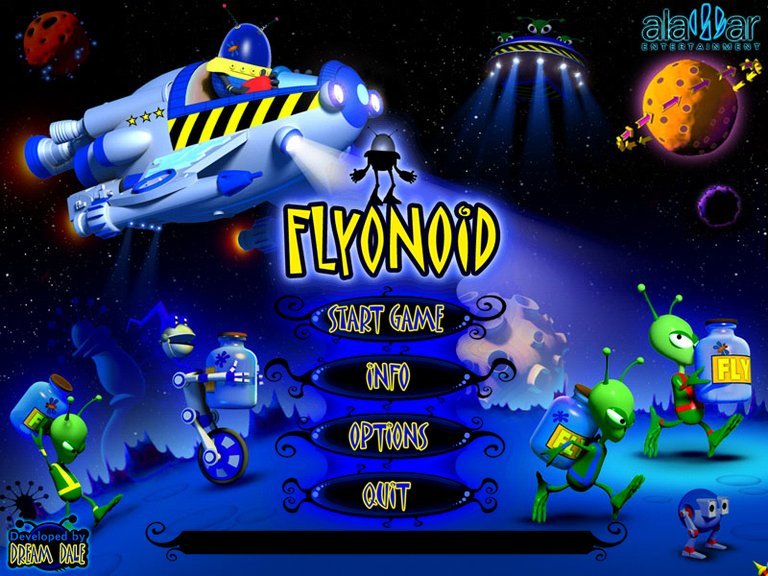
Description
Flyonoid is a 2D platform-shooter game where players embark on a mission to rescue kidnapped flies scattered across five alien planets. The game features a mix of action and exploration, with the protagonist navigating through 20 levels filled with hazards like monsters, rocks, water, and volcanoes. Players can utilize power-ups such as weapons, flight ability, invisibility, and extra lives to overcome challenges. The game is set in a whimsical, insect-themed world where the player must thwart alien invaders who have wreaked havoc on a peaceful green planet.
Flyonoid Reviews & Reception
gamepressure.com (70/100): The production is distinguished by its absurd humour.
mobygames.com : Flyonoid is a 2D platform game where hordes of alien scum attacked the little green planet.
Flyonoid Cheats & Codes
PC
Press C during gameplay to display the question window, then enter one of the following case-sensitive codes.
| Code | Effect |
|---|---|
| pleasehealth | 100% health |
| pleaserockets | 20 rockets to shoot |
| pleaselives | 5 extra lives |
| pleasefire | FireFury (multiple shots) bonus |
| pleasenextroom | Level skip |
| pleaseprevroom | Previous level |
| pleasespeed | Toggle high speed spaceship movement |
| pleasegod | Toggle invincibility |
| LOVE2KILL | Level 1 |
| DIMINISHME | Level 1, Stage 2 |
| VERDAMMTEN | Level 2 |
| 2BBEHEADED | Level 2, Stage 2 |
| KALISHITER | Level 3 |
| DEVILSHERE | Level 3, Stage 2 |
Flyonoid: A Forgotten Gem of Whimsical Platforming
Introduction: The Curious Case of a Fly-Saving Odyssey
In the vast, often overlooked annals of early 2000s indie gaming, Flyonoid (2004) stands as a peculiar artifact—a game that dared to blend the absurdity of insectoid heroism with the timeless appeal of 2D platforming. Developed by the obscure Russian studio Dream Dale and published by Alawar Entertainment, Flyonoid is a title that slipped through the cracks of mainstream recognition, yet its charm and quirky premise deserve a second look. At its core, the game is a rescue mission: aliens have kidnapped Earth’s flies, and it’s up to a plucky robot piloted by two fly brothers to save their buzzing brethren across five alien worlds.
This review seeks to dissect Flyonoid in its entirety—from its developmental origins to its gameplay mechanics, its whimsical narrative, and its lasting (or lack thereof) legacy. Was it a hidden masterpiece, or a forgettable footnote in the platformer genre? Let’s embark on this entomological adventure to find out.
Development History & Context: The Birth of an Insectoid Epic
The Studio Behind the Buzz: Dream Dale and Alawar Entertainment
Flyonoid emerged from Dream Dale, a small Russian development team with a penchant for casual and arcade-style games. The studio’s portfolio included titles like Magic Ball and Astro Fury, but Flyonoid was one of their more ambitious projects—a full-fledged platformer with a narrative twist. The game was published by Alawar Entertainment, a company known for distributing budget-friendly, family-oriented games in the early 2000s.
The collaboration between Dream Dale and Alawar was part of a broader trend in the mid-2000s, where Eastern European developers capitalized on the growing market for digital downloads and shareware games. With minimal marketing and distribution primarily through online platforms, Flyonoid was designed to appeal to a niche audience: younger players and those with a taste for offbeat humor.
Technological Constraints and Design Philosophy
Released in March 2004, Flyonoid was a product of its time. The early 2000s were a transitional period for PC gaming, with 3D graphics becoming the norm, yet 2D platformers still held a nostalgic appeal. Flyonoid embraced this retro aesthetic, opting for a side-scrolling, 2D platformer with simple but colorful visuals.
The game’s engine was lightweight, ensuring it could run on modest hardware—a necessity given the era’s diverse PC specifications. The controls were straightforward, catering to younger players, while the level design incorporated classic platforming tropes (jumping, shooting, avoiding hazards) with a twist: the protagonist was a robot controlled by flies.
The Gaming Landscape of 2004
2004 was a year dominated by blockbuster titles like Half-Life 2, World of Warcraft, and Doom 3. In this environment, a quirky, low-budget platformer about flies and aliens had little chance of making waves. Yet, Flyonoid carved out its own space in the casual gaming market, alongside other Alawar-published titles like Bejeweled and Zuma.
The game’s release coincided with the rise of digital distribution, allowing it to reach audiences without physical media. However, its lack of critical attention and limited marketing relegated it to obscurity—a fate shared by many indie titles of the era.
Narrative & Thematic Deep Dive: A Tale of Flies, Robots, and Alien Abduction
Plot Summary: The Great Fly Kidnapping
Flyonoid’s premise is as bizarre as it is charming. On April 38, 2009 (a fictional date), aliens invade Earth, committing a series of absurd crimes:
– Harassing three grasshoppers.
– Stealing the spots from a ladybug’s wings.
– Kidnapping all of Earth’s flies to study why they can “think without brains.”
The protagonists, John and Hans Muchowsky, are two flies who escape captivity and discover an alien combat robot named Muchtrix. Hans, a skilled mechanic, pilots the robot, while John provides tactical support. Together, they embark on a mission to rescue their fellow flies from glass jars scattered across five alien planets.
Characters and Dialogue: Whimsy Over Depth
The game’s characters are deliberately cartoonish:
– John and Hans – The fly brothers, whose personalities are barely developed beyond their roles (mechanic and strategist).
– Muchtrix – The robot, which serves as the player’s avatar.
– The Aliens – Generic, goofy antagonists with no distinct personalities.
Dialogue is minimal, relying on humorous text prompts rather than voice acting. The tone is lighthearted, with jokes about insect biology and alien incompetence. While not deep, the writing fits the game’s absurdist, child-friendly aesthetic.
Themes: Absurdity, Heroism, and the Underdog
Flyonoid’s themes are simple but effective:
1. The Underdog’s Triumph – Two small flies take on an alien empire.
2. Absurdity as Comedy – The premise is intentionally ridiculous, playing on the idea of insects as unlikely heroes.
3. Environmental Awareness (Subtle) – The aliens disrupt Earth’s ecosystem by removing flies, hinting at ecological balance.
The game doesn’t take itself seriously, which is part of its charm. It’s a celebration of the weird, where the stakes are high (for flies, at least) but the tone remains playful.
Gameplay Mechanics & Systems: Platforming with a Buzz
Core Gameplay Loop: Rescue, Shoot, Repeat
Flyonoid is a 2D side-scrolling platformer with shooter elements. The player controls Muchtrix, navigating through 20 levels across five planets, each with distinct environmental hazards:
– Volcanoes (lava pits)
– Water hazards (instant death)
– Falling rocks
– Alien enemies (ranging from grunts to boss fights)
The primary objective is to free trapped flies from glass jars while reaching the level’s exit (a teleporter).
Combat and Weapons: A Fly’s Arsenal
Muchtrix is equipped with multiple weapons, each with unique properties:
– Basic Blaster – Standard projectile.
– Spread Shot – Wide-area attack.
– Laser – Piercing beam.
– Bombs – Explosive damage.
Power-ups are scattered throughout levels, granting temporary abilities:
– Flight (limited-time hovering)
– Invisibility (brief invincibility)
– Extra Lives (rare but crucial)
Level Design: Variety and Challenge
The game’s five worlds each have four levels, with increasing difficulty:
1. Grassland Planet – Basic platforming.
2. Volcanic Planet – Lava and falling rocks.
3. Aquatic Planet – Water hazards and slippery surfaces.
4. Mechanical Planet – Moving platforms and traps.
5. Alien Fortress – Boss battles and final showdown.
While the levels are short and linear, they offer enough variety to keep the experience engaging. The difficulty curve is gentle, making it accessible to younger players.
UI and Controls: Simple but Effective
The HUD displays:
– Health bar
– Current weapon
– Fly counter (rescued vs. total)
– Power-up timer
Controls are keyboard-only (no gamepad support), with:
– Arrow keys for movement.
– Spacebar to jump.
– Ctrl to shoot.
– Shift to switch weapons.
The simplicity ensures easy pickup, though veteran platformer fans might find it too basic.
Innovations and Flaws
Innovations:
– Insect-themed protagonist – A rare premise in gaming.
– Lighthearted humor – The game doesn’t take itself seriously.
– Accessible difficulty – Great for younger audiences.
Flaws:
– Repetitive gameplay – The core loop doesn’t evolve much.
– Limited enemy variety – Most foes are palette swaps.
– No save system – Players must complete the game in one sitting (though levels are short).
World-Building, Art & Sound: A Colorful Insectoid Universe
Visual Design: Bright, Cartoonish, and Charming
Flyonoid’s art style is vibrant and cartoonish, with:
– Hand-drawn sprites (by Alexey Chernov, aka “Scia”).
– Exaggerated animations (flies buzzing, aliens wobbling).
– Distinct planetary themes (lush greens, fiery reds, icy blues).
The game’s color palette is cheerful, reinforcing its child-friendly appeal. While not technically impressive, the visuals are functional and charming.
Sound Design: Buzzing Beats and Quirky Effects
The audio, composed by Sergey Perminov, features:
– Upbeat, synth-heavy tracks – Fitting the game’s whimsical tone.
– Simple sound effects – Laser blasts, fly buzzing, alien squawks.
– No voice acting – All dialogue is text-based.
The soundtrack is catchy but repetitive, with only a few tracks looping throughout the game.
Atmosphere: A Lighthearted Adventure
The game’s tone is consistently playful and absurd, never taking itself too seriously. The combination of bright visuals, bouncy music, and silly premise creates an experience that feels like a Saturday morning cartoon—perfect for its target audience.
Reception & Legacy: The Forgotten Fly Rescue Mission
Critical Reception: A Niche Appeal
Flyonoid received little to no mainstream coverage upon release. Most reviews came from casual gaming sites and abandonware communities, where it was praised for:
– Charming premise – The fly-saving concept was unique.
– Accessible gameplay – Easy for kids to pick up.
– Humor – The absurdity was a selling point.
However, it was also criticized for:
– Lack of depth – Too simple for hardcore gamers.
– Repetitive design – Levels felt samey after a while.
Commercial Performance: A Budget Title’s Fate
As a digital-only release, Flyonoid likely sold modestly, primarily through Alawar’s website and shareware platforms. It never achieved commercial success but found a cult following among fans of obscure platformers.
Legacy: A Footnote in Platformer History
Flyonoid’s influence is minimal, but it remains a curiosity in gaming history:
– Inspired similar indie titles – Games like Mushroom Age (2010) share its whimsical tone.
– Preserved by abandonware communities – Sites like MyAbandonware keep it alive.
– A testament to early 2000s indie creativity – Proof that even small studios could craft memorable experiences.
Conclusion: A Buzzing Little Game That Deserves a Second Look
Flyonoid is not a masterpiece, nor is it a groundbreaking title. What it is, however, is a charming, lighthearted platformer that embraces absurdity with open wings. Its simple mechanics, colorful visuals, and silly premise make it a hidden gem for fans of retro platformers and offbeat humor.
Final Verdict: 7/10 – A Whimsical Delight
Pros:
✅ Unique premise (flies vs. aliens).
✅ Accessible, kid-friendly gameplay.
✅ Bright, cheerful visuals.
✅ Humorous tone.
Cons:
❌ Repetitive level design.
❌ Lack of depth for experienced players.
❌ No save feature.
❌ Minimal critical recognition.
Flyonoid may not have left a lasting mark on gaming history, but it remains a fun, forgotten adventure—one that proves even the smallest heroes (or flies) can save the day.
For fans of: Earthworm Jim, Jazz Jackrabbit, Worms (humor), Rayman (platforming).
Where to play? Available on abandonware sites like MyAbandonware and Ocean of Games.
Final Thought: If you ever wondered what a fly-powered robot would play like, Flyonoid is your answer. It’s silly, short, and sweet—just like a fly’s lifespan. Worth a buzz. 🪰🚀