
- Release Year: 2015
- Platforms: Linux, Macintosh, Windows
- Publisher: SEGA Games Co., Ltd.
- Genre: Special edition
- Game Mode: Single-player
Description
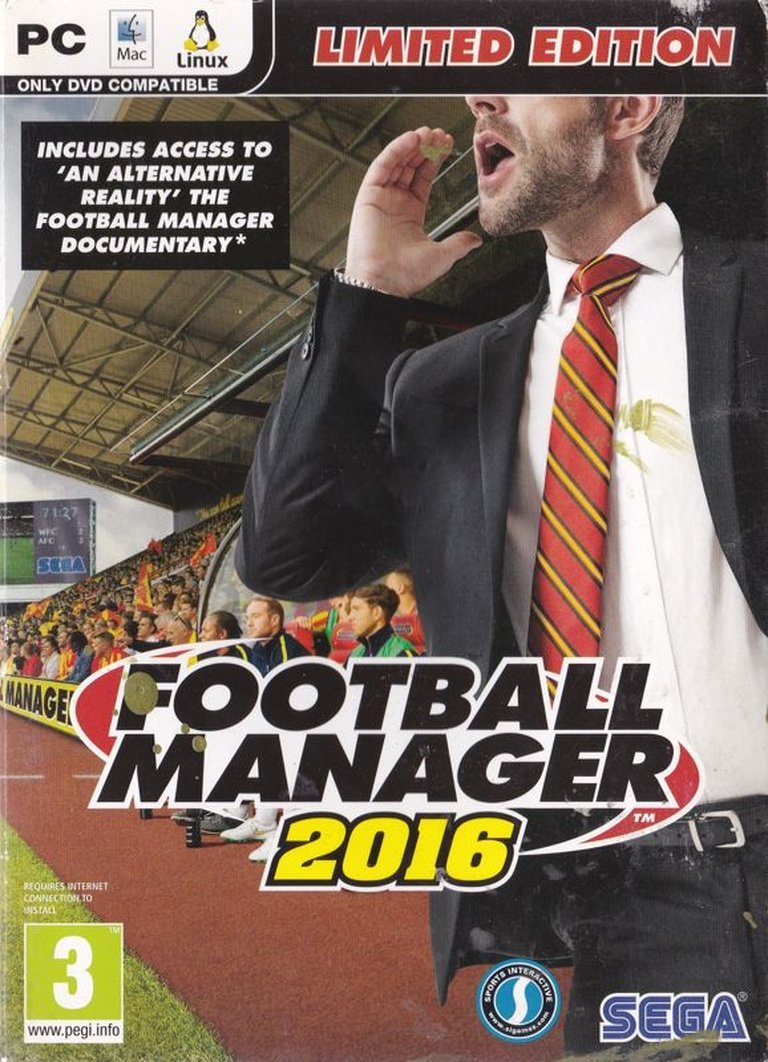
Football Manager 2016 (Limited Edition) is a physical DVD release of the acclaimed football management simulation game, where players assume the role of a manager to oversee all aspects of a football club, including player transfers, tactics, and finances, set within authentic real-world leagues. This special edition includes the base game on DVD, a manual, and a Steam activation code for the feature-length documentary ‘An Alternative Reality: The Football Manager Documentary’, offering enhanced value for collectors and fans of the series.
Football Manager 2016 (Limited Edition) Patches & Updates
Football Manager 2016 (Limited Edition) Reviews & Reception
pcgamer.com : Still untouchable on the footy frontbut shelf life and that inconsistent 3D engine chip away at its tender achilles.
trustedreviews.com : Football Manager 2016 doesn’t try to rewrite the rule book.
Football Manager 2016 (Limited Edition): The Tactical Pinnacle of Iterative Refinement
Introduction: The Unrivaled Monarch of the Dugout
To speak of Football Manager is to speak of an institution, a digital leviathan that has for decades held a monopoly on the fantasies of armchair managers worldwide. By 2015, Sports Interactive’s magnum opus was no longer just a game; it was a parallel universe, a meticulously simulated ecosystem where the dreams of millions played out in endless, data-rich seasons. Football Manager 2016 arrived not with a revolutionary claim to the throne, but with the quiet confidence of a sovereign who had already mastered the art of governance. Its thesis was one of profound, almost obsessive, refinement—a declaration that the deepest management simulation ever conceived could still be made more accessible, more immersive, and more intimately connected to the modern game without sacrificing a single iota of its legendary complexity. The Limited Edition, a physical collector’s item bundled with the feature-length documentary An Alternative Reality: The Football Manager Documentary, served as both a celebration of this legacy and a recognition that the game had transcended its genre to become a cultural artifact. This review argues that Football Manager 2016 represents the zenith of the series’ classic iterative model, a masterclass in systemic polishing that tightened the feedback loop between manager intent and virtual pitch outcome, setting a benchmark that would influence the design of management sims for years to come.
Development History & Context: A Studio at the Peak of Its Powers
The development of Football Manager 2016 was undertaken by Sports Interactive (SI), a studio that by 2015 had nearly two decades of specialized experience in the football management genre. Following their split from Eidos in 2004 and subsequent exclusive partnership with SEGA, SI had established a relentless annual release cycle, each iteration building upon a colossal, ever-expanding database and a deeply entrenched simulation engine. The technological context of 2015 was one of maturation; the series had long since moved past the limitations of 2D-only match representation (introduced in FM2009) and was now focused on iterating the 3D match engine, improving AI decision-making, and streamlining the famously daunting user interface.
The studio’s vision, as articulated in press releases and interviews, was clear: to make the “most realistic football management simulation” possible. For FM2016, this translated into two primary goals. First, to lower the steep learning curve that had become a rite of passage for new players, a barrier acknowledged by critics year after year. Second, to deepen the simulation’s responsiveness to the user, making the world feel more reactive and the tactical feedback more granular. This was achieved not through a ground-up rebuild, but through targeted, high-impact revisions across core systems. The era was also marked by the growing fragmentation of the franchise into mobile (Football Manager Mobile) and tablet (Football Manager Touch) editions, but the PC/Mac/Linux flagship remained the canonical, most complex experience.
Narrative & Thematic Deep Dive: The Story That Writes Itself
Unlike narrative-driven games, Football Manager possesses no authored plot. Its “story” is entirely emergent, born from the chaotic interplay of its systems and the player’s imagination. FM2016 enhances this emergent narrative in subtle but powerful ways, primarily through its thematic focus on modern managerial identity and tactical evolution.
The game’s central narrative theme is the manager as a multifaceted, contemporary figure. The introduction of customisable manager appearances on the pitch was more than a cosmetic toggle; it was a symbolic step, allowing players to project their own identity onto their avatar, blurring the line between the user and the on-screen persona. This was complemented by the expanded social media features (a nascent but telling inclusion), which reflected the modern manager’s public-facing role, where every decision is scrutinised in real-time.
The Create-a-Club mode, while a gameplay innovation, is also a profound narrative tool. It empowers the player to be not just a manager, but a founder, a visionary. The stories that emerge—of building a village team into a European powerhouse, of establishing a club philosophy from the kits to the tactical creed—are deeply personal and authored entirely by the user. This mode taps into a powerful fantasy of creation and legacy that transcends mere team management.
The most significant narrative driver, however, is the ProZone Match Analysis system. Borrowed from real-world analytics, it transforms post-match review from a vague feeling of “we played well/badly” into a data-rich narrative. The player can now “read” the story of the match in passing networks, shot maps, and player movement heatmaps. This isn’t just feedback; it’s a forensic report that allows the player to construct a post-hoc justification for victory or defeat, to assign blame or credit with statistical evidence, deepening the immersion and the managerial “story” of each season.
Gameplay Mechanics & Systems: The Engine Room of Beautiful Detail
Football Manager 2016 is a masterpiece of systemic design, where every knob and dial connects to a vast, underlying web of cause and effect. Its genius lies in the coherence of this web.
1. Core Loops & The Newcomer’s Gambit: The fundamental loop—scout, sign, train, pick team, watch match, analyse, repeat—remains sacrosanct. The critical refinement for FM2016 was in lowering the entry barrier for this loop. The improved user interface was widely praised (PC Gamer, The Guardian) for being cleaner and more intuitive, though critics like GameSpot noted persistent “inaccessibility” in deeper menus. The new Fantasy Draft mode brilliantly abstracts the core loop into a pick-and-play format for multiplayer, while the Create-a-Club mode offers a sandbox to learn the meta-game without inherited squad constraints.
2. The Tactical大脑: Overhauled Match Tactics & Set Piece Creator: This was the headline innovation. The match engine’s AI and animations received notable upgrades, but the tactical interface’s redesign was transformative. The new layout, as noted by Rock, Paper, Shotgun, moved analysis front and centre. More importantly, the Set Piece Creator was overhauled. This was no longer a neglected mini-game; it became a strategic workshop. Players could design intricate, player-specific routines for corners, free-kicks, and penalties, assigning roles (Dribbler,asserter, Blocker) and routines. Theoretically, a well-executed set-piece strategy could become a decisive, repeatable goal source, adding a crucial layer of tactical preparation previously underserved.
3. The Social Engine: Player Dynamics & Board Requests: Building on FM2015’s team cohesion system, FM2016 deepened the social dynamics within the squad. While not as graphically represented as the following year’s FM2018 “Dressing Room” view, hierarchies and cliques implicitly influenced player happiness and response to team talks. The Board Requests system was also refined, making long-term ambitions and short-term pressures feel more tied to specific, evolving club visions, as later fully realised in FM2020.
4. ProZone & The Data Dashboard: ProZone Match Analysis, developed with the real company, was a landmark addition. It provided post-match data akin to what real managers receive: passing networks, shot efficiency (xG was on the horizon), defensive actions, and player comparisons. This system did two things: it gave empirical weight to the user’s tactical diagnosis, and it created a new “minigame” of data interpretation, appealing to the superfan’s desire for analytical depth.
5. The Flaws in the Machine: Critics consistently highlighted two major pain points. First, the 3D match engine, while improved, was still prone to bizarre animations, illogical player decisions, and “scripted” moments that broke immersion. PC Gamer’s critique that it “chipped away at its tender Achilles” is apt. Second, the sheer pace of gameplay was noted as sluggish, particularly in the later stages of a long-term save with a massive database. The depth came at a performance cost that could test patience.
World-Building, Art & Sound: The Illusion of a Living World
The “world” of FM2016 is its database—over 600,000 players and staff, tens of thousands of clubs, leagues from Andorra to Zimbabwe. This is the game’s primary artistic and auditory achievement: a world of staggering, almost infinite, specificity. Each player has a meticulously crafted history, personality, preferred move, and hidden potential. The art direction is functional, not flashy. The 3D match engine, while lacking the graphical fidelity of AAA sports titles, prioritises clarity: you must instantly recognise a player’s body shape, their positioning relative to the offside line, the trajectory of a pass. The sound design is similarly utilitarian—the crowd’s roar, the thud of a tackle, the commentator’s clipped phrases—but it efficiently reinforces key moments without overwhelming.
The true “atmosphere” is generated by the interface and information density. The tactile satisfaction of navigating menus, the weight of a contract negotiation, the tension of a transfer deadline day—these are the sensory experiences that sell the world. The newly polished UI of FM2016, with its cleaner fonts and logical groupings, made this dense world slightly less intimidating to navigate, a crucial step in making the simulation feel less like a spreadsheet and more like a living workplace.
Reception & Legacy: A Critical Darling and a Commercial Force
Upon release in November 2015, Football Manager 2016 was met with broadly positive critical reception, though with noted reservations. It holds a Metacritic score of 81/100 based on 34 critic reviews.
- The Praise: Critics universally lauded its unprecedented depth and the significant quality-of-life improvements. The Guardian highlighted its “dangerously accessible” nature, noting that “the moreish management sim is back featuring its usual tactical depth, but with a more user-friendly road to success.” PC Gamer (83/100) celebrated the “vast depth” and the Create-a-Club mode, while VideoGamer.com (8/10) appreciated the iterative steps forward. The introduction of tactical customisation via the new set-piece routines and the clarity of ProZone were consistently cited as winners.
- The Criticisms: The chorus of complaint regarding inaccessibility for newcomers and the pace of the 3D match engine was loud and consistent. Tom Hatfield of GameSpot (7/10) explicitly wrote of its “inaccessibility and lack of speed,” feeling that while the depth was untouchable, the experience could be sluggish. The sense that the 3D engine was a necessary but occasionally frustrating evil was a recurring theme.
Commercially, the game was a monumental success. As stated on its Wikipedia page, Sports Interactive’s Miles Jacobson announced that Football Manager 2016 had sold 1 million copies by September 15, 2016. This figure, achieved in a single annual cycle without counting the differently structured Mobile or Touch versions, underscores the franchise’s dominant market position and its ability to sell millions of copies to a dedicated, niche audience.
Its Legacy: FM2016 is a pivotal, transitional title. It was the last major iteration before the franchise underwent a more dramatic visual and philosophical shift with FM2017. The focus on accessibility, ProZone, and set-pieces laid the groundwork for future innovations. The Create-a-Club mode, introduced here from the Editor, became a staple. The push for better tactical feedback evolved into the full “Dynamics” and “Dressing Room” systems of later years. Most importantly, it solidified the annual release model as a process not of revolution, but of relentless, data-driven refinement. It proved that the core simulation was so robust that the most meaningful progress could be made in the margins: faster loading, clearer UI, better scouting reports, more nuanced team talks. It is arguably the last “pure” FM game in the sense that its ambition was wholly concentrated on perfecting the manager’s experience on the virtual touchline, without the major structural overhauls (like FM2020’s “Club Vision” or FM24’s “Real World/Your World” modes) that would follow.
Conclusion: The Carefully Constructed Crown
Football Manager 2016 (Limited Edition) stands not as a radical departure, but as a masterpiece of consolidation and thoughtful enhancement. It is the culmination of years of incremental improvement, a game that took the famously impenetrable SI simulation and sanded down just enough of the rough edges to make it inviting, without ever compromising the staggering complexity beneath. The addition of ProZone analytics, the revamped set-piece scripting, and the more intuitive interface were not mere features; they were statements of intent, acknowledging that the modern football manager is as much an analyst and psychologist as a tactician.
Its flaws are the flaws of its ambition: a 3D match engine striving for realism but occasionally breaking the suspension of disbelief, and a sheer volume of information that, even when better presented, can still overwhelm. Yet, these are the exhaust fumes of a machine working at the very limit of its design. The Limited Edition packaging, with its included documentary, is a fitting capstone—a recognition that this was no longer just software, but a phenomenon worthy of examination.
In the grand timeline of the Football Manager series, FM2016 is the definitive “classic” iteration of the 2010s era. It represents the peak of the form established in the late 2000s, perfectly balancing the need for deeper simulation with the imperative of greater accessibility. It sold a million copies not by reinventing the wheel, but by making that wheel turn more smoothly, more quietly, and with a more satisfying grip on the road ahead. For historians, it marks the end of one phase and the quiet beginning of another—the last game to focus purely on the dugout experience before mobile integration and cross-platform play would redefine the franchise’s scope. It remains, for many, the most complete and satisfying expression of the pure, unadulterated Football Manager dream.