
- Release Year: 2000
- Platforms: Windows
- Publisher: Ubi Soft Entertainment Software
- Developer: Caffeine Studios Limited
- Genre: Simulation, Sports
- Game Mode: Single-player
- Gameplay: Business simulation, Managerial
- Setting: Football (European), Soccer
- Average Score: 74/100
Description
Football World Manager 2000 is a comprehensive soccer management simulation game where players take control of football clubs across a vast database featuring nearly 30,000 players from over 1,400 clubs in 95 divisions and teams from more than 70 countries, building on its 1998 predecessor with faster gameplay, enhanced player information, improved match action details, a tactics editor, and tools for training, transfers, substitutions, motivation, stadium upgrades, and financing.
Gameplay Videos
Football World Manager 2000 Free Download
Football World Manager 2000 Cracks & Fixes
Football World Manager 2000 Patches & Updates
Football World Manager 2000 Guides & Walkthroughs
Football World Manager 2000 Reviews & Reception
myabandonware.com (70/100): Nice game, it does work on win10, but like dr flash says it got a virus
Football World Manager 2000: Review
Introduction
Imagine inheriting a dilapidated English football club on a dreary Saturday morning: rusty emblems creaking in the wind, empty cans rattling across muddy terraces, and a defeated predecessor slurring excuses over an empty whisky bottle before shoving past you. This vivid vignette from the game’s introductory flavor text encapsulates the gritty allure of Football World Manager 2000 (FWM 2000), a 2000 Windows release that thrust players into the high-stakes pressure cooker of soccer management. As the direct sequel to the 1998 original, it expanded the formula with unprecedented scale—nearly 30,000 players across 1,400 clubs in 95 divisions and over 70 countries—positioning itself as a comprehensive sim in an era dominated by genre giants like Championship Manager. Yet, while it delivers addictive depth for newcomers and data enthusiasts, its technical limitations and stiff competition reveal it as a competent but not revolutionary artifact. This review argues that FWM 2000 endures as a nostalgic snapshot of late-90s management sim ambition, rewarding patient tacticians despite its era-bound flaws.
Development History & Context
Developed by the Huddersfield-based Caffeine Studios Limited—a small UK outfit led by figures like project leader Jim McDonagh and marketer Keef Sloan—Football World Manager 2000 emerged from the ashes of the 1998 predecessor, which had already earned praise for its scope (e.g., Sunday Express called it “the best management simulation game so far”). Caffeine’s vision was clear: iterate aggressively on feedback, ballooning the database by 20 countries (to 71 total), accelerating gameplay engines, and introducing tools like a Tactics Editor to appeal to sim purists craving realism. Published by Ubi Soft Entertainment Software (pre-Ubisoft branding dominance), it launched in January 2000 on CD-ROM for Windows, targeting ELSPA 3+ audiences with mouse-only controls in a single-player format.
The late-90s gaming landscape was a golden age for soccer management sims, fueled by the Premier League’s global boom and PC hardware leaps (Pentium II/III era, DirectX acceleration). Rivals like Eidos’ Championship Manager: Season 1999/2000, Gremlin’s The F.A. Premier League Football Manager 2000, and Dinamic’s Player Manager 2000 flooded the market, emphasizing deeper tactics and licensed leagues. FWM 2000’s tech constraints—fixed-resolution windows, no fullscreen mode, reliance on static 2D interfaces—mirrored the era’s limitations: 800×600 resolutions common, no widespread broadband for updates (though patches like v5.31 and data packs existed). Caffeine’s indie ethos shone in innovations like right-click shortcuts and staff feedback systems, but budget realities meant outsourced graphics and audio, positioning it as an underdog against Sports Interactive’s polished behemoths. Today, as abandonware (playable on Win10 with NoCD fixes, per MyAbandonware users), it reflects a transitional moment before 3D match engines revolutionized the genre.
Narrative & Thematic Deep Dive
Football World Manager 2000 eschews traditional plotting for emergent storytelling, a hallmark of managerial sims where “narrative” unfolds through career arcs, news cycles, and simulated drama. There’s no scripted protagonist; you embody the archetypal beleaguered manager, stepping into that “little white make-shift office” to rescue a club from obscurity. Themes revolve around strategic ascension: bootstrapping underdogs via shrewd transfers, training regimens, and tactical pivots, mirroring real-world managerial odysseys like Alex Ferguson’s Manchester United dynasty.
Key “characters” are procedural—your Head Coach and Assistant Manager provide flavorful reports (“juicy bits of info” on player form, per Eurogamer), while scouts deliver innovative reports that RealGamer lauded as “vernieuwend” (innovative), bridging sim to reality. Dialogue is sparse but functional: terse news items, motivational prompts, and post-match analyses. Underlying motifs include financial precarity (stadium upgrades, sponsorships amid budget woes), psychological warfare (player motivation, substitutions), and global ambition (95 divisions spanning 70+ countries foster cross-continental tales, e.g., scouting Brazilian gems for an English lower-leaguer).
Bugs add unintended humor, like Eurogamer’s anecdote of phantom trophy wins persisting seasons later, underscoring themes of unreliable media spin. The daily newspaper screen—unique per country, with graphical league summaries—serves as a “thematic deep dive” hub, weaving a tapestry of triumphs, scandals, and rivalries. Absent overt drama, the game’s pathos lies in quiet victories: nurturing a youth prospect to stardom or surviving a relegation scrap, evoking the existential grind of soccer’s backrooms over on-pitch glory.
Gameplay Mechanics & Systems
At its core, FWM 2000’s loop is a masterful deconstruction of soccer management: scout, train, select, simulate, adapt. Enhanced from the 1998 original, it boasts “faster gameplay” with a blazing-quick engine processing vast datasets without lag—Hacker magazine hailed it as offering “najviše mogućnosti” (most possibilities) among managers. Start by choosing a club, then dive into intuitive, icon-driven menus (Explorer-style trees, everything “two clicks away”).
Core Systems:
– Squad Building & Progression: Oversee 30,000 players’ attributes via revamped info screens. Transfers, loans, and contracts demand financial savvy; training boosts skills, while scouting (praised by RealGamer) uncovers hidden talents realistically.
– Matchday Tactics: Tactics Editor lets you tweak formations, styles (e.g., pressing, passing), and substitutions. “Match Action” mode delivers highlights with richer stats for post-game tweaks—watch naturally (1 min/game) or instant-resolve, though Eurogamer critiqued the binary speeds versus CM’s granular options.
– Club Management: Stadium expansions, financing, staff interactions (Head Coach suggestions). Right-click menus streamline actions; motivation/morale sliders add psychological depth.
– UI/UX: Mouse perfection—fluid, non-intrusive. Flaws: Tiny team selection screens (RealGamer gripe), no suspensions for 5 yellows (exploitable bug).
Innovations like staff feedback and global depth create addictive loops, but it’s “basic” for veterans (Eurogamer), lacking CM’s AI nuance. Progression feels rewarding: climb divisions, chase cups, with patches enabling data updates for realism.
| Mechanic | Strengths | Weaknesses |
|---|---|---|
| Database | 30k players, 95 divisions | Dated post-2000 rosters |
| Processing Speed | Lightning-fast | Reduces tension in sims |
| Tactics | Custom editor, real-time subs | Binary watch speeds |
| Scouting | Innovative, realistic | UI cramped |
| Finances | Stadium/financing depth | Exploits (e.g., no bans) |
World-Building, Art & Sound
FWM 2000’s “world” is a sprawling digital soccer universe—95 divisions evoke a lived-in globe, from Premier League glamour to obscure national tiers. Atmosphere builds via procedural news: country-specific papers chronicle your saga amid rivals’ woes, fostering immersion despite abstraction.
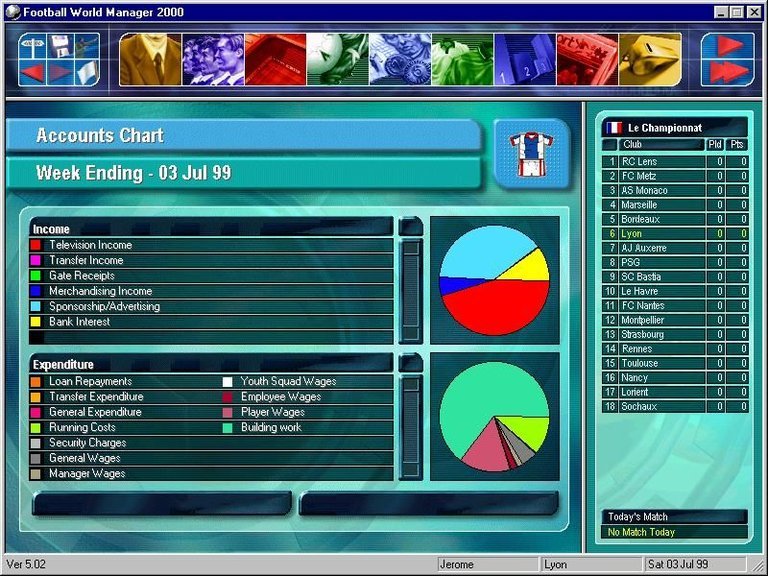
Visuals: Functional 2D—clean menus with thematic icons (e.g., kicking balls on player screens), but match highlights are “poor to say the least” (Eurogamer): blocky, low-res animations lacking mugshots or real photos. Fixed, non-resizable window frustrates modern eyes, evoking Minesweeper-era desktops. Title screens’ stills disappoint, prioritizing data over flair.
Sound Design: Ambient menu noises (telephones, kicks) add charm, but match crowd roars fall flat—tinny, afterthought-like. No soundtrack dominates; it’s utilitarian, enhancing focus on spreadsheets over spectacle. Collectively, these elements prioritize simulation purity: the thrill is cerebral conquest, not audiovisual bombast, though they pale against contemporaries’ polish.
Reception & Legacy
Critically, FWM 2000 averaged 78% on MobyGames (3 reviews): Hacker’s 95/100 praised its “retro” depth as a manager hit; Eurogamer’s 70/100 deemed it a solid intro but inferior to Championship Manager 99/00 (£19.99 steal); RealGamer’s 70/10 highlighted scouting innovation amid UI sloppiness. Players averaged 4.2/5 (sparse data); IMDb’s 7.9/10 (46 votes) suggests cult appeal. Commercially, it flew under radars in a saturated 2000 market (Player Manager 2000, O’Leary Manager 2000).
Legacy is niche: overshadowed by Sports Interactive’s lineage (evolving to modern Football Manager), it influenced scouting mechanics echoed in later sims. Abandonware status (MyAbandonware: 3.5/5, Win10 viable with patches) sustains communities—Neoseeker forums buzz with NoCD fixes, XP bugs, cheats. No major industry ripple, but as Caffeine’s swan song amid Ubisoft shifts, it preserves Y2K-era sim DNA: vast data, speed over flash. In Football Manager‘s evolution (3D engines post-2009), FWM 2000 marks a pre-3D pivot point.
Conclusion
Football World Manager 2000 masterfully scales its 1998 blueprint into a data-drenched delight, blending rapid-fire management with global ambition that captivates newcomers and retro fans. Its intuitive UI, innovative scouting, and sheer volume cement addictive loops, tempered by clunky visuals, basic audio, and rivals’ superiority. In video game history, it occupies a worthy footnote: not a genre-definer like Championship Manager, but a testament to indie grit in soccer sim’s explosive epoch. Verdict: 7.5/10—Play for historical immersion, especially patched on modern rigs; a solid gateway to management mastery, eternally overshadowed yet fondly recalled.