
- Release Year: 2004
- Platforms: PlayStation 2, Windows, Xbox
- Publisher: Akella, Empire Interactive Entertainment, Empire Interactive Europe Ltd.
- Developer: Razorworks
- Genre: Driving, Racing
- Perspective: 1st-person, Behind view
- Game Mode: LAN, Online PVP, Single-player
- Gameplay: Boost, Collecting, Drafting, Driver skills, Duel, Elimination, Overtake, Relay, Time Attack, Unlocking
- Setting: Beach, Mountain trails, Mud, Off-road, Oval, Race tracks, Road, Snow, Water
- Average Score: 51/100
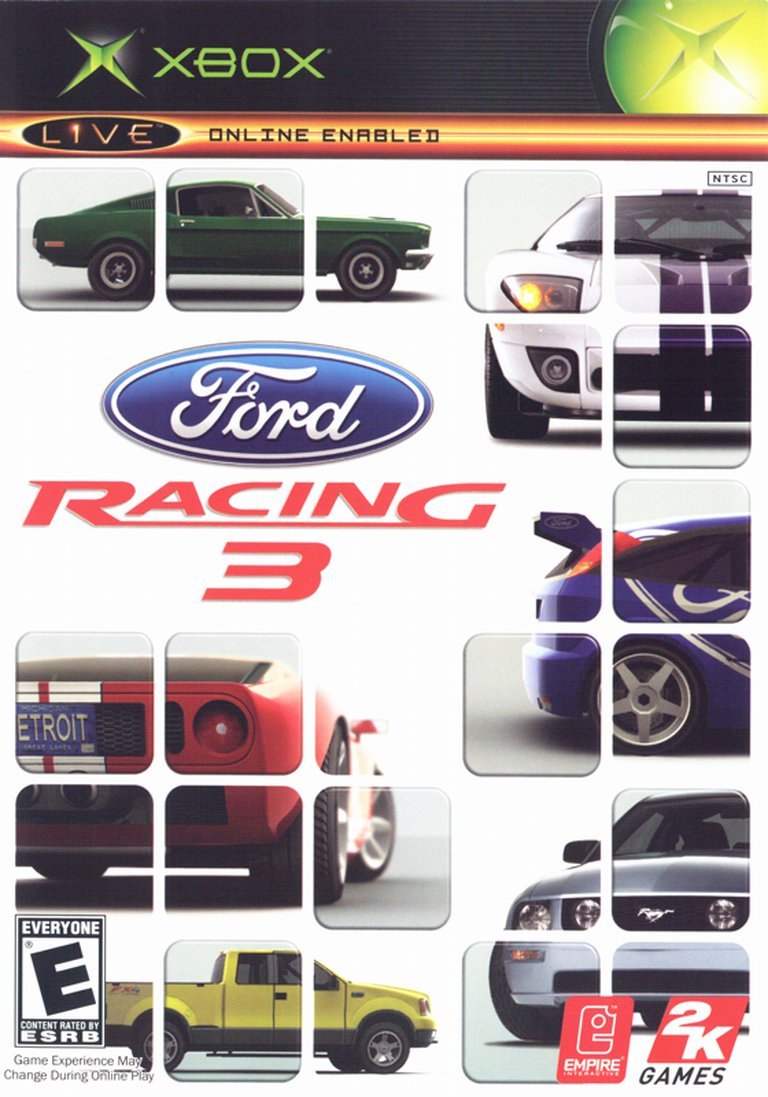
Description
Ford Racing 3 is the sequel to Ford Racing 2, a licensed racing game where players compete with 55 Ford models—including Mustangs, GTs, and trucks—unlocked by winning races. Set across 26 diverse tracks featuring environments like snow, mud, water, and mountain trails, the game offers two main modes: Ford Competition with 14 thematic cups and Ford Challenge with race types such as boost, relay, and elimination, along with multiplayer support for up to 6 players online or split-screen.
Gameplay Videos
Ford Racing 3 Free Download
Ford Racing 3 Cracks & Fixes
Ford Racing 3 Mods
Ford Racing 3 Reviews & Reception
metacritic.com (58/100): Despite the license and some interesting gameplay modes, Ford Racing 3 comes off feeling generic and far less distinct than the real-life vehicles the game attempts to capture.
ign.com (45/100): How many ways can you say mediocre?
Ford Racing 3 Cheats & Codes
PlayStation 2
| Code | Effect |
|---|---|
| L2, L1, R2, R1, X(2), Triangle, Square, Circle | Unlock all tracks |
| Circle, Square, Triangle, X(2), R1, R2, L1, L2 | Unlock all cars |
| 1R6A-WN5A-QVH31 | Master code must be enabled |
| AP8F-T1HH-TNRM3 | Master code must be enabled |
| 9YBT-B7AV-9NYUV | Infinite Boost |
| Q5E5-B39M-WRNJJ | Infinite Boost |
| UCAV-3BQ3-UA88N | Infinite Time |
| 02DJ-0E8U-W30AX | Infinite Time |
| 0EDA-3DTK-BURMG | Easy Drafting Challenges |
| GMN7-Y39Y-16P79 | Easy Drafting Challenges |
| F3V6-V4FN-ZC7RH | Competition Codes |
| KAGQ-WD9K-ZM6WD | Unlock Competitions |
| 4KTE-JPHT-M6ZT5 | Movie Car Chases |
| X4Q2-PGD2-WRZXJ | Movie Car Chases |
| 76A5-Q0WK-MEB9W | Off Road Ramblings |
| 3GET-WFM1-D2KT1 | Off Road Ramblings |
| 3H95-2K1A-M9UWU | A Classic Competition |
| RJW2-FFFA-54VH1 | A Classic Competition |
| 8194-020B-QG678 | Truck Trials |
| 08RX-P5U6-7P1VJ | Truck Trials |
| 04AP-JZPF-185WP | Special Vehicles Team |
| JPDH-6ZX3-351VH | Special Vehicles Team |
| D9RP-V8ER-X7MQ1 | Battle of the Coupes |
| 0DV1-1NA6-CEJKV | Battle of the Coupes |
| 1KYJ-V6Q1-PH7XN | Global Gears |
| W1T4-YZRT-PRTYX | Global Gears |
| Q8RC-WHVV-VWFNX | Focus Vs. GT |
| AP8H-9XV3-JP8X6 | Focus Vs. GT |
| 91Q0-XKDQ-7XTQE | Original Races |
| 6Y0G-8GT3-QBNQR | Original Races |
| 38VE-Y56J-AX2NR | Design Concepts |
| Z3U2-AVMA-RXUMY | Design Concepts |
| N5GD-RYP4-PPEM0 | Rally Vs. Trucks |
| U86M-5UPF-GM4K8 | Rally Vs. Trucks |
| 3H0Z-YB2E-DFMW9 | The Stock Car Circuit |
| 5Y1T-Q6UG-GEUXZ | The Stock Car Circuit |
| 5MCH-U7G0-ZX0AA | Size Matters |
| BV6M-78GN-9ZMYA | Size Matters |
| 4VAE-YKF2-EWXYV | The GT World |
| XGMJ-GEBD-V0Z5J | The GT World |
| 0H9M-575W-MR1GM | All Competitions |
| HW4A-7GEF-5Z7ZX | All Competitions |
| ZAMW-X2DW-VDQUP | All Competitions |
| 5VRK-D5ER-5H949 | Collection Codes |
| ZN6R-NPPU-7B9TK | Unlock Race Type |
| JB9E-91K0-74840 | Unlock Race Type |
| H6WM-B9W8-2KRDW | Standard Race |
| BN35-6BPD-CWPQ8 | Standard Race |
| 165U-BF9R-PTP5F | Boost |
| VZMU-U32X-AU90G | Boost |
| JDWB-RYPX-GXYEC | Elimination |
| VU99-U7FN-9C6MR | Elimination |
| 6RA7-J43W-6UC7B | Overtake |
| 3WZ4-0ZZZ-6WQYB | Overtake |
| A28U-C3K1-UE7E4 | Duel |
| 1ZGD-JJNU-3QB5E | Duel |
| XAAA-343Y-QWQED | Drafting |
| RH05-97A1-5DZZ4 | Drafting |
| B4QN-1CFH-DGM9M | Racing Line |
| EWF6-KT0Q-ZGZ6T | Racing Line |
| F44J-RQ6R-FMHVV | Relay |
| 09FX-N1Q6-FUP59 | Relay |
| KPF8-DYUW-AHT0N | Driving Skills |
| KE8G-VHQ9-5Z5UM | Driving Skills |
| ADX0-18PY-FW7BZ | Seconds Out |
| 6GBC-8P2Z-9612Y | Seconds Out |
| JGGH-R2Z8-X1MF9 | Time Attack |
| 6QQ0-TK5T-RN7PJ | Time Attack |
| 5DF0-G8MY-3ZP61 | All Race Types |
| 01NM-V38P-NKJWG | All Race Types |
| 3AYD-8YU6-CAAHG | All Race Types |
| BH14-U2W5-QH6ZN | All Track Themes |
| 499J-RBER-ZREZR | All Track Themes |
| FE1X-Z5V3-TAR65 | All Track Themes |
| T46T-RJR9-MZTJK | All Cars |
| X64C-57P5-1YJE7 | All Cars |
| WJ8A-18Q1-HDEER | All Cars |
| MY74-GXP2-3DPQ2 | Trophy Cabinet Codes |
| Q5PQ-DM4M-FD50R | All Ford Challenge Tokens |
| N9JA-DXDF-WUC85 | All Ford Challenge Tokens |
| E1KF-1QZK-QE9Z0 | All Ford Challenge Tokens |
| D4J6-ZRV7-FWH6B | All Ford Competition Cups |
| RWC9-V9TP-5C4KT | All Ford Competition Cups |
| ZPPM-VMJP-8WA84 | All Ford Competition Cups |
Game Boy Advance
| Code | Effect |
|---|---|
| 938827FF5532 | Master codes must be on |
| 4E211CE2C6E4 | Master codes must be on |
| B11FCB3D4BEA | Master codes must be on |
| 5E654DCD09A6 | 1 Lap Races |
| 6CAEF2A8A087 | Access All Competitions |
| 7CAEE7A9919F | Access All Race Types |
| C4F7970F7332 | Extra Top Speed |
| C6943002763E | Have 90 Points |
| 5C5B8AECC2E8 | Quick XLR8 |
| E532BF19B191 | Quick XLR8 |
| A132BF596B4D | Access All Models |
| A0BEB7E97353 | Access All Models |
| A33038586A41 | Access All Tracks |
| A2BC30E8725F | Access All Tracks |
| 82CD1AE656EA | Start On Lap #2 |
| 82FD5A2C5AEA | Start On Lap #2 |
Xbox
| Code | Effect |
|---|---|
| White, L, Black, R, A(2), Y, X, B | Unlock all tracks |
| B, X, Y, A(2), R, Black, L, White | Unlock all cars |
Ford Racing 3: The Quirky Relic of a Bygone Racing Era
Introduction: A Budget Title With a Cult Heart
In the crowded landscape of mid-2000s racing games, dominated by the cinematic thrills of Need for Speed and the meticulous simulation of Gran Turismo, Ford Racing 3 carved out a peculiar niche. Released in 2004/2005 as the third entry in Empire Interactive’s licensed series, it arrived not with a roar but with a budget-price tag and a singular, unwavering mission: to serve as a digital showroom for 55 Ford vehicles. This review will argue that Ford Racing 3 is a fascinating case study in constrained development, brand-driven design, and the art of the “good enough” game. It is neither a forgotten disaster nor a hidden masterpiece, but a deliberately modest arcade racer whose greatest strength—its vast, enthusiast-curated garage—was also the foundation of its most significant limitations. It represents a specific moment where a major automotive license was democratized into a no-frills package, offering a unique, if flawed, experience that has since gained a curious aura of nostalgic appreciation among a small but dedicated community.
Development History & Context: The Razorworks Formula
The Studio and the Vision
Ford Racing 3 was primarily developed by Razorworks, a UK-based studio with a clear specialization. Acquired by Empire Interactive in 2000, Razorworks had already cut its teeth on the first two Ford Racing titles (2000, 2003) and other racing projects like Total Immersion Racing (2002). Their established expertise lay not in pushing graphical or simulation boundaries, but in efficiently adapting a licensed vehicle roster into functional, accessible racing mechanics. The creative vision, led by designer Terry Watts (a series veteran), was straightforward: expand the garage, diversify the tracks and modes, and maintain the approachable, arcade-style handling that defined the series. There was no pretension to compete with Polyphony Digital or Criterion; the goal was to deliver a solid, varied, and affordable product for Ford enthusiasts and casual racers.
Technological Constraints and the 2004 Racing Landscape
The game was built on Razorworks’ own internal technology, refined from Ford Racing 2. In late 2004, this meant competing against the visual spectacle of Need for Speed: Underground 2 (with its tuning culture and neon-lit cityscapes) and the benchmark realism of Gran Turismo 4. Ford Racing 3‘s engine, while capable of a steady 60 FPS, was immediately noted for its “bieder” (plain) graphics, flat textures, and simplistic environmental models. The constraint was not just graphical, but design-oriented. The team’s resources were channeled into modeling 55 distinct Ford vehicles—from the 1908 Model T to the 2005 Mustang GT and Ford GT40—and creating 26 tracks across five environmental themes (Pacific Drive, Arctic Breeze, Colonial Run, Asuka Battle, Raceways). This focus on quantity and license fidelity over cutting-edge tech or sophisticated physics defined its aesthetic.
The publishing deal reflects the era’s regional complexities. Empire Interactive handled European distribution, while 2K Games (having recently been founded by Take-Two) took North American rights, leveraging its growing marketing muscle. The game’s budget-oriented positioning (initially $14.99-$19.99) was a key part of its identity, explicitly acknowledged in reviews as both a defense and a criticism.
Handheld Divergence
A unique aspect of Ford Racing 3‘s development was the parallel creation of Game Boy Advance and Nintendo DS ports by Visual Impact Productions (Belgium). These versions, released in late 2005, were forced to dramatically scale back content (26 cars on DS, ~25 on GBA) and alter perspectives due to hardware limits. The DS version used a dual-screen layout with a top-down 3D view and bottom-screen map, a clear adaptation to the system’s capabilities. This split development meant the “core” Ford Racing 3 experience existed in three significantly different forms.
Narrative & Thematic Deep Dive: The Collect-a-Thon as Story
Ford Racing 3 possesses no traditional narrative, plot, or characters. Its “story” is entirely systemic and embedded in its progression structure, which serves as a celebration of Ford’s automotive legacy.
The Ford Competition: Thematic Tournaments as Historical Journey
The primary single-player mode, Ford Competition, consists of 14 themed cups. These are not just difficulty tiers; they are curated exhibits of Ford history and specialization.
* Vintage & Classic Cups: These feel like a museum tour, pitting players in early Model T’s, Model A’s, and Thunderbirds against simple oval tracks and early road courses, evoking the dawn of motoring.
* Performance & Muscle Cups: Here, the focus shifts to American power—SVT Cobras, Mustangs of various eras, and the GT40—on faster, more technical circuits like those in the “Asuka Battle” (Japanese-inspired) and “Raceways” (speedway) categories.
* Modern & Off-Road Cups: These showcase the F-150, Escape, and Focus on rough, muddy “Pacific Drive” or snowy “Arctic Breeze” tracks, highlighting Ford’s versatility.
The Unlock as Narrative Payoff
The core narrative loop is the collection itself. The game’s thesis is simple: Ford built a remarkable range of vehicles; therefore, the player’s primary motivation is to experience that range by winning races. The dialogue is nonexistent, but the progression mechanic speaks volumes. Unlocking a 1968 Mustang Boss 429 after a hard-fought championship isn’t just a gameplay reward; it’s framed as acquiring a piece of Ford lore. The game’s manual and marketing explicitly tied the roster to Ford’s history, making the garage a interactive catalog. Even the inclusion of concepts like the Ford GT (pre-production) and movie cars (like the XXX film Mustang) reinforces this theme: Ford’s identity is built on imagination as much as production.
Underlying Theme: Democratized Enthusiasm
The underlying theme is the democratization of car culture. Unlike the elitist tone of Gran Turismo (with its “A-Spec” and “B-Spec” hierarchies) or the rebellious street-racing narrative of Need for Speed, Ford Racing 3 offers a blandly inclusive vision. There’s no protagonist, no villain, no underground scene. It’s just you, a vast selection of Fords, and a series of tracks. It appeals directly to the “Ford nut,” as Official U.S. PlayStation Magazine noted, positioning itself as a virtual showroom first and a racing game second. This lack of pretense is its most defining thematic statement.
Gameplay Mechanics & Systems: Arcade Accessibility Over All
Core Loops and Modes
The game is structured around two primary single-player frameworks:
1. Ford Competition: The 14-cup career mode. Each cup is a series of 3-6 races, often with specific vehicle class restrictions or race types (Elimination, Boost, Relay). Success earns trophies, unlocks new vehicles, and opens subsequent cups. This provides a clear, if repetitive, progression path.
2. Ford Challenge: A menu of 40+ standalone race events (4 per vehicle class x 3 difficulties). These are specific tasks: “Win a race in a Vintage car on Arctic Breeze,” “Overtake 20 cars in a single lap,” etc. Completing these is the main method to unlock the majority of the 55-car roster and all 26 tracks.
3. Ford Collection: A sandbox mode to create custom races using any unlocked car/track/conditions. This offers pure, sandbox play with no further unlocks, highlighting the game’s fundamental “toolkit” nature.
The “Ford Physics” Model: Arcade with a Quirk
The handling is pure, undiluted arcade. Acceleration is brisk, braking distances are short, and collisions are largely inconsequential (no damage model). This makes the game instantly accessible. However, the criticism from reviewers like IGN’s Douglass Perry (“steering radial tires on asphalt” vs. “nudging a boat on water”) and 4Players.de (“alle Boliden um eine Mittelachse gelenkt” – all cars steered around a central axis) points to the core flaw: a lack of tactile feedback. Vehicles, regardless of class (Vintage vs. Performance), have a similar, floaty, “planted-in-the-middle-of-the-road” feel. The distinction between a light, agile Focus RS and a heavy, lumbering F-150 is present in stats (top speed, acceleration) but rarely felt in the steering. The “Boost” mode (activated by following the ideal racing line, similar to FlatOut) is a nice arcade touch but doesn’t compensate for the underlying lack of weight or grip sensation.
Progression and Unlock Systems
The unlock system is generous but grindy. Starting with 3-4 basic cars, the player must win cups and complete challenges to reveal Ford’s full lineage. The two initial affordable cars—the 1923 Model T and 1931 Model A—are clever historical nods, but the path to the 2005 GT or SVT Cobra involves dozens of repeat races. This “collect-a-thon” is the game’s raison d’être but also its potential source of fatigue. The RPG-lite elements are minimal; there is no car tuning or performance upgrade system beyond selecting different factory models. Customization is purely cosmetic (color choices) or preset (choosing between stock and “racing” liveries for some cars).
User Interface and Presentation
The UI is functional and clear, reflecting the budget development. Menus are simple lists. The race HUD shows position, lap time, and a small minimap. The “Ford Competition” tree is easy to navigate. One praised feature, especially on Xbox, was custom soundtrack support, allowing players to replace the universally panned in-game rock tracks with their own MP3s—a critical quality-of-life feature for a 2005 racer.
Multiplayer
Multiplayer was a highlight for its time in a budget title.
* Console (PS2/Xbox): Split-screen for 2 players.
* Xbox: Supported Xbox Live for up to 6 players online—a significant selling point noted by TeamXbox and GameSpot, though server populations would have been sparse post-launch.
* PC: LAN play for 6 players.
* Handhelds: GBA via Link Cable, DS via local wireless (cartridge required for each player).
The online component, while rudimentary by today’s standards, was a legitimate value-add for a $15 game.
World-Building, Art & Sound: A Study in Contrasts
Visual Design: Functional Variety, Technical Poverty
The game’s world is split into five track categories, each with 5-6 unique layouts (often mirrored as reverse courses). This provides surface-level variety: you’ll race on sun-drenched Colonial Run (New England-style), the muddy Pacific Drive, the icy Arctic Breeze, the neon-drenched Asuka Battle, and sterile oval speedways (Raceways). The environments are conceptually diverse and sometimes feature minor互动 scenery (flags, crowds, water splashes). However, the execution is universally panned.
* Geometry and Textures: Models are low-polygon, textures are blurry and repetitive. Cars lack interior detail (most are “blank” cockpits). Tracks feel broad and empty.
* Effects: Lighting is basic. Rain or snow have minimal impact on visuals or, crucially, handling. The pop-in on GBA, as GameZone‘s “Code Cowboy” vividly described (“scenery comes and goes at random”), was a severe technical failing on handhelds.
* Frame Rate: The console versions maintain a stable 60 FPS, a technical achievement given the asset count, but this stability comes at the cost of visual fidelity.
The art direction has no identity. It’s not gritty like Burnout, not glamorous like Need for Speed, not realistic like Gran Turismo. It’s simply Ford—clean, corporate, and forgettable. As Official Xbox Magazine UK quipped, it has “not much in the way of glitz or glamour.”
Sound Design: The Achilles’ Heel
This is the game’s most universally maligned aspect.
* Music: Composed by Tim Follin (a legendary chiptune composer), Paul Stroud, and the group Muddy Funkers, the soundtrack is a looping series of generic, guitar-driven rock tracks. Critics consistently called it “cheesy,” “cock rock,” and “repetitive until your ears bleed” (GameSpy). Its only saving grace was the Xbox/PC custom soundtrack option.
* Sound Effects: The audio palette is exceptionally thin. Engine sounds are described as simplistic, often compared to “motorized scooters” or “generic drones,” and fail to differentiate the visceral roar of a V8 Mustang from the whine of a turbocharged Focus. Tire screeches are a single, reused sound effect regardless of surface (asphalt, mud, snow), shattering immersion. Collision noise is a dull thud. The sound design does zero work to enhance the distinct personalities of the 55 vehicles, a critical failure for a brand-centric game.
Reception & Legacy: The Definition of “Mixed”
Critical Reception at Launch
Ford Racing 3 holds a Metacritic score of 58 (Xbox), 50 (PS2), and 49 (DS), squarely in “mixed or average.” Reviews were polarized along philosophic lines.
* The “Budget Apologists” (TeamXbox 7.5/10, GameZone 6.5/10, Meristation 7/10): They acknowledged the technical shortcomings but praised the value proposition. The sheer number of cars (55), tracks (26), and modes (10+ race types including Boost, Elimination, Relay) was seen as generous for $15. The accessible physics and Xbox Live support were noted as positives. The thesis was: “It’s not great, but it’s good enough for the price.”
* The “Quality Purists” (IGN 4.5/10, PALGN 4/10, Joystick 3/10): They rejected the value argument. To them, poor graphics, floaty controls, weak AI (which made races too easy), repetitive sound, and a complete lack of atmosphere or style made it a failure regardless of cost. IGN’s Douglass Perry famously dismissed it with “Blech.”
* The “Ford Fans” (Official U.S. PlayStation Magazine 3/5): They conceded the game’s mediocrity but argued that for a “Ford nut,” the virtual showroom alone justified purchase.
The consensus was that it was a competent but soulless arcade racer. As GameSpot‘s Greg Mueller summarized: “It’s a passable choice for fans of arcade-style racing… but it’s ultimately a forgettable racing experience.” The DS version was particularly panned for its stiffer physics, ugly visuals, and lack of online play.
Commercial Performance
Sales figures are scarce but indicate modest success within its budget niche. VGChartz estimates suggest the PS2 version sold ~260,000 units worldwide. Its presence in cereal box promotions (as noted in MobyGames trivia) and subsequent low used-market prices ($3-$12) confirm its status as a widely distributed but low-prestige title. It was not a blockbuster, but it recouped its likely modest development cost.
Legacy and Influence
Ford Racing 3‘s legacy is twofold:
1. A Cul-de-Sac in the Licensed Racing Genre: It demonstrated the limits of a brand-centric approach without compelling gameplay or presentation. The series continued with Ford Mustang: The Legend Lives (2005) and Ford Street Racing (2006), but critical reception remained mixed to negative. The final mainline entry, Ford Racing Off Road (2008), which added Land Rovers, was critically panned. The series effectively died, proving that a license alone cannot sustain a franchise. It stands as a cautionary tale: content quantity cannot compensate for experiential quality.
2. A Cult Time Capsule: In the 2020s, a small, vocal community on forums and abandonware sites expresses genuine affection for the game. This nostalgia is not for its quality, but for its specificity—the unique roster of Fords, the simple joy of unlocking a GT40, the chill, low-stakes arcade racing. Its availability on abandonware sites (like My Abandonware) and the existence of community patches for modern hardware (noted in user comments) speaks to a persistent, niche attachment. It’s remembered as a perfectly adequate game to play with a friend on a split-screen, soundtrack replaced with your own music, focusing less on winning and more on tooling around in a Ford RS200 or a silly concept car.
Conclusion: A Verdict for the Ages
Ford Racing 3 is not a good game by any conventional critical metric. Its physics are imprecise, its sound design is abrasive, its graphics are dated, and its AI is pushover. Yet, to dismiss it entirely is to ignore the specific, almost academic value it holds.
It is the definitive artifact of a budget, license-driven racing game from the mid-2000s. It proves that with a authentic, extensive car list (55 vehicles spanning nearly a century), a multitude of race modes, and a low barrier to entry, a game can provide a functional, even occasionally fun, experience for a dedicated subset of players—those for whom the subject matter is the primary appeal. Its reception perfectly encapsulates the “value vs. quality” debate that defined budget gaming.
In the grand canon of racing games, Ford Racing 3 has no business competing with the titans. Its place is not among the greats but in the anthology of curious relics—a game that understood its audience (Ford enthusiasts on a budget) and served it with competent, if uninspired, mechanics. It is aInterestingly, it is perhaps the last game in its series to feel genuinely about Ford cars, rather than feeling like a generic racer with a Ford skin. In that sense, for all its flaws, it achieved its modest goal. It is, ultimately, a perfectly average game that does exactly what it set out to do: put you in a Ford, on a track, with minimal fuss. For that, in its own quiet, unassuming way, it earns a footnote in history—not as a classic, but as a clear, unambiguous case study in the economics and limitations of licensed game development.