
- Release Year: 2003
- Platforms: Macintosh, Windows
- Publisher: Kewlbox
- Developer: Blockdot, Inc.
- Genre: Educational, Reading, Typing, writing
- Game Mode: Single-player
- Gameplay: Puzzle, Typing
- Setting: Chicken Ranch
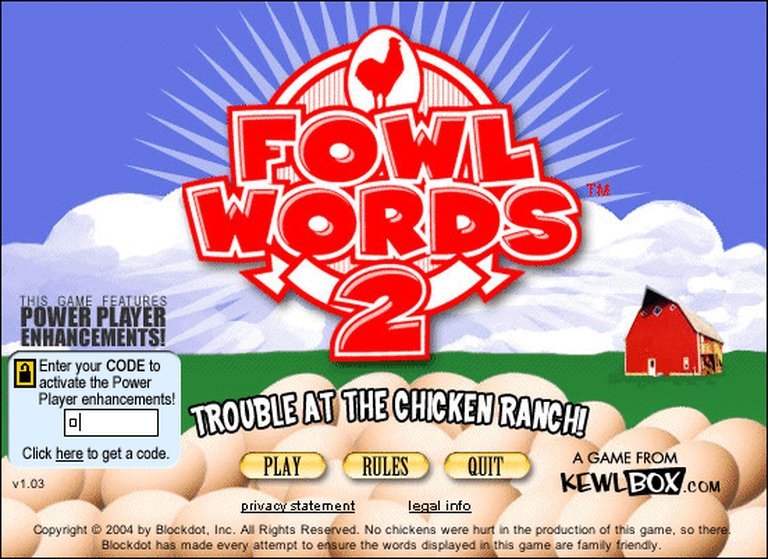
Description
Fowl Words 2: Trouble at the Chicken Ranch! is a 2003 educational word game developed by Blockdot, Inc. and set on a whimsical chicken ranch. Players must rapidly type words formed from grids of moving letter-eggs to save them from falling and breaking, with gameplay focusing on speed and accuracy. As rounds progress, the challenge intensifies with faster egg movements, longer word requirements, and bonus rounds where letters must be unscrambled before typing, blending typing practice with vocabulary building in a humorous farm-themed environment.
Gameplay Videos
Fowl Words 2: Trouble at the Chicken Ranch! Reviews & Reception
retro-replay.com : Fowl Words 2 delivers a focused, adrenaline-fueled test of your skills.
retrogek.com : this game offers a charming and engaging experience for word game enthusiasts.
Fowl Words 2: Trouble at the Chicken Ranch! Cheats & Codes
PC
Enter 985745 as a code.
| Code | Effect |
|---|---|
| 985745 |
Fowl Words 2: Trouble at the Chicken Ranch!: Review
Introduction: A Feathered Frenzy of Keystrokes
In the sprawling ecosystem of educational software from the early 2000s, a peculiar and charming sub-genre flourished: the typing tutor disguised as a frantic arcade game. From Mavis Beacon to TypeRacer, the core mandate was the same—improve words-per-minute (WPM)—but the packaging varied wildly. Into this arena charged Fowl Words 2: Trouble at the Chicken Ranch!, a 2003 shareware title from developers Blockdot, Inc. and publisher Kewlbox. As a direct sequel to Fowl Words: Farm Fresh Goodness, it represents a decisive and fascinating pivot: abandoning the “quick thinking” puzzle focus of its predecessor for a pure, unadulterated test of typing speed and reflex. This review will argue that while Fowl Words 2 is a narrowly focused and mechanically simple game, it is a masterclass in escalating tension and clear feedback within the constrained bounds of its educational genre. Its legacy is not one of critical acclaim or massive commercial success, but of a perfectly tuned instrument for a very specific skill—a digital metronome for the fingers that remains a compelling, if obscure, artifact of its time.
Development History & Context: The Niche of Blockdot
The studio behind the game, Blockdot, Inc., operated in a very specific pocket of the game industry in the early 2000s: the “serious games” and educational software market. This was an era before smartphone apps and widespread free online learning tools; educational software was often sold in big-box stores or via shareware downloads. Blockdot’s output, which includes other titles like Math Munchers Deluxe and Reader Rabbit adaptations (as seen in similar game lists), was aimed primarily at schools, parents, and children. Their expertise lay in taking core curriculum skills—math, reading, typing—and wrapping them in accessible, often whimsical, game shells.
Fowl Words 2 was released on December 5, 2003, for Windows and Macintosh, embodying the standard cross-platform strategy for educational titles of the period. Its business model was shareware, a tried-and-true distribution method where a limited version was freely distributable, with the full game unlocked upon purchase. This speaks to a target audience of cautious parents and educators trying before they buy. Technologically, the game was built for the era of Windows 98/ME/XP and Mac OS 9/early OS X, requiring nothing more than a keyboard and mouse—a stark contrast to the 3D accelerators becoming standard in mainstream gaming. The gaming landscape was split between the rising tide of console 3D epics (PS2, GameCube, Xbox) and a resilient PC market for simulation, strategy, and, notably, casual and educational titles. Fowl Words 2 existed firmly in the latter camp, competing directly with other typing software and word-based edutainment, carving out its identity with a unique, high-pressure theme.
Narrative & Thematic Deep Dive: The Absurd Peril of the Poultry
Do not mistake Fowl Words 2 for a narrative-driven experience; its story is a flavor-text thin veneer over the mechanical gameplay. Yet, within its constraints, it establishes a coherent and thematically resonant world. The premise is delivered with deadpan absurdity: a “chicken ranch” is in crisis. Its “prized eggs,” inexplicably containing letters that form words, are rolling off conveyors and careening toward destruction. The player is enlisted as an “Egg Saver Extraordinaire,” a hero whose sole power is rapid, accurate typing.
The theme is one of frantic rescue and slapstick peril. The eggs are not abstract data points; they are fragile, animated objects that “wobble comically” and “splat” with a “slapstick” sound upon failure. The ranch setting—with its “weathered fences, rolling hay bales, and the occasional curious hen peeking over a fence”—creates a rustic, pastoral atmosphere that contrasts humorously with the high-stakes, industrial-scale egg-moving machinery. The “ranch foreman” is an off-stage figure whose “training drills” (the bonus rounds) provide a thin narrative justification for the gameplay variance. There is no character development, no plot twists, and no dialogue trees. The story is told entirely through the game’s diegetic framing: the visual of eggs falling, the color-coding of rows suggesting different “lanes” on a production line, and the implication that your typing prowess is literally saving livestock (or at least, their future offspring). This minimalist approach is effective because it never interrupts the flow; the “narrative” is the player’s own rising tension and sense of responsibility for the doomed eggs.
Gameplay Mechanics & Systems: The Elegant Tyranny of Speed
Fowl Words 2 is a study in progressive, systemic difficulty. Its core loop is brutally simple: words (composed of letter-eggs) move from right to left across parallel rows. The player must type the word correctly to “save” it. Failure to type it before it exits the left side of the screen results in a “smashed” egg. The game is lost when 33 eggs are lost.
Where the design brilliance lies is in the parameters that scale across rounds:
1. Number of Words per Round: Starts at 6, increases.
2. Word Length: Progressively longer words.
3. Movement Speed: The baseline speed of all rows increases.
4. Row Speed Differential: A critical late-game twist where different rows move at significantly different speeds, forcing the player to constantly shift focus and prioritize based on urgency, not just word length.
5. The Loss Threshold (33 eggs): This creates a long-term resource management layer. A few early losses are recoverable, but a streak of misses in later rounds can trigger a rapid, cascading defeat.
The genius of this system is its clarity of cause and effect. Every player death is directly traceable to a failure of perceptual speed, finger dexterity, or vocabulary. There is no randomness or obscure enemy AI; the challenge is a pure, transparent metric of your own skill. The bonus rounds serve as a crucial mechanical and pacing variation. Here, scrambled letters are presented, requiring a brief moment of cognitive unscrambling before typing. This shifts the challenge from pure motor skill to a blend of lexical access speed and typing. Crucially, as the source notes, “smashed eggs don’t count against you” in these rounds, providing a pressure-release valve and a chance to recover from a bad streak. This also validates the player’s vocabulary knowledge, adding a secondary skill layer that prevents the game from becoming a mindless finger exercise.
The UI/feedback is impeccably tuned for its purpose. The remaining egg count (out of 33) is always visible. Each row is color-coded for instant tracking. The lettering on eggs is “crisp” and “bold,” ensuring legibility at high speeds. Success is met with a “poof of feathers and sparkles,” a powerful positive reinforcement. Failure is a “splat”—a clear, slightly humorous punishment that never feels overly punishing, encouraging another try. This creates a tight, addictive “one-more-round” loop.
World-Building, Art & Sound: Pastoral Panic
The game’s world is its most immediately charming and enduring feature. The visual direction is a bright, saturated cartoonish farmyard aesthetic. It avoids the generic “educational game” look by investing in specific, playful details: the aforementioned farm scenery, the expressive wobble of the eggs, and the varied animations for success and failure. This is not a sterile typing lab; it’s a rural cartoon in motion. The art style successfully lowers stress (it’s cute, not corporate) while maintaining absolute clarity. At no point can a player blame confusing graphics for a loss. The color-coding of rows is a functional masterpiece within this charming framework.
Sound design is likely minimalistic (a common trait of shareware titles), but the described audio-of “clucking chickens,” the “slapstick splat,” and presumably upbeat, non-intrusive background music—would complete the sensory package. The goal is to create a lively, bustling atmosphere that matches the frantic on-screen action without becoming distracting. The sound effects for actions (save, splat) are the primary audio feedback mechanisms, serving the same clear communicative purpose as the visual effects.
Together, the art and sound create a cohesive tone of good-natured urgency. The ranch is in peril, but it’s a funny, cartoon peril. This tonal balance is essential; it makes the high-pressure typing feel like a fun challenge rather than a stressful chore.
Reception & Legacy: The Quiet Specialist
Fowl Words 2 exists in a state of profound niche obscurity. Its MobyGames entry shows a “Moby Score” of “n/a” and an average user rating of 2.5/5 based on a single rating with zero written reviews. This is not a game that graced magazine covers or sparked internet debates. Its commercial impact was likely minimal, confined to the shareware distribution channels and perhaps bulk educational licensing.
Yet, within its specific category, its reputation as gleaned from retro-focused sites like Retro Replay and My Abandonware is respectful and positive. My Abandonware calls it an “above-average typing title in its time.” Retro Replay’s in-depth review (which provides the most detailed modern analysis) praises its “tightly focused, fast-paced typing challenge,” “compelling progression curve,” and excellent balance between “adrenaline and thoughtfulness.” These are not the accolades of a groundbreaking masterpiece, but of a highly competent, well-executed niche product.
Its influence on the industry is indirect. It did not spawn clones or redefine genres. Instead, it represents a peak of a specific design philosophy prevalent in early-2000s educational gaming: identify a single, valuable skill (typing speed/accuracy), create a game with a brutally simple core mechanic, and build a escalating, transparent difficulty curve around it. It stands as a contrast to more “gamey” typing titles that incorporated stories or RPG elements. Fowl Words 2 proves you can build a complete, satisfying game experience from almost nothing but a timing mechanic and a clear failure state. Its legacy is as a cult favorite among retro typing game enthusiasts and a perfect case study in minimalist, skill-based game design for a specific audience.
Conclusion: A Flawless Execution of a Limited Vision
Fowl Words 2: Trouble at the Chicken Ranch! is not a game that aspires to be The Elder Scrolls of typing. It aims to be a laser-focused, adrenaline-infused typing trainer, and on those terms, it succeeds admirably. Its mechanics are transparent, its difficulty curve is expertly graded, its feedback is immediate and satisfying, and its aesthetic is charmingly cohesive. The bonus rounds provide just enough cognitive variation to prevent repetitive strain, both physical and mental.
Its limitations are its defining features. The narrative is paper-thin. The replayability for a non-typing-enthusiast is low. Its technological footprint is small. But for the player seeking to benchmark or improve their WPM under pressure, or for the historian interested in the architecture of skill-based game design, Fowl Words 2 is a fascinating and surprisingly robust artifact. It is a testament to the idea that a game need not be complex to be deeply engaging; it need only be precise. In the barnyard of educational software, Fowl Words 2 is not the prize-winning show chicken, but it is the most reliable and speedy hen in the coop, efficiently laying a challenging, skill-building egg, day after day. It earns its place in history not as a landmark, but as a perfect specimen of a specialized craft.
Final Verdict: 7/10 — A brilliantly designed, narrowly focused typing game that executes its singular vision with charm and mechanical integrity. Its historical value lies in its pure, unadulterated translation of a real-world skill into a compelling digital challenge.