
- Release Year: 1997
- Platforms: DOS, Linux, Windows
- Publisher: Alternative Software Ltd., Gremlin Interactive Limited, Interplay Productions, Inc., Urbanscan Limited
- Developer: Cajji Software, Gremlin Interactive Limited
- Genre: Strategy, Tactics
- Perspective: Diagonal-down
- Game Mode: Single-player
- Gameplay: Base building, Business simulation, Combat, Diplomacy, Managerial, Real-time, Resource Management
- Setting: Futuristic, Sci-fi
- Average Score: 86/100
Description
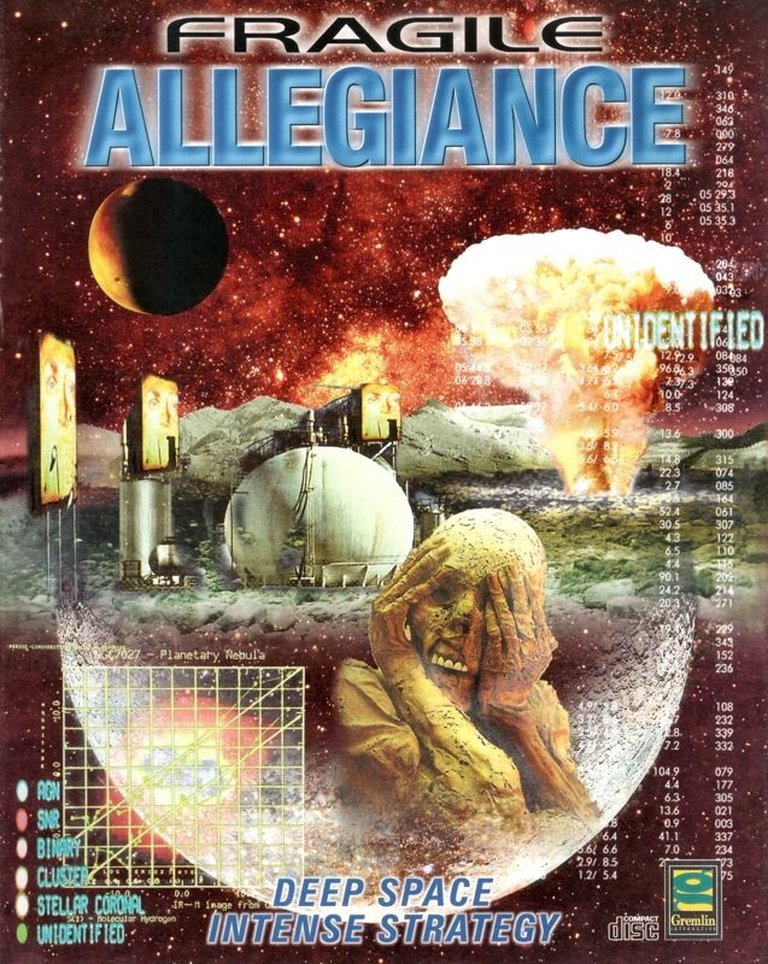
In ‘Fragile Allegiance’, you take on the role of a new employee of TetraCorp, tasked with colonizing and developing asteroids into thriving mining colonies. Starting with a single asteroid, you expand by colonizing nearby asteroids, mining precious ore, and selling it to the Federal Ore Transporter. As you progress, you must build massive fleets of warships to defend against the hostile Mauna race, while also negotiating treaties and alliances with other factions. The game combines real-time strategy with managerial simulation, set in a sci-fi universe where diplomacy, warfare, and resource management are key to survival.
Gameplay Videos
Where to Buy Fragile Allegiance
Fragile Allegiance Free Download
Fragile Allegiance Guides & Walkthroughs
Fragile Allegiance Reviews & Reception
metacritic.com (80/100): Great game especially for it’s age and having played K240 was keen to give this a go.
gamespot.com : Fragile Allegiance is a very tactical game, with colonies represented at the individual building level.
store.steampowered.com : Very Positive (93% of the 117 user reviews for this game are positive).
steambase.io (93/100): Fragile Allegiance has earned a Player Score of 93 / 100.
Fragile Allegiance Cheats & Codes
PC (American Version)
Start the game with the command line.
| Code | Effect |
|---|---|
| fragile /c.Osiris.fmsti | Extra money, all asteroids visible on the map, single day construction, all alien information, and all trade item descriptions. Game time may be set slower by pressing [Alt] + [F7] or faster by pressing [Alt] + [F8]. |
PC (European Version)
Start the game with the command line.
| Code | Effect |
|---|---|
| fragile /cKim.Jon.fmsti | Extra money, all asteroids visible on the map, single day construction, all alien information, and all trade item descriptions. Game time may be set slower by pressing [Alt] + [F7] or faster by pressing [Alt] + [F8]. |
Fragile Allegiance: A Deep Dive into a Forgotten Classic
Introduction
In the annals of real-time strategy (RTS) games, few titles have left as indelible a mark as Fragile Allegiance. Released in 1996 by Gremlin Interactive, this game is a unique blend of 4X (explore, expand, exploit, and exterminate) elements and real-time strategy, creating an engaging and multifaceted experience. Set in a distant future where humanity has ventured into the far reaches of space, Fragile Allegiance tasks players with managing resources, establishing colonies, and navigating the intricate web of interstellar diplomacy and conflict. This review aims to explore the game’s legacy, its innovative mechanics, and its place in the pantheon of strategy games.
Development History & Context
Fragile Allegiance was developed by Gremlin Interactive, a studio known for its innovative approach to game design. The game was essentially a remake of Gremlin’s 1994 Amiga game K240, with revamped graphics and user interface to take advantage of the improved PC hardware available at the time. The core gameplay elements of K240 were retained, including the setting in an asteroid belt, the Sci-Tek blueprint system replacing research, and the task of building up a successful mining operation.
The game was released in 1996 and competed against other empire-building titles such as Ascendancy and Master of Orion 2. It was marketed as an intense deep space real-time strategy game complete with complex face-to-face diplomacy. Notably, it was the first game to use Gremlin Interactive’s facial motion capture technology, which allowed for highly detailed and realistic-looking alien ambassadors, adding depth and atmosphere to the game’s diplomacy.
Narrative & Thematic Deep Dive
The narrative of Fragile Allegiance is set in the year 2496, where the player begins their employment with TetraCorp, a large interstellar megacorporation. The player is tasked with building up a successful mining operation to sell as much ore as possible to the Federation, a coalition of six of the seven known alien cultures. The seventh alien culture, the Mauna, are not members of the Federation and are revealed to be an untrustworthy and cruel species.
The game’s lore is meticulously crafted, with each faction having a detailed backstory that influences their interactions with the player. The human colonies, despite their technological advancements, face significant challenges from both natural hazards and hostile alien entities. This setting creates a sense of isolation and vulnerability, underscoring the importance of strategic alliances and careful planning.
Gameplay Mechanics & Systems
Fragile Allegiance successfully integrates 4X features into its real-time strategy framework. Players begin with a single asteroid base and must explore the surrounding asteroids to discover valuable resources and viable colony sites. Expansion involves establishing new colonies on asteroids, each requiring meticulous planning and resource management. Players must balance the extraction of minerals, production of food, and generation of energy to ensure the growth and sustainability of their colonies.
The economic model is detailed and demanding, requiring players to constantly adapt their strategies to maintain a thriving empire. Exploitation of resources is central to the gameplay, with players mining asteroids for minerals essential for building and upgrading structures, researching new technologies, and producing military units. The strategic placement of mines and factories significantly impacts a colony’s efficiency and productivity, adding depth to the resource management aspect.
Extermination, or military conquest, is a crucial element of Fragile Allegiance. The game features a variety of military units, from basic fighters to advanced warships, allowing players to defend their colonies or launch attacks against rivals. Combat is strategic and requires careful planning, as the loss of a battle can have severe consequences for the player’s empire.
World-Building, Art & Sound
The game’s setting is richly detailed, with a vast universe teeming with asteroid fields, habitable planets, and alien races. The visual direction is impressive for its time, with detailed and realistic-looking alien ambassadors and well-animated ships and buildings. The sound design, composed by Patrick Phelan, is equally noteworthy, with a relaxing and atmospheric soundtrack that enhances the game’s immersive experience.
Reception & Legacy
Fragile Allegiance was generally well received by reviewers, achieving average to good scores across the board. Its graphics and icon-based GUI drew a good deal of praise, and once the player works out the gameplay, the game was said to be engrossing and most enjoyable. The game was mostly criticized for its difficulty and the micromanagement required as the player’s empire grows, as well as its simplistic combat model and the amount of time required to transport ore.
Despite these criticisms, Fragile Allegiance has left a lasting legacy. It was praised for its innovative approach to the RTS genre, blending real-time strategy with 4X elements to create a unique and engaging experience. The game’s complex diplomacy system and detailed resource management mechanics have influenced subsequent games in the genre, making it a notable title in the history of strategy games.
Conclusion
Fragile Allegiance remains a unique and innovative title in the RTS genre, offering a rich and immersive experience. Its intricate gameplay mechanics, diverse factions, and dynamic plot ensure that each playthrough is unique and rewarding. Despite its age and some interface issues, it continues to be a game worth exploring for fans of space-based strategy games. Its legacy as a pioneering title in the blend of real-time strategy and 4X elements cements its place in video game history.