
- Release Year: 1998
- Platforms: Windows
- Publisher: TopWare Interactive Poland Sp. z o.o.
- Developer: P.P.H Maria SC
- Genre: Action
- Perspective: Side view
- Game Mode: Single-player
- Gameplay: Arcade, Platform
- Setting: Futuristic, Sci-fi
- Average Score: 68/100
Description
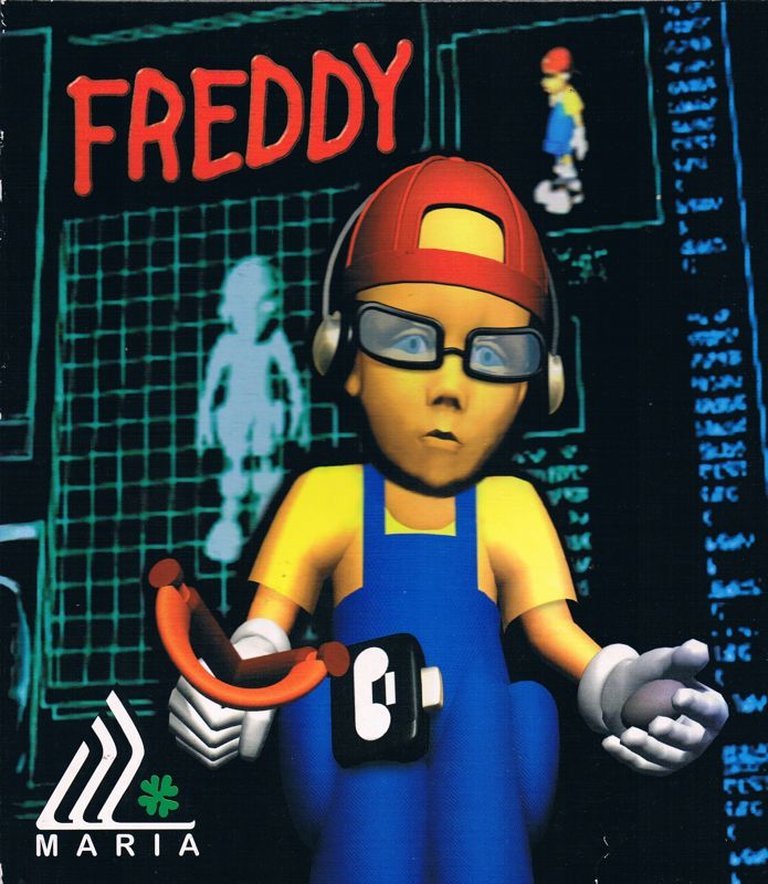
Freddy is a sci-fi platform game where a young boy accidentally shoots down an alien ship with his slingshot, causing him to be shrunk to ant size. To return to his normal size, he must find CD-ROMs to repair the ship while navigating 13 diverse levels—such as forests, caves, and space—filled with hostile creatures. The gameplay involves defeating enemies with kicks and weapons while collecting useful items like power boosters and a fan cap for flight.
Gameplay Videos
Where to Buy Freddy
PC
Freddy Reviews & Reception
imdb.com (80/100): Fazbear Entertainment hires an indie developer to make a series of point-and-click survival horror games based on the allegations against the company and makes a VR game based on it.
imdb.com (74/100): As a night guard, you must survive five nights as you are hunted by five animatronics hell-bent on killing you.
imdb.com (74/100): Do your best to complete your work as fast and as diligently as you can, but be careful. One wrong move at this job can lead to – unexpected consequences. It’ll be up to you to brave through the horrors to figure out the truth.
imdb.com (73/100): Freddy Fazbear’s Pizza is reopened with new versions of the animatronics and the same animatronics from the previous Freddy Fazbear’s Pizza restaurant.
imdb.com (73/100): Welcome to Circus Baby’s Pizza World, where family fun and interactivity go beyond anything you’ve seen at those *other* pizza places.
imdb.com (73/100): A new manager is hired at the brand new Freddy Fazbear’s Pizza Place.
imdb.com (73/100): Welcome to the ultimate FNaF mashup, featuring 50 selectable characters and custom difficulties.
imdb.com (73/100): Ruin follows a girl named Cassie as she breaks into abandoned and disheveled Freddy Fazbears Mega Pizzaplex in an attempt to save her friend Gregory who somehow got stuck there. She tries to save him but meets some unlikely friends, and enemies, along the way.
imdb.com (73/100): A technician from Fazbear Entertainment is sent to an abandoned workshop to retrieve the schematics of a prototype revolutionary endoskeleton, which hunts him around the place.
imdb.com (71/100): A young boy has nightmares about the Freddy Fazbear’s Pizza animatronics.
imdb.com (65/100): A horror attraction based on Freddy Fazbear’s pizza is opened. The attraction now has one animatr
Freddy: Review
Introduction
In the shadowed corridors of modern horror gaming, few franchises have cast as long or as unsettling a silhouette as Five Nights at Freddy’s. Born from Scott Cawthon’s digital nightmares in 2014, this series transcended mere gaming to become a multimedia phenomenon—a labyrinth of lore, terror, and tragedy that redefined indie horror. Its legacy lies not just in jump scares, but in its intricate, soul-crushing narrative about possession, familial ruin, and the persistence of evil. This review delves into the franchise’s evolution, dissecting its narrative depth, mechanical innovations, and cultural impact, arguing that Freddy is less a collection of games and more a grim chronicle of humanity’s darkest impulses trapped within robotic shells.
Development History & Context
The saga began with a twist of irony. Cawthon’s earlier family-friendly game, Chipper & Sons Lumber Co., was criticized for its characters’ resemblance to “scary animatronic animals.” Instead of abandoning this feedback, Cawthon pivoted, crafting Five Nights at Freddy’s (2014) as an intentional horror experiment. Developed in Clickteam Fusion 2.5 with Autodesk 3ds Max for visuals, the game exploded on Steam and Desura after being Greenlit, fueled by Let’s Play pioneers like PewDiePie. Its success birthed a record-breaking spree of sequels—seven mainline titles by 2017—cementing FNAF as a template for rapid-fire, lore-rich expansions.
Post-2019, Cawthon partnered with Steel Wool Studios, shifting to Unreal Engine 5 for Security Breach (2021) and VR-focused projects like Help Wanted (2019). This evolution mirrored the franchise’s growth from pixelated static shocks to expansive, immersive nightmares. Yet, amid technical leaps, Cawthon’s retirement in 2021—amidst political controversy—handed the torch to collaborators, ensuring the franchise’s mythos endured through films, novels, and a dedicated fan universe.
Narrative & Thematic Deep Dive
FNAF’s narrative is a tapestry woven from tragedy, obsession, and supernatural vengeance. At its core is William Afton, a “loving, obsessive father” (as theorized by MatPat) who descends into madness after his son’s death in the “Bite of ’83.” This incident—where a child’s skull was crushed by Fredbear’s jaw—ignites a chain of horrors: Afton murders children, stuffing their corpses into animatronics, their souls binding to the machines as “Remnant.”
The franchise’s emotional weight springs from its child victims. Charlotte Emily, Henry’s daughter, becomes the Puppet, a spectral guardian who binds other lost souls to animatronic suits. Elizabeth, Afton’s daughter, is consumed by Circus Baby, her ghost fueling a cycle of abduction. The narrative’s spine is Afton’s immortality quest—achieved via springlock suits that kill him but bind his soul to Springtrap—and his son Michael’s desperate attempts to atone by hunting his father.
Themes of abandonment and innocence lost permeate the lore. In Sister Location (2016), Michael infiltrates a facility where animatronics “harvest” children, only to be betrayed by the souls he sought to free. The original game’s ambiguity—via minigames and cryptic phone calls—invites players to piece together the tragedy, blurring lines between victim and villain. As Henry’s final monologue in Pizzeria Simulator (2017) declares, the franchise is a “labyrinth of sound and smells” where “the memory of everything that started this can finally begin to fade away.”
Gameplay Mechanics & Systems
FNAF’s gameplay is a masterclass in minimalist terror, built around resource scarcity and psychological dread. The original game tasks players with monitoring cameras and managing power to survive animatronics’ nightly hunts—a loop refined across sequels. FNAF 2 introduced Toy animatronics and a music box mechanic, demanding constant multitasking. Sister Location shattered the formula with room-to-room navigation and task-based puzzles, while Security Breach offered free-roam exploration in a Mega Pizzaplex, albeit with a flawed save system.
Innovations like the VR in Help Wanted deepened immersion, letting players physically dodge Springtrap or wind the Puppet’s music box. Yet, mechanics often clashed with narrative: FNAF 4’s bedroom defense felt disjointed from its emotional core, and Ultimate Custom Night (2018) leaned into chaotic customization over storytelling. The UI evolved from static screens to Gregory’s watch in Security Breach, but technical hiccups—like clunky controls in non-VR ports—marred otherwise innovative designs. Ultimately, FNAF’s enduring appeal lies in its “less-is-more” philosophy, where tension thrives in anticipation, not action.
World-Building, Art & Sound
FNAF’s universe is a character in itself, built on decay and dread. Settings like the decaying Fredbear’s Family Diner or the sterile, soulless Mega Pizzaplex reflect the franchise’s thematic obsession with childhood corruption. Art direction shifts from pixelated animatronics in early games to hyper-detailed models in Security Breach, yet the core aesthetic—grotesque mascots juxtaposed with childish charm—remains haunting. Springtrap’s mummified frame or Circus Baby’s uncanny valley design embodies the series’ blend of innocence and horror.
Sound design amplifies unease. The static-laced phone calls in the original game, the distorted lullabies of Sister Location, and the industrial thuds of Security Breach’s Pizzaplex create auditory dread. Help Wanted leveraged 3D audio to disorient, while FNAF 3’s phantom animatronics used silence as a weapon. Yet, the franchise’s most iconic audio cue—the screeching of Foxy or the distorted “It’s me” of Golden Freddy—transcends games, embedding itself in meme culture. This auditory landscape, paired with environments that feel like haunted dioramas, ensures FNAF’s world is as oppressive as it is memorable.
Reception & Legacy
FNAF’s reception mirrors its narrative: a mix of acclaim and contention. The original game earned a 78 Metacritic score, hailed for its “less-is-more” horror (PC Gamer), though critics noted repetitive gameplay. Subsequent entries divided audiences: Sister Location’s ambitious tasks were praised, while FNAF 4’s difficult minigames drew ire. Help Wanted revitalized the franchise with VR (Metacritic: 80), but non-VR ports were criticized for losing immersion. Commercially, FNAF is a juggernaut, with merchandise, novels, and two films—grossing nearly $300 million—expanding its reach.
Culturally, FNAF reshaped horror gaming. It sparked a fan-theory renaissance, with channels like The Game Theorists amassing 800M+ views dissecting its lore. Its mechanics inspired thousands of fan games, leading Game Jolt to create an “FNAF” genre. The franchise also influenced media beyond gaming, from Funko Pop figures to a Universal Studios haunted house. Yet, its legacy is blemished by overproliferation—spin-offs like FNaF World (2016) diluted its impact—and mixed critical consensus for later entries like Security Breach (Metacritic: 64). Still, FNAF remains a touchstone for indie horror, proving that the deepest fears often lurk in the simplest mechanics.
Conclusion
Five Nights at Freddy’s is more than a game series; it’s a sprawling gothic epic etched in silicon and sorrow. From Afton’s descent to the Puppet’s vigil, its narrative weaves tragedy into every animatronic seam. While mechanical inconsistencies and uneven pacing hinder its execution, the franchise’s genius lies in its atmosphere—where flickering cameras and distorted lullabies evoke more terror than graphic violence. Its legacy as a cultural force is undeniable, revitalizing indie horror and birthing a universe that’s as debated as it is beloved. In the end, FNAF’s true horror isn’t the machines—it’s the echoes of lost innocence, a reminder that some nightmares refuse to fade. Verdict: An essential, if flawed, cornerstone of gaming’s dark arts.