
- Release Year: 2016
- Platforms: Linux, Macintosh, Windows
- Publisher: Forever Entertainment S. A.
- Developer: Forever Entertainment S. A.
- Genre: Action, Anime, Manga, Music, rhythm
- Perspective: Fixed / flip-screen
- Game Mode: Single-player
- Gameplay: Music, rhythm
- Average Score: 70/100
Description
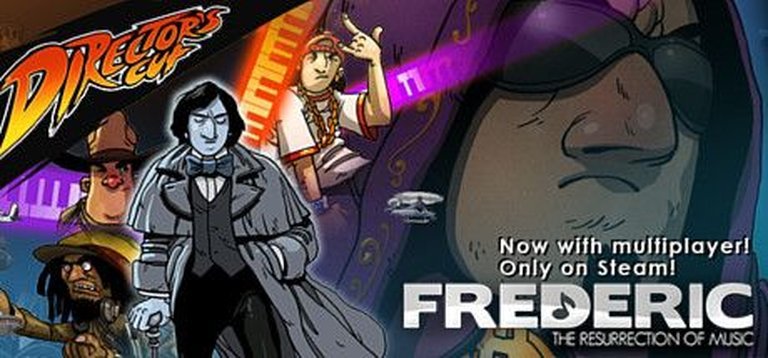
Frederic: The Resurrection of Music – Director’s Cut is an action-rhythm game where legendary composer Frederic Chopin returns from the grave to battle pop stars in intense musical duels. Set in a world corrupted by commercialization, Chopin fights against pop icons lured by profits, facing them in rhythm-based combat across new levels and exclusive online multiplayer modes in this enhanced Director’s Cut edition.
Gameplay Videos
Where to Buy Frederic: The Resurrection of Music – Director’s Cut
PC
Frederic: The Resurrection of Music – Director’s Cut Guides & Walkthroughs
Frederic: The Resurrection of Music – Director’s Cut Reviews & Reception
metacritic.com (70/100): then do yourself a favour and check this one out. It’s right up there.
Frederic: The Resurrection of Music – Director’s Cut: Review
Introduction
Imagine a world where the ghost of Frederic Chopin wages musical warfare against pop stars fueled by corporate greed. This is the audacious premise of Frederic: The Resurrection of Music – Director’s Cut, a rhythm-action game that resurrects the 19th-century composer to battle the soulless commercialization of modern music. As a cult-classic remastered for the digital age, this 2016 release represents a bold fusion of classical heritage and contemporary satire. Its legacy lies in its ability to transform historical reverence into irreverent, high-energy gameplay. This review argues that despite its niche premise, Director’s Cut delivers a meticulously crafted, harmonious experience that masterfully blends technical rhythm gameplay with thematic depth, cementing its status as an unsung gem in indie gaming.
Development History & Context
Frederic emerged from Polish studio Forever Entertainment S.A., a developer known for remastering retro titles and producing quirky indie projects. The original Frederic: The Resurrection of Music (2012) debuted on mobile and PS Vita, but Director’s Cut (2016) marked its definitive arrival on PC and Linux platforms. The team’s vision was ambitious: to educate and entertain by recontextualizing Chopin’s compositions through modern remixes, while lampooning the music industry’s commercial excesses. Technologically, the game was optimized for Windows 8 touchscreens, reflecting the era’s push for hybrid input methods—a forward-thinking choice that also accommodated traditional keyboard controls. The 2016 gaming landscape was dominated by AAA blockbusters, but indie titles like Inside and Ori and the Blind Forest proved that smaller studios could innovate. Frederic carved its niche by targeting rhythm-game enthusiasts and classical music novices alike, leveraging Steam’s burgeoning multiplayer infrastructure to add competitive duels absent in its earlier versions.
Narrative & Thematic Deep Dive
The narrative unfolds through an hour-long hand-drawn animated comic, where Chopin is resurrected to confront a dystopian music industry. His journey pits him against caricatured pop icons—like the Bollywood diva or the Jamaican dancehall star—who represent the homogenization of art. Dialogue is peppered with wry cultural critiques; when Chopin battles a “soulless pop star,” he quips, “Your music has more auto-tune than emotion!” This satire extends to broader themes: capitalism’s erosion of creativity, the resurrection of classical art in digital spaces, and the absurdity of commercializing cultural legacy. The story’s strength lies in its balance of historical reverence and playful anachronism—Chopin wields a piano as a weapon, his polonias remixed into reggae beats. While the plot is intentionally thin, it functions as a satirical vehicle for its core message: true artistry thrives beyond profit-driven machinery.
Gameplay Mechanics & Systems
Frederic’s core loop is a rhythmic duel system where players press seven piano keys (four white, three black) in sync with remixes of Chopin’s masterpieces. Combat is deceptively simple: pressing keys as notes fly down the screen builds a “combo meter,” with successful sequences damaging opponents. Three difficulty tiers—Chopin (easy), Normal, and Expert—cater to newcomers and virtuosos, though Expert’s punishing precision demands near-flawless execution. Key rebindings (default: ASDF/white keys, WER/black keys) accommodate diverse player preferences, while Steam-exclusive online multiplayer lets players challenge others globally in competitive duels. The UI is minimalist yet effective, with vibrant stage backdrops that shift dynamically during battles. However, the game’s pacing can feel uneven; some levels feature sparse note streams, followed by overwhelming barrages—a design choice that tests adaptability. Achievement hunters can pursue 25 Steam achievements, including “Saviour of Humankind” (beating Expert) and “Around the World” (winning in all multiplayer locations), adding replay value beyond the story.
World-Building, Art & Sound
Director’s Cut’s world is a vibrant, globetrotting tapestry of 10 locales—Paris, Jamaica, Bollywood, and the new additions of Stambul and Bollywood—each bursting with cultural motifs and hidden gags. Backgrounds are rich with easter eggs: a Paris stage features a caricature of Napoleon, while a Jamaican scene includes a reggae-version of Chopin’s “Minute Waltz.” The hand-drawn art style, reminiscent of anime/manga, emphasizes expressiveness; characters’ exaggerated expressions heighten the game’s comedic tone. Sound design is the star: 12 genre-bending remixes transform Chopin’s “Revolutionary Étude” into dubstep or “Fantasie-Impromptu” into Bollywood bhangra. These arrangements retain the composer’s melodic essence while infusing contemporary energy, creating an unexpected synergy. The inclusion of a DRM-free soundtrack underscores Forever Entertainment’s commitment to musical appreciation, making Frederic as much an auditory experience as a playable one.
Reception & Legacy
At launch, Director’s Cut earned a “Very Positive” Steam rating (83% based on 244 reviews), with critics praising its “megatons of humor” and “colorful art direction” (Kotaku). SlideToPlay lauded it as “impossible not to recommend,” while Rolling Stone highlighted its “sly digs at pop culture.” Commercially, it sold an estimated 17,000 units, aided by its budget-friendly price point ($5.99) and cross-platform availability. Player feedback was polarized: some adored the “beautiful pieces of music” and “quirky story,” while others criticized uneven difficulty spikes. Over time, its reputation has solidified as a cult favorite, celebrated for its niche appeal and innovative genre fusion. It spawned sequels (Frederic: Evil Strikes Back, Fred3ric) and influenced rhythm games by blending classical music with modern mechanics. Its legacy lies in proving that historical figures can thrive in interactive satire, paving the way for titles like Cadence of Hyrule that similarly merge art with gameplay.
Conclusion
Frederic: The Resurrection of Music – Director’s Cut is a masterclass in marrying technical rhythm gameplay with thematic satire. Its charming narrative, stunning remixes, and competitive multiplayer elevate it beyond a simple rhythm title, offering a poignant commentary on art and commerce. While its steep Expert difficulty and niche premise may alienate some, its humor and heart resonate universally. As a historical artifact, it immortalizes Chopin not as a relic, but as a rebellious spirit battling the commercial forces that threaten artistic purity. For players seeking a game where classical music meets irreverent fun, Director’s Cut is not just a recommendation—it’s a resurrection worth experiencing.