
- Release Year: 2003
- Platforms: Windows
- Publisher: Global Star Software Inc.
- Developer: AI Factory Limited
- Genre: Pool, Snooker, Sports
- Perspective: 1st-person
- Game Mode: Hotseat, Single-player
- Gameplay: AI opponents, Hints and tips
- Average Score: 65/100
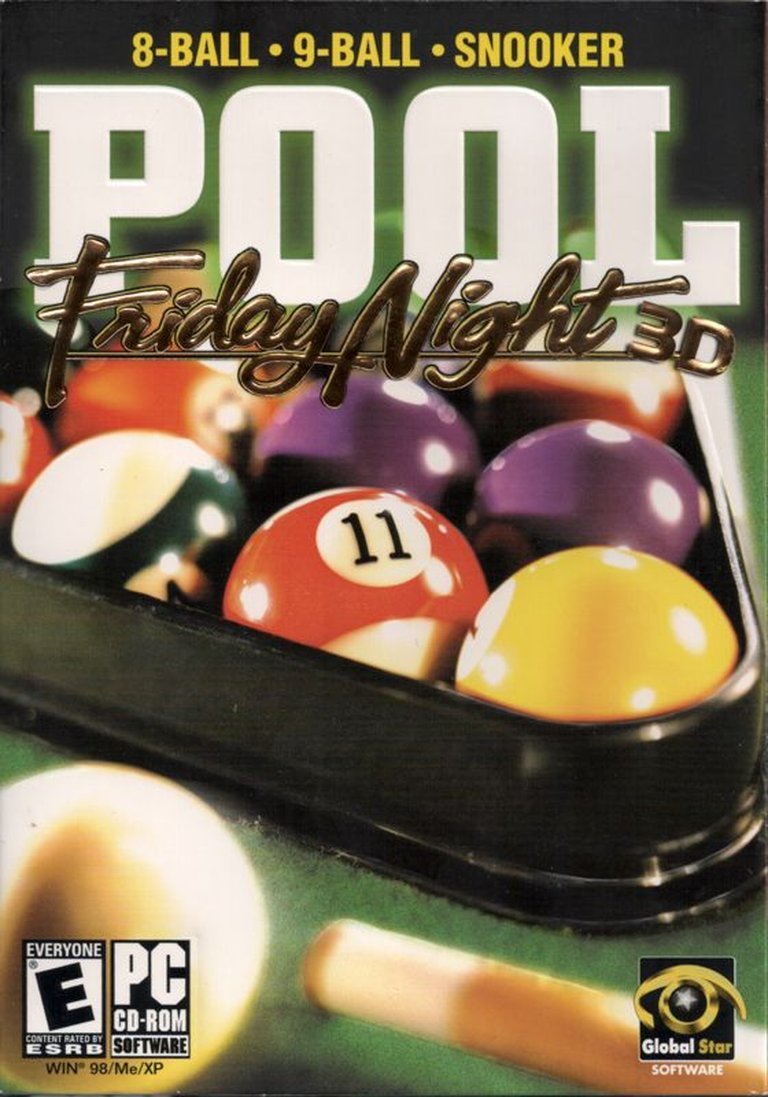
Description
Friday Night 3D Pool is a first-person sports game that simulates the excitement of pool and snooker in a realistic 3D environment. Players compete against over 77 computer opponents, each with unique playing styles and skill levels, and can utilize detailed in-game hints and tips to enhance their gameplay. Designed for 1-2 players on Windows, it offers an immersive and competitive billiards experience.
Friday Night 3D Pool Cracks & Fixes
Friday Night 3D Pool Patches & Updates
Friday Night 3D Pool Reviews & Reception
metacritic.com (65/100): A budget-priced affair that in many ways looks prettier than anything prior to it but generally sticks to the basics and isn’t immune to odd design choices and marginally flawed physics.
retro-replay.com : Friday Night 3D Pool delivers an immersive billiards experience right in your living room, capturing the tension of that crucial break in full detail.
Friday Night 3D Pool: A Deep Dive into a Niche Navigators’ Sim
Introduction: The Quiet Click of a Forgotten Cue
In the vast and varied canon of sports video games, certain titles achieve mythic status—the Tiger Woods or Madden of their genres. Others, however, occupy a more modest, almost subterranean stratum of gaming history. Friday Night 3D Pool (2003), developed by AI Factory Limited and published by Global Star Software, is one such title. It arrived not with a splash, but with the quiet, precise click of a well-struck cue ball, destined for the bargain bins and the memories of a select few cue-sports devotees. This review argues that while Friday Night 3D Pool represents a technically competent and ambitiously featured entry in the early-2000s pool simulation space, its ultimate legacy is one of a capable but transient title. It excelled in creating a robust, single-player career structure within a genre often focused on multiplayer, yet it was inevitably overshadowed by more polished contemporaries and the rapid evolution of 3D graphics, consigning it to a fascinating but minor footnote in the history of virtual billiards.
Development History & Context: A Budget Studio’s Precision Play
The Studio and the Vision: AI Factory Limited, a UK-based developer, was not a household name but had carved a niche for itself in the early 2000s with a series of competent, budget-priced sports and puzzle titles. Their portfolio, as seen in the MobyGames credits, includes Friday Night 3D Darts and Austin Powers Pinball, revealing a strategy of leveraging recognizable IPs (Austin Powers) or timeless pub game concepts (Darts, Pool) for a cost-conscious market. Friday Night 3D Pool was their flagship bid in the competitive pool sim arena. The director of product development, Jeff Quinn, and producer Heidi Amsler, guided a small team (10 credited) focused on delivering a feature-rich experience without the AAA budget. The writer, Sasha Gajic, suggests a nominal attempt at framing the experience, though as we will explore, the “narrative” was largely systemic.
Technological Constraints and the 2003 Landscape: Released in October 2003 for Windows (CD-ROM/DVD-ROM), the game was a product of its transitional technological moment. DirectX 8/9-era 3D acceleration was standard, allowing for genuine 3D tables and environments—a significant step from the 2D sprite-based predecessors like Sharkey’s 3D Pool (1989). However, it competed against established giants. Virtual Pool 3 (2000) had already set a high bar for physics and realism, while Midnight Pool (2002) offered a more arcadey, accessible style. Friday Night 3D Pool’s positioning, as noted in its Metacritic summary, was as a “budget-priced affair” that “looks prettier than anything prior to it but generally sticks to the basics.” This describes a game built on the reliable, if unspectacular, middleware or in-house engines of the time, prioritizing solid core mechanics over graphical groundbreaking. Its first-person perspective was a logical choice for immersion but was also the standard for the genre.
Publishing and Market Position: Publisher Global Star Software was known for value-oriented titles, often re-releases or games targeting the “casual” or “budget” shelf. This context is crucial. Friday Night 3D Pool was not aiming to dethrone Virtual Pool; it was aiming to provide a satisfying, full-featured pool experience for the price of a movie ticket. The inclusion of “over 77 different computer opponents” was its primary marketing hook and a key differentiator in a market where AI was often an afterthought.
Narrative & Thematic Deep Dive: The Journey is the story
Friday Night 3D Pool contains no traditional plot, no cutscenes with dialogue, and no named protagonist. Yet, it constructs a powerful, if minimalist, experiential narrative entirely through its gameplay systems—a thematic focus on progression, mastery, and the solitary pursuit of perfection.
The Career Ladder as a Narrative Arc: The game’s true “story” is the player’s ascent from a local bar hall to national tournament glory. This is not merely a menu selection but a structured, thematic journey. You begin in “basement” or local league settings, facing generic, lower-skill opponents. Each tournament victory is a narrative beat: you are “rising through the rankings.” The environments change—from smoky pubs to brighter, more formal tournament halls—visually communicating your progress. The “final bank shot” mentioned in the ad copy is the culminating moment of this systemic story.
The 77 Opponents: A Cast of Rivals: The claim of 77 unique opponents is the game’s most significant narrative device. They are not characters with names and backstories (with the possible exception of a few “champion” archetypes), but they are personalities defined by their AI styles. As Retro Replay observes, you face “defensive tacticians,” “aggressive potters,” and “tactical strategists.” This creates a dynamic, emergent rivalry. Defeating a tricky, spin-heavy opponent feels like overcoming a specific narrative obstacle. The opponent roster transforms the abstract concept of “AI difficulty” into a tangible cast of challengers you must learn to read and defeat. It’s the “Rival” system from fighting games applied to pool, creating personal mini-narratives with every match.
Themes of Authenticity and Craft: The game’s title, Friday Night 3D Pool, evokes a specific, relatable cultural touchstone: the weekly gathering at the local pool hall. The game’s stated goal is to “Bring home the real excitement of Pool and Snooker!” This speaks to a core theme: authenticity as体验 (experience). It’s not about telling a story about pool; it’s about simulating the feeling of pool—the tension of the break, the precision of a safety shot, the satisfaction of a run-out. The in-game “hints and tips” system is not just a tutorial but a thematic element, positioning the game as a mentor, a knowledgeable friend helping you “amaze your opponents with skill and precision.” The theme is thus one of craftsmanship and quiet competition, a stark contrast to the bombast of many contemporary sports titles.
Gameplay Mechanics & Systems: The Physics of a Niche
Core Gameplay Loop: At its heart, the game is a first-person pool/snooker simulator. The loop is simple: choose game mode (8-ball, 9-ball, Snooker, etc.), select opponent and venue, execute shots by aiming (likely with mouse/keyboard), applying power and spin, and watching the physics play out. The cycle of match, result, and progression to the next tournament forms the compelling core.
The AI System: Strength and Flaw: The 77-opponent system is the game’s defining mechanical feature. Each AI has a “unique playing style and skill level.” This suggests a parameterized AI with sliders for aggression, safety play, shot difficulty, and accuracy. The strength here is variety and replayability. No two matches against different opponents feel identical. However, the Metacritic critic review from GameSpot notes “marginally flawed physics.” This is a critical point. In a simulation genre where the fidelity of ball-to-ball collision, cloth friction, and spin response is paramount, even minor inconsistencies break the immersion and strategic depth. A flawed physics model undermines the entire premise of “skill and precision,” making shot outcomes feel unpredictable in a frustrating,而非真实 (unreal) way. The AI’s “unique styles” may also be shallow masks for a core set of behaviors that the flawed physics exacerbates.
Progression and Customization: The career mode provides the progression structure. The mention of moving from “playing in your basement all the way to competing in professional tournaments” implies a ranking or currency system. Customization options for “cues and tables” are also listed, a standard feature that adds superficial personalization but, in a budget title, likely involves a limited set of aesthetic swaps without performance modifiers.
User Interface and Controls: The game is described as having a “simple interface.” This is a double-edged sword. For accessibility, it’s a virtue. For hardcore sim fans seeking granular control over cue elevation, English application, and shot preview, it may feel rudimentary. The support for “Keyboard, Mouse” indicates the primary control scheme, likely a mouse-driven cue with keyboard modifiers for spin and power—common and functional for the era.
Innovation vs. Convention: Friday Night 3D Pool was not innovative in a groundbreaking sense. Its innovation was in feature consolidation for the budget space: packaging a large AI roster, multiple game variants (pool and snooker), a career mode, and competent 3D graphics into a single, affordable package. It was a value proposition first and a technological pioneer second.
World-Building, Art & Sound: Crafting the Hall’s Atmosphere
Visual Direction and 3D Environments: The Metacritic summary mentions “three unique 3D environments.” Retro Replay expands on this, describing “sleek modern hall” and “intimate pub setting” with details like “neon signs flickering” and “gentle hum of spectators.” This is where the game’s “prettier than anything prior” claim holds water. For a budget title, the attention to environmental detail—wood grain on rails, cloth textures, lighting—would have been noteworthy. The first-person perspective is fully realized, with camera switches between overhead and “close-up follow shots.” This visual diversity in venues is a subtle but effective world-building tool, making the career progression feel spatially real. The graphics, while not cutting-edge by 2003’s high-end standards, were likely clean, well-textured, and functionally immersive.
Sound Design and Audio Palette: The sources are light on audio specifics, but we can infer a standard design. The “crisp click of balls colliding” is a non-negotiable requirement for any pool sim. The “crowd ambiance” and “background music” mentioned by Retro Replay are crucial for world-building. The soundscape would have differentiated the “pub” (muted chatter, clinking glasses) from the “tournament hall” (larger, more reverent crowd noise). This audio layer, though probably not dynamic or interactive, reinforces the thematic journey from casual to professional.
Synthesis of Elements: The art and sound work in service of the game’s core theme: authentic, immersive simulation. They don’t tell a story but sell a place. You are not just controlling dots; you are in a pool hall. The visual fidelity of the table and balls ensures the core mechanic looks credible. The environmental details ensure the space feels lived-in. Together, they elevate the act of playing pool from a menu-based activity to a situated experience. This is the game’s greatest artistic achievement: making the virtual table feel like a place you could occupy.
Reception & Legacy: The Quiet After the Break
Contemporary Reception: Critical reception was muted but not hostile. The sole cited critic review on Metacritic (GameSpot’s 65/100) captures the consensus: it was a “budget-priced affair” with commendable visuals but “odd design choices and marginally flawed physics.” It was seen as a solid, middle-of-the-road option. User scores on MobyGames are based on a mere 4 ratings (average 3.7/5), indicating a very small player base. It was not a breakout hit, but it was not reviled. It likely satisfied its target audience of casual players and pool enthusiasts looking for a inexpensive, feature-complete game.
Commercial Trajectory and “Abandonware” Status: Its appearance on sites like My Abandonware and the fact it is discussed in terms of “retro gaming” confirms its commercial lifecycle is complete. It was a product of its time, sold in stores, and as physical media faded, it transitioned into the realm of preserved, downloadable abandonware. Its “Collected By” count on MobyGames (4 players) is minuscule, a stark statistic underscoring its obscurity compared to titles like Virtual Pool or later entries like Pool Paradise or Pure Pool.
Influence and Historical Position: Friday Night 3D Pool did not significantly influence the genre’s trajectory. It did not pioneer a new control scheme, physics engine, or online multiplayer paradigm. Its legacy is that of a competent niche filler. It represents a specific moment in the early 2000s where the barrier to entry for 3D sports simulations was lowering, allowing smaller studios to produce respectable, if unexceptional, titles. Its extensive AI roster was a notable feature for its price point, but one not widely copied as a primary selling point. It is historically significant as a data point—an example of the “B-tier” sports sim that populated retail shelves, offering a full suite of features without the polish or depth of the “A-tier” competition from studios like Celeris (Virtual Pool) or later, Codemasters (Pool Paradise). It is remembered, if at all, by its alternate titles (Wuye 3D Taiqiu, Супер бильярд в пятницу вечером) as a localized curiosity in Russian and Chinese markets.
Conclusion: A Well-Played Hand in a Quiet Game
Friday Night 3D Pool is neither a forgotten masterpiece nor a notorious flop. It is, in the precise language of the GameSpot review, a “budget-priced affair” that succeeded in its modest goals. It delivered a functional, immersive first-person pool experience with an unusually deep single-player career structure for its time and price. Its world, built from competent 3D models and atmospheric sound, effectively transported the player to various pool halls. Its fatal flaw, the “marginally flawed physics,” is a death knell in a simulation genre where truthfulness is the paramount virtue. No amount of opponent variety or cute cues can compensate for a game that doesn’t feel right in the moment of impact.
Its place in history is secure as a representative specimen of the early-2000s “value simulation.” It demonstrates that a small studio could compile the major checklist items of a sports sim—modes, AI, career progression, 3D graphics—into a coherent product. Yet, it also shows the limits of that approach without the resources to perfect the core simulation. It is the virtual equivalent of a well-maintained, generic felt table in a reliable neighborhood pool hall: perfectly serviceable, occasionally capable of wonderful shots, but ultimately outclassed by the tournament-felt, professional-grade tables of its era. For the historian, it is a valuable study in constrained development and market positioning. For the player, it remains a curious, functional relic—a game that understood the soul of billiards was in the competition, but could never quite perfect the language of the balls.