
- Release Year: 2002
- Platforms: Windows
- Publisher: ChessBase GmbH, Excalibur Publishing Limited, FX Interactive, S.L., Noviy Disk, Viva Media, LLC
- Developer: ChessBase GmbH
- Genre: Educational, Strategy, Tactics
- Perspective: 1st-person
- Game Mode: Online PVP, Single-player
- Gameplay: Chess, logic, Math
- Average Score: 80/100
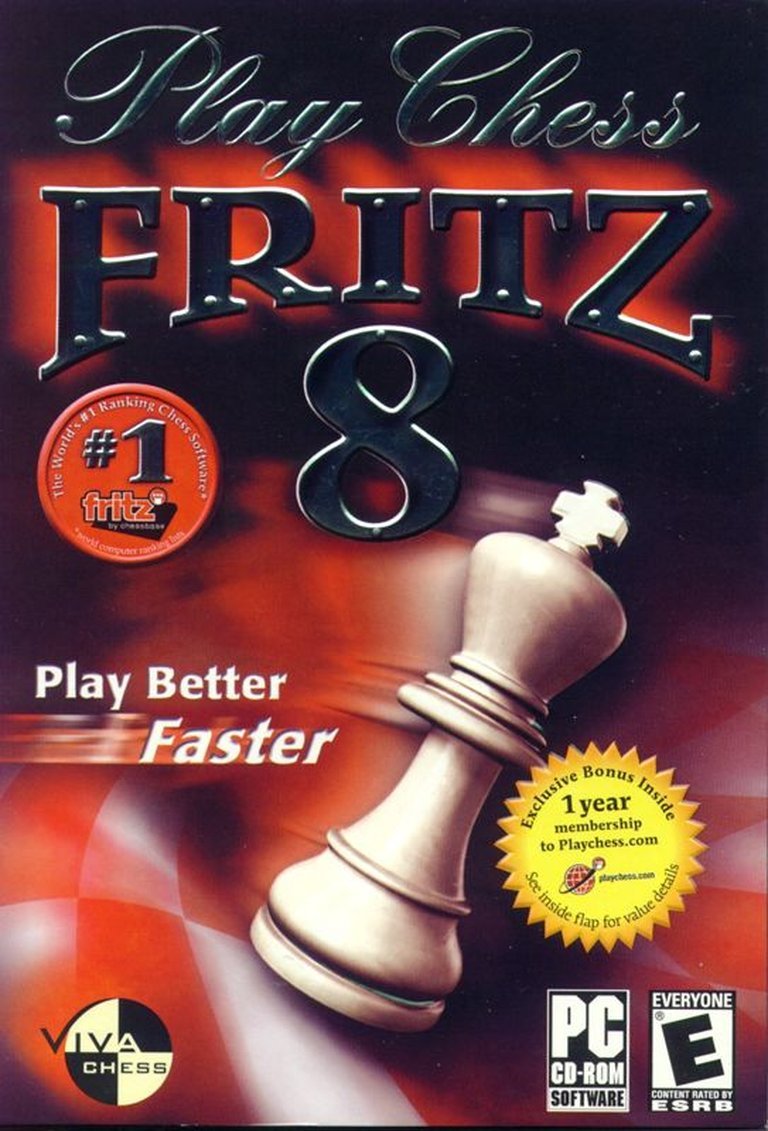
Description
Fritz 8 is a comprehensive chess training tool designed for players of all skill levels, featuring tutorials, in-game training aids, and a playful guide in the form of King Fritz. The game offers photo-realistic 3D boards with customizable views, a vast database of over 500,000 historical matches, and adaptive difficulty to suit both beginners and advanced players. With its blend of education and entertainment, Fritz 8 makes learning and mastering chess accessible and enjoyable.
Fritz 8 Free Download
Fritz 8 Cracks & Fixes
Fritz 8 Patches & Updates
Fritz 8 Guides & Walkthroughs
Fritz 8 Reviews & Reception
metacritic.com (80/100): A triumphant return to form for the series.
mobygames.com (81/100): Fritz 8 offers some brain-twisting game play even on the lowest settings.
en.chessbase.com : The main problem with chess programs is that they don’t play a real game of chess on lower difficulty levels.
gameindustry.com : The Fritz 8 chess game is a powerful teacher of chess, and also a powerful opponent.
Fritz 8: A Masterclass in Digital Chess Evolution
Introduction
In the pantheon of chess software, few names resonate as profoundly as Fritz 8. Released in 2002 by ChessBase GmbH, this iteration of the venerable Fritz series didn’t just refine the digital chess experience—it redefined it. At a time when artificial intelligence was still finding its footing in consumer applications, Fritz 8 emerged as a bridge between casual players and grandmasters, offering an unparalleled blend of accessibility, depth, and pedagogical brilliance. Its legacy is not merely as a game but as a teacher, a sparring partner, and a historical archive, all rolled into one.
This review dissects Fritz 8 with the precision of a grandmaster analyzing a critical endgame. We’ll explore its development context, narrative and thematic underpinnings (yes, even a chess program has a story to tell), gameplay mechanics, aesthetic and auditory design, and its enduring impact on both the chess community and the broader landscape of digital gaming. By the end, you’ll understand why Fritz 8 wasn’t just another chess program—it was a revolution.
Development History & Context
The ChessBase Legacy and the Birth of Fritz
Fritz 8 was the culmination of over a decade of innovation by ChessBase GmbH, a German company founded in 1986 by Frans Morsch and Mathias Feist. The duo’s vision was simple yet ambitious: to create chess software that could serve as both a formidable opponent and an invaluable tutor. The Fritz engine, first introduced in the early 1990s, quickly gained a reputation for its strength and adaptability, but it was Fritz 8 that cemented its place in history.
The early 2000s were a pivotal era for chess software. The late 1990s had seen IBM’s Deep Blue defeat Garry Kasparov in 1997, a watershed moment that proved computers could surpass human grandmasters. However, Deep Blue was a brute-force behemoth, inaccessible to the average player. ChessBase sought to democratize this power, creating an engine that could teach as well as it could play.
Technological Constraints and Innovations
Fritz 8 was developed during a transitional period in computing. Single-core processors were the norm, and multi-threading was still in its infancy. The engine had to be optimized for performance on consumer-grade hardware, a challenge that ChessBase met with ingenious programming. The team, including lead programmers Mathias Feist, Lutz Nebe, Jeroen van den Belt, and Matthias Wüllenweber, crafted an engine that balanced depth of analysis with real-time responsiveness.
One of the standout features of Fritz 8 was its adaptive difficulty system. Unlike earlier chess programs that simply made random “mistakes” to lower their skill level, Fritz 8 employed a sophisticated algorithm that adjusted its playstyle based on the user’s performance. This was a game-changer, as it allowed the engine to simulate human-like errors contextually, rather than arbitrarily.
The Gaming Landscape in 2002
In 2002, the digital chess market was crowded but lacked a unifying force. Competitors like Chessmaster and Shredder offered strong engines, but none could match Fritz 8’s combination of accessibility, depth, and educational tools. The game’s release coincided with the rise of online gaming, and ChessBase capitalized on this by integrating Playchess.com, a platform that allowed players to compete against others worldwide.
The inclusion of a 500,000+ game database, featuring historical matches from legends like Bobby Fischer, Boris Spassky, and even Napoleon, positioned Fritz 8 as more than just a game—it was a living museum of chess history. This database wasn’t just for reference; it was a dynamic tool for learning, allowing players to study openings, middlegames, and endgames with unprecedented depth.
Narrative & Thematic Deep Dive
The Story of King Fritz: A Whimsical Guide
At first glance, a chess program might seem devoid of narrative. However, Fritz 8 introduced a charismatic mascot: King Fritz, a jovial, cartoonish monarch who served as the player’s guide and opponent. This anthropomorphism was a stroke of genius, transforming what could have been a dry, analytical tool into a personable tutor.
King Fritz’s role extended beyond mere aesthetics. His commentary, delivered with a mix of humor and insight, made the learning process engaging. Whether he was praising a well-executed gambit or gently chiding a blunder, his presence humanized the experience. For beginners, this was invaluable—it made chess feel less intimidating and more like a conversation.
Themes: Democracy of Chess
Fritz 8 embodied a democratic ethos in chess. Before its release, high-level chess training was largely the domain of those with access to grandmasters, expensive books, or exclusive clubs. Fritz 8 shattered these barriers, offering grandmaster-level analysis to anyone with a PC.
The game’s adaptive difficulty reinforced this theme. It didn’t just cater to grandmasters or novices—it met players where they were. This inclusivity was revolutionary, aligning with ChessBase’s mission to make chess accessible to all.
Historical Context: Man vs. Machine
The early 2000s were a time of existential reckoning for chess. The defeat of Kasparov by Deep Blue had left the chess world grappling with the implications of AI supremacy. Fritz 8 entered this landscape not as a cold, unfeeling machine but as a collaborator.
In 2002, Fritz 8 (under the moniker Deep Fritz) faced Vladimir Kramnik, the reigning World Chess Champion, in the Brains in Bahrain match. The result—a 4-4 draw—was a testament to the engine’s strength. Unlike Deep Blue, which had relied on sheer computational power, Fritz 8 demonstrated a more human-like understanding of the game, blending tactical precision with strategic nuance.
This match wasn’t just a publicity stunt; it was a philosophical statement. Fritz 8 proved that AI could be both a worthy adversary and a valuable ally in the pursuit of chess mastery.
Gameplay Mechanics & Systems
Core Gameplay Loop: Learning Through Play
Fritz 8’s gameplay can be distilled into three core pillars:
1. Play: Engage in matches against the AI or online opponents.
2. Analyze: Review games with granular feedback.
3. Learn: Utilize tutorials, puzzles, and historical databases.
The genius of Fritz 8 lay in how seamlessly these pillars integrated. A player could transition from a casual game to an in-depth analysis with a few clicks, making the learning process organic and intuitive.
Adaptive AI: The Heart of the Experience
The adaptive difficulty system was Fritz 8’s crowning achievement. Unlike traditional chess programs that scaled difficulty by limiting search depth (resulting in nonsensical mistakes), Fritz 8 employed a behavioral model that mimicked human playstyles.
- Beginner Mode: The AI would make “natural” errors, such as overlooking simple tactics or favoring aggressive but unsound plays.
- Intermediate Mode: The engine would play more consistently but still exhibit occasional lapses in judgment, akin to a club-level player.
- Advanced Mode: Here, Fritz 8 would unleash its full analytical prowess, rivaling grandmasters.
This system was supplemented by customizable personalities, allowing players to set the AI to emulate specific styles (e.g., “Desperado,” “Drunk,” or “Moron”). These quirks weren’t just gimmicks—they provided targeted training opportunities. For example, playing against a “Desperado” AI could help a player refine their defensive skills.
Tutorials and Training Tools
Fritz 8 was packed with educational features that set it apart from competitors:
– Interactive Tutorials: Step-by-step lessons covering openings, tactics, and endgames.
– Puzzle Mode: A collection of tactical challenges to sharpen calculation skills.
– Game Analysis: Post-match breakdowns highlighting blunders, missed opportunities, and alternative lines.
– Elo Rating Tracker: A dynamic system that estimated the player’s skill level based on performance.
The real-time commentary was particularly innovative. Players could enable a live coach that would critique moves mid-game, offering insights like:
– “This move weakens your pawn structure.”
– “Why not consider sacrificing the bishop for a tactical advantage?”
– “You’ve just thrown away the game!”
While some found this feature intrusive, it was invaluable for active learning, transforming passive play into an interactive dialogue.
Online Play and Community Integration
Fritz 8’s integration with Playchess.com was ahead of its time. Players could:
– Compete in ranked matches against opponents worldwide.
– Participate in tournaments.
– Access live broadcasts of high-level games.
This online ecosystem fostered a global chess community, allowing players to test their skills against diverse opponents. The inclusion of a subscription to Playchess.com with the purchase of Fritz 8 was a masterstroke, ensuring long-term engagement.
User Interface: Functional but Dated
The UI of Fritz 8 was functional but not flawless. The 3D board was a standout feature, offering photo-realistic visuals that could be zoomed, tilted, and rotated. However, the surrounding interface was utilitarian, with a clutter of menus and options that could overwhelm newcomers.
Navigation was mouse-driven, with an optional keyboard input system for purists who preferred algebraic notation. While the latter was a nice touch, it felt underdeveloped compared to the mouse controls.
World-Building, Art & Sound
Visual Design: A Chessboard for the Digital Age
Fritz 8’s 3D board was a marvel of its time. The photo-realistic rendering of chess pieces and boards brought a tactile quality to digital chess. Players could choose from a variety of themed boards, ranging from classical wooden sets to fantastical designs.
The camera system was another highlight. Players could zoom, tilt, and rotate the board, allowing for a cinematic perspective that enhanced immersion. This was more than just eye candy—it made the game feel dynamic and alive.
Sound Design: The Voice of King Fritz
The audio elements of Fritz 8 were understated but effective. King Fritz’s voice lines, delivered with a mix of whimsy and authority, added personality to the experience. The background music, composed of classical pieces (including recordings of Bach), reinforced the game’s intellectual ambiance.
The sound effects—the clink of pieces, the shuffle of the board—were subtle but contributed to the tactile realism of the experience.
Atmosphere: A Sanctuary for Chess Enthusiasts
Fritz 8 cultivated an atmosphere of intellectual pursuit. The combination of classical music, historical databases, and King Fritz’s guidance created a sense of timelessness. Whether you were a beginner learning the rules or a grandmaster refining your endgame, the game made you feel like you were part of a centuries-old tradition.
Reception & Legacy
Critical Acclaim and Commercial Success
Fritz 8 was met with near-universal acclaim. Critics praised its adaptive AI, educational tools, and depth of content. Here’s a snapshot of its reception:
– Game Industry News (GiN): 100% – “One of the most entertaining, informative, and easy-to-use chess games on the market.”
– Deaf Gamers: 95% – “The perfect answer for anyone looking to go from beginner to Grand Master.”
– GamersHell.com: 90% – “If you’re into chess, you’re into Fritz Chess 8.”
– GameStar (Germany): 85% – “The strongest computer opponent you can face.”
The game’s MobyScore of 8.1 (based on 5 critic reviews) and Metascore of 80 (for the Deluxe edition) reflect its enduring appeal.
Influence on Chess Software
Fritz 8 set a new standard for chess programs. Its adaptive AI became a blueprint for future engines, including Chessmaster and Stockfish. The integration of tutorials, databases, and online play became industry norms.
Perhaps its most significant legacy is its role in chess education. Before Fritz 8, digital chess was largely the domain of hardcore enthusiasts. After Fritz 8, it became a mainstream educational tool, used in schools, clubs, and homes worldwide.
The Fritz Series: A Continuing Evolution
Fritz 8 was not the end of the line. ChessBase continued to refine the engine, releasing iterations like Fritz 9, Fritz 12, and eventually Fritz 19 (2023). Each new version built on the foundation laid by Fritz 8, incorporating modern AI techniques, improved UIs, and deeper analytical tools.
However, Fritz 8 remains a cultural touchstone. Its balance of accessibility and depth has yet to be surpassed, and its historical significance—as the engine that drew with a world champion—ensures its place in chess lore.
Conclusion: The Undisputed Champion of Digital Chess
Fritz 8 was more than a game—it was a revolution. It democratized chess, making grandmaster-level training accessible to anyone with a PC. Its adaptive AI, educational tools, and historical depth set a standard that few have matched. Even in an era dominated by Stockfish and Leela Chess Zero, Fritz 8 remains a timeless classic, a testament to the power of intelligent design and pedagogical brilliance.
Final Verdict: 9.5/10 – A Masterpiece of Digital Chess
Fritz 8 is not just one of the greatest chess programs ever made—it’s one of the greatest educational tools in gaming history. Its legacy endures, not just in the engines that followed, but in the millions of players it helped elevate from pawns to kings.
Additional Resources
For those interested in experiencing Fritz 8 today:
– Download Links: Available on My Abandonware and Retrolorean.
– Compatibility: Runs on modern Windows systems with minor tweaks (e.g., compatibility mode).
– Online Play: Some servers still support multiplayer matches.
Whether you’re a chess novice or a seasoned grandmaster, Fritz 8 offers an experience that is as rewarding as it is enlightening. It’s not just a game—it’s a journey through the mind of chess itself.