
- Release Year: 2011
- Platforms: Android, Browser, iPad, iPhone, Linux, Macintosh, Nintendo Switch, Windows Phone, Windows
- Publisher: Cateia Games, K.I.D. d.o.o., Layernet GmbH, Ocean Media d.o.o., UIG Entertainment GmbH
- Developer: Cateia d.o.o.
- Genre: Puzzle
- Perspective: Top-down
- Game Mode: Single-player
- Gameplay: Puzzle-solving, Strategic, Turn-based
- Average Score: 65/100
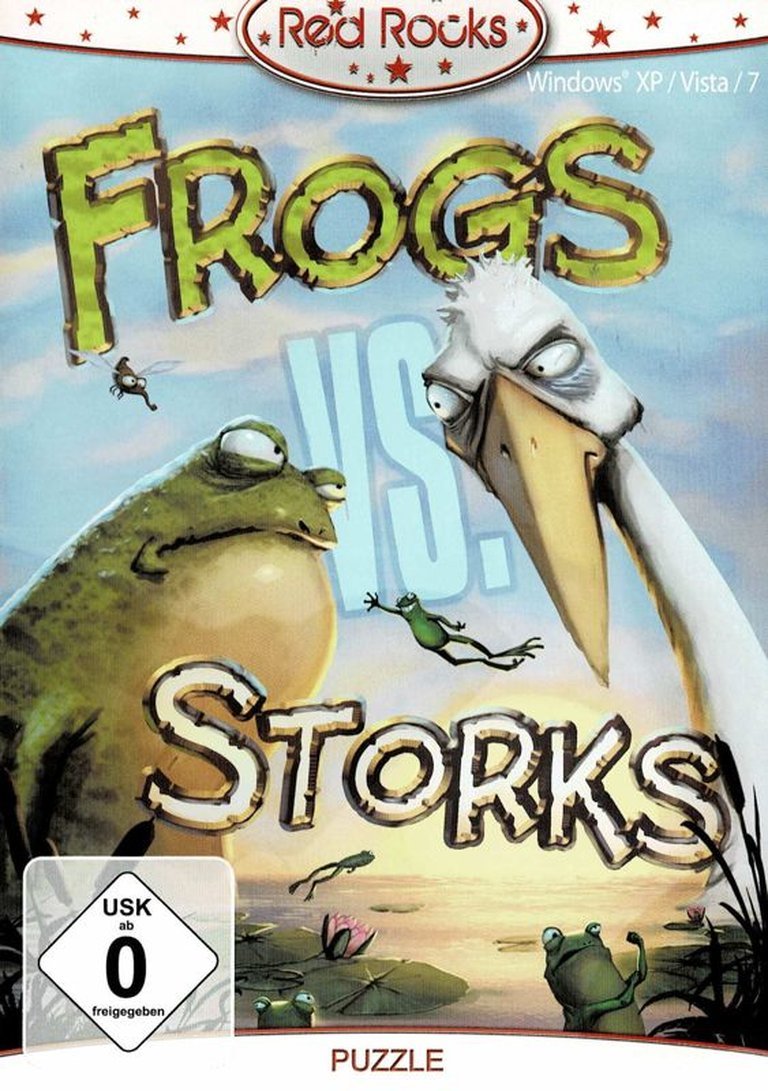
Description
Frogs vs. Storks is a turn-based strategic puzzle game where players guide frogs to safety across a grid of water lilies while evading storks. Played from a top-down perspective, the game challenges players to outmaneuver storks by moving frogs horizontally or vertically, with storks mirroring movements in the opposite direction. The game introduces bonuses like flowers and flies for extra points, hazards such as water lilies that double movement, and obstacles like broken lilies that reset positions. With randomly generated levels and increasing difficulty, players must strategically navigate multiple frogs and storks to ensure all frogs reach the safe yellow lilies.
Gameplay Videos
Where to Buy Frogs vs. Storks
PC
Frogs vs. Storks Guides & Walkthroughs
Frogs vs. Storks Reviews & Reception
geardiary.com : Frogs vs. Storks is fun – fun enough that I bought the game for the PC as well as the iPad!
indiegamereviewer.com : Frogs Vs. Storks feels like it has its puzzle roots in just enough different soil patches, as well as sprinkling in its own seeds of creativity to ultimately feel like a unique specimen.
mobygames.com (65/100): Frogs vs. Storks is a turn-based strategic puzzle game where frogs need to be guided to a safe location.
Frogs vs. Storks: A Deep Dive into a Unique Puzzle Experience
Introduction
In the vast ocean of puzzle games, Frogs vs. Storks (2011) stands as a quirky, understated gem—a title that defies conventional expectations by blending simplicity with deceptive depth. Developed by Croatian studio Cateia Games, this turn-based strategy puzzle challenges players to guide frogs across a lily pad grid while evading predatory storks. At first glance, its premise seems almost childlike, but beneath the surface lies a meticulously crafted experience that rewards patience, foresight, and adaptability.
This review will explore Frogs vs. Storks in exhaustive detail, examining its development history, narrative (or lack thereof), gameplay mechanics, artistic design, and lasting legacy. By the end, we’ll determine whether this game is a forgotten masterpiece or a charming but flawed curiosity.
Development History & Context
The Studio Behind the Game
Cateia Games, a small independent studio based in Croatia, developed Frogs vs. Storks as part of a broader portfolio of casual and puzzle games. The team, led by Ivan Bralić (who served as executive producer, project lead, and artist), had previously worked on titles like Kaptain Brawe: A Brawe New World and Fate of the Pharaoh. Their experience in crafting accessible yet engaging experiences is evident in Frogs vs. Storks, which balances simplicity with strategic depth.
The game was published by multiple entities, including K.I.D. d.o.o., UIG Entertainment GmbH, and Ocean Media d.o.o., indicating a collaborative effort to bring it to a wide audience. Its release across numerous platforms—Windows, Mac, iOS, Android, and even Nintendo Switch—demonstrates an ambition to reach both casual and dedicated gamers.
Technological Constraints and Design Philosophy
Released in 2011, Frogs vs. Storks emerged during a transitional period in gaming. The rise of mobile platforms (iOS and Android) was reshaping the industry, and indie developers were experimenting with digital distribution models. The game’s minimalist design—top-down perspective, grid-based movement, and turn-based mechanics—reflects both the technological limitations of the era and a deliberate choice to prioritize gameplay over graphical fidelity.
The absence of a traditional AI opponent is one of the game’s most intriguing design decisions. Instead of programming storks with complex behaviors, the developers opted for a mirroring system: every move a frog makes is mirrored by the storks in the opposite direction. This mechanic forces players to outthink themselves rather than an algorithm, creating a uniquely cerebral challenge.
The Gaming Landscape of 2011
At the time of its release, Frogs vs. Storks entered a market dominated by casual puzzle games like Angry Birds and Fruit Ninja, as well as more complex strategy titles. Its blend of accessibility and depth made it a standout, though it never achieved the mainstream success of its contemporaries. The game’s niche appeal—targeting players who enjoy methodical, turn-based challenges—ensured it carved out a small but dedicated fanbase.
Narrative & Thematic Deep Dive
The Premise: A Battle for Survival
Frogs vs. Storks eschews traditional storytelling in favor of a minimalist, almost allegorical setup. The frogs, once living peacefully in their pond, now face an existential threat from storks, who have invaded their habitat. The game’s premise is simple: guide the frogs to safety (yellow lily pads) while avoiding the storks, who move in opposition to the player’s actions.
This lack of narrative depth is not a flaw but a deliberate choice. The game’s charm lies in its purity—it’s a battle of wits, not a story-driven epic. The frogs and storks serve as abstract representations of predator and prey, with the player acting as an unseen force guiding the frogs to survival.
Themes: Strategy, Patience, and Self-Reflection
The game’s core theme is self-reflection. Since the storks mirror the player’s moves, every decision directly influences the opponent’s actions. This creates a meta-layer of strategy: players must anticipate their own mistakes and plan several moves ahead. The game becomes a battle against one’s own impulsivity, rewarding patience and foresight.
Another theme is adaptability. As levels progress, new mechanics—such as lazy frogs (which must be pushed by others), slippery lily pads, and teleporting hazards—force players to adjust their strategies constantly. The randomly generated levels ensure no two playthroughs are identical, reinforcing the idea that flexibility is key to survival.
Characters and World-Building
The game’s characters are deliberately simple:
– Frogs: The protagonists, represented as small, green, and somewhat helpless creatures. Their animations are minimal but effective, conveying a sense of urgency as they hop from pad to pad.
– Storks: The antagonists, depicted as towering, menacing figures. Their movements are mechanical, reinforcing the idea that they are extensions of the player’s own actions.
– Lazy Frogs: A later addition, these frogs cannot move independently and must be pushed by others, adding a layer of complexity to the puzzle-solving.
The world itself—a grid of lily pads—is abstract but evocative. The varying colors of the pads (orange for starting points, yellow for safety) create a visual language that players quickly understand. The absence of a detailed environment keeps the focus squarely on the gameplay.
Gameplay Mechanics & Systems
Core Gameplay Loop
At its heart, Frogs vs. Storks is a turn-based puzzle game where players must navigate frogs across a 6×7 grid of lily pads. The rules are simple:
1. Movement: Frogs move one space at a time (horizontally or vertically).
2. Mirroring: Storks move in the exact opposite direction of the player’s last move.
3. Objective: Guide all frogs to the yellow lily pads at the top of the screen.
This simplicity belies the game’s depth. Since storks mirror the player’s actions, every move must be calculated to avoid trapping the frogs. The game’s difficulty ramps up as more frogs and storks are introduced, along with environmental hazards.
Hazards and Bonuses
The game introduces several mechanics to complicate (and enrich) the experience:
– Slippery Pads: Double the movement distance, making precision harder.
– Broken Pads: Teleport frogs or storks back to their starting positions.
– Flies and Flowers: Collectibles that grant bonus points if gathered by frogs but deduct points if taken by storks.
– Stork Eggs: Left behind by storks, these can be collected for points.
– Lazy Frogs: Must be pushed by other frogs, adding a layer of logistical planning.
These elements transform the game from a simple puzzle into a dynamic challenge where players must weigh risk and reward constantly.
Progression and Difficulty
The game’s difficulty curve is steep but fair. Early levels serve as tutorials, introducing basic mechanics before escalating into complex scenarios. Later stages require players to manage multiple frogs, each with unique movement constraints, while dodging multiple storks with varying speeds.
The randomly generated levels ensure replayability, as no two playthroughs are identical. This design choice keeps the game fresh, even after multiple attempts.
UI and Controls
The user interface is minimalist, with a clean top-down view of the grid. Controls are mouse-driven, with players clicking to select and move frogs. The lack of clutter ensures the focus remains on the puzzle-solving, though some players might find the UI too sparse.
World-Building, Art & Sound
Visual Design: Simplicity as Strength
Frogs vs. Storks embraces a cartoonish, almost storybook aesthetic. The lily pads are brightly colored, the frogs are round and expressive, and the storks are angular and imposing. This contrast reinforces the game’s themes of vulnerability and danger.
The art style is reminiscent of classic arcade games, with a modern twist. The animations—such as frogs hopping or storks pecking—are smooth and satisfying, adding a tactile feel to the gameplay.
Sound Design: Ambience and Feedback
The game’s soundtrack is understated but effective, featuring light, whimsical tunes that evoke a swampy atmosphere. Sound effects—such as the plop of a frog landing on a pad or the swoosh of a stork moving—provide essential auditory feedback, helping players track their actions without relying solely on visual cues.
The lack of voice acting or complex audio design is not a detriment; the game’s soundscape is functional and immersive, enhancing the overall experience.
Reception & Legacy
Critical and Commercial Reception
Upon release, Frogs vs. Storks received modest but positive reviews. Critics praised its innovative mechanics and charming presentation but noted its niche appeal. Brash Games gave it a 7/10, calling it “a good buy for puzzle fans,” while Mana Pool scored it 6/10, describing it as “simply pleasing” but not groundbreaking.
Commercially, the game found a small but dedicated audience, particularly among fans of turn-based puzzles. Its availability on multiple platforms ensured it reached a wide range of players, though it never achieved mainstream success.
Influence and Legacy
While Frogs vs. Storks did not spawn a franchise or revolutionize the puzzle genre, its unique mechanics have influenced smaller indie titles. The concept of mirroring opponent movements—where the player’s actions directly control the enemy—remains a rare and intriguing design choice, one that later games have occasionally emulated.
The game’s legacy lies in its proof that simplicity and depth are not mutually exclusive. It stands as a testament to the creativity of indie developers, who can craft engaging experiences without relying on cutting-edge graphics or complex narratives.
Conclusion: A Hidden Gem Worth Discovering
Frogs vs. Storks is a game that defies easy categorization. It is neither a casual time-waster nor a hardcore strategy epic but something in between—a puzzle game that demands thought, patience, and adaptability. Its minimalist design, innovative mechanics, and charming presentation make it a standout title in the crowded puzzle genre.
While it may not have achieved the fame of Tetris or Portal, Frogs vs. Storks deserves recognition as a clever, well-crafted experience. For players who enjoy methodical challenges and appreciate games that reward strategic thinking, it remains a hidden gem worth discovering.
Final Verdict: 8/10 – A brilliant, underrated puzzle game that rewards patience and foresight.
Additional Notes
- Platform Availability: The game is available on Steam, iOS, Android, Nintendo Switch, and other platforms, making it accessible to a wide audience.
- Replayability: The randomly generated levels ensure that no two playthroughs are identical, adding significant replay value.
- Accessibility: The game’s simple controls and clear visual language make it easy to pick up, though mastering it requires skill.
For those seeking a puzzle game that challenges the mind without overwhelming the senses, Frogs vs. Storks is a must-play.