
- Release Year: 2024
- Platforms: Nintendo Switch, PlayStation 4, Windows, Xbox One, Xbox Series
- Publisher: QUByte Interactive Ltda., Wired Dreams Studio
- Developer: Wired Dreams Studio
- Genre: Action
- Perspective: Side view
- Game Mode: Single-player
- Gameplay: Platform, Turn-based
- Setting: Fantasy
- Average Score: 71/100
Description
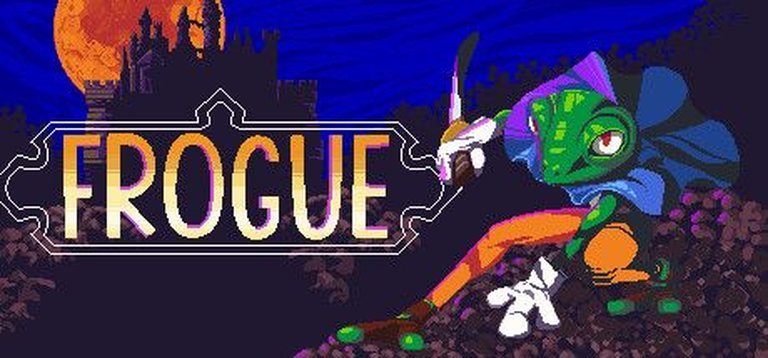
Frogue is a roguelike bullet hell platformer set in a fantasy world where players control Kene Legstrong, a frog knight on a mission to rescue his kidnapped dog and stop a sinister force. The game merges turn-based strategy with fast-paced action, requiring players to dash through enemy bullets, throw knives, and strategically freeze time to survive procedurally generated levels. With upgrades, permadeath mechanics, and a side-view perspective, Frogue offers a unique blend of precision platforming, tactical reflexes, and roguelike challenge.
Gameplay Videos
Where to Buy Frogue
Frogue Free Download
Frogue Mods
Frogue Guides & Walkthroughs
Frogue Reviews & Reception
metacritic.com (70/100): FROGUE’s unique mechanics elevates it from a glut of other rogue-likes. It’s a bit repetitive and clumsy but there’s a lot to like here.
opencritic.com (72/100): A weird combination of gameplay elements makes Frogue a very unique and enjoyable game.
thegeeklygrind.com : Frogue offers refreshingly unique gameplay, but not without issues.
Frogue: Review
In the crowded landscape of indie gaming, Frogue stands out as a bold experiment in genre-blending, merging roguelike mechanics, turn-based strategy, and bullet hell action into a singular, froggy experience. Developed by Wired Dreams Studio, this game tasks players with controlling Kene Legstrong, a frog knight on a mission to rescue his dog from a dark castle teeming with enemies. Frogue is a game that defies easy categorization, offering a unique blend of mechanics that, while flawed, create a compelling and addictive experience. This review will dissect Frogue across its various facets, exploring its development history, narrative, gameplay, art direction, reception, and legacy to determine its place in video game history.
Development History & Context
Wired Dreams Studio, a Brazilian indie developer, crafted Frogue as a labor of love, drawing inspiration from classic action-platformers and roguelike games. The studio’s vision was to create a game that felt both nostalgic and innovative, blending the precision of turn-based strategy with the frenetic energy of bullet hell shooters. The game’s development was constrained by the technological limitations of the time, particularly in its early iterations, but the studio managed to create a polished experience that feels distinct from its contemporaries.
At the time of its release in February 2024, the gaming landscape was saturated with roguelike titles, each vying for attention with unique twists on the genre. Frogue entered this competitive space with a bold proposition: a game that combined the methodical planning of turn-based strategy with the adrenaline-pumping action of bullet hell shooters. The studio’s decision to focus on a frog protagonist was both a nod to the whimsical and a deliberate choice to stand out in a sea of more conventional heroes.
Narrative & Thematic Deep Dive
Frogue’s narrative is straightforward but effective, drawing players into its world with a minimalist yet engaging premise. Kene Legstrong, a frog knight of the Order of the Hanuro Clan, embarks on a Castlevania-esque journey to rescue his dog from a dark castle that has mysteriously appeared. The game’s opening cutscene sets the tone, establishing the stakes without overcomplicating the story. The narrative’s simplicity allows the gameplay to take center stage, but it also leaves room for players to project their own interpretations onto the world.
Thematically, Frogue explores the duality of precision and chaos. The turn-based mechanics demand careful planning and strategy, while the bullet hell elements introduce an element of controlled chaos. This tension between order and disorder is reflected in the game’s design, from the methodical exploration of the castle to the frenetic combat encounters. The game’s themes are further reinforced by its art direction, which emphasizes the contrast between the serene, almost meditative moments of planning and the explosive action of combat.
Gameplay Mechanics & Systems
Frogue’s gameplay is its most compelling feature, blending multiple genres into a cohesive and engaging experience. The core mechanic revolves around Kene’s unique movement system, which allows him to hop from one surface to another in a straight line. This movement is turn-based, meaning time freezes while the player plans their next move. Enemies, however, are not idle; they fire projectiles that the player must dodge by carefully choosing their landing spots.
Combat in Frogue is equally innovative. Players can either leap through enemies to slash them with their sword or throw their sword at distant foes. Throwing the sword leaves the player vulnerable until they retrieve it, adding a layer of risk and reward to the combat. The game also features a chronosphere, an item that allows players to freeze time for a limited number of turns, providing a strategic advantage in tight situations.
The roguelike elements of Frogue are well-implemented, with procedural generation ensuring that each run feels fresh. Players explore a randomly generated castle, encountering a variety of enemies, bosses, and upgrade rooms. Upgrades are typically ability-based rather than stat increases, encouraging players to experiment with different playstyles. However, the game’s upgrade system has been criticized for being hit-or-miss, with some upgrades feeling useless or overly situational.
The user interface (UI) is clean and intuitive, with clear indicators for enemy attacks and available upgrades. The game’s controls, however, have been a point of contention. Some players have reported issues with aiming and landing on the correct spots, particularly during high-pressure moments. These control quirks can be frustrating but are often overcome with practice.
Core Gameplay Loops
- Exploration: Players navigate through procedurally generated levels, discovering new areas and secrets.
- Combat: Engage in turn-based, bullet-hell style combat, using Kene’s unique movement and attack mechanics.
- Upgrades: Collect and equip ability-based upgrades to enhance Kene’s capabilities.
- Time Manipulation: Use the chronosphere to freeze time and gain a strategic advantage.
Innovative Systems
- Turn-Based Movement: Time freezes while the player plans their next move, adding a layer of strategy to the gameplay.
- Chronosphere: An item that allows players to freeze time for a limited number of turns, providing a strategic advantage.
- Ability-Based Upgrades: Encourages experimentation with different playstyles.
Flawed Systems
- Control Scheme: Some players have reported issues with aiming and landing on the correct spots, which can be frustrating during high-pressure moments.
- Upgrade System: Critics have noted that some upgrades feel useless or overly situational, making the system feel hit-or-miss.
World-Building, Art & Sound
Frogue’s art direction is a deliberate throwback to 8-bit and 16-bit era games, with pixel art that is both charming and functional. The game’s visuals are sparse, with dark, minimalist environments that emphasize the action. Kene Legstrong, the game’s protagonist, is a standout character, designed with a cool, samurai-inspired aesthetic that contrasts with the game’s otherwise bleak setting.
The sound design in Frogue is equally impressive, with a retro-inspired soundtrack that complements the game’s visual style. The music is electronic and atmospheric, shifting to match the intensity of the gameplay. The sound effects are crisp and satisfying, from the clang of sword strikes to the whoosh of projectiles. The game’s audio design creates an immersive experience, drawing players into its world and enhancing the sense of urgency during combat.
Reception & Legacy
Frogue received a mixed but generally positive reception upon its release. Critics praised the game’s innovative mechanics and unique blend of genres, while noting its flaws, particularly in the control scheme and upgrade system. The game’s affordability, with a price point of $4.99, was also highlighted as a positive, making it an accessible entry point for players interested in the roguelike genre.
The game’s legacy has been shaped by its influence on subsequent titles, with developers citing Frogue as an inspiration for their own experiments in genre-blending. The game’s unique mechanics have also sparked discussions within the gaming community about the potential for turn-based strategy and bullet hell elements to coexist in a single experience.
Conclusion
Frogue is a game that defies easy categorization, blending multiple genres into a singular, froggy experience. Its innovative mechanics, while flawed, create a compelling and addictive gameplay loop that sets it apart from its contemporaries. The game’s narrative is simple but effective, and its art and sound design contribute to a cohesive and immersive experience. While its reception was mixed, Frogue has carved out a niche for itself in the roguelike genre, influencing subsequent titles and sparking discussions about the potential for genre-blending in indie games.
In the grand tapestry of video game history, Frogue stands as a testament to the power of innovation and experimentation. It is a game that challenges players to think differently about genre conventions and embraces the chaos and precision of its unique mechanics. For these reasons, Frogue deserves a place in the pantheon of indie games that pushed the boundaries of what is possible in interactive entertainment.