
- Release Year: 2011
- Platforms: Browser, PlayStation 3, Windows, Xbox 360
- Publisher: Ubisoft Entertainment SA
- Developer: Ubisoft Montpellier SAS
- Genre: Strategy, Tactics
- Perspective: 1st-person
- Game Mode: Single-player
- Gameplay: Element control, Puzzle, Resource Management, Terrain manipulation
- Setting: Mystical, Natural, Tribal
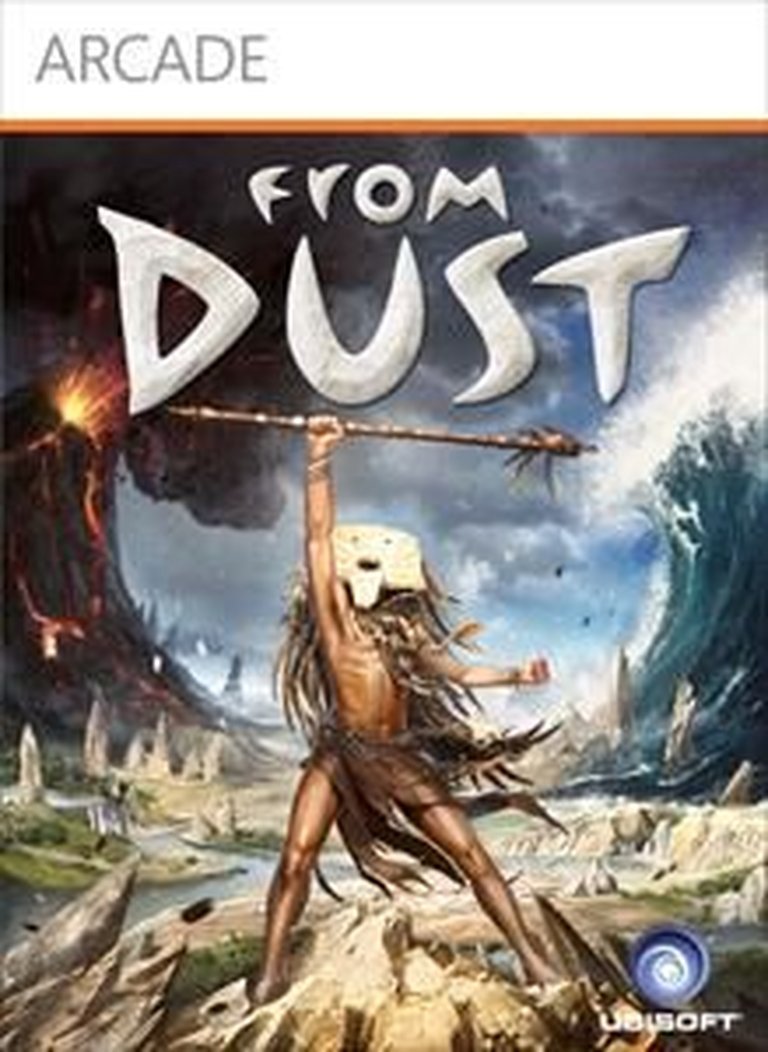
Description
From Dust is a god game where players embody ‘The Breath’, a divine entity guiding a nature tribe to thrive by dynamically manipulating the environment. Through absorbing and repositioning elements like lava, water, and earth, players must protect the tribe from disasters, ensure safe passages, and facilitate village construction across 13 campaign missions and 30 time-limited challenge maps, with gameplay reminiscent of Populous and infused with puzzle elements.
Gameplay Videos
Where to Buy From Dust
PC
From Dust Guides & Walkthroughs
From Dust Reviews & Reception
ign.com : From Dust is hugely impressive, both technically and visually.
engadget.com : God lets bad things happen because he honestly forgot he put the exploding tree there.
From Dust: Review
Introduction: The Fragile God of a Living World
In the pantheon of god games, titles like Populous, Black & White, and Spore have traditionally granted players near-omnipotent power over their worshippers and worlds. From Dust, the 2011 title from Ubisoft Montpellier directed by the legendary Éric Chahi, subverts this fantasy entirely. Here, the player is not an all-powerful deity but a constrained, elemental force known as “The Breath,” tasked with guiding a primitive tribe through a dynamically simulated archipelago where nature itself is the primary antagonist—and the star. This review argues that From Dust is a monumental, if profoundly flawed, experiment in video game poetics. It is a game that achieves breathtaking beauty through its revolutionary simulation of natural forces, only to be often hamstrung by punitive design choices and technical shortcomings that reflect the very fragility its narrative themes espouse. Its legacy is that of a brilliant, idiosyncratic artifact—a game that daringly asked players to feel the weight of stewardship rather than the thrill of tyranny, leaving an indelible mark on those who persisted through its storms.
Development History & Context: The Volcano in the Room
From Dust emerged from the long sabbatical of Éric Chahi, the visionary behind the cinematic masterpiece Another World (1991) and the challenging Heart of Darkness (1998). Following the latter’s notoriously difficult development, Chahi left the industry to pursue a passion for volcanology. A pivotal 1999 trip to the erupting crater of Mount Yasur in Vanuatu crystallized his desire to create a game capturing nature’s “ambivalence—beautiful and potentially violent at the same time.” This personal obsession became the game’s core.
Presented to Ubisoft in 2006, the project faced initial rejection before being greenlit. Development proper began in January 2008 with a tiny team of 3-20 people—a “indie within a publisher” scenario. The team utilized the proprietary LyN engine, built from the ground up to handle the game’s staggering computational demands. Chahi’s lecture at GDC Europe 2010, “Creating a High-Performance Simulation,” revealed the technical artistry: a rule-based system where flowing water carves rivers, volcanic lava cools into rock, and vegetation propagates organically from soil. The team intentionally eschewed handcrafted algorithms for rivers or volcanoes, seeking truly emergent, dynamic behavior.
The decision for a digital-only release via Xbox Live Arcade, PlayStation Network, and Steam was both pragmatic (avoiding manufacturing costs) and philosophical, allowing for potential future expansions like a world editor or multiplayer—ideas discussed but never realized. Announced as Project Dust at E3 2010, it was marketed as the “spiritual successor” to Peter Molyneux’s Populous, though Chahi’s vision was far more specific and elemental. The influences were eclectic: Conway’s Game of Life for emergent patterns, the dystopian art of Zdzisław Beksiński, the time-lapse natural imagery of Koyaanisqatsi, and research into African and New Guinean tribal cultures. Science fiction novelist Laurent Genefort helped craft the world’s lore.
Narrative & Thematic Deep Dive: A Cyclical Journey of Loss and Rediscovery
From Dust’s story is a sparse, poetic frame for its mechanical core. A nameless tribe, having lost the knowledge of their ancestors—”The Ancients”—summons The Breath to guide them. The narrative is delivered through brief, enigmatic text passages and the tribe’s dialogue, creating a mythic, oral-history feel.
The plot unfolds across 13 campaign missions. The tribe traverses a mysterious archipelago, building villages next to magical Totems to open gateways to new lands. Their quest is to recover lost “songs” (powers) from magical stones, such as “Repel Water” to survive tsunamis. Thematically, the journey is cyclical and ambiguous. The final mission tasks the player with shaping a new island for the tribe’s final ritual. Upon completion, that island collapses and sinks, leaving only the gateway. The tribe passes through, only to find themselves back on their starting island. The narrator’s closing line—”And here we are, as on the first day”—implies a Sisyphean cycle or a metaphorical rebirth, not a linear victory. This reframes the entire campaign: not a conquest of nature, but an eternal, fragile negotiation with it.
Key themes resonate deeply:
* The Fragility of Civilization: Villages can be wiped out in seconds by a diverted lava flow or an unexpected tsunami. The game constantly reminds the player that human settlements are temporary veneers on a chaotic world.
* Ambiguous Divinity: The Breath is not a loving or wrathful god; it is an indifferent tool. The tribe’s masks and totems suggest worship, but the relationship is utilitarian. As Chahi stated, the team tried to avoid overt religion, but the mechanics “pushed us back to it.” The player experiences the theological problem of evil directly: disaster strikes not out of malice, but because the player’s control is limited and indirect.
* Knowledge as Power and Vulnerability: The tribe’s “songs” are gained from the land, but these same elements (water, fire) can destroy them. Knowledge is a double-edged sword.
* Cyclical Time vs. Linear Progress: Unlike most strategy games, From Dust suggests history and culture are not linear advancements but recurring patterns of struggle and renewal, echoing the volcanic and tidal cycles that govern its simulation.
Cut content reveals even deeper ambitions. A scrapped biological life cycle for the tribespeople (birth, aging, death) and more diverse fauna were dropped due to technical scope, hinting at a richer, more morally complex simulation that never materialized.
Gameplay Mechanics & Systems: Sculpting with a Spherical Cursor
From Dust is a real-time god game from a first-person perspective. The interface is the Breath cursor—a glowing, amorphous sphere that changes color/texture based on the selected element (brown for earth, blue for water, red for lava). The core mechanic is terrain manipulation: absorb matter (sand, soil, water, lava) into the cursor and deposit it elsewhere. This simple act belies immense complexity due to the game’s physics.
The Living Simulation:
The game’s genius lies in its dynamic, rule-based ecosystem:
* Water & Erosion: Water flows downhill, eroding terrain. Damming a river causes it to back up and flood; redirecting it can carve new canyons.
* Lava & Geology: Lava flows, cools into solid rock upon contact with water or air, and can be channeled to create new land bridges or barriers. Volcanoes erupt periodically, spewing lava that follows gravity.
* Vegetation: Soil covered by water becomes fertile. Once a village is built, plants spread organically from it, turning barren soil green. Trees can catch fire; certain plants explode.
* Tribal Agency: Villagers act independently, walking from their village to totems or magical stones. They have notoriously poor pathfinding AI, often getting stuck on terrain or walking into hazards—a persistent, frustrating flaw.
Progression & Powers:
The campaign is structured around active objectives: settle villages near all totems on a map to open a gateway. Settling near a totem grants a new power (e.g., Jellify Water, turning it temporarily solid; Evaporate Water; Extinguish Fire). Finding magical stones teaches the tribe passive abilities (e.g., Repel Water to protect villages from tsunamis). This creates a loop: complete a map → gain power → face a harder map.
Game Modes:
* Story Mode (13 missions): A curated, escalating difficulty curve. Early levels are tutorials; later ones are brutal, multi-front disasters requiring constant, frantic manipulation.
* Challenge Mode (30 maps): Bite-sized, puzzle-like scenarios with strict time limits and specific win conditions, recorded on leaderboards. This mode highlights the pure mechanics but feels disconnected from the narrative’s meditative pace.
Flaws in the System:
* Tribal AI: The single greatest source of frustration. Villagers frequently