
- Release Year: 2017
- Platforms: Windows
- Publisher: Vive Studios
- Developer: Fantahorn Studio
- Genre: Action
- Perspective: 1st-person
- Game Mode: Single-player
- Gameplay: Shooter
- Setting: World War II
- Average Score: 63/100
- VR Support: Yes
Description
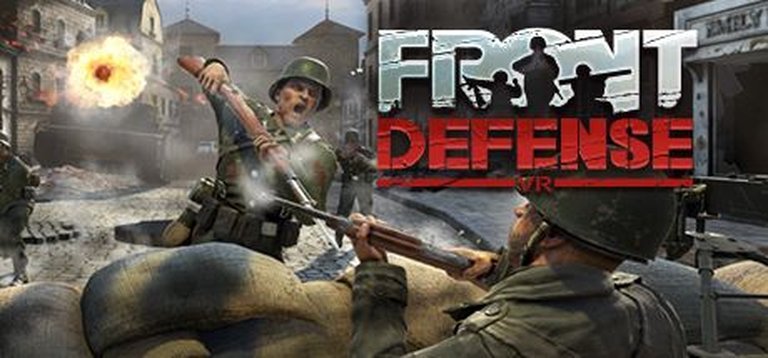
Front Defense is a room-scale VR shooter set in the final days of World War II’s European theater, where players take on the role of an Allied Forces hero defending a fictional European town from a relentless Axis onslaught following the Normandy invasion. Hunkered down in strategic positions, players duck, dive, reload weapons, throw grenades, man mounted guns, use bazookas, call in airstrikes, and battle infantry, tanks, and dive bombers in intense, arcade-style firefights designed for HTC Vive’s precision tracking.
Where to Buy Front Defense
PC
Front Defense Reviews & Reception
metacritic.com (60/100): Mixed or Average
uploadvr.com : just another wave shooter that lacks the creativity and depth needed to be anything more than a passing curiosity.
Front Defense: Review
Introduction
Imagine hunkering down in the rubble-strewn streets of a war-torn European town, the thunder of artillery shaking your bones as waves of Axis soldiers charge your position—ducking bullets in room-scale VR, your heart pounding with every reload. Released in 2017 as one of HTC Vive’s flagship titles, Front Defense promised to transplant the visceral chaos of World War II shooters into virtual reality’s immersive embrace. Developed by Vive Studios’ in-house team Fantahorn Studio, it arrived amid VR’s nascent consumer boom, leveraging the HTC Vive’s precision tracking for an “arcade-style room-scale VR shooter” that aimed to hook both VR novices and genre veterans. Yet, for all its polished gunplay and historical flair, Front Defense emerges as a tantalizing but ultimately undercooked prototype—a bold swing at VR authenticity that stumbles on brevity and depth, cementing its place as a footnote in early VR’s arcade wave-shooter glut rather than a timeless classic.
Development History & Context
Front Defense was born from HTC’s ambitious Vive Studios initiative, launched in 2016 to rival Oculus Studios by funding and publishing high-caliber VR exclusives. Fantahorn Studio, Vive Studios’ first-party developer, crafted the game using Unity, targeting the HTC Vive’s room-scale capabilities—demanding at least 3 square meters of play space for ducking and weaving. Released on July 7, 2017 (with Steam and Viveport availability), it arrived during VR’s “Year Two,” when headsets like the Vive and Oculus Rift had been consumer-available for just 18 months. The gaming landscape was flooded with simplistic wave shooters (The Brookhaven Experiment, early SteamVR titles), as developers grappled with motion sickness, tracking limits, and content scarcity.
Fantahorn’s vision was clear: deliver a “trusted genre” (first-person WWII shooter) to lure core gamers wary of VR’s gimmicks. Post-Normandy invasion setting evoked blockbusters like Call of Duty or Medal of Honor, but technological constraints shaped its stationary defense loop—no smooth locomotion to avoid nausea, reliance on Vive Trackers for intuitive gestures. Priced at $19.99 (or bundled in Viveport subscriptions), it reflected HTC’s push for “polished” experiences amid hardware sales struggles. A sequel, Front Defense: Heroes (December 2017), pivoted to 5v5 multiplayer with AI bots, smooth locomotion, and modes like Team Deathmatch—signaling Fantahorn’s response to single-player critiques. In hindsight, Front Defense embodies 2017 VR’s optimism: innovative motion controls amid immature ecosystems, where arcade purity trumped narrative ambition.
Narrative & Thematic Deep Dive
Front Defense‘s story is lean, almost perfunctory—an arcade shooter prioritizing action over script. Players embody an unnamed Allied Forces hero in WWII’s European theater’s “final days,” post-Normandy D-Day. The invasion’s beaches secured, the narrative thrusts you into a fictional town’s brutal siege: Axis forces launch a “last relentless onslaught,” escalating from infantry to tanks, Stuka dive bombers, and a climactic “mysterious Axis super weapon” boss. No voiced protagonist or branching paths; exposition unfolds via environmental cues—destroyed buildings, radio chatter, and loading screens evoking heroism amid desperation.
Thematically, it romanticizes the Allied push: themes of defiance, sacrifice, and technological triumph mirror real WWII lore (e.g., Battle of the Bulge desperation). You’re the lone bulwark against “increasingly brutal” foes, calling airstrikes like a one-man D-Day redux. Dialogue is sparse—grunts, orders from unseen comrades—heightening isolation, a VR strength amplifying vulnerability. Subtle motifs emerge: a “beautifully detailed European town slowly being destroyed” symbolizes civilization’s fragility; the super-weapon boss nods to Wunderwaffen myths, blending history with pulp fiction.
Yet, narrative depth falters. No character arcs, motivations, or moral ambiguity—enemies are faceless waves, dumbly charging like arcade fodder. Compared to Brotherhood of Arms or Hell Let Loose, it lacks emotional weight, reducing WWII to trigger-pulling spectacle. In VR, this immersion-without-substance works for thrills but evaporates on replay, underscoring Fantahorn’s arcade focus over cinematic storytelling.
Gameplay Mechanics & Systems
At its core, Front Defense is a stationary wave shooter: defend positions across a tutorial shooting range and three escalating levels, popping from cover to fend off endless Axis assaults. Vive’s motion controls shine in physicality—grip rifles intuitively, slam magazines home (echoing The London Heist), man 50-cal turrets with thunderous recoil. Weapon switching is seamless (rifles, SMGs, heavies), grenades demand pulling pins “with teeth” (hold to mouth, yank—a clunky but thematic gimmick), bazookas obliterate armor, airstrikes vaporize tanks.
Progression is stage-based: waves intensify (infantry → vehicles → bombers → boss), with global leaderboards for scores. UI is minimalist—HUD-free, relying on physical holsters and radio icons—immersive but occasionally opaque (e.g., airstrike prompts). No character upgrades; replayability hinges on high scores and escalating difficulty.
Flaws abound: AI is “not intelligent,” standing exposed or ignoring bullets, diluting tension. No locomotion confines you to knees/cover, limiting room-scale promise (though 3m² enables dynamic peeking). Reloading feels premium, but grenade delays frustrate; content scarcity (three levels) pales post-waves. Compared to Superhot VR or Robo Recall, it lacks innovation—no power-ups, puzzles, or asymmetry. Still, frantic peaks—Stuka swarms, boss spectacle—deliver VR’s “visceral thrills,” rewarding Vive owners with physicality absent in flatscreen ports.
| Mechanic | Strengths | Weaknesses |
|---|---|---|
| Reloading/Weapons | Tactile, precise; multi-tool arsenal | Grenade pin-pull laggy |
| Defense Loop | Escalating waves, power weapons | Stationary; dumb AI |
| VR Interactions | Room-scale ducking, mounted guns | Space-demanding; no locomotion |
| Progression | Leaderboards, boss finale | Short (3 levels); no RPG elements |
World-Building, Art & Sound
The game’s fictional European town is a standout: cobblestone streets, shattered facades, and dynamic destruction craft a lived-in WWII diorama. Visuals leverage Unity for Vive—crisp textures, particle-heavy explosions, volumetric smoke—slowly crumbling under siege, heightening stakes. Atmosphere builds via escalation: dawn skirmishes yield to nightmarish bomber runs, VR’s 360° view amplifying paranoia (flank checks feel vital).
Art direction evokes Medal of Honor: Allied Assault—grimy authenticity without gore overload (mature violence noted). Lighting shifts dramatically, casting long shadows amid flares; scale impresses, tanks looming like behemoths.
Sound design amplifies immersion: muffled booms through cover, ricochets pinging helmets, Stuka sirens wailing. Weapon feedback is punchy—rifle barks, 50-cal chatter—synced to haptics for recoil jolts. Sparse score swells heroically; radio static adds grit. Together, they forge “one of the most intense war shooter experiences,” though repetitive waves dilute atmosphere over time.
Reception & Legacy
Launch reception was mixed: Metacritic 60/100 (4 critics: GamingTrend 80—”frantic arcade fun”; Road to VR/GMW3 60—”limited fun, potential untapped”; UploadVR 40—”bland wave shooter”). MobyGames 60%, Steam user score 69% (Mixed, 83 reviews)—praise for controls/WWII flair, gripes over length/AI. Dutch outlet Gameplay called it a “fun snack, but nothing more.” Commercial viability? Bundled in Viveport subs, it sold modestly amid VR’s niche (~$20 price), spawning Heroes (Mixed Steam reviews, discontinued post-SteamVR 2.0).
Legacy is modest: exemplifies early room-scale VR’s peaks (physical reloading influenced Pistol Whip, Blood & Truth) but warns of pitfalls (content drought, AI woes). No industry shaker like Beat Saber, yet it advanced Vive ecosystem, bridging arcade roots (House of the Dead) to VR. Post-2017, wave shooters evolved (Arizona Sunshine); Front Defense endures as HTC’s earnest, flawed WWII foray—influencing multiplayer pivots but fading amid VR’s maturation.
Conclusion
Front Defense captures VR’s promise—intimate, body-driven WWII chaos—in a polished package, its tactile gunplay and escalating sieges evoking arcade highs amid historical grit. Yet, brevity (three levels), rote waves, and unremarkable AI relegate it to curiosity status, a “passing thrill” in VR’s crowded shooter scene. As a 2017 artifact, it merits preservation for pioneering room-scale defense, but lacks the depth for pantheon status. Verdict: 6.5/10—Recommended for Vive diehards craving WWII catharsis, but skip if seeking substance; a historical curio in video game evolution, best as a 30-minute adrenaline hit before shelving.