
- Release Year: 2020
- Platforms: Windows
- Publisher: SosiskaGames
- Developer: SosiskaGames
- Genre: Action
- Perspective: Side view
Description
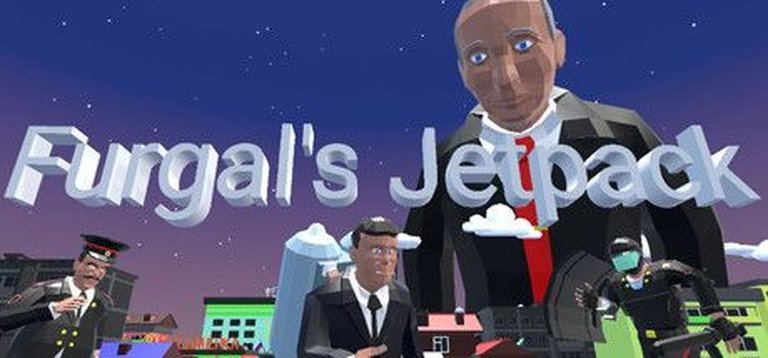
Furgal’s Jetpack is a 2D side-scrolling action runner where you play as an unjustly imprisoned character escaping with a jetpack. Navigate a chaotic urban jungle in the Russian hinterland, dodging cars and flying clubs from the evil Momon-corp in a madcap chase filled with absurd humor and dynamic platforming.
Where to Buy Furgal’s Jetpack
PC
Furgal’s Jetpack: A Defiantly Absurdist Sprint Through the Russian Dystopian Hinterland
Introduction: The Unlikely Jailbreak
In the vast, often homogenous landscape of the indie runner genre, Furgal’s Jetpack emerges not with a whisper, but with a chaotic, satirical shout. Released into a world saturated with endless runners and physics-based platformers, this 2020 title from the enigmatic SosiskaGames immediately distinguishes itself through a premise of glorious, purposeful absurdity. You are unjustly imprisoned, your captors have made the fatal error of leaving you near a functioning jetpack, and your escape route is a surreal, procedurally generated vision of the “Russian hinterland” under the oppressive gaze of the “Momon-corp.” This review argues that Furgal’s Jetpack is a fascinating, if flawed, artifact of特定 indie sensibilities—a game that weaponizes minimalist design and dark, surreal humor to critique bureaucratic dystopia while delivering a mechanically tight, if unforgiving, score-attack experience. Its legacy is not one of mainstream acclaim, but of a cultish, defiant originality that punches far above its modest $4.99 price tag and obscurity.
Development History & Context: An Obfuscated Vision from the Conglomerate 5
The developmental story of Furgal’s Jetpack is as murky and minimalist as its visual presentation. The game was developed and published by SosiskaGames, a studio about which virtually no public information exists. MobyGames lists the title as a “Conglomerate 5” franchise entry, and Steam store data confirms publishers “Conglomerate 5” and “Big Black Bear,” suggesting a small, possibly collaborative network of indie developers or a singular creator operating under multiple pseudonyms. This lack of a traditional developer narrative is, in itself, a statement, aligning with the game’s themes of anonymous oppression and chaotic escape.
The game was built in Unity, the democratizing engine of the 2010s indie explosion, and released on September 22, 2020, exclusively for Windows. Its release timing is notable. It arrived amidst the global COVID-19 pandemic, a period that saw both a boom in indie game development and a heightened cultural anxiety about confinement, systemic failure, and absurd authority—themes Furgal’s Jetpack tackles with gallows humor. Technologically, it represents the tail end of the “2.5D” procedural runner trend (alongside contemporaries like Fez or Super Meat Boy‘s later chapters), utilizing Unity’s capabilities for a lightweight, physics-driven experience with low system requirements (Intel Core i3 1st gen, 2GB RAM). The gaming landscape of 2020 was dominated by massive live-service titles and polished AAA releases; Furgal’s Jetpack‘s existence is a testament to the enduring power of the “one weird idea” game, distributed digitally via Steam with a minimalist store presence and almost no marketing push beyond its own bizarre description.
Narrative & Thematic Deep Dive: Satire as a Jetpack Fuel
The narrative of Furgal’s Jetpack is deceptively simple on the surface—a classic prison escape—but its execution is dripping with layered, cynical satire.
The Premise as Political Allegory: The player is “unjustly imprisoned” by the “evil Momon-corp.” The name “Momon-corp” is a clear, satirical jab at monolithic, faceless corporate or state entities—a portmanteau evoking “Momon” (a potential Slavic corruption or nonsense word) and “corp.” It embodies a Kafkaesque bureaucracy where your crime is not specified, your imprisonment is arbitrary, and your guards attack with “flying clubs.” This isn’t a grand rebellion; it’s a desperate, personal scramble against an absurd, poorly organized tyranny. The setting—the “thorns of the urban jungle” of the “Russian hinterland”—positions the game not in a fantasy realm, but in a distorted, hyper-stylized version of post-Soviet or contemporary Russian provincialia. The “urban jungle” suggests a decaying, brutalist concrete sprawl where nature (the “thorns”) and capitalist decay (the cars, the corporate enforcers) are equally hostile.
The Absurdist Hero and His Captors: The protagonist, “Furgal,” is an everyman. His name is generic, slightly comical, and undefined. His power is not martial prowess but the accidental acquisition of a jetpack—a tool of chaotic liberation. His captors are not elite soldiers but thugs wielding “flying clubs.” This disproportion highlights the absurdity of the power dynamic. The corporation’s security is so incompetent they leave a jetpack within reach, yet their determination to stop you is relentless. This is a satire of both oppressive systems (which are terrifyingly powerful yet fundamentally idiotic) and the individual’s futile but heroic struggle against them.
Themes of Dystopian Parkour and Systemic Madness: The user-generated tags “Dystopian,” “Surreal,” “Dark Humor,” and “Politics” are the key to the narrative’s heart. The game’s world is a parkour dystopia where the environment itself—the cars, the clubs, the procedural layout—is an active agent of the state (Momon-corp). The humor is dark and situational: the sheer ridiculousness of flying a jetpack while being pelted by clubs from assailants who presumably have better things to do. It posits a world where the rules are nonsensical, the enemies are ludicrous, and “freedom” is measured in meters flown and clubs dodged. It’s a commentary on modern life under late-stage capitalism or authoritarianism, where the systems we battle are often as nonsensical as they are oppressive, and our victories are small, temporary, and deeply personal.
Gameplay Mechanics & Systems: Physics-Based Agony and Ecstatic Flight
At its core, Furgal’s Jetpack is a side-scrolling, procedural runner with direct control and a heavy emphasis on physics-based flight. The Steam description’s call for “dynamic chases” and “absurdity” is a direct promise of its mechanical identity.
Core Loop & Flight Model: The player controls Furgal from a side view, navigating a constantly (or stage-by-stage) scrolling environment. The jetpack is not a simple hover mechanic but a physics-propulsion system. It requires constant fuel management (likely a finite resource or rechargeable bar) and precise thrust control to gain altitude, maintain momentum, and avoid hazards. This creates a tense, rhythmic gameplay loop: thrust to climb, modulate thrust to glide, release to descend, all while the screen scrolls relentlessly. The “Dodge flying clubs” directive indicates enemies or environmental hazards that arc or thrust towards the player’s path, demanding split-second timing and spatial awareness. The mention of flying “over cars” suggests multi-layered obstacle courses where ground, air, and perhaps mid-level threats must all be negotiated.
Procedural Generation & Score Attack: The “Procedural Generation” tag signals that the urban jungle layout is not hand-crafted but algorithmically assembled from a set of “thorns” (spikes, barriers), vehicles, club-throwers, and architectural elements. This ensures no two escape attempts are identical, focusing the game on adaptability and mastery of the core physics model rather than memorization. The “Score Attack” tag confirms the primary extrinsic goal is not narrative completion but achieving a high score—likely based on distance survived, collectibles gathered (if any), or hazards destroyed. This frames the entire experience as a performance, a brutal ballet of jetpack physics against an indifferent, regenerating cityscape.
Innovation and Flaws: The innovation lies in the marriage of a brutally simple control scheme (likely up/down/space for thrust) with a deep, emergent physics system and a thematically charged procedural world. The “dark humor” comes from the gameplay itself—the frustrating, hilarious failures as a club bonks you off-screen or a misplaced thrust sends you into a cluster of cars. Potential flaws, inferred from its niche reception, could include a steep difficulty curve due to the unforgiving physics and randomized hazards, a lack of substantive progression systems beyond score (no permanent upgrades or unlocks, keeping it pure arcade), and a minimalist presentation that may feel barren or repetitive to some. The “minimalist” tag suggests a stripped-back visual and UI design, which could be both a strength (focus on gameplay) and a weakness (lack of feedback or personality). The “Character Action Game” tag is interesting, implying Furgal has a distinct moveset beyond basic flight—perhaps a dash, a club-swinging melee, or a dunking maneuver, though the source material is silent on this.
World-Building, Art & Sound: The Beautiful Desolation of the Hinterland
Furgal’s Jetpack‘s world is its most potent narrative vehicle, built through minimalist, 2.5D visuals and a likely stark soundscape.
Visual Direction & Atmosphere: The game employs 2D scrolling with a 2.5D perspective—a 2D plane with 3D lighting, depth, or parallax layers. Given the “Russian hinterland” and “urban jungle” descriptors, the palette is likely dominated by grays, concrete tones, grimy greens, and the dull glow of streetlights or corporate logos. The “Momon-corp” aesthetic would be a pastiche of brutalist architecture, faded Cyrillic signage (perhaps deliberately mangled or absurdist), and looming, monolithic structures. The “surreal” tag indicates that this world is not realistic but subtly wrong—buildings might tilt, clubs might have a floating, unnatural glow, the sky could be a perpetual, oppressive twilight. The procedural generation means the player’s mental map of the “hinterland” is a collage of recurring assets (the same rusty Lada car, the same church domes, the same decrepit playground) arranged in maddeningly similar but different configurations, reinforcing the theme of a repetitive, systemic trap.
Sound Design & Audio-Logical Storytelling: With full audio in English (per Steam), the sound design is crucial. One can infer a soundscape of diegetic, industrial noise: the roar of the jetpack (a likely harsh, gasoline-sputtering sound rather than a clean sci-fi hum), the crunch of impacts with cars or ground, the thwack of flying clubs, the distant wail of sirens or industrial drones from Momon-corp facilities. The music, if present, would be minimalist—perhaps a repetitive, driving synth bassline or a melancholic, detuned balalaika melody, amplifying the game’s darkly comedic and dystopian tone. The audio is not melodic but logistical, communicating the game’s rules (club whirring = danger) and its world’s oppressive atmosphere.
Synthesis of Elements: The extreme minimalism in UI and visuals (“Minimalist” tag) forces the player to focus on the physics and the immediate, threatening space. The “Parkour” tag isn’t just about movement; it’s about reading this sparse, brutalist environment in real-time. Every car is a platform, every gap a risk, every shadow a potential club-thrower. The world feels both real in its tactile physics and utterly unreal in its satirical, surreal composition. It’s a masterclass in environmental storytelling through suggestion rather than exposition, where the “Russian hinterland” is a feeling of oppressive, mundane yet insane architecture, not a detailed map.
Reception & Legacy: The Cult of the Unjustly Imprisoned
The critical and commercial reception of Furgal’s Jetpack exists almost entirely in the realm of the silent majority and the enthusiastic few.
Launch & Contemporary Reception: Upon its September 2020 release, the game was met with near-total critical silence. Metacritic lists “tbd” for both critic and user scores, reflecting zero professional reviews. Its MobyGames entry is sparse, added by a single user (“BOIADEIRO ERRANTE”) and lacking a formal description until the Steam blurb was imported. This obscurity is typical for a micro-budget indie title from an unknown studio with no marketing budget. However, within its tiny player base, it found a devoted audience. Steam user reviews show a consistently high positive rating (approximately 91-92% across different aggregators from 12-21 reviews). The language of these reviews (visible in Steam’s breakdown but not quoted in sources) likely centers on phrases like “so bad it’s good,” “surprisingly deep physics,” “hilariously frustrating,” and “perfect absurdist humor.” It did not chart commercially but exists in the vast, long-tail of Steam’s catalog, sustained by word-of-mouth among players seeking unconventional, “weird” experiences.
Evolving Reputation & Influence: Over time, Furgal’s Jetpack‘s reputation has solidified as a cult classic of the “absurdist runner” subgenre. It has not influenced mainstream AAA development, but its DNA can be traced in the growing trend of “anti-competent” game design—games where the humor and theme are baked into the mechanics’ inherent frustration (e.g., Getting Over It with Bennett Foddy, QWOP). Its specific synthesis of Soviet/Russian aesthetic satire with Western indie runner mechanics is unique. It pre-dates and perhaps lightly informs the more explicit political surrealism of later indie darlings, standing as an early, pure example of using a simple gameplay loop to deliver a pointed, if messy, political critique. Its procedural generation approach to a linear runner is a niche but interesting design choice that prioritizes moment-to-moment adaptation over mastery of a fixed level, a philosophy seen in games like Downwell but with a very different tone.
Conclusion: A Flawed, Furious Gem of Indie Insanity
Furgal’s Jetpack is not a perfect game. It is likely short, visually austere, and may infuriate as much as it amuses. Its narrative is a sketch, its world a collection of evocative stereotypes. Yet, to judge it by the metrics of polish, narrative depth, or widespread appeal is to miss its point entirely. It is a deliberate, coherent artistic statement forged in the constraints of a tiny indie studio. It takes the familiar, safe formula of the infinite runner and injects it with a dose of vitriolic, surreal satire that targets the bureaucratic and corporate absurdities of modern life. Its procedural “urban jungle” is a perfect metaphor for navigating a system whose rules are constantly shifting and inherently hostile.
The genius of Furgal’s Jetpack is in its economy. Every element—the frustrating physics, the minimalist visuals, the repetitive yet unpredictable cityscape, the dumb clubs, the inexplicable jetpack—serves its thesis: freedom is a chaotic, painful, and hilarious scramble against an idiotic, powerful machine. Its 91% positive Steam rating from a couple dozen players is not a measure of quality by traditional standards, but a testament to its success in creating a specific, unpolished, and deeply personal experience for those who vibe with its dark, Slavic-tinged absurdism.
In the canon of video game history, Furgal’s Jetpack will not be taught alongside Super Mario Bros. or Celeste. Its place is in the annotated margins—a curious, defiant footnote in the evolution of the runner genre and a prime example of how indie games can use limited resources to target narrow, profound themes with the subtlety of a flying club to the face. It is a game that understands, in its bones, that sometimes the most potent political statement is a man with a jetpack, fleeing a club-wielding bureaucracy through a concrete maze, and laughing madly all the way down. For that, it earns its place as a minor, messy, and utterly essential artifact of 2020’s indie landscape.