
- Release Year: 2022
- Platforms: Windows
- Publisher: Nidal Nijm Games
- Developer: Nidal Nijm Games
- Genre: Action
- Perspective: Behind view
- Game Mode: Single-player
- Setting: Contemporary, Middle East
- Average Score: 78/100
Description
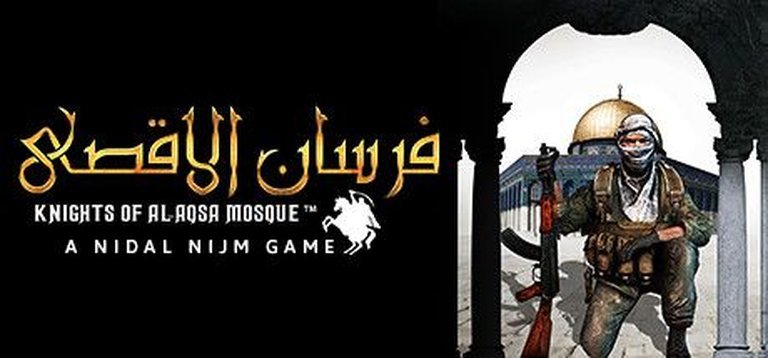
Fursan al-Aqsa: The Knights of the Al-Aqsa Mosque is an action game set against the backdrop of the contemporary Middle East conflict. Players assume the role of Ahmad al-Falastini, a young Palestinian student who, after being unjustly imprisoned and tortured by Israeli soldiers for five years and losing his entire family to an Israeli airstrike, seeks revenge upon his release. The game features a mix of action, warfare, and stealth elements across various mission objectives, all driven by a narrative of personal vengeance and war.
Crack, Patches & Mods
Guides & Walkthroughs
Reviews & Reception
gog.com : This game is different because you are finally able to play the underdog against an opressing genocidal regime.
godkingandnation.substack.com : I have no particular love of Islam, but I must admit I hold Muslims in a certain esteem.
metacritic.com (78/100): What is present throughout the game is the obvious passion that has gone into it. Fursan al-Asqa never falls into a comfortable routine and repeats itself.
Fursan al-Aqsa: The Knights of the Al-Aqsa Mosque: Review
In the annals of video game history, few titles arrive with as much political and cultural baggage as Fursan al-Aqsa: The Knights of the Al-Aqsa Mosque. More than a game, it is a statement—a decade-long labor of love, rage, and defiance by a single developer seeking to shatter one of the industry’s most entrenched paradigms. This is not merely a first-person shooter; it is a digital act of resistance, a deliberate inversion of the power fantasy that has long defined the military shooter genre. To review it is to navigate a minefield of geopolitics, propaganda, and the very purpose of interactive entertainment.
Introduction: A Weaponized Narrative
From the river to the sea, video games have almost universally cast the Western soldier as the hero. For decades, players have been asked to don the digital fatigues of American, British, and Israeli forces, fighting against faceless, often Arab, antagonists in conflicts stripped of their historical and moral complexity. Fursan al-Aqsa violently upends this tradition. Developed by Brazilian-Palestinian solo developer Nidal Nijm, the game is a consciously provocative piece of media that places the player squarely in the boots of a Palestinian resistance fighter. Its very existence is a challenge to the status quo, a gauntlet thrown at the feet of an industry and a world often content with a single narrative. This review will argue that while Fursan al-Aqsa is, by conventional metrics, a flawed and technically unpolished experience, its historical significance, raw passion, and subversive intent make it one of the most important—and controversial—artifacts of its time.
Development History & Context: The One-Man Army
The Visionary and His Mission
Nidal Nijm’s journey is the bedrock upon which the game is built. The son of a Fatah member who emigrated to Brazil after the 1982 Lebanon War, Nijm was encouraged by his father to study game development with a specific, profound goal: to create a game that did not depict the West as the protagonist and to promote the Palestinian struggle. This personal history is not a footnote; it is the game’s entire thesis. Over approximately ten years, working alone, Nijm toiled in a custom version of the Unreal Engine 3 (UDK), a technological choice that itself speaks to the game’s long gestation period and the developer’s limited resources.
A Landscape of Censorship and Controversy
The game’s development was a constant battle against external pressure. A free demo released in September 2021 went viral not for its gameplay, but for its content: the portrayal of Palestinian militants killing Israeli soldiers. This led to its first major confrontation with power. In October 2021, just two months before its planned release, the game was removed from Steam. This followed pressure from the International Legal Forum, an Israeli advocacy group, which warned Valve that the game might violate U.S. anti-terrorism laws. This pre-emptive delisting was a stark demonstration of the external forces arrayed against a narrative it sought to suppress.
Despite this, Nijm persisted. The game finally saw an official release in April 2022, receiving an 18+ advisory rating from the Brazilian Ministry of Justice. Its journey was a preview of the firestorm to come. An updated version in 2023, which incorporated events from the escalating Gaza war including the October 7 attacks, ignited a global media frenzy and led to its removal from Steam in the United Kingdom in October 2024 following a request from the UK’s Counter-Terrorism Internet Referral Unit. Its development history is thus inextricably linked to its reception; it was forged in controversy.
Narrative & Thematic Deep Dive: A Story of Vengeance and Vindication
Plot: The Arc of the Oppressed
The player assumes the role of Ahmad al-Falastini, a young Palestinian student whose backstory is a catalog of trauma designed to justify his radicalization. Unjustly tortured and imprisoned by Israeli soldiers for five years, Ahmad emerges to discover his entire family has been killed in an Israeli airstrike. With nothing left to lose, he seeks revenge by joining the titular resistance movement, Fursan al-Aqsa (The Knights of the Al-Aqsa Mosque).
The narrative is a straightforward revenge tale, but its power derives from its perspective. It intentionally mirrors the origin stories of countless Western video game protagonists—the tragic loss of family, the quest for justice—but applies it to a figure traditionally reserved for the role of villain. The dialogue and cutscenes are described by critics and players as “over-the-top” and “absurd,” featuring a level of melodrama that walks a fine line between earnest propaganda and conscious satire. This tone can disarm criticism; to take the game’s narrative entirely at face value is to potentially miss a layer of deliberate, provocative spectacle.
Themes: Subverting a Genre
Thematically, the game is a direct assault on what Nijm and many players see as a pervasive bias in mainstream media. Its core mission is to “break the cliché of portraying Muslim and Arabs as Terrorists, Bandits, Villains and the Americans/Israelis as the ‘Good Guys’ and ‘Heroes’ of History.” It actively engages with pro-Palestinian slogans, most prominently featuring the phrase “From the River to the Sea, Palestine Will Be Free” in its official marketing.
The game forces the player to engage with a perspective that is systemically excluded from popular entertainment. It is not a nuanced historical documentary but a raw, emotional response to perceived oppression. It frames the conflict not as a complex geopolitical issue but as a simple binary of occupier and occupied, oppressor and freedom fighter. This reductive framing is its greatest strength as a work of propaganda and its greatest weakness as a work of art, but it is undeniably effective in achieving its stated goal: making the player feel what it is like to be on the other side of the rifle sight.
Gameplay Mechanics & Systems: Janky but Passionate
Core Loop and Combat
Built on the aging UDK framework, Fursan al-Aqsa’s gameplay is a testament to the challenges of solo development. Reviews consistently note its lack of polish, with criticisms aimed at its “bad UX, horrible animations and graphics.” The combat is described as functional but unremarkable, drawing clear inspiration from the linear, objective-based missions of classic Call of Duty and the third-person cover mechanics of Metal Gear Solid.
The game features nine missions, each with five objectives, tasking players with a variety of goals from standard shootouts to vehicle sequences, including the operation of a tank. It offers both first and third-person perspectives, a nod to its varied influences. While the systems are not innovative, the Hooked Gamers review noted that “Fursan al-Aqsa never falls into a comfortable routine and repeats itself. There’s always another interesting mission objective or absurd cut-scene.” The gameplay serves the narrative, providing a vehicle for its spectacle rather than being a spectacle in itself.
Jank as a Feature
For a certain segment of players, the game’s technical shortcomings are part of its charm. It embodies the spirit of a passionate, if under-resourced, indie project. The “jank”—the clunky animations, the sometimes-unreliable AI—becomes a badge of honor, a signifier of its authenticity against the homogenized polish of AAA blockbusters. It feels handmade, and in a media landscape dominated by corporate products, that rawness is compelling.
World-Building, Art & Sound: Aesthetic of Resistance
Visual Direction and Setting
The game’s visual presentation is a product of its engine and budget. Using Unreal Engine 3, it achieves a look that is decidedly last-generation, but functional. The settings are drawn from the contemporary Middle East, aiming for a realistic depiction of urban and rural combat zones within Palestine. The art direction is not about graphical fidelity but about establishing a consistent and oppressive atmosphere of conflict.
The iconography is crucial. Israeli flags and military insignia are prominently featured as targets and destructible objects, a simple but powerful act of symbolic violence. The game’s world is built to feel like a place under occupation, a playground for resistance.
Sound Design: A Powerful Tool
The soundtrack is one of the game’s most potent elements. It employs “nasheeds”—Islamic vocal songs—and other music that reinforces the cultural and emotional context of the struggle. This choice is not without its own controversy; some have criticized the use of music as being against Islamic principles, while others see it as a vital part of the game’s authentic texture. The sound design works in tandem with the visuals to create an experience that is relentlessly focused on its thematic mission. Every auditory cue, from the prayers to the explosions, is designed to immerse the player in the perspective of the resistance fighter.
Reception & Legacy: The Controversy is the Point
Critical and Commercial Reception
Commercially, the game has been a niche product. Despite massive media coverage, Newsweek reported it had a peak of just 10 concurrent players on Steam in October 2023. Ynet noted that players tended to “quickly abandon the game” after downloading it. Its impact was never going to be measured in sales.
Critically, it exists in a bifurcated reality. The sole professional review on MobyGames, from Hooked Gamers, awarded it a 78%, praising its relentless passion and novelty while acknowledging its technical flaws. User reviews, however, tell a more polarized story. On platforms like Metacritic and Steam, ratings are intensely bimodal. Supporters hail it as “a really well made indie game with an uplifting story of liberation” and “a fresh breath of air.” Detractors dismiss it as “complete garbage” that “encourages terrorism.” The discourse around the game is almost entirely divorced from its qualities as a piece of software; it is a Rorschach test for the player’s geopolitical views.
Enduring Legacy: A Line in the Sand
The legacy of Fursan al-Aqsa is secure. It will be remembered not for how it played, but for what it represented. It proved that a single determined developer could create a piece of media potent enough to draw the ire of governments and international advocacy groups. It forced a conversation about narrative asymmetry in video games, censorship, and the limits of creative expression.
Its influence can be seen in the growing discourse around “perspective games” and the preservation of controversial art. As one user on GOG wrote, “This game may not be the best, but it is important. It tells the living memory and resistance of a people… And with the game being delisted from Steam in some regions due to government pressure, preserving it… is more important than ever.” It has become a symbol, a digital monument to a perspective that the gaming industry had long ignored and that powerful entities have tried to silence.
Conclusion: An Imperfect, Indispensable Artifact
Fursan al-Aqsa: The Knights of the Al-Aqsa Mosque is not a great game by any standard measure of technical proficiency, narrative complexity, or balanced gameplay. It is janky, melodramatic, and unabashedly propagandistic.
Yet, it is an indispensable artifact of video game history. It is a raw, unfiltered expression of a perspective that is almost entirely absent from the medium. It is a testament to the power of an individual creator to challenge gigantic cultural and corporate narratives. Nidal Nijm did not set out to create a balanced documentary; he set out to create a weapon for a digital intifada, a counter-narrative to decades of what he views as propaganda. In that, he succeeded unequivocally.
Its final verdict is therefore split. As a game, it is a curiosity—a 6/10 experience interesting mostly for its novelty. As a cultural, historical, and political statement, it is a landmark—a 10/10 achievement that redefined the boundaries of what a video game can be and say. It is a game that will be studied, debated, and condemned for years to come, and for that alone, it has earned its place in the pantheon of gaming’s most consequential titles.