
- Release Year: 2004
- Platforms: Windows
- Publisher: TOPOS Verlag GmbH
- Developer: Mediaphor Software Entertainment AG
- Genre: Sports
- Perspective: Diagonal-down
- Game Mode: LAN, Single-player
- Gameplay: League Play, Tactical Planning, Team Management
- Average Score: 71/100
Description
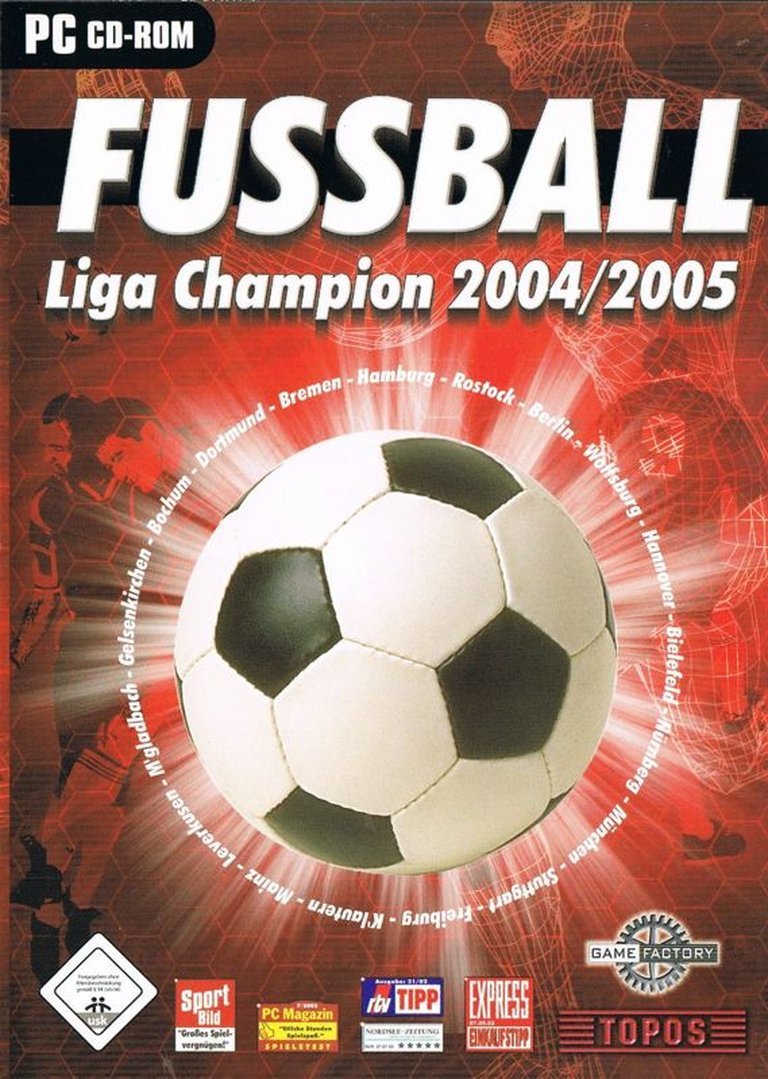
Fussball Liga Champion 2004/2005 is a football simulation game released in 2004 for Windows, developed by Mediaphor Software Entertainment AG. The game allows players to manage and train teams, set tactics, and compete in various leagues and championships. With over 800 players across 40 teams, each with unique skills, players can enjoy both single-player matches against AI and multiplayer games against other players. The game is known for its intuitive interface, realistic graphics, and challenging gameplay, making it appealing to football enthusiasts of all ages.
Fussball Liga Champion 2004/2005 Reviews & Reception
cubed3.com : we have to say this is probably the best ‘FIFA’ game so far.
Fussball Liga Champion 2004/2005 Cheats & Codes
PC
Enter codes during gameplay.
| Code | Effect |
|---|---|
| D+X | the ball will take effect |
| D+C | the player will not shout and the GK will jump and you will have a lot of space in your face |
| D+C | the GK will jump and the player will not shout |
| D + C | the ball will take effect |
Fussball Liga Champion 2004/2005: Review
Introduction
In the golden age of mid-2000s football simulations, Fussball Liga Champion 2004/2005 emerged as a quiet contender—a German-engineered title aiming to carve its niche in a market dominated by EA’s FIFA and Konami’s Pro Evolution Soccer. Developed by Mediaphor Software Entertainment AG and published by TOPOS Verlag GmbH, this game promised depth through tactical nuance, team management, and a robust roster of 800 players across 40 clubs. Yet, its legacy remains obscure, buried under the weight of bigger franchises. This review explores whether Fussball Liga Champion deserves recognition as an underappreciated gem or if its anonymity is justified.
Development History & Context
Studio Vision and Constraints
Mediaphor Software Entertainment AG, a lesser-known German developer, sought to capitalize on Europe’s football craze with a simulation tailored for armchair managers. Released on September 15, 2004, the game entered a crowded field: EA’s UEFA Champions League 2004-2005 and FIFA 2005 offered polished gameplay, while Pro Evolution Soccer reigned supreme in tactical realism. Mediaphor’s ambition was clear—create a budget-friendly alternative emphasizing managerial control and player individuality.
Technological Landscape
Built for Windows 98/ME/XP, Fussball Liga Champion faced limitations. The diagonal-down camera perspective echoed early 2000s football games, avoiding the 3D overhaul seen in EA’s titles. With a modest CD-ROM release, it lacked the cinematic flair of its competitors but focused on accessibility for low-end PCs—a deliberate choice for broader reach in an era of varying hardware capabilities.
Narrative & Thematic Deep Dive
As a sports simulator, Fussball Liga Champion foregoes traditional storytelling for a structure centered on career progression. Players assume the role of a manager tasked with leading their chosen team—drawing from real-world clubs like Juventus, Barcelona, and Manchester United (albeit unlicensed)—through friendlies, league matches, and cup tournaments.
Themes of Strategy and Rivalry
The game’s thematic core lies in its emphasis on tactical mastery. From adjusting formations to managing mid-game injuries and substitutions, every decision impacts the season’s trajectory. Unlike narrative-driven sports titles, its drama unfolds through emergent moments: a last-minute goal to secure promotion or a star player’s season-ending injury.
Gameplay Mechanics & Systems
Core Gameplay Loop
– Tactical Depth: Players customize strategies with options for build-up play, diagonal passes, and defensive formations. The “individual skills” system differentiates players, requiring managers to adapt tactics to their squad’s strengths.
– Match Execution: The diagonal-down perspective simplifies spatial awareness but limits immersion. Controls are direct yet clunky compared to PES’s fluidity, with passing and shooting feeling utilitarian rather than dynamic.
– Management Systems: Training modules and squad rotations add depth, though menus are overly simplistic, lacking the polish of Football Manager.
Innovations and Flaws
– Automatic Substitutions: A standout feature, automating substitutions based on fatigue, though occasionally erratic.
– Online Play: A rarity for 2004, offering tournaments and cash prizes—a bold but underutilized experiment due to limited player bases.
– UI Shortcomings: The interface feels dated, with cramped menus and minimal feedback during matches.
World-Building, Art & Sound
Visual Direction
The game’s graphics straddle realism and pragmatism. While player models lack detail, stadiums and crowds are rendered with surprising vibrancy for a budget title. Customizable camera angles and crowd noise settings add a layer of personalization, though the overall aesthetic pales next to FIFA’s licensed authenticity.
Sound Design
A German commentator provides play-by-play narration, a niche touch for its target audience. Chants and ambient crowd noises vary by stadium, but the limited soundtrack and repetitive dialogue loops highlight budget constraints.
Reception & Legacy
Critical and Commercial Performance
No formal critic reviews exist, per MobyGames and Amazon listings, suggesting minimal marketing and distribution. Player feedback is equally scarce, with eBay and abandonware sites indicating niche collector interest. Commercial obscurity was likely inevitable amid EA and Konami’s dominance.
Industry Influence
While Fussball Liga Champion didn’t revolutionize the genre, its focus on management-heavy gameplay foreshadowed the rise of hybrid titles like FIFA Manager. Its abandonment of licensed teams also mirrored the indie ethos of later football sims like Sensible Soccer.
Conclusion
Fussball Liga Champion 2004/2005 is a fascinating relic—a game that prioritized tactical rigor and accessibility over spectacle. Its lack of polish and licensing relegated it to obscurity, but for enthusiasts of granular team management, it offered a compelling alternative. Today, it stands as a testament to the mid-2000s’ diverse football gaming landscape, where ambition sometimes outstripped execution. While not a masterpiece, it deserves acknowledgment as a curious footnote in sports simulation history.
Final Verdict: A flawed yet earnest attempt at football realism, best suited for historians and collectors of forgotten games.