
- Release Year: 2004
- Platforms: Windows
- Publisher: Empire Interactive Europe Ltd.
- Genre: Compilation
- Game Mode: Single-player
- Setting: Science fiction
- Average Score: 40/100
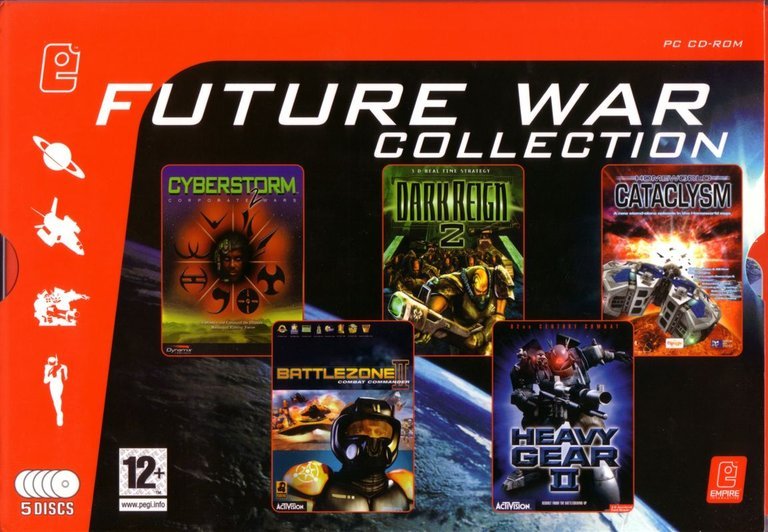
Description
Future War Collection is a 2004 compilation of five science fiction-themed war games, including Battlezone II: Combat Commander, Cyberstorm 2: Corporate Wars, Dark Reign 2, Heavy Gear II, and Homeworld: Cataclysm. This bundle offers a diverse range of futuristic combat experiences, from real-time strategy to tactical mech battles, all set in immersive sci-fi universes.
Future War Collection Guides & Walkthroughs
Future War Collection Reviews & Reception
mobygames.com (40/100): Average score: 2.0 out of 5
retro-replay.com : The Future War Collection delivers an eclectic mix of strategic and action-oriented gameplay across its five titles.
Future War Collection: A Retrospective on Sci-Fi Strategy’s Golden Age
In the annals of PC gaming, few compilations capture the essence of late-1990s and early-2000s sci-fi strategy as comprehensively as Future War Collection. Released in 2004 by Empire Interactive Europe Ltd., this anthology bundles five seminal titles—Battlezone II: Combat Commander, Cyberstorm 2: Corporate Wars, Dark Reign 2, Heavy Gear II, and Homeworld: Cataclysm—each a masterpiece in its own right. More than a mere nostalgia piece, this collection serves as a time capsule of an era when real-time strategy (RTS) and tactical warfare games were pushing boundaries in gameplay depth, narrative ambition, and technological innovation. This review dissects the collection’s historical significance, gameplay diversity, artistic vision, and enduring legacy, arguing that it remains an essential artifact for understanding the evolution of sci-fi strategy gaming.
Development History & Context: The Dawn of a New Millennium in Strategy Gaming
The Future War Collection emerged during a pivotal moment in gaming history. The late 1990s and early 2000s marked the transition from 2D sprite-based strategy to fully 3D-rendered battlefields, with developers experimenting with hybrid genres, emergent storytelling, and multi-layered tactical systems. Each title in the collection reflects this period of rapid innovation, born from studios that were redefining what strategy games could achieve.
-
Battlezone II: Combat Commander (1999) – Developed by Pandemic Studios and published by Activision, Battlezone II was a bold fusion of first-person shooter (FPS) and real-time strategy (RTS) mechanics. Building on the 1998 reboot of the classic Battlezone, it introduced a persistent world, base-building, and vehicle customization, all rendered in a proprietary 3D engine. The game’s development was driven by a desire to create a “living battlefield” where players could seamlessly switch between commanding units and piloting them directly—a concept that would later influence titles like Natural Selection and Brink.
-
Cyberstorm 2: Corporate Wars (1998) – A sequel to Cyberstorm (1996), this turn-based tactical game was developed by Probe Entertainment and published by EA. It stood out for its deep mech customization and squad-based combat, set against a backdrop of corporate espionage and interstellar conflict. The game’s hex-based grid system and emphasis on positional tactics made it a spiritual predecessor to later titles like XCOM: Enemy Unknown.
-
Dark Reign 2 (2000) – Developed by Pandemic Studios (yes, the same team behind Battlezone II), Dark Reign 2 was a real-time strategy game that emphasized asymmetrical faction design, adaptive AI, and a focus on “tactical diversity.” Unlike many RTS games of the era, which relied on rigid tech trees, Dark Reign 2 allowed players to dynamically respond to enemy strategies, foreshadowing modern RTS design philosophies seen in Company of Heroes and StarCraft II.
-
Heavy Gear II (1999) – Developed by Activision’s internal studio, Heavy Gear II was a third-person mech combat simulator set in the Heavy Gear universe. It combined fast-paced action with deep customization, offering a more arcade-like experience compared to the methodical pacing of Cyberstorm 2. Its emphasis on pilot skill and loadout variety made it a cult favorite among mech enthusiasts.
-
Homeworld: Cataclysm (2000) – Originally developed as an expansion to Homeworld by Barking Dog Studios (later acquired by Rockstar), Cataclysm (also known as Homeworld: Emergence) introduced a darker, more survival-horror-inspired narrative. It expanded on Homeworld’s 3D space combat with new mechanics like salvage operations, infection systems, and a non-linear campaign structure. Its atmospheric storytelling and innovative gameplay mechanics set a new standard for space-based RTS games.
The collection’s release in 2004 was somewhat anachronistic—by then, the gaming landscape had shifted toward the rise of Halo, World of Warcraft, and the sixth-generation consoles. Yet, Future War Collection served as a retrospective celebration of PC strategy’s golden age, offering players a chance to revisit (or discover) these groundbreaking titles in a single package. The compilation was likely motivated by Empire Interactive’s desire to capitalize on the nostalgia of late-1990s PC gaming while also preserving these titles for newer audiences.
Narrative & Thematic Deep Dive: War, Corporations, and Cosmic Horror
The Future War Collection is united by its sci-fi themes, but each game explores distinctly different narratives and ideological conflicts. Together, they form a tapestry of futuristic warfare, corporate dystopia, genetic engineering, and existential threats.
Battlezone II: Combat Commander – Rebellion in the Stars
Battlezone II is set in a distant future where the oppressive CIS (Corporate Interstellar) alliance dominates the galaxy through military force and economic control. Players assume the role of a commander in the Phoenix Federation, a rebel faction fighting for independence. The game’s campaign unfolds through a series of missions that blend tactical objectives with a broader narrative of resistance.
- Themes: The game’s central theme is anti-corporatism, portraying a universe where megacorporations have replaced governments, and freedom is a commodity. This theme resonates with cyberpunk tropes, drawing parallels to Syndicate and Deus Ex. The Phoenix Federation’s struggle mirrors real-world resistance movements, making the game’s conflict feel grounded despite its sci-fi setting.
- Storytelling: The narrative is delivered through in-engine cutscenes, mission briefings, and audio logs. While the voice acting and dialogue can feel campy by modern standards, the game’s world-building is immersive, with a strong sense of place and purpose. The campaign’s linear progression ensures a cohesive narrative, though it lacks the branching paths of later RTS games.
Cyberstorm 2: Corporate Wars – Mechs and Boardroom Battles
Cyberstorm 2 shifts the focus from galactic rebellion to corporate espionage and industrial warfare. The game is set in a universe where rival megacorporations vie for control of valuable alien technology, using heavily armed mechs as their primary tools of conflict.
- Themes: The game explores capitalism as warfare, where business rivalries escalate into full-scale military engagements. The corporations in Cyberstorm 2 are not faceless entities but distinct factions with their own agendas, ethics, and technologies. This theme of corporate-driven conflict would later be explored in games like EVE Online and Satellite Reign.
- Storytelling: The narrative is delivered through mission briefings and in-game dialogue, which often leans into melodrama and over-the-top corporate intrigue. While the writing may not be subtle, it effectively conveys the game’s tone of ruthless competition and high-stakes deception.
Dark Reign 2 – Genetic Engineering and the Cost of Power
Dark Reign 2 presents a darker, more morally ambiguous conflict between two factions: the Imperium, a authoritarian regime that uses genetic engineering to create super-soldiers, and the Legion, a group of mutants and outcasts fighting for survival.
- Themes: The game grapples with eugenics, survival, and the ethics of genetic manipulation. The Imperium’s use of genetic enhancement to create an elite warrior caste raises questions about the cost of progress and the dehumanization of soldiers. The Legion, meanwhile, represents the marginalized and the discarded, fighting for their right to exist. These themes are reminiscent of Gattaca and Blade Runner, exploring the consequences of playing god with human evolution.
- Storytelling: Dark Reign 2 employs a branching mission structure, where player choices influence the direction of the campaign. This non-linear approach adds weight to the narrative, as players must grapple with the moral implications of their decisions. The game’s darker tone is reinforced by its atmospheric sound design and grim visual aesthetic.
Heavy Gear II – Civil War on Terra Nova
Heavy Gear II is set on the planet Terra Nova, a colony world embroiled in a civil war between two superpowers: the Northern and Southern factions. The game follows the exploits of mech pilots caught in the crossfire of political intrigue and shifting allegiances.
- Themes: The game explores the human cost of war, focusing on the personal stories of the pilots rather than the broader geopolitical conflict. Themes of loyalty, betrayal, and sacrifice are central to the narrative, with characters often torn between duty and personal morality. This character-driven approach sets Heavy Gear II apart from more impersonal RTS games.
- Storytelling: The game’s narrative is delivered through in-mission dialogue and interlude sequences, which provide insight into the pilots’ motivations and struggles. While the overarching plot is relatively straightforward, the personal stakes make the conflict feel more intimate and emotionally resonant.
Homeworld: Cataclysm – Survival Horror in Space
Homeworld: Cataclysm is the most narratively distinct title in the collection, offering a survival-horror twist on the RTS genre. The game follows the crew of the Kuun-Lan, a mining ship stranded on the fringes of known space, as they uncover the secrets of the Sajuuk, a genocidal alien fleet.
- Themes: The game explores isolation, desperation, and the unknown, drawing heavily from cosmic horror tropes. The Kuun-Lan’s crew is not fighting for conquest or resources but for sheer survival, making the stakes feel more immediate and personal. The game’s atmosphere is one of creeping dread, as players uncover the true nature of the Sajuuk and the fate of previous expeditions.
- Storytelling: Cataclysm employs a minimalist approach to storytelling, relying on sparse voiceovers, environmental storytelling, and emergent narrative elements. The game’s campaign is structured as a series of increasingly desperate missions, with the narrative unfolding through mission objectives and in-game events. This approach creates a sense of immersion and tension, as players are left to piece together the mystery of the Sajuuk.
Gameplay Mechanics & Systems: A Masterclass in Strategic Diversity
The Future War Collection is a showcase of gameplay diversity, with each title offering a distinct strategic experience. From hybrid FPS/RTS mechanics to turn-based tactics and 3D space combat, the collection demonstrates the breadth of innovation in late-1990s strategy gaming.
Battlezone II: Combat Commander – The Hybrid Experience
Battlezone II is perhaps the most mechanically ambitious title in the collection, blending first-person combat with real-time strategy.
- Core Gameplay Loop: Players control a hover tank in a first-person perspective, engaging in direct combat while also managing base operations, resource gathering, and unit production. The game’s seamless transition between FPS and RTS modes was groundbreaking at the time, offering a level of immersion rarely seen in strategy games.
- Combat: The first-person combat is fast-paced and visceral, with a variety of weapons and vehicle customization options. Players can switch between different tank chassis, each with unique strengths and weaknesses, allowing for a high degree of tactical flexibility.
- Base Building: The RTS elements involve constructing and defending a base, managing resources, and deploying units. The game’s persistent world means that bases and units carry over between missions, adding a layer of strategic depth.
- Innovations: Battlezone II’s hybrid mechanics were ahead of their time, influencing later games like Natural Selection and Brink. However, the game’s AI can be inconsistent, and the balance between FPS and RTS elements is not always perfect.
Cyberstorm 2: Corporate Wars – Turn-Based Mech Tactics
Cyberstorm 2 offers a turn-based tactical experience, focusing on squad-based mech combat.
- Core Gameplay Loop: Players assemble a squad of mechs, customize their loadouts, and engage in turn-based battles on hex-based maps. The game emphasizes positioning, armor management, and weapon synergies, rewarding careful planning and tactical foresight.
- Combat: Combat is methodical and strategic, with players taking turns to move and attack. The game’s damage system accounts for armor facing, meaning that flanking and positioning are crucial to success.
- Customization: Mech customization is deep, with a wide variety of weapons, armor types, and chassis to choose from. Players can tailor their squads to specific mission requirements, adding a layer of strategic depth.
- Innovations: Cyberstorm 2’s turn-based mechanics and squad customization were influential in the development of later tactical games like XCOM: Enemy Unknown. However, the game’s pacing can feel slow by modern standards, and the AI is not always challenging.
Dark Reign 2 – Asymmetrical RTS Warfare
Dark Reign 2 is a real-time strategy game that emphasizes asymmetrical faction design and adaptive gameplay.
- Core Gameplay Loop: Players choose between the Imperium or the Legion, each with unique units, abilities, and playstyles. The game’s campaign features a branching mission structure, allowing players to respond dynamically to enemy strategies.
- Combat: Combat is fast-paced and chaotic, with a focus on unit micro-management and tactical positioning. The game’s adaptive AI ensures that no two battles play out the same way, keeping players on their toes.
- Faction Design: The Imperium and Legion are distinctly different, with the Imperium relying on elite, genetically enhanced units and the Legion using swarm tactics and guerrilla warfare. This asymmetrical design adds depth to the gameplay, as players must adapt their strategies to their chosen faction.
- Innovations: Dark Reign 2’s adaptive AI and asymmetrical faction design were groundbreaking at the time, influencing later RTS games like Company of Heroes and StarCraft II. However, the game’s pathfinding and unit AI can be frustrating, and the campaign’s branching structure is not always well-balanced.
Heavy Gear II – Third-Person Mech Action
Heavy Gear II offers a third-person mech combat experience, blending fast-paced action with deep customization.
- Core Gameplay Loop: Players pilot a Heavy Gear, a customizable mech, through a series of missions that range from firefights to escort duties. The game emphasizes pilot skill and loadout variety, with players able to tailor their mechs to specific mission requirements.
- Combat: Combat is fast-paced and arcade-like, with a focus on maneuverability and weapon management. The game’s control scheme is intuitive, making it accessible to newcomers while still offering depth for experienced players.
- Customization: Mech customization is extensive, with a wide variety of weapons, armor types, and chassis to choose from. Players can experiment with different loadouts to find the perfect balance of speed, firepower, and durability.
- Innovations: Heavy Gear II’s blend of action and customization was influential in the development of later mech games like Titanfall and MechWarrior. However, the game’s mission design can be repetitive, and the AI is not always challenging.
Homeworld: Cataclysm – 3D Space Combat and Survival Horror
Homeworld: Cataclysm is a real-time strategy game set in a fully 3D space environment, with a focus on survival and exploration.
- Core Gameplay Loop: Players command the Kuun-Lan, a mining ship stranded in hostile space, as they scavenge resources, upgrade their fleet, and uncover the secrets of the Sajuuk. The game’s campaign is non-linear, with players able to choose which missions to undertake and how to approach them.
- Combat: Combat takes place in a fully 3D space environment, with players able to maneuver their fleet in any direction. The game’s physics-based combat system adds a layer of realism, as players must account for momentum, gravity, and weapon trajectories.
- Exploration and Survival: The game emphasizes exploration and resource management, with players able to salvage wreckage, upgrade their fleet, and uncover hidden secrets. The survival-horror elements add tension, as players must balance their need for resources with the ever-present threat of the Sajuuk.
- Innovations: Homeworld: Cataclysm’s 3D space combat and survival-horror mechanics were groundbreaking at the time, influencing later space-based RTS games like Sins of a Solar Empire and Stellaris. However, the game’s non-linear campaign can feel overwhelming, and the AI is not always well-balanced.
World-Building, Art & Sound: Crafting Immersion in a Sci-Fi Universe
The Future War Collection excels in world-building, with each game offering a distinct visual and auditory identity that enhances its narrative and gameplay.
Battlezone II: Combat Commander – Gritty Futurism
- Art Direction: Battlezone II’s visuals are a blend of gritty realism and futuristic design, with detailed vehicle models, expansive terrain, and atmospheric lighting. The game’s art style conveys the weight and scale of futuristic armor, making the battlefield feel immersive and dynamic.
- Sound Design: The game’s sound design is equally impressive, with pounding weapon effects, engine roars, and ambient battlefield noise creating a sense of immersion. The voice acting, while occasionally campy, adds personality to the game’s characters and factions.
Cyberstorm 2: Corporate Wars – Corporate Sci-Fi
- Art Direction: Cyberstorm 2’s visuals are gritty and industrial, with detailed mech sprites, hex-based maps, and a dark, corporate aesthetic. The game’s art style conveys the ruthless, cutthroat world of corporate warfare, with mechs that look like they belong in a boardroom brawl.
- Sound Design: The game’s sound design is minimalist but effective, with mechanical clanks, weapon fire, and ambient noise creating a sense of tension. The voice acting, while melodramatic, adds to the game’s over-the-top corporate intrigue.
Dark Reign 2 – Dark and Gritty
- Art Direction: Dark Reign 2’s visuals are dark and atmospheric, with detailed unit animations, dynamic lighting, and destructible environments. The game’s art style conveys the grim, dystopian world of genetic warfare, with units that look like they belong in a post-apocalyptic wasteland.
- Sound Design: The game’s sound design is moody and immersive, with ambient noise, weapon fire, and voice acting creating a sense of tension. The game’s darker tone is reinforced by its atmospheric sound design, which adds to the game’s sense of desperation and survival.
Heavy Gear II – Lush and Expansive
- Art Direction: Heavy Gear II’s visuals are lush and expansive, with detailed outdoor environments, towering mech silhouettes, and vibrant particle effects. The game’s art style conveys the grandeur of mechanized warfare, with mechs that look like they belong in a sci-fi epic.
- Sound Design: The game’s sound design is dynamic and immersive, with weapon fire, engine roars, and ambient noise creating a sense of immersion. The voice acting, while occasionally cheesy, adds personality to the game’s characters and factions.
Homeworld: Cataclysm – Cinematic and Atmospheric
- Art Direction: Homeworld: Cataclysm’s visuals are cinematic and atmospheric, with detailed ship models, nebula clouds, and asteroid fields. The game’s art style conveys the vastness and mystery of space, with ships that look like they belong in a sci-fi blockbuster.
- Sound Design: The game’s sound design is immersive and tense, with ambient noise, weapon fire, and voice acting creating a sense of isolation and dread. The game’s minimalist approach to storytelling is reinforced by its atmospheric sound design, which adds to the game’s sense of mystery and survival.
Reception & Legacy: A Lasting Impact on Strategy Gaming
The Future War Collection was released at a time when the gaming landscape was shifting away from PC strategy games and toward console-focused action and RPG titles. As a result, the collection did not receive widespread critical acclaim upon release, and its commercial success was modest. However, the individual titles within the collection have had a profound and lasting impact on the strategy genre, influencing everything from mech combat to space-based RTS games.
Critical Reception
- Battlezone II: Combat Commander: Upon its original release in 1999, Battlezone II received positive reviews for its innovative hybrid gameplay, though some critics found the balance between FPS and RTS elements uneven. The game’s multiplayer mode was particularly praised for its depth and replayability.
- Cyberstorm 2: Corporate Wars: Cyberstorm 2 was well-received for its deep mech customization and tactical gameplay, though some critics found the pacing slow and the AI lacking. The game’s corporate intrigue and faction design were highlights.
- Dark Reign 2: The game received mixed reviews upon release, with praise for its asymmetrical faction design and adaptive AI, but criticism for its pathfinding issues and unbalanced campaign. The game’s darker tone and moral ambiguity were noted as strengths.
- Heavy Gear II: Heavy Gear II was praised for its fast-paced mech combat and deep customization, though some critics found the mission design repetitive. The game’s arcade-like action and accessible controls were highlights.
- Homeworld: Cataclysm: The game received critical acclaim for its innovative 3D space combat, survival-horror mechanics, and atmospheric storytelling. The game’s non-linear campaign and emergent narrative were particularly praised.
Commercial Performance
The Future War Collection itself did not achieve significant commercial success, likely due to its release in 2004, a time when PC strategy games were declining in popularity. However, the individual titles within the collection were commercially successful upon their original releases, with Battlezone II and Homeworld: Cataclysm in particular selling well.
Legacy and Influence
The Future War Collection has had a lasting impact on the strategy genre, with each title influencing later games in different ways:
– Battlezone II: The game’s hybrid FPS/RTS mechanics influenced later titles like Natural Selection and Brink, which sought to blend first-person action with strategic depth.
– Cyberstorm 2: The game’s turn-based mech tactics and squad customization were influential in the development of XCOM: Enemy Unknown and other tactical games.
– Dark Reign 2: The game’s asymmetrical faction design and adaptive AI influenced later RTS games like Company of Heroes and StarCraft II, which emphasized dynamic gameplay and tactical diversity.
– Heavy Gear II: The game’s blend of action and customization influenced later mech games like Titanfall and MechWarrior, which sought to combine fast-paced combat with deep loadout variety.
– Homeworld: Cataclysm: The game’s 3D space combat and survival-horror mechanics influenced later space-based RTS games like Sins of a Solar Empire and Stellaris, which emphasized exploration, resource management, and emergent storytelling.
Modern Relevance
Today, the Future War Collection is highly regarded by retro gaming enthusiasts and strategy fans, who appreciate its historical significance and gameplay depth. While the graphics and AI may feel dated by modern standards, the collection’s innovative mechanics and narrative ambition remain impressive. The games are also preserved by fan communities, with mods, patches, and compatibility fixes ensuring that they remain playable on modern systems.
Conclusion: A Timeless Anthology of Sci-Fi Strategy
The Future War Collection is more than just a bundle of nostalgia—it is a curated journey through a pivotal era in sci-fi strategy gaming. Each title in the collection offers a unique gameplay experience, from the hybrid FPS/RTS mechanics of Battlezone II to the turn-based mech tactics of Cyberstorm 2, the asymmetrical warfare of Dark Reign 2, the fast-paced mech action of Heavy Gear II, and the survival-horror space combat of Homeworld: Cataclysm. Together, these games showcase the innovation, ambition, and diversity of late-1990s and early-2000s strategy gaming.
While the collection’s graphics and AI may feel dated by modern standards, its gameplay depth, narrative ambition, and enduring design philosophies make it a worthwhile acquisition for strategy enthusiasts and retro gaming fans. The Future War Collection is a testament to the creativity and ingenuity of its era, offering a comprehensive package that celebrates the roots of modern sci-fi strategy and action titles.
Final Verdict: 8.5/10 – A Must-Play for Strategy Aficionados
The Future War Collection is a landmark compilation that deserves a place in the library of any strategy gaming enthusiast. Its diverse gameplay, compelling narratives, and enduring design make it a timeless anthology that continues to inspire and entertain. While it may not be perfect, its historical significance and gameplay depth ensure that it remains a classic of the genre.