
- Release Year: 1998
- Platforms: DOS, Windows 16-bit, Windows
- Publisher: Sierra On-Line, Inc.
- Developer: Sierra On-Line, Inc.
- Genre: Compilation
- Perspective: Third-person
- Game Mode: Single-player
- Setting: Horror
- Average Score: 81/100
Description
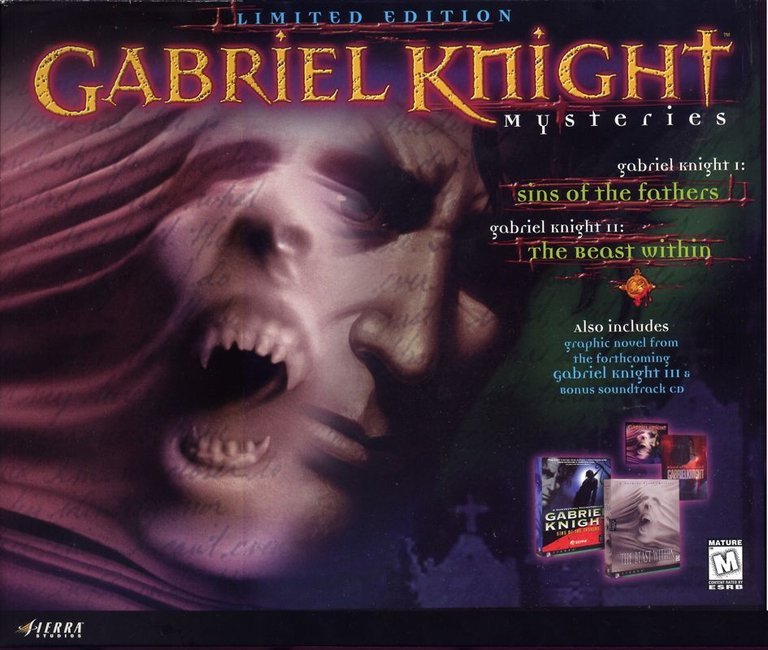
Gabriel Knight Mysteries: Limited Edition is a special compilation package that introduces players to the horror and adventure world of the Gabriel Knight series, featuring the first two groundbreaking adventure games—Gabriel Knight: Sins of the Fathers, set amid voodoo mysteries in New Orleans, and The Beast Within: A Gabriel Knight Mystery, a full-motion video tale of werewolf lore in Germany—along with a graphical novel for the third installment, Blood of the Sacred, Blood of the Damned, and a CD soundtrack from the original game.
Gabriel Knight Mysteries: Limited Edition Reviews & Reception
mobygames.com (81/100): The GK Mysteries package is recommended for the completist only.
pcgamesnewreleases.blogspot.com : They truly are the best.
retro-replay.com : masterclass in puzzle design and narrative exploration.
mobygames.com (82/100): The GK Mysteries package is recommended for the completist only.
Gabriel Knight Mysteries: Limited Edition: Review
Introduction
In the shadowed bayous of New Orleans and the mist-shrouded forests of Bavaria, where voodoo rituals clash with ancient werewolf curses, few video game series have woven supernatural horror into point-and-click adventure mastery quite like Gabriel Knight. Released in 1998 by Sierra On-Line amid the twilight of the adventure genre’s golden age, Gabriel Knight Mysteries: Limited Edition bundles the first two installments—Gabriel Knight: Sins of the Fathers (1993) and The Beast Within: A Gabriel Knight Mystery (1995)—alongside tantalizing extras like a graphic novel prologue for the unreleased third game (in this context, teasing Blood of the Sacred, Blood of the Damned), a CD soundtrack, and in some editions, Jane Jensen’s novelization of the original. This collector’s package isn’t just a rehash; it’s a time capsule of narrative ambition, technological daring, and cultural depth that elevates mundane murders into mythic quests. My thesis: As a pinnacle of 1990s adventure gaming, the Limited Edition cements the Gabriel Knight series as an enduring legacy, offering unmatched storytelling and atmospheric immersion that influenced the genre’s evolution toward cinematic depth, even as it grapples with the era’s pricing and compatibility pitfalls.
Development History & Context
Sierra On-Line, the adventure game behemoth behind King’s Quest and Space Quest, was riding high in the early 1990s but seeking edgier fare to compete in a maturing market. Enter Jane Jensen, a former Hewlett-Packard programmer turned writer, hired in 1990 after impressing with a short story submission. Fresh from contributions to Police Quest III and co-designing EcoQuest: The Search for Cetus, Jensen apprenticed under Roberta Williams on the lauded King’s Quest VI: Heir Today, Gone Tomorrow (1992), absorbing lessons in narrative layering and team direction. Emboldened, she pitched Sins of the Fathers—a neo-noir horror thriller inspired by Angel Heart, blending voodoo lore with family curses—in 1992. Sierra co-founder Ken Williams greenlit the dark tone, diverging from the company’s whimsical roots.
Technological constraints defined the era: Sins launched Sierra’s SCI32 engine for 640×480 VGA graphics, supporting voice acting on CD-ROM (floppy versions used subtitles and static images). The all-star cast—Tim Curry as Gabriel, Mark Hamill as Mosely, Leah Remini as Grace—elevated it, but development hit snags transitioning engines, delaying release to December 17, 1993. Sales were solid but not blockbuster, prompting a bolder sequel. The Beast Within (1995) embraced full-motion video (FMV), filming live actors like Dean Erickson (Gabriel) and Joanne Takahashi (Grace) against blue screens on virtual sets derived from Phantasmagoria. Budget ballooned nearly $1 million over its $3 million target, forcing a chapter cut (originally eight, shipped as six across six CDs). Released amid FMV hype, it capitalized on CD-ROM ubiquity but highlighted the tech’s pitfalls: high costs, B-movie vibes in lesser hands.
By 1998, adventure games waned against 3D action titles like Quake, and Sierra restructured post-CUC acquisition. The Limited Edition repackaged GK1 (1 CD) and GK2 (6 CDs) with digital manuals, a 419-page Sins novelization by Jensen (expanding game events), the Sins soundtrack CD by Robert Holmes (Jensen’s husband), a 33-page graphic novel on ancestor Günter Ritter, and a 20-page GK3 prologue. Priced at $50, it targeted completists amid abandonware proliferation on eBay. Platforms spanned DOS, Windows, and Windows 3.x (16-bit), with keyboard/mouse input and Mature ESRB rating. This context underscores a desperate bid to sustain a dying genre through collector appeal.
Narrative & Thematic Deep Dive
At its core, Gabriel Knight Mysteries chronicles reluctant hero Gabriel Knight—a sardonic, skirt-chasing New Orleans bookstore owner and struggling novelist—as he uncovers his Schattenjäger (“Shadow Hunter”) destiny, battling supernatural threats with wits over powers. Sins of the Fathers unfolds over “days” in a linear yet explorable structure: Gabriel probes “Voodoo Murders” for book fodder, aided by researcher Grace Nakimura and detective Mosely. Nightmares reveal his Ritter lineage; Uncle Wolfgang at Schloss Ritter unveils the family curse from a 17th-century ancestor. Themes probe heritage vs. hedonism—Gabriel’s arc from dilettante to duty-bound hunter culminates in dual endings (love/forgiveness or justice), blending voodoo history (real rituals like Dr. John’s museum) with fiction. Dialogue sparkles: Curry’s wry timbre bickers with Remini’s sharp Grace, narrated by Virginia Capers.
The Beast Within, set a year later, alternates chapters between Gabriel (in Rittersberg/Munich) and playable Grace. Gabriel probes werewolf attacks tied to Baron von Glower’s hunting club; Grace unearths Mad King Ludwig II and Wagner lore, linking to the “Black Wolf.” Their budding romance simmers amid moral ambiguity—Gabriel’s temptations mirror his doubts. Jensen’s script, praised as “interactive Anne Rice,” expands in the novelization (rewritten from scratch for cohesion). Extras deepen lore: The GK1 graphic novel details Günter’s voyage; GK3’s prologue sets Rennes-le-Château intrigue with vampires, Templars, and Grail myths.
Themes unify: Supernatural as metaphor for personal demons, research as empowerment (Grace’s growth from sidekick to partner), and folklore authenticity (voodoo, lycanthropy). Dialogue trees reward nuance—exhaust options for points, uncovering subplots like Gerde Hull’s devotion. No overt romance in GK1 teases GK2/3 tensions; Grace’s agency evolves her from “moral compass” to equal, lauded as a realistic female lead sans tropes.
Gameplay Mechanics & Systems
Classic point-and-click loops dominate: Investigate scenes, interrogate NPCs via branching trees, collect/use inventory for puzzles, accruing points (full scores unlock max endings). Sins offers nonlinear “day” progression—e.g., autopsy dissections, voodoo doll rituals— with rare deaths (restorable saves). UI is intuitive: Single “hand” icon walks/talks/interacts; talk menus cycle topics. Arcade elements like lockpicking add variety.
The Beast Within innovates with FMV: Pre-rendered videos trigger on hotspots, alternating Gabriel/Grace control. Puzzles escalate—Wagner opera reconstructions via timed inputs, wolf disguises— but linearity bites (one chapter cut). No combat; progression gates via “time blocks.” Both award optional points for easter eggs, encouraging replays.
Limited Edition adds non-interactive bonuses: Soundtrack immerses passively; novels/graphic novels expand canon without mechanics. Flaws persist: Obtuse puzzles (e.g., pixel-hunting), no hints, modern incompatibility (needs patches like ScummVM). Yet systems shine in rewarding curiosity, mirroring Schattenjäger research.
World-Building, Art & Sound
New Orleans’ steamy alleys and bayous in Sins burst with hand-painted 256-color VGA splendor—St. George’s Rare Books feels lived-in, voodoo shops pulse authenticity. Beast Within‘s Bavaria contrasts: Grainy FMV on photo backdrops evokes documentary grit, castles looming ethereally. Graphic novels amplify: Terese Nielsen’s vivid 17th-century panels; Ron Spears’ GK3 previews.
Robert Holmes’ scores—haunting piano, orchestral swells—define mood: Sins‘ jazz-infused dread, Beast‘s Wagnerian leitmotifs. Voice acting elevates: Curry/Hamill/Remini in GK1 outshine GK2’s earnest Erickson/Takahashi. Atmosphere builds immersion—nightmares, multilingual chants—making worlds tangible, supernatural threats visceral.
Reception & Legacy
Launches shone: Sins nabbed 1994 Game of the Year (Computer Gaming World); Beast topped charts, mainstream nods from Rolling Stone. Limited Edition scored 8.1/10 on MobyGames (55 raters), but jTrippy’s 2009 review dings $50 tag (“absurd for abandonware”), praising extras yet noting eBay bargains. No critic reviews; player average 4.1/5.
Legacy endures: Milestone adventures blending horror/history, influencing The Longest Journey-esque narratives. GK3’s 3D falter (1999, Sierra’s last) marked genre decline, but 2014’s Sins 20th Anniversary remake (Pinkerton Road) revived it. Jensen’s pitches for GK4 (ghosts/witches) persist amid Activision rights woes. Extras presaged collector’s editions; series hailed for Grace’s realism, Jensen’s research-driven prose.
Conclusion
Gabriel Knight Mysteries: Limited Edition masterfully packages two genre-defining adventures with lore-expanding extras, capturing 1990s innovation—from SCI32 voices to FMV risks—amid Sierra’s swan song. Jensen’s narratives, atmospheric worlds, and clever mechanics transcend era flaws, offering 40+ hours of mythic detective work. For completists, it’s invaluable; casuals, seek digital ports. Verdict: An essential artifact securing Gabriel Knight‘s pantheon spot—a shadow hunter for adventure gaming’s soul, eternally 9/10.