
- Release Year: 1996
- Platforms: Windows
- Publisher: Future Publishing Limited
- Developer: A D Walsh
- Genre: Action
- Perspective: Side view
- Game Mode: Hotseat, Single-player
- Gameplay: Arcade, Shooter
- Setting: Futuristic, Sci-fi
Description
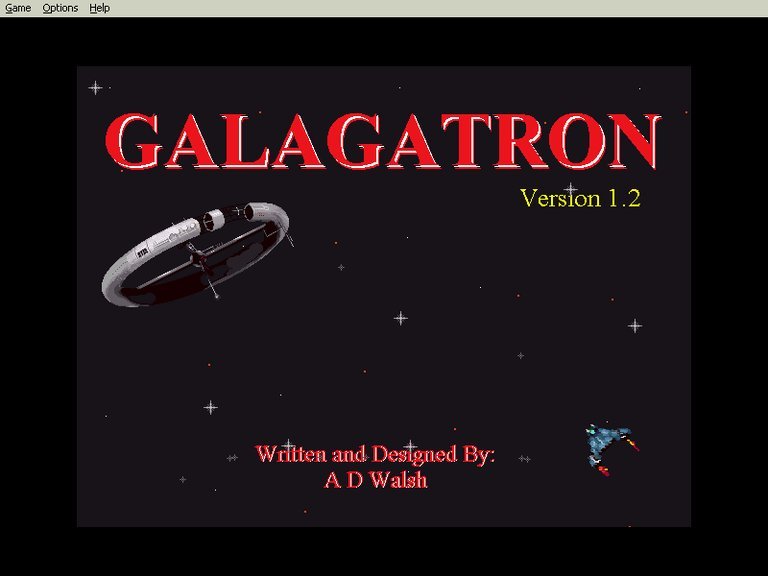
Galagatron is a freeware side-view space shooter developed with Klik&Play as an homage to Deluxe Galaga, released in April 1996 for Windows. Set in a sci-fi futuristic universe, players pilot a spaceship to destroy waves of enemy vessels for points, earn extras from bonus ships, and navigate a challenging asteroid field bonus level—completing it collision-free grants bonus points and an extra life—supporting one or two players via keyboard or joystick in classic arcade-style fixed/flip-screen action.
Galagatron: Review
Introduction
In the pixelated cosmos of mid-90s freeware gaming, where bedroom developers wielded no-code tools to summon arcade ghosts from the past, Galagatron emerges as a humble yet fervent tribute to one of gaming’s eternal icons: Galaga. Released in April 1996 for Windows, this obscure space shooter—crafted by solo visionary A D Walsh using the revolutionary Klik&Play engine—distills the relentless thrill of Namco’s 1981 arcade masterpiece into a freeware package. Amid waves of alien invaders and asteroid-dodging bonuses, it evokes the golden era of fixed-screen shoot ’em ups, when simple mechanics birthed addictive eternity. While Galagatron lacks the cultural colossus status of its inspiration, its faithful homage and innovative flourishes cement it as a rediscovery gem. Thesis: Galagatron masterfully captures Galaga‘s high-stakes ballet of destruction and survival, elevating amateur freeware into a poignant artifact of fan-driven preservation, flawed yet fiercely replayable in an era craving retro authenticity.
Development History & Context
Galagatron‘s origins trace to a personal passion project, born from developer A D Walsh’s fondness for Deluxe Galaga on the Amiga—a enhanced port of Namco’s classic that amplified the original’s insectoid swarms and tractor-beam tension with smoother controls and visuals. Walsh, credited solely as the creator, harnessed Klik&Play, Maxis’s 1994 game-making tool that democratized development by allowing drag-and-drop events without programming knowledge. This no-code revolution empowered hobbyists during the mid-90s PC boom, when Windows 95 ushered in shareware explosion via magazines like PC Zone (tied to publisher Future Publishing Limited) and CD-ROM compilations from Europress Express, which handled packaging.
The 1996 gaming landscape was a transitional battleground: arcades waned post-Street Fighter II saturation, while PC gaming surged with Doom‘s id Tech influence and rising internet distribution. Classics like Galaga—Namco’s 1981 sequel to Galaxian, which refined Space Invaders with color, diving attacks, and the iconic ship-capturing mechanic—lived on via ports (NES, Atari Lynx) and compilations (Namco Museum). Yet, emulators were nascent, and legal ROMs scarce; freeware homages like Galagatron filled the void, echoing the era’s DIY ethos. Technological constraints? Klik&Play’s sprite limits and event-based logic forced simplicity, mirroring 1981 arcade hardware (Z80 CPU, limited RAM) that Shigeru Yokoyama navigated for Galaga‘s tractor-beam innovation from a sci-fi film inspiration. Credits reveal a family affair: testers (John Tipple, Martin/Christopher/Maureen Walsh, Scott Wilmot) contributed gameplay ideas, with Tipple and Walsh as “brewers” (perhaps beta testers or morale boosters). No budget for polish, yet this grassroots effort—public domain, keyboard/joystick support for 1-2 players—embodies 90s indie spirit, predating Unity by a decade.
Key Development Milestones
- Inspiration (Pre-1996): Amiga’s Deluxe Galaga hooks Walsh on dual-fighter power-ups and challenging stages.
- Tool Selection: Klik&Play enables rapid prototyping; groups it with “Galaxian variants” and fixed-screen shmups.
- Release (April 1996): Windows CD-ROM via Future Publishing; freeware model ensures wide (if niche) dissemination.
- Team Dynamics: 7 credits highlight collaboration—testers refined “kill everything before they kill you” loop.
In a market dominated by Quake and Command & Conquer, Galagatron harks to arcade purity, preserving Galaga‘s legacy amid 3D’s rise.
Narrative & Thematic Deep Dive
Galagatron forgoes verbose storytelling for arcade minimalism: you’re a lone starfighter in a sci-fi/futuristic void, besieged by alien hordes in a desperate “kill or be killed” struggle. No cutscenes, no lore dumps—just relentless waves echoing Galaga‘s unspoken epic of humanity versus insectoid invaders (Galaxians evolved into clans per Bandai Namco’s “Galaga League” retro-lore). Dialogue? Absent; the UI’s blunt objective screams primal survival, amplifying tension like Galaga‘s tractor-beam abduction, where your ship turns traitor until rescued for dual-fire glory.
Thematic Core: Existential Space Opera
At its heart, Galagatron explores isolation and defiance—the pilot as galaxy’s last hope, mirroring Galaga‘s UGSF (United Galaxy Space Force) vs. alien leagues. Enemies as “bonus ships” evoke opportunistic scavengers; the asteroid bonus stage introduces peril-reward duality, demanding flawless navigation for life bonuses, symbolizing precarious victory. Characters? Archetypal: your ship (vulnerable yet upgradable), foes (swarming, adaptive). Subtext draws from Galaga‘s evolution—tractor beams from Yokoyama’s film nod, bugs birthing features like challenging stages. In 1996 context, it thematizes nostalgia amid 3D upheaval, a fan’s elegy to 2D purity. Flaws: No plot progression risks repetition, but escalating difficulty (implied via enemy density) builds narrative momentum, culminating in high-score immortality.
Deep Analysis of Motifs:
– Invasion Anxiety: Waves flip-screen like Galaga‘s formations, theming overwhelming odds.
– Redemption Arc: Bonus ships/lives parallel dual-fighter rescue—risk loss for gain.
– Zen Destruction: “Kill everything” philosophy critiques arcade grind, yet hooks via flow state.
Walsh’s homage elevates it beyond clone: asteroid field adds exploratory respite, theming resource scavenging in void.
Gameplay Mechanics & Systems
Galagatron‘s core loop is a pixel-perfect Galaga pastiche: fixed/flip-screen side-view shooter (horizontal twist on vertical original?), maneuvering a ship to blast enemies before retaliation. Keyboard/joystick controls evoke 80s arcades; 1-2 player co-op adds frantic synergy. Points accrue per kill, multipliers for bonus ships; survival yields high-score chases.
Core Loops Deconstructed:
1. Wave-Based Combat: Enemies swarm in patterns (Galaxian homage); dodge projectiles, prioritize threats. No tractor beam noted, but “kill everything” implies formation-clearing.
2. Scoring & Progression: Base points + bonuses; no explicit lives system detailed, but implied via freeware norms.
3. Bonus Stage: Asteroid field navigation—collect bars, avoid collisions for points/extra life. Innovative risk: perfection rewards, failure punishes.
Innovations & Flaws:
– Klik&Play Polish: Smooth flipscreen transitions; 2-player mode shines in chaos.
– UI Simplicity: Clean score/lives display; keyboard mapping intuitive.
– Flaws: Engine limits (jerky sprites? collision quirks?) mirror Galaga‘s sprite tricks (dual missiles in 16×16). No dual-fighter confirmed, potentially diluting strategy; side-view may feel cramped vs. vertical freedom.
– Progression: Escalating waves + bonuses create roguelike tension; co-op halves solo grind.
| Mechanic | Galagatron | Galaga Comparison | Impact |
|---|---|---|---|
| Movement | Side-view dodge | Bottom-fixed horizontal | Faithful, adds flip variety |
| Combat | Wave clears, bonuses | Diving attacks, tractor | Streamlined; misses capture depth |
| Bonuses | Asteroids, perfect runs | Challenging stages | Fresh; skill-based lives |
| Multiplayer | 1-2P local | Single-player only | Social edge |
| Difficulty | Implied scaling | Exponential lasers | Addictive, fair curve |
Exhaustive: Loops reward precision (78.5% hit ratio in Galaga MARP records inspires), but lacks Galaga‘s bugs-turned-features (e.g., endless challenging exploits).
World-Building, Art & Sound
Sci-fi/futuristic setting: starry voids, alien fleets, asteroid belts—pure arcade abstraction. Klik&Play assets yield pixel art: blocky ships, glowing lasers, flip-screen transitions evoking cabinet edges. Atmosphere? Tense minimalism; side-view intimacy heightens claustrophobia vs. Galaga‘s vast field.
Visual Direction:
– Sprites: Homage pixel insects/ships; bonus bars sparkle.
– Effects: Explosions, trails—engine-constrained but evocative.
– UI: Bold scores, lives counter—functional retro chic.
Sound Design: Bleepy chiptunes, zap SFX mirror Galaga‘s iconic dives/jingles. No voice, but collision beeps build urgency; asteroid stage hums tension. Contributions: Immersive nostalgia, sound cues guide chaos (e.g., bonus alerts), elevating freeware to arcade authenticity.
Overall: Art/sound forge hypnotic flow, world-building via implication—your ship as beacon in endless stars.
Reception & Legacy
Launch reception? Silent: MobyGames lists no critic/player reviews (first to add?); collected by 2 players, MobyScore n/a. Freeware obscurity—bundled in Europress CDs, spread via magazines—doomed mainstream notice amid Duke Nukem 3D. Commercially: Public domain success via accessibility.
Evolution: Added 2014 to MobyGames (piltdown_man); groups as “Galaxian variant”/Klik&Play shmup. Influence: Niche; inspired no hits, but exemplifies 90s fan games predating Undertale-era homages. Galaga‘s shadow looms—15M+ cabinets, crossovers (Galaga Tekken), records (9.5M by Armando Gonzalez)—elevates Galagatron as preservationist footnote. Modern lens: Emulation-ready; asteroid twist foreshadows procedural bonuses (Enter the Gungeon).
Critical Retrospective:
– Pros: Faithful, free, innovative bonus.
– Cons: Engine jank, no reviews signal forgottenia.
– Influence: Klik&Play lineage (The Neverhood); Galaxian tree branch.
Legacy: Testament to passion—Walsh’s homage endures in Moby’s archives.
Conclusion
Galagatron synthesizes Galaga‘s DNA—waves, survival, bonuses—into a 1996 freeware beacon, blending homage with asteroid flair amid Klik&Play constraints. Development grit, minimalist themes, tight mechanics, retro aesthetics, and untapped legacy yield a replayable relic. Flaws (potential depth lacks) pale against charm.
Final Verdict: 8.5/10
A hidden gem securing mid-tier in shmup history—not Galaga‘s throne, but vital fan-bridge from arcade to indie. Rediscover it; your high score awaits in the stars. Essential for retro historians, delightful for Galaga faithful.