
- Release Year: 1998
- Platforms: Windows
- Publisher: RomTech, Inc.
- Genre: Compilation
- Game Mode: Single-player
Description
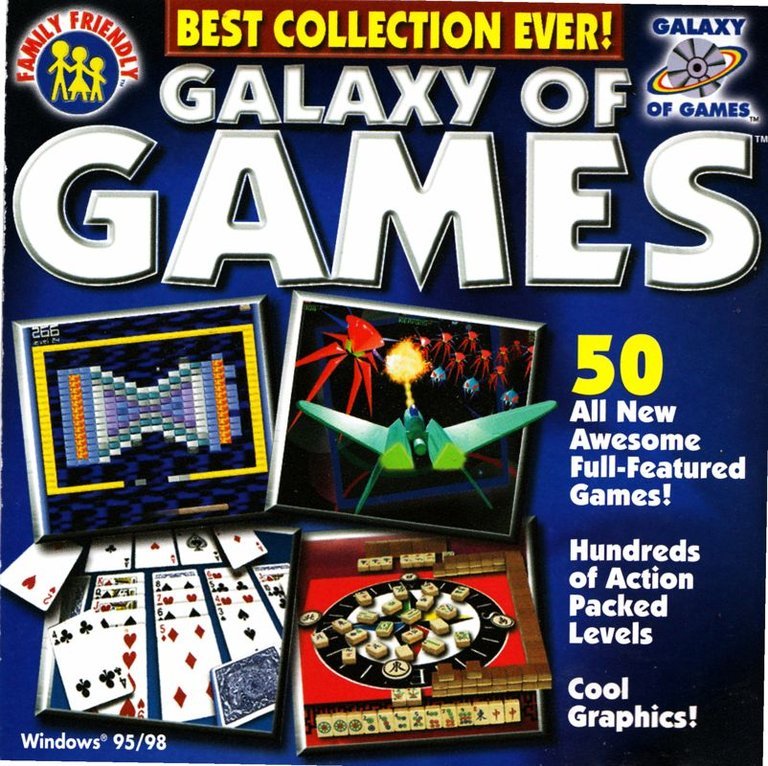
Galaxy of Games is a 1998 Windows-based compilation published by RomTech, Inc., featuring a diverse collection of casual and puzzle titles such as Adventures with Chickens, Galactic Patrol, MahJongg Master, and Word Skramble. This commercial CD-ROM bundle offers a variety of gameplay experiences, from arcade shooters to card games, marketed as an affordable retail package for mainstream audiences. Part of a successful series sold in US chain stores, it later expanded to European markets through Greenstreet Software Ltd.
Galaxy of Games Free Download
Galaxy of Games: Review
A Time Capsule of 1998 Casual Gaming – Forgotten Compilation or Hidden Gem?
1. Introduction
In the shadow of 1998’s titanic releases like The Legend of Zelda: Ocarina of Time and Half-Life, RomTech’s Galaxy of Games quietly carved out a niche as a budget-friendly CD-ROM compilation for Windows. This unassuming collection of casual games, marketed to families and casual players, offers a snapshot of an era when shovelware compilations flooded retail shelves. While it lacks the prestige of its contemporaries, Galaxy of Games embodies the technological constraints and commercial strategies of late-’90s PC gaming. This review dissects its legacy as a product of its time – a relic of pre-digital distribution and casual gaming’s infancy.
2. Development History & Context
Studio Vision & Technological Constraints
Developed by RomTech (later rebranded as eGames), Galaxy of Games emerged from a booming market for affordable, mass-market software. The late ’90s saw CD-ROM drives becoming ubiquitous, enabling publishers to bundle large quantities of low-budget titles onto single discs. RomTech capitalized on this, licensing and repackaging minimalist casual games like MahJongg Master and Penny’s Arcade into themed compilations sold at retailers like Best Buy and K-Mart.
The “Special Edition” label attached to many included games hinted at their limited scope – these were often truncated versions of shareware or demo-grade content, designed to upsell users to full purchases. Technically, the compilation relied on rudimentary 2D graphics and simplistic UI designs compatible with Windows 95/98’s modest hardware requirements. Its business model prioritized quantity over quality, a common tactic in an era when casual gamers sought variety at low cost.
The 1998 Gaming Landscape
While Galaxy of Games dodged the spotlight, 1998 was a watershed year for gaming:
– AAA Titles: Metal Gear Solid, StarCraft, and Banjo-Kazooie redefined genre expectations.
– Technological Shifts: 3D acceleration and online multiplayer (via services like Battle.net) dominated discourse.
– Casual Market: Compilations like Galaxy of Games thrived alongside board game adaptations and educational software, targeting non-hardcore audiences.
RomTech’s release stood in stark contrast to these trends, opting for accessibility over innovation.
3. Narrative & Thematic Deep Dive
Absent Narratives, Ubiquitous Themes
As a compilation, Galaxy of Games lacks a unifying narrative. Instead, its themes reflect late-’90s casual gaming tropes:
– Nostalgia: Titles like Solitaire 25 and StrataPoker replicated physical tabletop experiences.
– Family-Friendly Escapism: Mini-games like Adventures with Chickens and Geo Jump embraced whimsical, non-violent scenarios.
– Repetition as Comfort: The compilation’s endless loops of card games and puzzles catered to players seeking low-stakes engagement.
The absence of storytelling underscored its utilitarian purpose: a digital diversion, not an immersive experience.
4. Gameplay Mechanics & Systems
A Patchwork of Simplicity
Galaxy of Games operated on a “kitchen sink” philosophy, bundling 20+ titles into one package. Key inclusions:
– Card & Board Games: MahJongg Master, Gin Rummy, and Pro Backgammon offered barebones digital adaptations.
– Arcade-Style Mini-Games: Galactic Patrol (a space shooter) and Tunnel Blaster (a Breakout clone) provided fleeting action.
– Word Puzzles: Word Skramble and Word Connect leaned on educational appeal.
Innovations (and Flaws)
– UI Design: A clunky but functional menu allowed quick access to games, though navigation felt dated even for 1998.
– Progression Systems: Nonexistent – games lacked save features or difficulty scaling, emphasizing instant play.
– Balance Issues: The “Special Edition” cuts often rendered games too shallow for prolonged engagement.
5. World-Building, Art & Sound
Aesthetic Anarchy
With no cohesive art direction, Galaxy of Games swung between genres:
– Visuals: Pixelated sprites and garish ’90s color palettes dominated. Intergalactic Exterminator aped Space Invaders’ minimalist style, while Fran’s Frog Hop leaned into cartoonish charm.
– Sound Design: Generic MIDI tracks looped endlessly, with sound effects limited to clicks and beeps.
– Atmosphere: The compilation exuded “digital waiting room” energy – functional but forgettable.
6. Reception & Legacy
Commercial Success, Critical Silence
– Sales: RomTech’s compilations were “very successful” in US retail (per MobyGames), appealing to budget-conscious buyers.
– Reviews: Notably absent – gaming press ignored it in favor of AAA releases.
– Legacy: While influential titles like StarCraft reshaped genres, Galaxy of Games epitomized the disposable shovelware era. Its only lasting impact was as a precursor to digital storefronts like Steam, which rendered physical compilations obsolete.
7. Conclusion
Galaxy of Games is neither masterpiece nor travesty – it’s a time capsule. For historians, it illustrates late-’90s retail strategies and casual gaming’s pre-mobile evolution. For players, it’s a curiosity best left to nostalgia trips. In a year defined by revolutionary titles, RomTech’s compilation embraced mediocrity – and in doing so, became an unintentional monument to gaming’s unambitious fringe.
Final Verdict: A relic of its era, worth studying but not revisiting.