
- Release Year: 2001
- Platforms: Windows
- Publisher: JoWooD Productions Software AG
- Genre: Compilation
- Game Mode: LAN
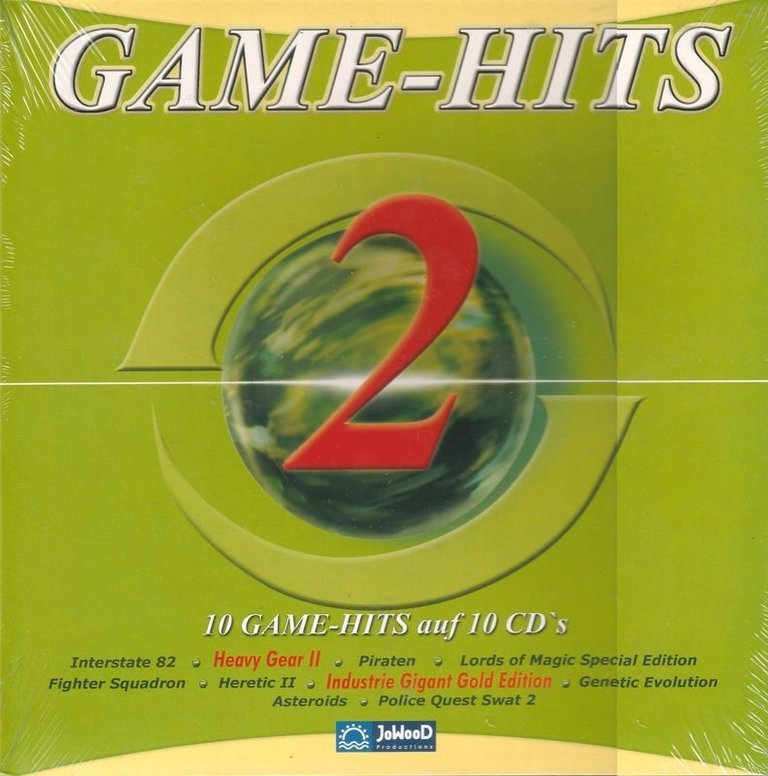
Description
Game-Hits 2 is a 2001 Windows compilation and sequel to Game-Hits 1, bundling ten diverse video games from genres including action, strategy, and simulation onto ten CD-ROMs, with manuals available only in PDF format on the discs.
Game-Hits 2: A Time Capsule of PC Gaming’s Diverse Turn-of-the-Millennium Landscape
Introduction: More Than the Sum of Its Parts
To dismiss Game-Hits 2 as merely a budget compilation is to miss its historical significance. Released in 2001 by JoWooD Productions, this ten-CD set is not a curated greatest hits album in the modern sense, but a raw, unvarnished snapshot of the ambitious, genre-fractured PC gaming landscape at the dawn of the new millennium. It represents a specific publishing philosophy—one of volume and variety over polish and prestige—capturing an era where “must-play” titles could coexist with intriguing niche experiments and forgotten curiosities. My thesis is this: Game-Hits 2 is a fascinating archival document. Its value lies not in the consistent quality of its individual entries, but in its collective testimony to a period of explosive creative diversity in PC gaming, just before the industry began its inexorable march toward homogenized AAA blockbusters and standardized digital storefronts.
Development History & Context: JoWooD’s Volume-First Strategy
The Studio and the Vision: JoWooD Productions, an Austrian publisher active from 1996 to 2011, carved its niche with a pragmatic, market-driven approach. Unlike developer-publishers with a singular creative vision (like a Valve or a Blizzard), JoWooD’s strength was in assembling and localizing packages for the European and global markets. The Game-Hits series was a direct response to the competitive budget and compilation space, following the success of the first Game-Hits. The vision was straightforward: acquire publishing rights to a diverse set of recently released or mid-tier PC titles, bundle them, and sell the package at a compelling price point (approximately 50 Deutsche Mark at release).
Technological & Market Context (2001): The year 2001 was a pivotal transition. The PlayStation 2 had launched, but the PC remained a vibrant, open platform. Digital distribution was nascent (Steam wouldn’t launch until 2003), so physical retail—and specifically, value-priced multi-game boxes—was king for reaching a broad audience. The games included in Game-Hits 2 are almost all from the 1997-1999 window, representing the tail end of the classic Windows 95/98 era and the early adoption of hardware acceleration (3D accelerators like the Voodoo2 and early GeForces). This was the golden age of the “genre specialist” simulator and tactics game, a richness that compilations like this one preserved.
The “Hits” Paradox: The title Game-Hits 2 is both a marketing claim and an implicit admission. It suggests popularity, yet the included titles are a mix of genuine hits (Heavy Gear II, Heretic II), respected cult favorites (Lords of Magic), and outright commercial disappointments or critically middling games (Police Quest: SWAT 2, Industry Giant). This reveals JoWooD’s strategy: fill ten CDs with any viable rights they could secure, creating a package where the sum of the parts’ perceived value justified the purchase, even if several components wereweak.
Narrative & Thematic Deep Dive: A Curated Gallery of Millennial Stories
As a compilation, Game-Hits 2 has no singular narrative. Its story is the story of its contents, each game a window into the thematic preoccupations of late-’90s PC design.
- The Action-Strategy Spectrum: Games like Interstate ’82 (a vehicular combat game) and Fighter Squadron: The Screamin’ Demons Over Europe (a flight sim) speak to the era’s love of hyper-specific, simulation-adjacent action. Their narratives are thin, contextual veneers for gameplay—patriotic posturing for the former, WWII dogfighting for the latter. They represent a strand of design prioritizing moment-to-moment kinetic feedback.
- The “Intelligent Life” Simulator: Evolution: The Game of Intelligent Life and Industry Giant: Gold Edition belong to the “god game” and business simulation lineages. Evolution’s speculative narrative—guiding species from single-celled organisms to interstellar travelers—taps into the turn-of-the-century optimism about technology and progress. Industry Giant reduces economic history to a spreadsheet fantasy, reflecting a fascination with systemic control and logistical optimization.
- Fantasy & Horror Re-imagined: Lords of Magic: Special Edition and Heretic II are genre rehashes with a ’90s edge. Lords of Magic applies the Heroes of Might and Magic formula to a more traditional high-fantasy setting, while Heretic II transplants the Quake engine’s gothic fantasy into a third-person action-adventure frame. Their stories are archetypal (good vs. evil, dark gods) but told through the lens of emergent, physics-driven combat.
- The “Serious” Simulation: Police Quest: SWAT 2 and Pirates: Captain’s Quest attempt to marry genre simulation with narrative weight. SWAT 2 uses its tactical mechanics to tell a story of procedural tension and law enforcement, though its infamous difficulty and obtuse interface often dwarf its narrative intentions. Pirates, despite its title, is less about the romanticized pirate myth and more a harsh, systemic life sim on the high seas, where narrative is procedurally generated from trade, combat, and scurvy.
- The Arcade Legacy: The inclusion of a 1998 remake of Asteroids is the clearest nod to nostalgia. Its narrative is nonexistent—pure abstract challenge—serving as a bridge to gaming’s pre-narrative past.
The collective thematic thread is one of agency and system mastery. Whether piloting a mech (Heavy Gear II), managing a supply chain (Industry Giant), evolving a species (Evolution), or clearing a room as SWAT, these games ask the player to understand and manipulate complex rulesets. They are, in essence, puzzles made of simulated worlds.
Gameplay Mechanics & Systems: A Compendium of Late-’90s Design Philosophies
This section must be tackled game-by-game, as Game-Hits 2 contains no unified mechanics. The compilation is a museum of interface and control schemes.
- The Simulation- adventure Hybrid (Heretic II, Heavy Gear II): These titles attempted to bridge the gap between first-person shooter fluidity and RPG-like progression. Heretic II features a third-person perspective with real-time combat, inventory puzzles, and character stats. Heavy Gear II pairs piloting a giant walking mech (with distinct movement physics) with on-foot infantry combat and mission-based objectives. Both struggle with janky controls and camera issues by modern standards but exemplify the era’s ambition to make everything “deeper.”
- The Pure Simulator (Interstate ’82, Fighter Squadron, SWAT 2): These are hardcore. Interstate ’82 simulates vehicle physics and armament to a meticulous degree, at the cost of accessibility. Fighter Squadron demands knowledge of WWII aviation—engine management, ammunition types, tactical formations. SWAT 2 is legendary for its unforgiving realism: a single misjudged command can get your entire team killed. Their “innovations” are in the depth of their systems, but their “flaws” are the steep cliffs of their learning curves.
- The God/Strategy Game (Lords of Magic, Evolution, Industry Giant, Pirates): These employ turn-based (Lords of Magic) or real-time-with-pause (Pirates) strategic layers. Evolution is uniquely abstract, using a “DNA point” system to evolve creatures. The common flaw across these is often a lack of clear feedback or opaque numerical relationships beneath a charming facade. Their innovation lies in their thematic integration—the systems directly represent their subject matter, from magical research trees to corporate supply chains.
- The Arcade Holdover (Asteroids): A pure skill-based loop. Its inclusion is a baseline, a control scheme so timeless it needs no adaptation, serving as a palate cleanser between the heavier simulations.
The Compilation’s “UI”: The user experience of Game-Hits 2 itself is telling. Manuals are PDF-only on the discs, a cost-saving and anti-consumer move that was common but frustrating. Installation often required juggling multiple CD swaps due to the ten-disc format. This was not a seamless experience but a literal, physical interaction with the software’s volume, reinforcing the “collection” aspect over “platform.”
World-Building, Art & Sound: An assemblage of Aesthetics
The compilation does not have a unified artistic direction; it is a collage of the era’s prevailing styles.
- Pre-rendered to In-Engine Transition: Earlier titles (Lords of Magic, Asteroids) rely on static, painted backgrounds or pre-rendered sprites. Later ones (Heavy Gear II, Heretic II) use the Quake/Thief engine or derivatives, featuring fully 3D environments with textured polygons, fog, and dynamic lighting. The visual progression across the set maps the rapid technical evolution of 1997-1999.
- The “JoWooD” Aesthetic: There is a certain “Euro-PC” sensibility—often a bit more grim, brown, and utilitarian than the colorful, cartoony Japanese or polished American releases. Interstate ’82‘s desolate American highways, SWAT 2‘s grim urban corridors, and Evolution‘s stark primordial soup share a muted, sometimes grimy palette.
- Sound Design as System Feedback: In the simulators, sound is functional: radar pings in Fighter Squadron, financial chimes in Industry Giant. In the action games, it’s atmospheric and diegetic: the clank of Heavy Gear‘s footsteps, the shrieks of Heretic II‘s monsters. The standout is likely Asteroids, whose iconic, minimalist sound effects are a masterclass in auditory feedback.
- The Compilation’s Presentation: The menus and organization are basic, text-driven. The “art” of Game-Hits 2 is its spreadsheet-like back-of-box list of contents. The value proposition is presented as pure informational density.
Reception & Legacy: A Snapshot of Divided Criticism
Contemporary Reception (2001): Reviews were mixed, as captured by the two sourced German critics. PC Player (100%) saw the forest for the trees, focusing on the few standout titles (Interstate ’82, Heretic II, Lords of Magic) and deeming the package worthwhile for the price. PC Games (60%) took the opposite view, arguing that better, more focused collections were available for the same cost (“Bessere Kollektionen kosten gleich wenig Geld”). This dichotomy defines the compilation’s critical challenge: its worth is entirely dependent on the player’s pre-existing interest in its specific niche contents. A reviewer looking for a coherent experience would be disappointed; a bargain hunter with a penchant for forgotten sims would be delighted.
Commercial & Cultural Legacy: Game-Hits 2 was not a landmark sale, but it was a successful model for its time. It represents the last gasps of the “big box” compilation era. Within a few years, digital storefronts like Steam would make such physical collections obsolete, offering individual games à la carte and “bundles” that were curated thematically (e.g., “Action Pack”) rather than by publisher’s remaining rights inventory.
Its legacy is archival. For preservationists and historians, it is a primary source. It ensured that games like Evolution or Pirates: Captain’s Quest, which might have faded into complete obscurity, remained accessible. It stands as a monument to the fragmented diversity of PC gaming before market forces consolidated genres around a few dominant templates (the MOBA, the Battle Royale, the Open-World RPG). It proves that the late ’90s PC space was not just Half-Life and StarCraft, but also a sprawling wilderness of ambitious, flawed, and fascinating niche titles.
Conclusion: The Definitive Verdict
Game-Hits 2 is not a “great” game. It is not a “coherent” experience. It is, however, an essential historical artifact. Its 3.0/5 average player rating on MobyGames is fair for evaluating it as a product to be played today. Many of its games are clunky, dated, and legally dubious by modern standards.
But as a curated artifact of a bygone era, it is invaluable. It encapsulates a moment when the PC platform’s strength was its chaotic, anything-goes software ecosystem. The compilation’s very flaws—the PDF manuals, the CD swaps, the jarring quality dip from Heavy Gear II to Police Quest: SWAT 2—are features of its time. It demands engagement not as a seamless whole, but as a museum curator: you select your exhibits, appreciate the innovations of the few (Heavy Gear II‘s mech feel, Evolution‘s sublime scale), and forgive the failures of the many.
In the pantheon of video game history, Game-Hits 2 occupies a humble but specific niche. It is the antithesis of the curated classic. It is the unrefined ore from which the memories of a generation of PC gamers were forged—not through masterpieces, but through long nights with strange simulations, frustrating tactical shooters, and the sheer, bewildering volume of it all. For that, it earns its place not on a shelf of “best games,” but in the catalog of “most representative times.” It is the sound of a platform shouting its diverse, messy, wonderful identity into the void, just before the void started shouting back in a single, homogenized voice.