
- Release Year: 2000
- Platforms: Windows
- Publisher: Take-Two Interactive Software, Inc.
- Genre: Compilation
- Game Mode: LAN, Online PVP, Single-player
- Average Score: 93/100
Description
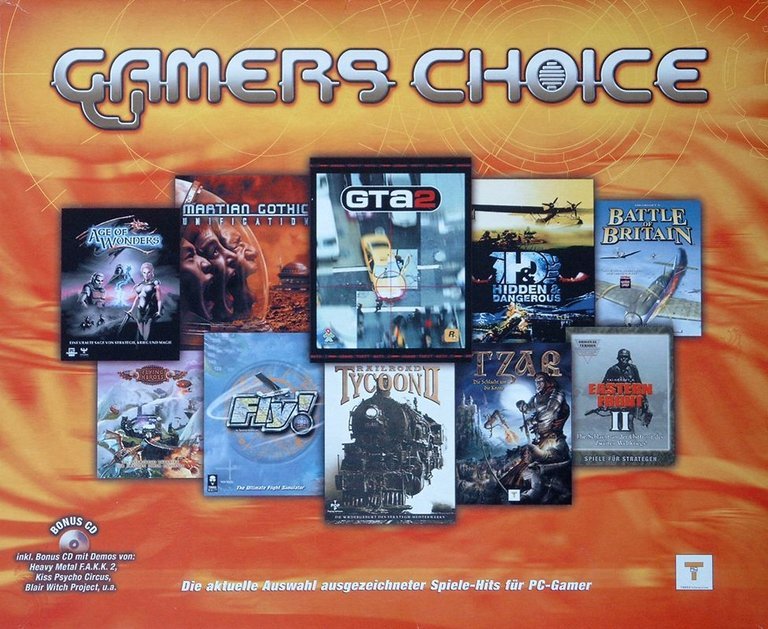
Gamers Choice is a compilation released in 2000 for Windows, featuring ten diverse games across multiple genres, including strategy, action, and simulation. Published by Take-Two Interactive, the collection includes titles like Age of Wonders, Grand Theft Auto 2, Hidden & Dangerous, and Railroad Tycoon II, offering a mix of critically acclaimed and popular games from the late 1990s and early 2000s. The compilation was praised for its balanced selection and pre-patched games, making it a convenient package for players seeking variety.
Gamers Choice Reviews & Reception
metacritic.com (97/100): A deeper, more refined version of the original game.
comicbook.com (97/100): Nowadays, it’s rare to see a sports game score this highly, but developer Visual Concepts was at the top of its game in 2000.
mobygames.com (85/100): This compilation contains the following ten games from many different genres.
Gamers Choice Cheats & Codes
PlayStation (PSX)
Press Start after a whistle, then enter the strategies screen and select ‘Timeout’. Immediately press Triangle, enter the screen again, and immediately press X. This can be repeated until your line is full.
| Code | Effect |
|---|---|
| Bruce Willis | The announcers will refer to the character as ‘The Dude’ during the game. |
| Hammer | The announcers will refer to the character as ‘The Hammer’ during the game. |
| Wayne Gretzky | The game will automatically assign him jersey number 99. |
| Peter Forsberg | Answer ‘Yes’ to use his ratings, then adjust them as needed. Return to the previous screen and change his name to your choice, but do not change any other setting. |
| Joe Sakic | Answer ‘Yes’ to use his ratings, then adjust them as needed. Return to the previous screen and change his name to your choice, but do not change any other setting. |
| Sandis Ozolinsh | Answer ‘Yes’ to use his ratings, then adjust them as needed. Return to the previous screen and change his name to your choice, but do not change any other setting. |
| Patrick Roy | Answer ‘Yes’ to use his ratings, then adjust them as needed. Return to the previous screen and change his name to your choice, but do not change any other setting. |
PC
Use one of the following codes at the indicated screen:
| Code | Effect |
|---|---|
| awaygoal | Award a goal to the away team. |
| homegoal | Award a goal to the home team. |
| zambo | Zamboni moves on ice during game. |
| injury | Cause an injury. |
| flash | Camera flashes from crowd. |
| victory | Fireworks during game. |
| check | Automatically check on contact with opposing player. |
| grab | Automatic stick hold on contact with opposing player. |
| spots | Enable pre-game spotlights. |
| mantis | Elongated arms, legs, and necks. |
| quickftr | Fast players. |
| penalty | Powerplay1. |
| big fight | Entire team fights. |
| bloody | Bloody fights. |
| nhlkids | Small players. |
| buffed | Big players. |
| gulliver | Big goalies. |
| headbone | Big heads. |
| massrink | Big rink. |
| squeaky | High pitched commentary. |
| barrywhite | Low pitched commentary. |
| warp9 | Fast game. |
| slomo | Slow game. |
| night | Dark arena with spotlights. |
| zerog | No gravity for puck. |
Gamers Choice: A Time Capsule of Early 2000s Gaming
Introduction
In the annals of video game history, few compilations capture the essence of an era as vividly as Gamers Choice, a 2000 release by Take-Two Interactive. This anthology is more than a mere collection of games; it is a snapshot of the turn-of-the-millennium gaming landscape, a testament to the diversity and ambition of developers at the cusp of a new century. Gamers Choice stands as a bridge between the late ’90s golden age of PC gaming and the burgeoning console dominance of the early 2000s, offering a curated experience that reflects the tastes, technologies, and trends of its time.
At its core, Gamers Choice is a celebration of variety. It bundles ten distinct titles spanning multiple genres—strategy, simulation, action, and adventure—each a standout in its own right. From the turn-based grandeur of Age of Wonders to the high-octane chaos of Grand Theft Auto 2, the compilation is a microcosm of the gaming industry’s creative breadth. Yet, its significance extends beyond its individual components. Gamers Choice is a historical artifact, a product of an era when physical media reigned supreme, and compilations were a strategic response to the challenges of distribution, marketing, and consumer engagement.
This review will dissect Gamers Choice with the precision of a historian and the passion of a gamer. We will explore its development context, the narratives and themes woven into its games, the mechanics that defined its gameplay, and the artistic and technical achievements that brought its worlds to life. We will also examine its critical reception, its commercial performance, and its lasting legacy in an industry that has since undergone seismic shifts. By the end, we will not only understand Gamers Choice as a product of its time but also appreciate its enduring relevance in the pantheon of video game history.
Development History & Context
The Studio and the Vision
Take-Two Interactive, the publisher behind Gamers Choice, was already a formidable player in the gaming industry by the late 1990s. Known for its aggressive acquisition strategy and a knack for identifying market trends, Take-Two had built a portfolio that included both established franchises and innovative new IPs. The company’s vision for Gamers Choice was straightforward yet ambitious: to create a compilation that would appeal to a broad audience by offering a diverse selection of high-quality games. This was not merely a cost-cutting exercise or a way to offload excess inventory, as some compilations of the era were perceived to be. Instead, Gamers Choice was designed to showcase the depth and variety of Take-Two’s catalog, positioning the publisher as a curator of premium gaming experiences.
The late 1990s and early 2000s were a period of rapid evolution in the gaming industry. The rise of 3D graphics, the increasing power of home PCs, and the growing popularity of genres like real-time strategy and open-world action games created a fertile ground for experimentation. Take-Two, with its finger on the pulse of these trends, saw an opportunity to capitalize on the growing demand for diverse gaming experiences. Gamers Choice was conceived as a way to meet this demand, offering something for everyone—whether they were strategy aficionados, simulation enthusiasts, or action junkies.
Technological Constraints and Innovations
The late 1990s were a time of transition in gaming technology. The shift from 2D to 3D graphics was well underway, but developers were still grappling with the limitations of hardware. The games included in Gamers Choice reflect this transitional period. Titles like Age of Wonders and Tzar: The Burden of the Crown showcased the potential of 3D rendering in strategy games, while Grand Theft Auto 2 demonstrated the possibilities of open-world design in an era when such games were still a novelty.
One of the key challenges faced by developers during this period was the need to balance graphical fidelity with performance. The average gaming PC of the late 1990s was far less powerful than today’s machines, and optimizing games to run smoothly on a wide range of hardware was a significant hurdle. The games in Gamers Choice were no exception. Many of them employed a mix of 2D and 3D elements, using pre-rendered backgrounds and sprites to create the illusion of depth while keeping system requirements manageable.
Another notable aspect of the era was the growing importance of multiplayer gaming. The late 1990s saw the rise of LAN parties and early online gaming communities, and many of the games in Gamers Choice reflected this trend. Titles like Hidden & Dangerous and Flying Heroes included multiplayer modes that allowed players to compete or cooperate over local networks or the internet. This was a time when online gaming was still in its infancy, and the inclusion of these features in Gamers Choice underscored Take-Two’s commitment to staying ahead of the curve.
The Gaming Landscape of 2000
The year 2000 was a pivotal one for the gaming industry. The PlayStation 2 had just launched, heralding a new era of console gaming, while the PC market was thriving thanks to the popularity of genres like real-time strategy and first-person shooters. The industry was also beginning to grapple with the challenges and opportunities presented by the internet, from digital distribution to online multiplayer.
In this context, Gamers Choice was a product of its time—a physical compilation designed to appeal to PC gamers who were still primarily purchasing games in brick-and-mortar stores. The inclusion of a mix of genres reflected the diversity of the PC gaming market, which was not yet dominated by the first-person shooters and open-world games that would come to define the next decade. Instead, PC gamers of the early 2000s had a wide range of tastes, and Gamers Choice catered to this diversity.
The compilation also reflected the industry’s growing emphasis on value. As games became more expensive to develop and market, publishers looked for ways to maximize the return on their investments. Compilations like Gamers Choice were one way to do this, offering consumers a bundle of games at a price that was often lower than the sum of their individual parts. This was a win-win for both publishers and consumers, as it allowed publishers to move inventory while giving gamers more bang for their buck.
Narrative & Thematic Deep Dive
The Stories Within
One of the most striking aspects of Gamers Choice is the sheer diversity of its narratives. Each game in the compilation tells a different story, set in a different world, and driven by different themes. This diversity is a testament to the creative ambition of the developers behind these titles, as well as Take-Two’s commitment to offering a broad range of experiences.
-
Age of Wonders: A fantasy strategy game that blends turn-based combat with empire-building, Age of Wonders invites players to explore a richly detailed world filled with magic, mythical creatures, and political intrigue. The game’s narrative is driven by the player’s choices, as they decide which races to ally with, which territories to conquer, and which magical artifacts to pursue. Themes of power, ambition, and the consequences of war are central to the experience, making Age of Wonders a compelling blend of strategy and storytelling.
-
Grand Theft Auto 2: Set in a sprawling, crime-ridden metropolis, Grand Theft Auto 2 is a darkly humorous take on the open-world action genre. Players take on the role of a criminal trying to rise through the ranks of the city’s underworld, completing missions for various gangs and factions. The game’s narrative is nonlinear, with players free to choose which missions to undertake and which alliances to form. Themes of crime, corruption, and the pursuit of power are explored with a satirical edge, making GTA 2 a biting commentary on urban life.
-
Hidden & Dangerous: A tactical shooter set during World War II, Hidden & Dangerous puts players in the shoes of elite commandos tasked with completing high-stakes missions behind enemy lines. The game’s narrative is driven by its mission-based structure, with each level presenting a new challenge and a new story. Themes of bravery, sacrifice, and the horrors of war are central to the experience, making Hidden & Dangerous a gripping and immersive journey into the heart of combat.
-
Martian Gothic: Unification: A survival horror game set on a desolate Mars colony, Martian Gothic blends sci-fi and horror to create a tense and atmospheric experience. Players take on the role of a security officer investigating a series of mysterious disappearances, uncovering a conspiracy that threatens the entire colony. Themes of isolation, paranoia, and the unknown are explored with a sense of dread and unease, making Martian Gothic a chilling exploration of fear and survival.
Themes and Motifs
While the games in Gamers Choice span a wide range of genres and settings, they share several common themes and motifs. One of the most prominent is the exploration of power and its consequences. Whether it’s the political maneuvering of Age of Wonders, the criminal underworld of Grand Theft Auto 2, or the military tactics of Hidden & Dangerous, each game invites players to grapple with the complexities of power—how it is acquired, how it is wielded, and what it costs.
Another recurring theme is the idea of survival in hostile environments. From the war-torn battlefields of Hidden & Dangerous to the alien landscapes of Martian Gothic, the games in Gamers Choice often place players in situations where survival is not guaranteed. This theme is explored through a variety of lenses, from the physical challenges of combat and exploration to the psychological toll of isolation and fear.
The compilation also explores the tension between order and chaos. Games like Railroad Tycoon II and Tzar: The Burden of the Crown task players with building and managing empires, requiring them to impose order on chaotic systems. In contrast, games like Grand Theft Auto 2 and Flying Heroes embrace chaos, allowing players to wreak havoc and disrupt the status quo. This duality reflects the broader cultural anxieties of the early 2000s, a time when the world was grappling with the rapid pace of technological change and the uncertainties of a new millennium.
Dialogue and Character Development
The dialogue and character development in the games of Gamers Choice vary widely, reflecting the diverse narratives and themes at play. In Age of Wonders, dialogue is often used to convey political intrigue and diplomatic negotiations, with characters representing different factions and races. The game’s writing is rich and detailed, with a focus on world-building and lore.
In Grand Theft Auto 2, dialogue is used to create a sense of dark humor and satire. The game’s characters are often exaggerated caricatures, from the sleazy gangsters to the corrupt politicians, and their interactions are filled with wit and irony. This approach to dialogue helps to reinforce the game’s themes of crime and corruption, while also providing a layer of entertainment and levity.
Hidden & Dangerous, on the other hand, takes a more serious approach to dialogue and character development. The game’s characters are soldiers and commandos, and their interactions are often focused on mission briefings, tactical planning, and the realities of war. The writing is grounded and realistic, with a focus on authenticity and immersion.
Martian Gothic uses dialogue to build tension and suspense. The game’s characters are isolated and paranoid, and their interactions are filled with mistrust and uncertainty. The writing is atmospheric and eerie, with a focus on creating a sense of dread and unease.
Gameplay Mechanics & Systems
Core Gameplay Loops
The games in Gamers Choice employ a variety of core gameplay loops, each designed to engage players in different ways. In Age of Wonders, the loop revolves around turn-based strategy, with players managing resources, building armies, and engaging in tactical combat. The game’s progression is driven by the player’s ability to expand their empire and conquer new territories, with each turn presenting new challenges and opportunities.
Grand Theft Auto 2 employs a more open-ended loop, with players free to explore the city, complete missions, and engage in side activities. The game’s progression is nonlinear, with players able to choose which missions to undertake and which alliances to form. This freedom is balanced by the game’s difficulty, which increases as the player progresses, requiring them to adapt their strategies and tactics.
Hidden & Dangerous uses a mission-based loop, with each level presenting a new objective and a new set of challenges. The game’s progression is driven by the player’s ability to complete these missions, with each success unlocking new levels and new equipment. The game’s difficulty is high, with players required to use stealth, tactics, and teamwork to overcome the odds.
Martian Gothic employs a survival horror loop, with players exploring the colony, solving puzzles, and avoiding or confronting enemies. The game’s progression is driven by the player’s ability to uncover the mystery behind the disappearances, with each discovery revealing new clues and new dangers. The game’s difficulty is balanced by the player’s ability to manage resources and make strategic decisions.
Combat and Character Progression
The combat systems in Gamers Choice vary widely, reflecting the diverse genres and settings of the games. In Age of Wonders, combat is turn-based and tactical, with players managing units on a grid-based battlefield. The game’s progression system allows players to upgrade their units and unlock new abilities, adding depth and strategy to the combat.
Grand Theft Auto 2 employs a more action-oriented combat system, with players engaging in shootouts, car chases, and hand-to-hand combat. The game’s progression system is tied to the player’s reputation, with success in missions unlocking new weapons, vehicles, and allies.
Hidden & Dangerous uses a realistic combat system, with players required to use cover, stealth, and teamwork to overcome enemies. The game’s progression system is tied to the player’s performance, with success in missions unlocking new equipment and abilities.
Martian Gothic employs a survival horror combat system, with players using a mix of stealth, puzzles, and combat to survive. The game’s progression system is tied to the player’s ability to uncover the mystery, with each discovery unlocking new areas and new challenges.
UI and Innovative Systems
The user interfaces in Gamers Choice are designed to be intuitive and immersive, with each game employing a unique approach to presenting information and controls. In Age of Wonders, the UI is designed to be clean and functional, with a focus on providing players with the information they need to make strategic decisions. The game’s interface includes a mini-map, a resource panel, and a unit management system, all of which are designed to be easy to use and understand.
Grand Theft Auto 2 employs a more minimalist UI, with a focus on providing players with the information they need to navigate the city and complete missions. The game’s interface includes a radar, a mission tracker, and a weapon selection system, all of which are designed to be unobtrusive and easy to use.
Hidden & Dangerous uses a realistic UI, with a focus on providing players with the information they need to complete missions and manage their team. The game’s interface includes a tactical map, a mission briefing system, and a team management system, all of which are designed to be functional and immersive.
Martian Gothic employs a atmospheric UI, with a focus on creating a sense of tension and unease. The game’s interface includes a health and sanity meter, a puzzle-solving system, and a map, all of which are designed to be intuitive and immersive.
One of the most innovative systems in Gamers Choice is the inclusion of multiplayer modes in several of the games. Hidden & Dangerous and Flying Heroes both include LAN and internet multiplayer, allowing players to compete or cooperate with others in real-time. This was a relatively new feature at the time, and its inclusion in Gamers Choice underscored Take-Two’s commitment to staying ahead of the curve.
World-Building, Art & Sound
Setting and Atmosphere
The worlds of Gamers Choice are as diverse as the games themselves, each offering a unique setting and atmosphere. Age of Wonders invites players to explore a fantasy realm filled with magic, mythical creatures, and ancient ruins. The game’s world is richly detailed, with a focus on lore and history, and the atmosphere is one of wonder and discovery.
Grand Theft Auto 2 presents a sprawling, crime-ridden metropolis, a dark and gritty world where corruption and violence are the norm. The game’s setting is inspired by real-world cities like New York and Los Angeles, and the atmosphere is one of chaos and danger.
Hidden & Dangerous takes players to the battlefields of World War II, a world of war-torn landscapes, hidden bunkers, and high-stakes missions. The game’s setting is grounded in historical reality, and the atmosphere is one of tension and suspense.
Martian Gothic transports players to a desolate Mars colony, a world of isolation, paranoia, and unknown horrors. The game’s setting is inspired by sci-fi and horror, and the atmosphere is one of dread and unease.
Visual Direction
The visual direction of the games in Gamers Choice reflects the technological constraints and artistic ambitions of the late 1990s. Age of Wonders employs a mix of 2D and 3D graphics, using pre-rendered backgrounds and sprites to create a sense of depth and detail. The game’s art style is colorful and vibrant, with a focus on fantasy and magic.
Grand Theft Auto 2 uses a top-down perspective and a mix of 2D and 3D elements, creating a sense of scale and immersion. The game’s art style is gritty and realistic, with a focus on urban decay and crime.
Hidden & Dangerous employs a first-person perspective and a mix of 2D and 3D graphics, creating a sense of realism and immersion. The game’s art style is grounded and detailed, with a focus on historical accuracy and tactical gameplay.
Martian Gothic uses a mix of 2D and 3D graphics, with a focus on creating a sense of atmosphere and tension. The game’s art style is dark and eerie, with a focus on horror and sci-fi.
Sound Design
The sound design in Gamers Choice is a crucial element of the overall experience, with each game employing a unique approach to audio. Age of Wonders features a rich and orchestral soundtrack, with a focus on creating a sense of epic scale and grandeur. The game’s sound effects are detailed and immersive, with a focus on creating a sense of magic and wonder.
Grand Theft Auto 2 employs a mix of licensed music and original compositions, creating a sense of urban realism and grit. The game’s sound effects are detailed and immersive, with a focus on creating a sense of chaos and danger.
Hidden & Dangerous uses a realistic and immersive soundtrack, with a focus on creating a sense of tension and suspense. The game’s sound effects are detailed and accurate, with a focus on creating a sense of realism and immersion.
Martian Gothic features a dark and atmospheric soundtrack, with a focus on creating a sense of dread and unease. The game’s sound effects are detailed and eerie, with a focus on creating a sense of horror and isolation.
Reception & Legacy
Critical Reception
Gamers Choice received a mixed but generally positive reception from critics. German gaming magazines like PC Player, PC Games, and GameStar praised the compilation for its diversity and value, with PC Player awarding it a perfect score of 100%. Critics highlighted the inclusion of well-regarded titles like Age of Wonders and Grand Theft Auto 2, as well as the convenience of having multiple games bundled together. However, some reviewers noted that the compilation’s appeal was somewhat limited by the fact that many of the included games were already available individually, and that the selection might not appeal to all gamers.
Player reception, on the other hand, was more muted. The compilation’s average player score on MobyGames is a modest 2.0 out of 5, based on a single rating. This disparity between critical and player reception is not uncommon for compilations, which often struggle to find a broad audience due to their niche appeal.
Commercial Performance
Gamers Choice was released at a time when the gaming industry was undergoing significant changes. The rise of digital distribution and the growing popularity of console gaming posed challenges for physical compilations like Gamers Choice. While the compilation likely found an audience among PC gamers looking for a diverse selection of games, its commercial performance was likely modest compared to the individual sales of its included titles.
Influence and Legacy
Despite its mixed reception and modest commercial performance, Gamers Choice holds a unique place in video game history. As a snapshot of the late 1990s and early 2000s gaming landscape, it offers a glimpse into the diversity and ambition of developers during this transitional period. The compilation’s inclusion of multiplayer modes and its focus on value and variety also reflect the industry’s growing emphasis on innovation and consumer engagement.
In the years since its release, Gamers Choice has become a collector’s item, sought after by fans of retro gaming and historians of the medium. Its legacy is not one of groundbreaking innovation or commercial success, but rather of preservation and curation. By bringing together a diverse selection of games in a single package, Gamers Choice serves as a testament to the creativity and ambition of the developers who shaped the gaming landscape of the early 2000s.
Conclusion
Gamers Choice is more than just a compilation of games; it is a time capsule of an era. Released at the turn of the millennium, it captures the diversity, ambition, and innovation of the late 1990s and early 2000s gaming landscape. From the turn-based strategy of Age of Wonders to the open-world chaos of Grand Theft Auto 2, the compilation offers a broad range of experiences that reflect the tastes and trends of its time.
While Gamers Choice may not have achieved the critical acclaim or commercial success of some of its individual components, its significance lies in its role as a curator of gaming history. By bringing together a diverse selection of games in a single package, it serves as a testament to the creativity and ambition of the developers who shaped the gaming landscape of the early 2000s. For retro gaming enthusiasts and historians of the medium, Gamers Choice is a valuable artifact—a snapshot of an era that laid the foundation for the gaming industry as we know it today.
In the grand tapestry of video game history, Gamers Choice may not be the most celebrated or influential thread, but it is an important one. It reminds us of a time when gaming was still finding its footing, when developers were experimenting with new ideas and technologies, and when compilations like Gamers Choice offered a way to explore the breadth and depth of the medium. For those who lived through this era, Gamers Choice is a nostalgic trip down memory lane. For those who came later, it is a window into the past—a chance to experience the games that shaped the industry and inspired the titles we enjoy today.
Ultimately, Gamers Choice is a celebration of gaming’s diversity and creativity. It is a reminder that, at its best, gaming is about more than just graphics and gameplay—it is about storytelling, world-building, and the power of interactive experiences to transport us to new and exciting places. In this sense, Gamers Choice is not just a compilation of games, but a celebration of the medium itself—a testament to the enduring appeal of video games and their ability to captivate and inspire us, no matter the era.