
- Release Year: 2006
- Platforms: Browser, Macintosh, Windows
- Publisher: Pixeljam Games, Inc.
- Developer: Pixeljam Games, Inc.
- Genre: Action
- Perspective: Side view
- Game Mode: Single-player
- Gameplay: Arcade, Shooter
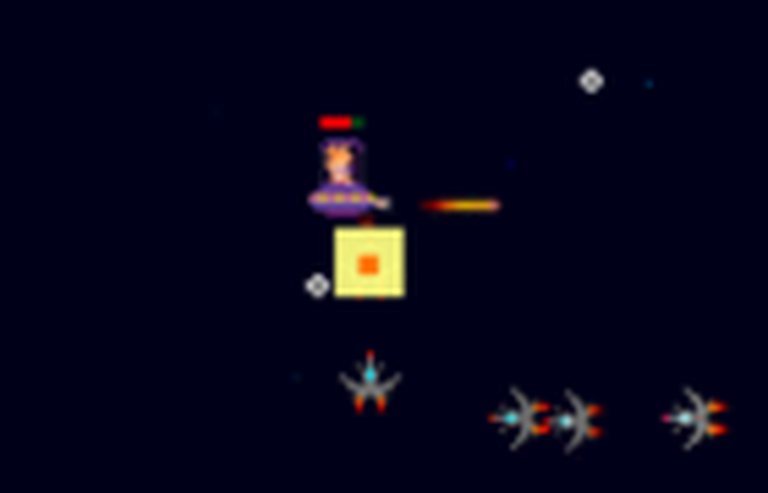
Description
Gamma Bros is a classic shoot ’em up game from 2006 where players control brothers Buzz and Zap Gamma as they battle through hordes of enemies during their commute home from a galactic workshift on a space station near Jupiter. Developed by Pixeljam Games, this freeware title offers fast-paced, 2D side-scrolling arcade action with a focus on space flight and shooter gameplay.
Gameplay Videos
Where to Buy Gamma Bros
PC
Gamma Bros Guides & Walkthroughs
Gamma Bros Cheats & Codes
PC
Enter codes at the password entry.
| Code | Effect |
|---|---|
| super | Enables ultra laser |
| golvl2 | Jump to level 2 |
| golvl3 | Jump to level 3 |
| ship2 | Version 2 ship |
| ship3 | Version 3 ship |
| golv12 | Skip to level 2 |
| golv13 | Skip to level 3 |
Gamma Bros: The Unassuming Odyssey of Two Pixelated Commuters
In an era dominated by increasingly photorealistic graphics and bloated open-world designs, Gamma Bros stands as a quiet, profound testament to the power of minimalist design and thematic coherence. Released in 2006 by the then-nascent indie studio Pixeljam Games, this free Flash shoot ’em up tasks players with guiding two brothers, Buzz and Zap Gamma, through a relentless alien assault on their daily commute from a space station near Jupiter to Earth. On the surface, it is a deceptively simple top-down shooter reminiscent of Robotron: 2084 or Galaga. Beneath its 8-bit aesthetic, however, lies a meticulously crafted experience that uses its mechanics, pacing, and sparse narrative to foster a rare sense of emotional investment in its protagonists. Gamma Bros is not about saving the galaxy; it is about the Sisyphean, heroic struggle to get home for dinner. This review argues that Gamma Bros represents a pivotal, though often overlooked, milestone in independent game development—a work that prioritized empathetic game design and atmospheric tension over spectacle, proving that sophisticated emotional resonance can emerge from the most abstract of pixelated forms.
Development History & Context: Pixelated Ambition from a Two-Person Team
Gamma Bros emerged from the foundations of Pixeljam Games, a studio formed in December 2005 by artist Richard Grillotti and programmer Miles Tilmann, who were roommates at the time. Their journey began not with Gamma Bros, but with a more ambitious, unfinished project: a room-to-room adventure game that incorporated Robotron-style gameplay. From this aborted effort, the characters of Buzz and Zap Gamma were salvaged—originally conceived as boss characters—and reimagined as the stars of their own, more focused title. The development of Gamma Bros was a intensive, roughly six-to-eight-month process for the core duo, with composer Mark Denardo contributing the critical audio layer. The team’s previous release, the mini-game Ratmaze (2005), served as a proof-of-concept for their ability to deliver a succinct, polished experience.
The technological and market context of 2006 is essential to understanding Gamma Bros‘s significance. This was the golden age of browser-based Flash games, a democratized ecosystem where independent creators could bypass traditional publishing gatekeepers. Platforms like Kongregate and Newgrounds were thriving, and the Independent Games Festival (IGF) had become a crucial launchpad for indie talent. Developing in Flash presented specific constraints: limited file size, performance bottlenecks, and a reliance on keyboard controls. Rather than see these as limitations, Pixeljam embraced them as creative directives. Tilmann noted their daily Flash programming experience, while Grillotti’s pixel art, honed for a fashion show series, was already minimalist. The decision to make the game freeware was a conscious philosophical and strategic choice. As Tilmann explained, they “thought selling it might create a wall between us and the player” and wanted “as many people to experience” their carefully crafted ending as possible. This model of offering a complete, high-quality experience for free to build an audience would later become a cornerstone of successful indie distribution.
Narrative & Thematic Deep Dive: The Heroism of the Ordinary
The narrative of Gamma Bros is delivered with the subtlety of a haiku. The official description establishes the premise: the Gamma Brothers are hardworking laborers on a station near Jupiter who endure a dangerous daily commute. There is no villainous overarching plot, no galactic threat, no exposition-dumping cutscenes. Their motivation is domestic: “dinner time on earth, and the Gamma Brothers’ families will not be pleased if you don’t get them home safely.”
This premise is a deliberate subversion of sci-fi and shooter tropes. Instead of messianic heroes or elite soldiers, the protagonists are blue-collar everymen. Their conflict is not ideological but logistical; their journey is not epic but quotidian. The thematic core is the dignity and peril inherent in ordinary labor and the universal desire to return home. The “aliens of unknown origin” are not an invading army but an occupational hazard—as routine and irritating as traffic or a rainstorm on the highway. This mundane framing makes the constant combat strangely relatable. The player isn’t liberating the world; they’re ensuring two brothers make it to their tables.
The characters themselves are defined by profound simplicity. Buzz and Zap differ only in minor visual details (hair, color), a design choice Grillotti championed to create “racially ambiguous” figures whose brotherhood is biological but whose identities are universal. They are not given personalities through dialogue but through their shared predicament and the game’s core mechanic of mutual reliance. The narrative deepens not through story beats, but through gameplay consequence: the loss of one brother permanently alters the game’s ending, a mechanic developer Anthony Burch famously praised in Destructoid as “one of the most simple, subtle, and clever methods of developing player/character empathy I’ve ever witnessed.” The story is not told to the player; it is lived by the player through the mechanics of survival and sacrifice.
Gameplay Mechanics & Systems: Empathy Through Interdependence
Gamma Bros is a twin-stick shooter where movement is controlled via arrow keys, and firing is mapped to the WASD keys, allowing for four-directional shooting (with an update later adding true 8-way firing). The core gameplay loop is a masterclass in escalating tension and rewarding player investment.
-
Core Loop & Pacing: The game’s genius lies in its deliberate, almost meditative pace compared to the frenetic chaos of its contemporaries. The scrolling background is often quiet, with music and intense sound effects reserved for enemy waves and boss battles. This creates a powerful contrast: moments of serene space travel punctuated by sudden, violent confrontations. As Jay Is Games noted, this “mixing action with the serenity of gently scrolling backgrounds goes a long way for ambiance.” The slow pace is not a lack of content but a feature, allowing the player to absorb the atmospheric composition and brace for the next engagement.
-
Combat & Enemy Patterns: Enemies attack in organized waves, often entering in symmetrical formations reminiscent of Space Invaders. They possess distinct attack patterns: fighters that charge, spread shot users, and missiles. The most significant tactical elements involve exploiting enemy vulnerabilities—many cannot fire forward, making flanking attacks from above or below highly effective. The game rewards pattern recognition and strategic positioning over reflexive spraying.
-
Character Progression & Economy: The progression system is tied to an in-game economy of “space coins” dropped by enemies and gained by destroying asteroids (which yield gems). A flying salesman periodically appears, allowing players to purchase weapon upgrades (double lasers, penetrating shots), health, and even new ships. Crucially, this currency is shared between the two brothers. If one brother dies, the player continues as the other, but their accumulated weapons, shields, and coins are transferred upon switching. This creates a powerful, tangible link between the brothers’ survival and the player’s cumulative investment. Spending coins on a brother who then dies feels like a genuine loss.
-
The Brother-Switching Mechanic: This is the game’s defining systemic feature. When both brothers are alive, their ships appear on screen. Physically bumping into the other’s ship allows for an immediate switch. This is not merely a lives system; it is a tactical resource. A player can let a weakened brother retreat (their ship disappears, leaving them as a vulnerable space-suited figure) while the fresh brother takes the offensive. More poetically, it embodies the theme of brotherly support—tagging in to relieve your sibling. The ultimate cost of failure is not a “Game Over” screen but the permanent loss of one brother, which irrevocably changes the final sequence and ending, cementing the emotional weight of each death.
-
UI & Password System: Reflecting its 2006 browser roots, the game uses a password system for stage continuation (e.g., “GOLVL2”), entered at the main menu. This archaic but effective method reinforced the game’s retro aesthetic and created a community of players sharing codes, a social layer common in pre-autosave eras.
World-Building, Art & Sound: Atmosphere from Abstraction
Gamma Bros’s world is a masterclass in suggestive minimalism. The visual style, crafted by Grillotti, uses large, chunky “minimum pixel” characters and environmental assets. The backgrounds are sparse starfields with simple, geometric debris and the occasional immense, looming structure like the Jupiter station. This abstraction forces the player’s imagination to fill the gaps, making the universe feel larger than the screen. The color palette is limited but effective, using stark contrasts to make enemies and pick-ups pop against the dark void.
The sound design, by Mark Denardo, is integral to the experience. The 8-bit chiptune soundtrack is used sparingly but memorably, often swelling during boss fights or significant waves to heighten tension. The majority of the commute is accompanied by eerie silence broken only by the subtle hum of engines, the pew of lasers, and the satisfying chime of coin collection. This auditory austerity makes the moments of music feel like a ramp-up to crisis and makes the ambient sound effects feel more immersive. It’s a technique that predates, but aligns with, the “less is more” philosophy of games like Limbo or Journey.
The world-building is entirely environmental and contextual. There are no text logs or NPC dialogue explaining the station or the aliens. The player understands the journey’s length and danger through the cumulative experience of the gameplay itself—the gradual increase in enemy density, the introduction of new hazards like asteroids, and the pacing that suggests a long-haul trip. The setting is a character in itself: the vast, uncaring void of space, against which the brothers’ daily struggle becomes a defiant act of human (or humanoid) connection.
Reception & Legacy: Cult Classic to Steam Staple
Upon its release in June 2006, Gamma Bros was met with enthusiastic praise from the nascent indie and Flash gaming communities. Its nomination for “Best Web Browser Game” at the 2007 IGF was a significant validation, placing it alongside notable titles like Aquaria and Castle Crashers. Reviews from outlets like Jay Is Games (4.6/5 at the time) and bloggers like Anthony Burch highlighted its unique atmosphere, clever empathy mechanics, and perfect distillation of arcade fun. Player comments on sites like JayIsGames and itch.io frequently praised its “old-school” feel, challenging yet fair difficulty, and the satisfaction of its climax.
Commercially, its freeware distribution strategy was a success by indie metrics—it was widely played and shared. However, its legacy was nearly lost with the decline of Flash. Pixeljam’s attempt to launch an early access paid mobile version in 2016 “did not work out so well,” as they later admitted on Steam. The turning point was its re-release as a free, polished downloadable title on Steam (and itch.io) in December 2018. This resurrection introduced the game to a new generation and yielded remarkable results: as of 2026, Gamma Bros holds a “Very Positive” rating on Steam with 91% approval across over 160 reviews. Many newer reviews express surprise and delight at discovering such a polished, heartfelt game for free, with frequent mentions of the emotional impact of the brother-switching and the final boss.
Gamma Bros’s influence is subtle but present in the DNA of later indie design. It validated that:
1. Mechanics can be narrative: The brother-switch system directly conveys relationship and mutual dependency without a single line of scripted dialogue.
2. Atmosphere over polygon count: Its success proved that composition, sound design, and pacing could create immersion far more effectively than graphical fidelity, a tenet embraced by countless pixel-art and minimalist indies.
3. Free distribution builds legacy: Its no-cost release model fostered a dedicated community and ensured its survival beyond Flash’s demise, culminating in a successful, organic move to Steam.
4. The mundane can be epic: The game’s premise inspired later works to find heroism in the everyday, from the labor of Frostpunk to the domestic quests of Untitled Goose Game.
Conclusion: An Essential Artifact of Indie Philosophy
Gamma Bros is not the most technically advanced, longest, or graphically impressive game ever made. Its historical importance lies precisely in its conscious rejection of those metrics. It is a game born from specific constraints—a two-person team, the Flash platform, a shoestring budget—that used those constraints to forge a unique and emotionally resonant identity. Its twin-stick shooting is solid, but its true innovation is systemic storytelling: the shared economy, the permanent loss of a brother, and the ending’s dependence on these choices create a bond between player and pixelated protagonists that is rare in the genre.
From the quiet, lonely vastness of its space backgrounds to the fever-pitch intensity of its final boss, Gamma Bros is a perfectly calibrated emotional journey. It is a poignant commentary on work, family, and fraternity, wrapped in the accessible skin of an arcade shooter. Its IGF nomination was deserved, its Steam re-release is a triumph of preservation, and its design philosophy remains a vital lesson: that the most enduring gaming experiences often come not from scale, but from the precise, thoughtful alignment of theme, mechanics, and mood. Gamma Bros is an essential, undervalued artifact of indie game history—a pixelated proof that heart, in games as in life, matters more than horsepower.