
- Release Year: 2005
- Platforms: Windows
- Publisher: ESP International Ltd
- Developer: Maestro Learning, Inc., Paws, Inc.
- Genre: Educational
- Perspective: 1st-person
- Game Mode: Single-player
- Gameplay: Drag-and-drop, Mini-games, Ordering sequences, Picture matching
- Setting: Educational, Pre-school
Description
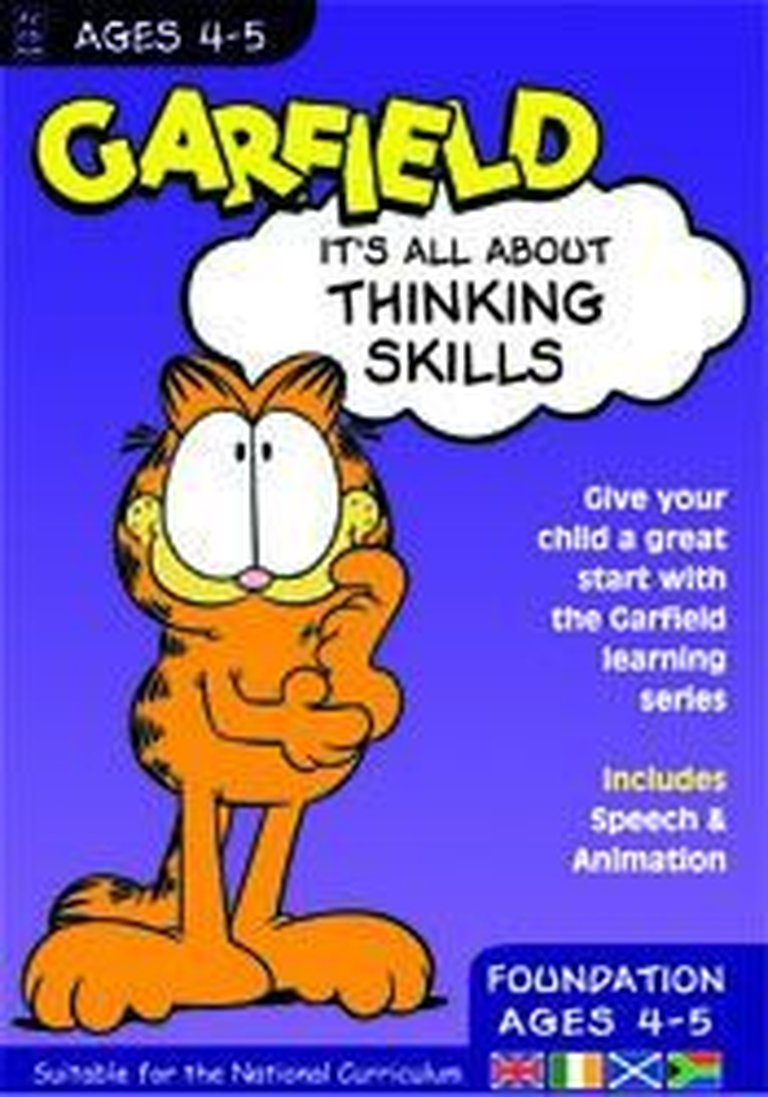
Garfield’s It’s All About Thinking Skills is an educational game designed for preschool children aged 4-5, featuring a collection of mini-games focused on developing early cognitive abilities. Players navigate a main menu styled like Garfield holding a card with food items, each triggering a different activity such as picture matching, sequencing, or identifying objects that belong together. The game uses simple mouse controls for drag-and-drop or selection tasks, with optional audio assistance to guide young learners through challenges like letter recognition, logical sequencing, and problem-solving.
Garfield’s It’s All About Thinking Skills: A Deep Dive into the Forgotten Edutainment Gem
Introduction: The Unlikely Marriage of Garfield and Early Childhood Education
In the vast, often chaotic landscape of early 2000s educational software, Garfield’s It’s All About Thinking Skills (2005) stands as a curious artifact—a product of its time, both in its pedagogical approach and its reliance on a beloved pop culture icon to engage young minds. Developed by Maestro Learning, Inc. and Paws, Inc., and published by ESP International Ltd., this CD-ROM-based title targeted preschoolers aged 4-5, promising to cultivate “logical thinking” through a series of mouse-driven mini-games. Yet, despite its noble intentions and the enduring appeal of its feline mascot, the game has faded into obscurity, overshadowed by more ambitious (or infamous) entries in the Garfield gaming canon.
This review seeks to resurrect Garfield’s It’s All About Thinking Skills from the digital dustbin, examining it not just as a piece of edutainment software but as a cultural artifact—a snapshot of early 2000s educational philosophy, technological constraints, and the commercialization of childhood learning. Through a meticulous analysis of its development, gameplay, narrative framing, and legacy, we will argue that while the game is far from a masterpiece, it is a fascinating case study in how licensed properties were leveraged to make learning palatable to young children, and how the limitations of its era shaped its design.
Development History & Context: The Edutainment Boom and the Garfield Empire
The Rise of Edutainment in the Early 2000s
The early 2000s were a golden age for educational software, a period when parents and educators alike embraced the idea that computers could be powerful tools for early childhood development. Titles like The Oregon Trail, Reader Rabbit, and JumpStart had already cemented the “edutainment” genre as a lucrative market, blending entertainment with curriculum-based learning. Publishers like ESP International Ltd. specialized in this niche, churning out titles that promised to teach everything from phonics to critical thinking, often with the help of recognizable mascots.
Garfield’s It’s All About Thinking Skills emerged from this ecosystem, part of a broader trend of licensing popular children’s characters to lend credibility and appeal to educational software. The game was not alone in this approach—ALF’s Thinking Skills (1988) and BRAINtastic! Word Skills (2006) followed similar formulas—but Garfield brought with it a unique cultural cachet. By 2005, Jim Davis’s lasagna-loving cat was a global phenomenon, with a syndicated comic strip, animated TV specials, and even a live-action film (Garfield: The Movie, 2004) under his belt. The character’s ubiquity made him an ideal vehicle for educational content, a familiar face that could ease children into the sometimes daunting world of structured learning.
The Creators and Their Vision
The development of Garfield’s It’s All About Thinking Skills was a collaboration between Maestro Learning, Inc., a company specializing in educational software, and Paws, Inc., Jim Davis’s own production company. The credits reveal a team of educators, artists, and engineers, including:
– Peter H. Dublin (Ed. D.), President of ESP International, whose background in education likely shaped the game’s pedagogical approach.
– Roberta Grenard, credited with content development, presumably ensuring the mini-games aligned with early childhood learning standards.
– David Reddick, a writer and artist who had worked on previous Garfield games, including Garfield: It’s All About Phonics – Kindergarten (2004).
– Jim Davis, the creator of Garfield, whose involvement was likely limited to licensing and oversight but whose influence loomed large over the project.
The game’s development was constrained by the technological standards of 2005. Running on Windows XP with a mere 32 MB of RAM and 60 MB of storage space, it was designed to be accessible to families with modest hardware. The fixed/flip-screen visuals and direct mouse control reflected the limitations of the era, prioritizing functionality over graphical fidelity. The CD-ROM format, while already being phased out in favor of digital distribution, was still the dominant medium for educational software, ensuring compatibility with school and home computers alike.
The Gaming Landscape of 2005
2005 was a transitional year for gaming. The PlayStation 2 and Xbox were in their prime, while the Nintendo DS and PSP were ushering in a new era of portable gaming. Yet, the PC remained the dominant platform for educational software, thanks to its ubiquity in schools and households. Garfield’s It’s All About Thinking Skills existed in a parallel universe to the blockbuster titles of the time—World of Warcraft, Half-Life 2, and Resident Evil 4—catering instead to a niche audience of parents and educators.
The game’s release also coincided with a broader cultural moment: the peak of Garfield‘s multimedia empire. The 2004 live-action film had been a commercial success, grossing over $200 million worldwide, and the franchise was expanding into new territories, including video games. Garfield: A Tail of Two Kitties (2006) and Garfield’s Mad About Cats (2000) were part of this wave, but It’s All About Thinking Skills occupied a unique space as one of the few Garfield games explicitly designed for educational purposes.
Narrative & Thematic Deep Dive: Garfield as Pedagogue
The Illusion of Narrative
Garfield’s It’s All About Thinking Skills is, at its core, a collection of mini-games with only the thinnest veneer of narrative. The game begins with a “sign-in” screen, a common feature in educational software of the era, designed to give children a sense of ownership over their progress. Once logged in, players are greeted by a main menu depicted as Garfield holding a card adorned with various food items—a clever nod to the character’s gluttonous persona. Clicking on these items launches the mini-games, each framed as a distinct “activity” rather than part of a cohesive story.
This lack of narrative cohesion is not necessarily a flaw. The game’s target audience—preschoolers—was unlikely to demand a complex plot. Instead, the narrative framing serves a purely functional purpose: to contextualize the mini-games within the Garfield universe. For example:
– “Garfield Don’t Be Late” presents a storybook extract, presumably tying into the character’s well-known laziness.
– “What Belongs?” and “What Doesn’t Belong?” use scenarios that feel lifted from the comic strips, such as a garden shed or a kitchen, reinforcing the game’s connection to the source material.
Thematic Underpinnings: Logic, Categorization, and Early Childhood Development
The game’s themes are explicitly educational, focusing on the development of “thinking skills”—a broad term that encompasses logical reasoning, pattern recognition, and categorization. Each mini-game targets a specific cognitive skill:
1. Drag The Object: Tests visual matching and fine motor skills, requiring players to drag items to their corresponding pairs.
2. First, Last, Next: Introduces the concept of sequencing, a foundational skill for storytelling and problem-solving.
3. Select The Picture: Reinforces letter recognition and association, tying into early literacy.
4. What Belongs? / What Doesn’t Belong?: Encourages categorization and critical thinking, asking players to identify relationships between objects.
These themes are presented in a way that feels organic to the Garfield universe. The humor and visual style of the comic strip are ever-present, from the exaggerated expressions of the characters to the occasional lasagna joke. The game’s art direction, led by Betsy Knotts and featuring contributions from longtime Garfield artists like Gary Barker and Lori Barker, ensures that the aesthetic remains faithful to the source material, even if the gameplay itself is simplistic.
The Role of Garfield and Friends
Garfield himself serves as the game’s de facto guide, appearing in the main menu and occasionally offering audio assistance via the help button. His presence is largely decorative—he does not actively participate in the mini-games—but his inclusion is crucial for maintaining the child’s engagement. The option to “change the character” who provides help suggests that other Garfield universe characters (such as Odie or Jon Arbuckle) might have been available, though documentation on this feature is sparse.
The dialogue, written by David Reddick, is minimal but effective, leveraging the dry, sarcastic humor that defines the Garfield comic strip. For example, the “What Doesn’t Belong?” mini-game might present a scenario where Garfield quips, “Hmm, a clown in the garden? That doesn’t belong unless it’s my birthday!” These moments of levity serve to break up the educational content, making the experience feel less like a chore and more like an extension of the Garfield brand.
Gameplay Mechanics & Systems: The Building Blocks of Thinking
Core Gameplay Loop
Garfield’s It’s All About Thinking Skills is structured around a series of self-contained mini-games, each accessible from the main menu. The gameplay loop is straightforward:
1. Select a mini-game from the main menu.
2. Engage with the activity, which typically involves either dragging and dropping objects or selecting the correct answer from a set of options.
3. Receive feedback, usually in the form of audio cues (e.g., a cheerful “Good job!” or a gentle “Try again”).
4. Repeat or exit, with the option to return to the main menu and choose a different activity.
This loop is designed to be intuitive for young children, with no complex controls or convoluted objectives. The mouse-driven interface ensures that even players with limited fine motor skills can participate, while the drag-and-drop mechanics in games like “Drag The Object” and “First, Last, Next” provide a tactile, engaging way to interact with the content.
Mini-Game Breakdown
Let’s examine each mini-game in detail, assessing its educational value and execution:
-
Drag The Object
- Objective: Match items from the bottom of the screen to their corresponding pairs at the top.
- Skills Developed: Visual discrimination, hand-eye coordination, pattern recognition.
- Analysis: This is one of the simplest activities, but its effectiveness lies in its clarity. The drag-and-drop mechanic is intuitive, and the visual feedback (e.g., items snapping into place) reinforces success.
-
First, Last, Next
- Objective: Arrange pictures in the correct chronological order (e.g., a seedling growing into a flower).
- Skills Developed: Sequencing, logical reasoning, narrative comprehension.
- Analysis: This mini-game is particularly strong, as it introduces the concept of cause and effect in a way that is accessible to preschoolers. The use of familiar scenarios (e.g., a plant growing, a sandwich being made) ensures that children can rely on prior knowledge to solve the puzzles.
-
Garfield Don’t Be Late
- Objective: Read (or listen to) a storybook extract.
- Skills Developed: Literacy, comprehension, attention span.
- Analysis: This is the most passive of the mini-games, essentially a digital storybook. While it lacks interactivity, it serves as a nice break from the more demanding activities, reinforcing the idea that reading can be enjoyable.
-
Select The Picture
- Objective: Match uppercase and lowercase letters, often decorated with Garfield characters.
- Skills Developed: Letter recognition, association, early literacy.
- Analysis: This activity is a clever way to tie the Garfield brand into literacy education. The use of colorful, character-themed letters makes the task more engaging than a traditional flashcard approach.
-
What Belongs?
- Objective: Select items that logically belong with a central picture (e.g., a barbeque in a garden).
- Skills Developed: Categorization, logical reasoning, contextual understanding.
- Analysis: This mini-game is one of the most effective, as it encourages children to think critically about relationships between objects. The inclusion of absurd options (e.g., a performing seal in a garden) adds a layer of humor that keeps the activity lighthearted.
-
What Doesn’t Belong?
- Objective: Identify the odd one out in a set of pictures.
- Skills Developed: Critical thinking, pattern recognition, deduction.
- Analysis: Similar to “What Belongs?” but inverted, this activity challenges children to spot inconsistencies. It is slightly more difficult, as it requires the player to recognize what doesn’t fit rather than what does.
User Interface and Accessibility
The UI is designed with young children in mind, featuring large, colorful buttons and minimal text. The main menu, depicted as Garfield’s food card, is visually appealing but somewhat cluttered—only certain food items are interactive, which could confuse younger players. The help button, which provides audio assistance, is a welcome feature, though its effectiveness depends on the clarity of the voice acting (which, based on the lack of reviews, is difficult to assess).
One notable limitation is the lack of customization or progression tracking. Unlike more advanced edutainment titles, Garfield’s It’s All About Thinking Skills does not appear to save player progress or adapt difficulty based on performance. This means that the experience remains static, regardless of how many times a child plays through the activities.
Innovations and Flaws
The game’s most innovative aspect is its seamless integration of the Garfield brand into educational content. By leveraging the character’s humor and visual style, it makes learning feel like an extension of the comic strip rather than a separate, academic exercise. However, this integration is also its greatest limitation. The mini-games are so tightly tied to the Garfield aesthetic that they lack the universality of more generic edutainment titles. A child who is not already a fan of Garfield might find the experience less engaging.
From a mechanical standpoint, the game’s simplicity is both a strength and a weakness. The drag-and-drop and selection-based activities are easy to grasp, but they offer little in the way of depth or replayability. There are no unlockable rewards, no branching pathways, and no multiplayer options—just a linear progression through a fixed set of challenges.
World-Building, Art & Sound: The Garfield Aesthetic in Digital Form
Setting and Atmosphere
Garfield’s It’s All About Thinking Skills does not attempt to create a cohesive virtual world. Instead, it presents a series of isolated scenarios, each tailored to the specific mini-game. The main menu, with its food-themed design, evokes the cluttered, chaotic aesthetic of the Garfield comic strip, where lasagna and doughnuts are recurring motifs. The individual activities take place in settings familiar to fans of the franchise:
– A garden shed for “What Belongs?”
– A kitchen for “What Doesn’t Belong?”
– A plant pot for “First, Last, Next”
These environments are rendered in a bright, cartoonish style that mirrors the comic strip’s visual language. The fixed/flip-screen perspective ensures that the focus remains on the gameplay rather than exploration, reinforcing the game’s educational priorities.
Visual Design: Faithful to the Source
The art direction, overseen by Betsy Knotts and executed by a team of Garfield veterans, is one of the game’s strongest aspects. The character designs are instantly recognizable, with Garfield’s signature smug expression and Odie’s dopey grin faithfully reproduced. The color palette is vibrant, with plenty of oranges, yellows, and blues—colors that are both visually appealing to young children and synonymous with the Garfield brand.
The mini-games themselves are visually simple but effective. “Select The Picture,” for example, uses large, bold letters adorned with Garfield characters, making the task of matching uppercase and lowercase letters more engaging. “First, Last, Next” employs clear, sequential images that leave little room for ambiguity.
Sound Design: Minimal but Effective
Given the game’s target audience, the sound design is understandably minimal. The audio assistance feature, triggered by the help button, likely provides verbal cues to guide players through the activities. Beyond this, the game relies on simple sound effects—chimes for correct answers, gentle buzzes for incorrect ones—to reinforce feedback.
Notably absent is a full musical score. While this might seem like a missed opportunity, it is consistent with the game’s focus on education over entertainment. A looping soundtrack could have been distracting for young players, detracting from the cognitive tasks at hand.
Reception & Legacy: The Forgotten Edutainment Title
Critical and Commercial Reception
Garfield’s It’s All About Thinking Skills is a ghost in the annals of gaming history. There are no critic reviews on Metacritic, no user scores on IGN, and no substantial discussions on gaming forums. The game’s MobyGames page lists only six players who have “collected” it, and its inclusion in the 10 Krazy Kids PC Games (2007) compilation suggests that it was not a standalone success.
This lack of reception is not necessarily indicative of the game’s quality. Educational software, particularly titles aimed at preschoolers, rarely receives the same level of scrutiny as mainstream games. Parents and educators were the primary audience for Garfield’s It’s All About Thinking Skills, and their feedback—if it existed—would have been shared in classrooms and living rooms rather than online reviews.
Evolution of the Genre
The edutainment genre has evolved significantly since 2005. Modern educational games, such as DragonBox or Endless Alphabet, leverage touchscreen interfaces, adaptive difficulty, and gamification techniques to create more engaging experiences. Garfield’s It’s All About Thinking Skills, with its static mini-games and lack of progression, feels dated by comparison.
However, the game’s core principles—using familiar characters to make learning accessible, focusing on foundational cognitive skills, and prioritizing simplicity—remain relevant. Titles like PBS Kids Games and Sago Mini continue to employ similar strategies, albeit with more sophisticated technology.
The Garfield Gaming Legacy
Within the Garfield gaming canon, It’s All About Thinking Skills occupies a unique but minor position. The franchise’s video game history is a mixed bag, ranging from the critically panned Garfield: Caught in the Act (1996) to the more competent Garfield Kart (2013). Educational titles like Garfield’s Typing Pal (2003) and Garfield: It’s All About Phonics – Kindergarten (2004) share It’s All About Thinking Skills‘ focus on early childhood development, but none have left a lasting impact on the industry.
The game’s obscurity is perhaps its most defining feature. Unlike Garfield Kart, which has developed a cult following for its absurdity, or Garfield: A Tail of Two Kitties, which benefits from its association with the live-action films, It’s All About Thinking Skills has no such cultural footprint. It exists as a relic of its time, a reminder of when Garfield was not just a comic strip but a multimedia juggernaut capable of infiltrating even the most niche corners of the entertainment industry.
Conclusion: A Modest but Meaningful Contribution to Edutainment
Garfield’s It’s All About Thinking Skills is not a great game by any conventional metric. Its gameplay is simplistic, its narrative is nonexistent, and its technical limitations are glaring by modern standards. Yet, to dismiss it outright would be to overlook its significance as a product of its era—a time when educational software was seen as a vital tool for childhood development, and when licensed properties were leveraged to make learning feel like play.
The game’s greatest strength is its faithfulness to the Garfield brand. By integrating the character’s humor, visual style, and personality into its educational content, it creates an experience that feels cohesive and engaging for young fans. The mini-games, while basic, are effective at teaching foundational cognitive skills, and the drag-and-drop mechanics ensure that the experience is interactive rather than passive.
Ultimately, Garfield’s It’s All About Thinking Skills is a forgotten footnote in both gaming history and the Garfield franchise. It is neither a masterpiece nor a disaster, but a modest, well-intentioned attempt to merge education with entertainment. For historians of edutainment, it serves as a fascinating case study in the commercialization of childhood learning. For fans of Garfield, it is a curious artifact—a reminder of a time when the lasagna-loving cat was everywhere, even in the most unexpected places.
Final Verdict: 6/10 – A competent but unremarkable edutainment title that fulfills its educational goals without transcending them.