
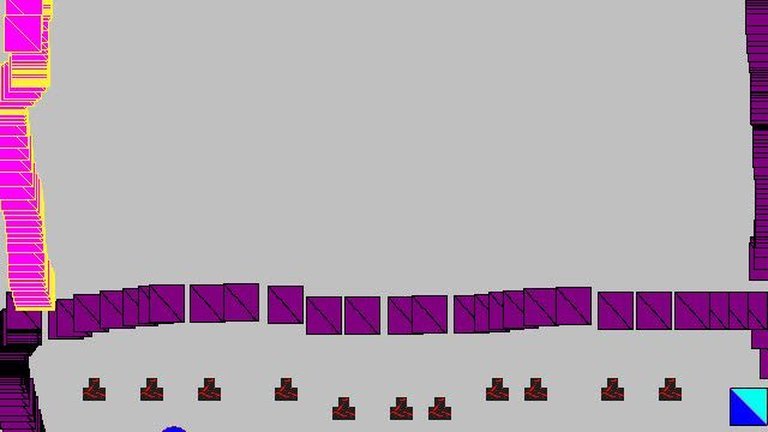
Description
In ‘gavno’, you take on the role of a purple ball navigating through various levels in a fantasy setting. The gameplay involves traveling across different stages, where you must defeat white balls to progress further. This arcade-style action game offers a side-view perspective and is designed for single-player offline play, with simple keyboard controls.
gavno Reviews & Reception
ign.com (90/100): A delightful, daring, and different expansion that reinforces Forza Horizon 3’s reputation as one of the best racing games ever made.
polygon.com : Video games can be frivolous. They can be important. And quite often, they manage to be both at once.
gavno: A Minimalist Masterpiece or a Forgotten Oddity?
Introduction: The Enigma of gavno
In the vast, ever-expanding universe of video games, where blockbuster titles and indie darlings vie for attention, gavno (2017) exists as a curious footnote—a game so stripped-down, so unassuming, that it almost defies analysis. Developed by an unknown creator (credited only as “Deleted” on MobyGames) and released as freeware, gavno is a side-scrolling arcade game where players control a purple ball navigating through levels, battling white balls to progress. Its title, which translates to “shit” in Russian, hints at a self-aware, almost nihilistic humor, as if the game itself is a meta-commentary on the absurdity of minimalist game design.
Yet, beneath its rudimentary premise lies a fascinating case study in game development, narrative absence, and the very definition of what constitutes a “game.” Is gavno a deliberate artistic statement, a placeholder for something greater, or simply a forgotten experiment? This review seeks to dissect gavno from every conceivable angle—its development, its “narrative,” its mechanics, and its place in gaming history—to determine whether it is a hidden gem, a relic of its time, or merely digital detritus.
Development History & Context: The Birth of a Purple Ball
The Studio and the Creator’s Vision
The origins of gavno are shrouded in mystery. The game’s MobyGames entry lists its creator as “Deleted,” suggesting either an abandoned project, a pseudonymous developer, or a placeholder for an unknown entity. The lack of credits, promotional material, or even a clear development timeline makes gavno a ghost in the machine—a game that exists without a discernible creator.
What little we know comes from its MobyGames description:
“In gavno you play as purple ball. You travel to different levels. In some levels you have to defeat the white balls to go further.”
This terse summary reads like a dare, a challenge to the player to find meaning in the meaningless. The game’s Russian title, гавно, further reinforces this tone. The choice of such a vulgar word for a game title is unusual, even in indie circles, and suggests either a rebellious streak, a joke, or a deliberate attempt to subvert expectations.
Technological Constraints and the Era of Its Release
gavno was released on October 11, 2017, a year that saw the launch of titanic games like The Legend of Zelda: Breath of the Wild, Horizon Zero Dawn, and PlayerUnknown’s Battlegrounds. In this context, gavno is the antithesis of the AAA spectacle—a game that eschews high-definition graphics, complex narratives, and even basic polish in favor of raw, unfiltered simplicity.
Technologically, gavno is a throwback to the earliest arcade games, reminiscent of Pong or Breakout. Its side-view perspective and basic collision mechanics suggest it was built with minimal tools, possibly as a quick experiment or a learning project. The fact that it is freeware and supports only keyboard input reinforces the idea that it was not intended for commercial success but perhaps as a personal or educational endeavor.
The Gaming Landscape of 2017
2017 was a year of both innovation and nostalgia in gaming. Indie developers pushed boundaries with titles like Cuphead (a hand-drawn homage to 1930s animation) and Hollow Knight (a Metroidvania with deep lore and atmospheric world-building). Meanwhile, AAA studios delivered open-world epics and competitive multiplayer experiences that dominated headlines.
In this environment, gavno is an outlier—a game that doesn’t just ignore trends but actively resists them. It has no story, no characters, no dialogue, and no apparent ambition beyond its core mechanic. It is, in many ways, the anti-game, a rejection of the increasingly complex and narrative-driven experiences that dominated the year.
Narrative & Thematic Deep Dive: The Story of Nothing
Plot and Characters: The Absence of Meaning
gavno has no plot. There is no backstory, no lore, no exposition. The player is a purple ball. The enemies are white balls. The objective is to defeat the white balls to progress. That’s it.
This absence of narrative is striking, especially in an era where games are often judged by the depth of their storytelling. Even abstract games like Katamari Damacy or Journey have underlying themes or emotional arcs. gavno, by contrast, offers nothing—no context, no motivation, no resolution. It is a pure mechanical experience, a game reduced to its most basic elements.
Yet, this very absence invites interpretation. Is gavno a commentary on the futility of existence? A satire of games that prioritize mechanics over meaning? Or is it simply a game that doesn’t care to explain itself?
Themes: Nihilism, Minimalism, and the Absurd
If we were to ascribe themes to gavno, they would likely revolve around:
1. Nihilism: The game’s title and lack of narrative suggest a rejection of meaning. The player’s actions—defeating white balls—have no consequence beyond progression. There is no grand victory, no moral lesson, no emotional payoff.
2. Minimalism: gavno strips away everything that isn’t essential to the gameplay loop. There are no cutscenes, no dialogue, no side quests. It is a game about moving and fighting, nothing more.
3. The Absurd: The sheer simplicity of the game borders on the absurd. Why is the player a purple ball? Why are the enemies white balls? The game offers no answers, leaving the player to either accept the absurdity or reject the game entirely.
Dialogue and World-Building: The Silence of the Balls
There is no dialogue in gavno. There are no characters to speak, no text to read, no environmental storytelling. The world is a series of levels, each populated by white balls that must be defeated. There is no lore to uncover, no history to explore. The game is, in every sense, a blank slate.
This silence is deafening in an era where games like The Last of Us and Disco Elysium are praised for their rich, dialogue-driven narratives. gavno doesn’t just ignore these trends—it actively resists them, offering a gaming experience that is purely mechanical.
Gameplay Mechanics & Systems: The Art of the Basic
Core Gameplay Loop: Move, Fight, Repeat
gavno’s gameplay is as simple as its premise. The player controls a purple ball that moves left and right, jumping and attacking white balls. The controls are limited to basic keyboard inputs, and the mechanics are straightforward:
– Movement: The purple ball can move horizontally and jump.
– Combat: The player defeats white balls by colliding with them (presumably).
– Progression: Defeating white balls allows the player to advance to the next level.
There are no power-ups, no upgrades, no special abilities. The game is a pure test of reflexes and timing, with no depth beyond its core mechanic.
Combat and Character Progression: The Illusion of Growth
Since there is no character progression in gavno, the player’s purple ball remains unchanged throughout the game. There are no experience points, no new abilities, no equipment to collect. The only “progression” is moving from one level to the next, each presumably more challenging than the last.
This lack of progression is unusual in modern gaming, where even the simplest mobile games often include some form of character growth. gavno rejects this entirely, offering a static experience where the player’s skill is the only variable.
UI and Innovation: The Beauty of Simplicity
The game’s UI is equally minimalist. There are no health bars, no score counters, no maps. The player is given no information beyond what is immediately visible on-screen. This lack of UI reinforces the game’s focus on pure gameplay, stripping away any distractions.
In terms of innovation, gavno offers none. It is not trying to reinvent the wheel—it is content to be a very basic, very simple game. Whether this is a deliberate artistic choice or a result of limited development resources is unclear, but the effect is the same: a game that is unapologetically basic.
World-Building, Art & Sound: The Aesthetics of Nothingness
Setting and Atmosphere: The Void
gavno’s setting is as abstract as its narrative. The levels are presumably simple, geometric environments with no distinguishing features. There is no world to explore, no lore to uncover, no atmosphere to immerse oneself in. The game is a series of challenges, nothing more.
Visual Direction: The Purple and the White
The game’s art style is as minimalist as its mechanics. The player is a purple ball; the enemies are white balls. The levels are likely basic, with no detailed textures or elaborate designs. The visuals are functional, serving only to facilitate the gameplay.
This lack of visual flair is striking in an era where games like Cuphead and Ori and the Blind Forest are celebrated for their artistic ambition. gavno doesn’t just ignore aesthetics—it actively resists them, offering a visual experience that is as barebones as possible.
Sound Design: The Silence of the Spheres
There is no information available about gavno’s sound design, but given its minimalist approach, it is likely that the game features little to no audio. There may be basic sound effects for jumping or defeating enemies, but no music, no ambient noise, no voice acting. The game is, in every sense, a silent experience.
This silence is another layer of the game’s minimalism. Without sound, the player is forced to focus entirely on the gameplay, with no auditory cues to guide or distract them.
Reception & Legacy: The Game That Wasn’t
Critical and Commercial Reception: The Sound of Crickets
gavno has no recorded reviews on MobyGames, no Metascore, no user ratings. It is, for all intents and purposes, a game that was released and immediately forgotten. There are no articles, no Let’s Plays, no discussions about its merits or flaws. It exists in a vacuum, a game that was made and then left to fade into obscurity.
This lack of reception is telling. In a year dominated by games that pushed boundaries in storytelling, graphics, and gameplay, gavno offered none of these things. It was, and remains, a game that is easy to ignore.
Influence and Legacy: The Ghost in the Machine
gavno’s legacy is nonexistent. It has not inspired sequels, spin-offs, or imitators. It has not been referenced in other games or discussed in gaming circles. It is, in every sense, a footnote—a game that was made, released, and forgotten.
Yet, there is something fascinating about its existence. In an industry that increasingly values spectacle, gavno is a reminder that games can be simple, that they can exist without narrative or ambition. It is a relic of a time when games were made for the sake of making them, not for commercial success or critical acclaim.
Conclusion: The Meaning of gavno
gavno is not a good game by any conventional metric. It has no story, no depth, no innovation. It is a basic, unpolished experiment that offers little beyond its core mechanic. And yet, there is something strangely compelling about it—a game that exists purely for the sake of existing, with no pretensions or ambitions.
In a world where games are increasingly judged by their narratives, their graphics, and their emotional impact, gavno is a rejection of all these things. It is a game that doesn’t care if you like it, that doesn’t try to impress you, that doesn’t even try to explain itself. It is, in many ways, the purest form of a game: a set of rules, a challenge, and nothing more.
Is gavno a masterpiece? No. Is it a forgotten oddity? Yes. But in its simplicity, in its refusal to be anything more than what it is, there is a strange kind of beauty. It is a game that doesn’t ask for your time, your money, or your attention. It simply is.
And in that, perhaps, lies its greatest strength.
Final Verdict: 2/10 – A fascinating failure, a game that exists in defiance of everything we expect from the medium.