
- Release Year: 2015
- Platforms: Linux, Windows
- Publisher: Amaxang Games
- Developer: Amaxang Games
- Genre: Action
- Perspective: Diagonal-down
- Setting: Futuristic, Sci-fi
- Average Score: 27/100
Description
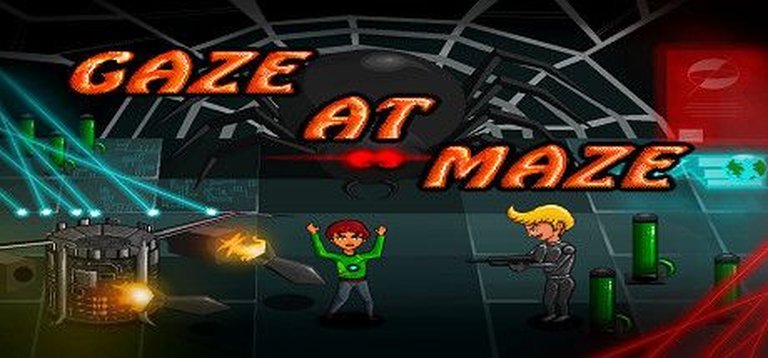
In ‘Gaze at Maze’, players assume the role of Jack, a curious boy transported into a bizarre sci-fi maze world after discovering a mysterious globe. This 2D top-down action game challenges players to navigate labyrinthine levels filled with genetically modified monsters, security bots, and hidden traps while rescuing a captive princess and uncovering dark experiments. With 22 levels, key-card hunts, security-hacking mechanics, and collectible cubes, the game blends exploration and strategy. Developed solo by Amaxang Games using GameMaker, it features retro-inspired visuals and a futuristic setting brimming with environmental hazards and enemies.
Where to Buy Gaze at Maze
PC
Gaze at Maze Patches & Updates
Gaze at Maze: Review
A labor of love buried beneath labyrinthine flaws
Introduction
A boy, a maze, and an impassioned solo developer’s Sisyphean dream. Gaze at Maze (2015), developed by one-man studio Amaxang Games (Anamik Majumdar), is a 2D top-down sci-fi maze runner that exemplifies both the earnest ambition and technical limitations of indie game development. Positioned as a “challenging and difficult” experience in the vein of retro dungeon crawlers, this obscure title attempts to blend arcade-style precision platforming with a B-movie narrative about genetic experiments and interdimensional rescue missions. Our thesis: Gaze at Maze is a fascinating artifact of persistence—a game whose glaring imperfections paradoxically amplify its value as a case study in solitary creation, yet render it an often-frustrating artifact for modern players.
Development History & Context
The solo odyssey of Anamik Majumdar
Born from a 9-month development cycle (March 2014–January 2015) using GameMaker Studio, Gaze at Maze emerged during an era when indie platforms like Steam Greenlight and itch.io democratized publishing—but also flooded the market with amateur projects. Majumdar, operating without a team, handled every aspect except music composition, later reflecting: “As a solo developer, I have worked very hard on every aspect… including graphics, artwork, programming, and level design.”
Technological constraints defined the project. Built on GameMaker’s 2D toolkit, the game sidestepped 2015’s industry trend toward 3D immersion (e.g., The Witcher 3, Bloodborne) in favor of a deliberate retro aesthetic. However, limitations in physics programming and collision detection—critical for a maze game demanding pixel-perfect movement—haunted the final product. Majumdar’s post-launch updates (e.g., V3.5 in February 2016) retooled lighting effects and GUI elements, but couldn’t rectify foundational issues like hitbox inaccuracy.
The 2015 indie landscape: With titles like Undertale redefining narrative depth and Rocket League polishing arcade simplicity, Gaze at Maze’s clunky systems felt out of step—a relic of 1980s arcade mazes (e.g., Berzerk) with none of their razor-sharp design.
Narrative & Thematic Deep Dive
A pulpy sci-fi fable drowning in unrealized potential
The premise reads like discarded Twilight Zone fanfic: Teenager Jack discovers a mysterious globe that teleports him to a maze dimension ruled by genetically modified “Demons” (robotic spiders, laser-eyed dragons) and an unseen villain experimenting on human embryos. His quest: Rescue a princess and escape 22–54 levels (sources conflict) of claustrophobic corridors.
Characters and dialogue: Minimalist to a fault. Jack is a silent protagonist; the princess exists solely as a damsel-in-distress MacGuffin. Environmental storytelling—security terminals, imprisoned NPCs—is buried beneath repetitive objectives (“collect gems to unlock doors”). Thematically, the game gestures toward Frankenstein-esque critiques of unchecked science, but lacks the textual depth to explore them.
Tone: A dissonant blend of whimsy and horror. “Weird looking creatures” (per Majumdar’s description) clash with grim implications of human experimentation, while gameplay oscillates between Saturday-morning cartoon aesthetics (“Dragon Balls” as collectibles) and sadistic difficulty spikes.
Gameplay Mechanics & Systems
A Rube Goldberg machine of frustration
At its core, Gaze at Maze is a time-attack maze navigator with RPG-lite elements:
– Movement: Direct control via keyboard/gamepad. Diagonal-down perspective creates depth perception issues; collision detection is infamously unreliable, with players reporting deaths while “visibly not touching spikes”.
– Objective loop: Collect keys/gems → disable security systems → avoid enemies → exit through a flag. Monotonous but functional—until procedural flaws intrude.
– Enemies & Traps: Spider bots patrol corridors; wall-mounted “Magic Eyes” spawn enemies on contact; rotating lasers and “movable thorns” demand frame-perfect timing. Problem: Hitboxes frequently extend beyond sprites, making traps unpredictable.
– Progression: Lives system (6–8 per run) with “life portals” granting extras. No permanent upgrades or difficulty scaling.
– Innovations: “Hacking” minigames (basic tile-matching puzzles) to disable security—a rare moment of tactile engagement.
Flaws laid bare:
– Hitbox Hell: Steam reviewers lamented “deaths while clearly safe” due to misaligned collision detection.
– Level Design Whiplash: Early stages ease players in; later levels (e.g., “Spider Bot Specials”) overwhelm with enemy spam.
– UI/UX: Cluttered HUD elements obscure action; post-update lighting effects strain visibility.
World-Building, Art & Sound
Aesthetic schizophrenia and technical ingenuity
– Visual Design: Pixel art channels 16-bit RPGs (e.g., Pokémon Red) but lacks polish. Wall textures vary wildly—some detailed, others placeholder-quality. V3.5’s lighting updates added dramatic shadows, but created new visibility issues.
– Enemy Design: A jumble of influences: Robotic spiders evoke Half-Life 2’s antlions; “wall dragons” recall Castlevania’s mythical beasts. Sadly, animations are stiff; AI pathfinding is rudimentary.
– Sound: Outsourced tracks blend chiptune and synthwave. While serviceable, audio lacks dynamic range—no adaptive scores for tension or relief.
– Atmosphere: Despite inconsistencies, glimpses of dread emerge: Claustrophobic corridors, flickering terminal screens, and the unnerving click-click of approaching spider bots.
Audiovisual legacy: Gaze at Maze’s DIY aesthetic foreshadowed Majumdar’s later pivot to horror (The Haunted Spot), where mood triumphed over mechanics.
Reception & Legacy
A muted launch and cautionary legacy
– Critical Reception: No mainstream reviews. Steam and Steambase user scores average 27/100 (Mostly Negative), citing “unfair difficulty” and “broken hitboxes”. Positive reviews praise its “retro charm” and low price ($0.49–4.99).
– Commercial Impact: Minimal sales; niche visibility on itch.io and Steam. Majumdar’s subsequent focus on horror games (Ghost in the Barn House, Ryo: The Haunted Office) found marginally more success.
– Legacy: Gaze at Maze inadvertently became a microcosm of indie dev struggles:
– Influence: Its failure to refine core mechanics echoes in modern “rage platformers” (Getting Over It) that pair tight controls with masochism.
– Historical Value: Preserves a snapshot of GameMaker’s limitations circa 2014—and the perils of solo overambition.
– Cultural Artifact: A “so bad it’s good” curiosity for streams and retrospectives dissecting amateur design.
Conclusion
A maze worth gazing at—from a distance
Gaze at Maze is not a great game—nor even a competently executed one. Its collision detection is broken, its narrative half-baked, and its difficulty curve a jagged cliff. Yet, in its very imperfections, it embodies a raw, uncut vision of indie perseverance. Majumdar’s labor radiates from every rough edge: the obsessive lighting tweaks, the handmade sprites, the delirious sci-fi lore.
For historians, it’s a poignant study in lone-wolf development; for masochists, a challenge to conquer; for most players, a $0.49 lesson in game design pitfalls. Its legacy lies not in influence, but as a testament to the unyielding drive to create—flaws and all. Final Verdict: Gaze at Maze is a flawed yet emblematic indie relic—a game best appreciated as a museum piece, not a playable experience.
Place in History: ★☆☆☆☆ (1/5 stars)
Historical Significance: ★★★☆☆ (3/5 stars)
“A polarizing artifact—more fascinating for existing than for being played.”