
- Release Year: 2008
- Platforms: Macintosh, Windows
- Publisher: Spiderweb Software
- Developer: Spiderweb Software
- Genre: Role-playing
- Perspective: Diagonal-down
- Game Mode: Single-player
- Gameplay: Class-based, Exploration, Open-ended, Point and select, Skill Points, Turn-based
- Setting: Cyberpunk, dark sci-fi Fantasy
Description
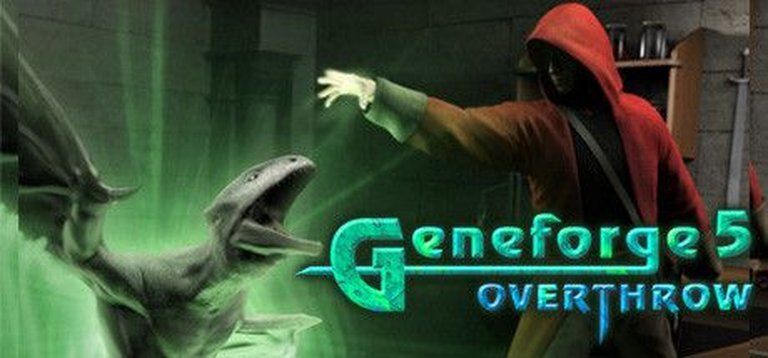
Geneforge 5: Overthrow is the fifth and final entry in the Geneforge RPG series, continuing the narrative from Geneforge 4: Rebellion. Players explore a freely traversable world blending cyberpunk and dark sci-fi with fantasy elements, shaped by the Shapers—elite beings who create dangerous life forms—while choosing from six classes and specializing in close combat, Shaper skills, or magic, with enhanced UI and graphics compared to prior games.
Gameplay Videos
Where to Buy Geneforge 5: Overthrow
PC
Geneforge 5: Overthrow Patches & Updates
Geneforge 5: Overthrow Guides & Walkthroughs
Geneforge 5: Overthrow Reviews & Reception
macworld.com : it looks and plays like a game released 15 years ago.
honestgamers.com : This is about interactive, non-linear storytelling of the finest quality.
Geneforge 5: Overthrow Cheats & Codes
Geneforge 5: Overthrow PC
Press Shift-D to open the cheat dialogue, and then type a code from the list below.
| Code | Effect |
|---|---|
| shieldsup | Bless your party |
| pleaselikeme | Erase your criminal record of most crimes |
| giveasnack | Spawn cake |
| iampoor | Spawn money |
| iamweak | Extra experience points |
| healmenow | Heal your party |
| whereami | Lists character’s current zone and coordinates |
| showmeall | Mark all characters on mini-map |
| dontshowmeall | Hide all characters on mini-map |
| clearthisarea | Marks current area as completed on world map |
| iloverebels | Gain favor with the Rebels |
| ihaterebels | Gain favor with the Shapers |
| rechargeme | Refill energy and essence |
| resetbugs | Reset the Shredbugs |
| exitzone | Go to the world map |
Geneforge 5: Overthrow Macintosh
Press Shift-D to open the cheat dialogue, and then type a code from the list below.
| Code | Effect |
|---|---|
| shieldsup | Blesses your party. |
| pleaselikeme | Erases your criminal record. Certain crimes are unforgivable. |
| giveasnack | Gives you cake. |
| iampoor | Gives you money. |
| iamweak | Gives you XP. |
| healmenow | Heals your party. |
| whereami | Lists your character’s current zone and (x,y) coordinates. |
| showmeall | Marks all characters on your minimap. |
| clearthisarea | Marks the current area as completed on the world map. |
| iloverebels | Put yourself on good terms with the Rebels. |
| ihaterebels | Put yourself on good terms with the Shapers. |
| rechargeme | Refills your energy and essence. |
| resetbugs | Resets the Shredbugs. |
| exitzone | Sends you to the world map. |
Geneforge 5: Overthrow: The Lyrical Conclusion of a Shaped World
Introduction: A Niche Forged in Code and Conviction
In an era where the RPG genre had largely coalesced around cinematic presentation and action-oriented mechanics, the release of Geneforge 5: Overthrow in late 2008 felt like a deliberate anachronism—and a profound statement. As the culmination of a seven-year, five-game saga from the unassuming Seattle-based indie studio Spiderweb Software, it was not merely a game but the final movement in a grand, player-directed symphony of bio-ethics, rebellion, and consequence. While the broader gaming world raced toward high-fidelity graphics and streamlined systems, Geneforge 5 stood firm in its commitment to the pillars of classic computer role-playing: deep, text-driven storytelling, unparalleled player agency, and systemic complexity born from humble, hand-crafted code. This review argues that Geneforge 5: Overthrow is a landmark of indie RPG design not in spite of its dated aesthetics, but because of its unyielding focus on narrative depth and consequential choice. It is a testament to the enduring power of the written word in interactive media and a final, majestic proof that a game’s soul is forged in its systems and stories, not its polygon count.
Development History & Context: The Persistent Vision of Jeff Vogel
The Spiderweb ethos: To understand Geneforge 5, one must first understand Spiderweb Software and its founder, Jeff Vogel. Operating since 1994 from a home base (first Seattle, later eastern Washington), Spiderweb was, and remains, a bastion of sustainable, solo-driven indie development. Vogel, a self-taught programmer with a background in applied mathematics, eschewed the publisher model entirely, pioneering a direct-sales, shareware (later “demoware”) distribution system. This model—selling complete, substantial games directly to a dedicated niche audience—allowed for complete creative control but imposed strict budgetary and technical constraints. The studio’s size was minimal; for Geneforge 5, the credited team numbered 27, but core development revolved around Vogel (design, programming, interface art), his wife Mariann Krizsan (business management), and a handful of key artists like Linda Strout and Andrew Hunter. This lean operation meant art and sound were always secondary to design and writing.
The Technological Lineage: The Geneforge series ran on a custom, proprietary 2D isometric engine written in C++. Over its five iterations, this engine saw incremental, pragmatic refinements:
* Geneforge 1-2 (2001-2003): Built for 800×600 resolution, 16-bit color, and minimal animations, targeting systems as modest as Windows 98. Sound was sparse MIDI.
* Geneforge 3 (2005): Introduced a revamped engine with smoother animations and 32-bit color, but retained the core resolution and tile-based maps.
* Geneforge 4: Rebellion (2006): A significant leap to 1024×768 resolution, featuring enhanced particle effects, dynamic lighting for spells, and weather systems. NPC visibility mechanics were improved for stealth.
* Geneforge 5: Overthrow (2008): The pinnacle of this technical line. It incorporated OpenGL support for hardware acceleration, allowing for smoother rendering and better scalability on modern monitors. The interface was streamlined, the world map was larger with smaller icons for better overview, and animations/cutscenes were further improved over Geneforge 4. Yet, the core aesthetic—diagonal-down isometric tilesets, 16-bit-style sprites, and a turn-based engine—remained unmistakably rooted in the late 1990s/early 2000s.
The 2008 Landscape: Geneforge 5 arrived in a transformed industry. The “CRPG renaissance” was nascent, with Oblivion (2006) and Mass Effect (2007) defining console RPGs, and Fallout 3 (2008) imminent. Turn-based combat was largely relegated to niche markets or strategy hybrids. Against this backdrop, Spiderweb’s steadfast adherence to its core formula was both a liability and a badge of honor. The game was a product of a specific, now-fading era of shareware PC gaming, where depth and replayability could trump blockbuster production values for a devoted subset of players.
Narrative & Thematic Deep Dive: The Weight of a Shaper’s Choice
The Amnesiac Protagonist in a Fractured World: Geneforge 5 continues directly from Geneforge 4: Rebellion, yet cleverly lowers the barrier to entry through its protagonist’s amnesia. The player awakens under the thrall of the powerful Shaper Rawal, a puppet with no memory. This device serves a dual purpose: it’s a classic RPG trope that allows for expositional dialogue, and more importantly, it symbolically represents the central conflict—the struggle to define one’s own identity and purpose in a world where one’s very essence (be it a Shaper’s power or a creation’s sentience) is controlled by another. The player’s journey is thus both geopolitical and deeply personal.
The Five-Faction Stalemate: The game’s narrative engine is its multi-faction allegiance system. Set four years after Geneforge 4, the war between the authoritarian Shapers and the Rebels (awakened creations and rogue humans) has stalemated. The player enters a landscape fractured into five major, ideologically distinct power blocs, each with its own cities, quests, and ultimate goals:
1. The Shaper Loyalists (General Alwan): Embodied by the wounded, zealous traditionalist Alwan. They represent unyielding order, secrecy, and the Shaper right to rule, advocating for the complete suppression of the rebellion and the restoration of strict control over all shaping.
2. The Rebel Mainstream (Ghaldring): Led by the Drayk Ghaldring. This faction seeks the total overthrow of Shaper rule and the seizure of Shaping technology for all creations, driven by a righteous fury against millennia of oppression.
3. The Pragmatists (Councillor Astoria): A Shaper-led faction seeking a negotiated peace with the Rebels. Astoria believes the Shapers’ ethical failures necessitate compromise, representing a middle path of reform and coexistence.
4. The Radical Absolutists (Litalia & the Trakovites): A rebel sect that believes the very art of Shaping is corrupt. They advocate for the complete abandonment and destruction of all Shaping knowledge and technology, viewing it as an inherently abusive practice.
5. The Genocidal Utilitarians (Sage Taygen & the Takers): The most extreme faction. Taygen, a brilliant but mad Shaper, plans to unleash a tailored bacterium to wipe out all creations—both loyal Shaper tools and rebel forces—seeing them as an unacceptable threat to human (Shaper) supremacy and planetary stability. His goal is a “clean slate.”
Themes of Creation, Control, and Consequence: The Geneforge saga has always been a vehicle for exploring bioethical dilemmas, and Overthrow is its most complex iteration. The core tension is between creator responsibility and created autonomy. The Shapers, as creators, grapple with the “slavery” of their creations—a moral failure they attempt to rectify through control or, in Astoria’s case, negotiated liberation. The Rebels fight for self-determination, yet their methods often mirror the Shapers’ authoritarianism. The gameplay directly embodies these themes: the player’s Shaping skill allows them to create disposable allies (creations), but overuse or poor management leads to disloyalty and rebellion. The ethical weight of using Skill Canisters—mutagenic enhancements that boost powers but risk arrogance and physical mutation—is a constant mechanic-driven dilemma.
Writing and Character Duality: The writing, as noted by HonestGamers, is “lovely” and “delectable,” compensating for the lack of voice acting. Vogel’s prose is functional, vivid, and often poetic in its descriptions of the war-torn world of Terrestria. The strength lies in branching dialogue and consequential choices. Helping a faction alters your reputation globally, locks or unlocks quests, and ultimately determines which of the game’s dozens of endings you receive. Key NPCs like the conflicted Alwan, the pragmatic Greta (returning from Geneforge 3), and the fanatical Litalia are well-drawn through text, their philosophies clashing in the player’s journal. However, as the Macworld review astutely observes, this narrative richness exists in tension with a world that often feels lifeless in exploration. Many NPCs are faceless “quest dispensers,” and settlements lack organic logic, creating a disconnect between the profound themes and the static environments that contain them.
Gameplay Mechanics & Systems: The Calculus of Shaping
The Core Loop: The gameplay cycle is quintessential Spiderweb: explore a region in real-time on an isometric world map, engage in turn-based combat when encountering foes, complete quests to gain experience and items, and return to a Shaping Circle to create and customize new creations from your essence pool. The world is divided into ~80 areas, with a green outline denoting cleared zones on the automap, encouraging thorough exploration.
The Shaping System – Heart of the Machine: This is the series’ signature innovation and the game’s primary strategic axis.
* Essence as Resource: The player’s Essence Pool is a finite resource (expanded by leveling Intelligence) required to create creatures. Each creation type (Fyora, Clawbug, Drakon, etc.) has an essence cost and required Shaping Skill thresholds (Battle, Fire, Magic Shaping).
* Creation Customization: After creating a base form, players can invest additional essence to upgrade stats (health, damage, AP) and grant special abilities (e.g., a fire-breathing Drakon). This is a deep, math-heavy optimization game.
* Loyalty Mechanics: Creations have a loyalty meter. Factors like taking damage, absorbing essence from multiple creators, or gaining power too quickly can cause disobedience or outright rebellion in combat. High Leadership and Shaping skills improve control. This creates a constant tension between building powerful creations and maintaining a stable, obedient force.
* Creation Permadeath: If a creation falls in battle, it is permanently lost, with only ~66% of its invested essence refunded. This makes creations tactically expendable yet strategically valuable, encouraging careful positioning.
Character Progression & Classes: Geneforge 5 uniquely offers nine starting classes, blending the traditional three Shaper archetypes (Shaper, Guardian, Agent) with six Rebel classes (Warrior, Infiltrator, Servile, Lifecrafter, Shock Trooper, Sorceress). This reflects the game’s central theme of merging ideologies. Progression is through skill points gained on level-up. Skills (Melee Weapons, Missile Weapons, Magic, Leadership, Mechanics, Battle/Fire/Magic Shaping) have escalating costs, with class discounts encouraging specializations. The system is brutally no-respec; choices are permanent, demanding careful build planning. The HonestGamers review correctly identifies that the game subtly but strongly favors combat-oriented builds, as Leadership/Stealth paths are underdeveloped and often require high levels to avoid combat, which is the primary source of experience.
Combat: Turn-Based Tension: Combat switches to a grid-based, turn-based system. Each character/creation gets Action Points (AP) per turn (typically 8, reduced by encumbrance). Movement costs 1 AP; most attacks/spells cost 9. This forces precise movement and ability use. The system is stat-driven with high randomness. Hit chances are calculated by weapon skill vs. enemy armor/dexterity, leading to frustrating “misses from point-blank range” as noted by HonestGamers. Area-of-effect spells and attacks are common and can cause friendly fire on higher difficulties (Veteran/Torment), adding a layer of tactical caution. The AI is competent but simple; enemies often clump together, blocking paths. The primary flaw, as synthesized from both HonestGamers and Macworld, is that combat is overly frequent and repetitive. Many story-critical locations force engagements, undermining the advertised possibility of a “pacifist” run, which feels more like a theoretical outcome than a practical one without massive, early investment in Leadership.
The “Peaceful” Illusion and Quest Design: The game’s claim that it can be completed without violence is misleading. While high Leadership can occasionally avoid fights, and stealth can bypass some encounters, the experience economy is overwhelmingly combat-based. Most side quests degenerate into “kill X monsters” or “clear dungeon Y” tasks, as Macworld describes. This creates a dissonance between the narrative’s moral depth and the gameplay’s mechanical encouragement of violence. The main quest pacing is better, but even it features padding, like the “evil spirit” quest that escapes twice, which HonestGamers cites as an example of presumptuous design.
World-Building, Art & Sound: Primitive, But Purposeful?
The Aesthetic of Terrestria: The world of Terrestria is a science-fantasy hybrid. It feels medieval in its social structures and typical fantasy races, but is infused with “steampunk” and biopunk elements: wires, levers, glass tubes, alarms, and, most importantly, the bio-engineered landscapes and creatures. The Shaper Citadel and cities are masonry-heavy, but thewilderness is populated with consciously designed, often grotesque creations. This blend is effective in the lore and writing but only faintly echoed in the visual design. The isometric tilesets are functional but generic; dungeons are repetitive collections of similar stone walls and floors. As Macworld bluntly states, the environments feel “monotonous” and “unidentifiable,” making it hard to form an attachment to the physical world despite the rich history.
Art and Animation: The graphics, even for 2008, were deliberately primitive. Character sprites are small and simple. Creature animations are basic (a walking cycle, a simple attack animation). The “improvements” in Geneforge 5 over previous entries are relative: smoother movement, better spell effects, and more detailed creature sprites. But by contemporary standards (2008’s Fallout 3, Mass Effect), they are “visually prehistoric,” as HonestGamers says. This is a conscious trade-off by Vogel: resources are poured into writing, quest design, and systems, not art assets. For the target audience—nostalgic CRPG fans—this aesthetic is part of the charm, evoking Ultima VI or Arcanum. For the wider audience, it is an immediate and significant barrier.
Sound Design: The audio is practically noneistent by modern standards. There is no musical score, only sparse, repetitive sound effects for combat, spells, and UI clicks. This is a severe limitation, contributing to the “lifeless” feel of settlements. The absence of audio ambience leaves a huge hole in the atmospheric immersion that games like Planescape: Torment (which HonestGamers invokes) used to brilliant effect. It is arguably the series’ most dated element.
The Primitive-as-Style Argument: One can argue that the low-fi aesthetic forces the player’s imagination to engage, with the dense text providing the vivid description. To an extent, this works for the concepts (the horror of a rogue Shaper, the majesty of a Drakon). But it fails for the places. The world does not “breathe” because the visual language cannot support the narrative’s claimed scale and diversity. The art serves function over feeling.
Reception & Legacy: A Cult Classic’s Bitter-Sweet Swan Song
Critical Reception at Launch: Geneforge 5 had the lowest critical Metacritic/average score in the series, with MobyGames showing 64% from four critics. The reviews were mixed but consistent in their assessment:
* Inside Mac Games (80%): Focused on value: “$28 is pretty cheap for an RPG that lasts over thirty hours, especially one that’s this entertaining.”
* HonestGamers (70%): Praised the “interactive, non-linear storytelling of the finest quality” while acknowledging the “visually primitive” presentation.
* Macworld (60%): The most damning critique: “The game’s main problem is also its main selling point: it looks and plays like a game released 15 years ago.” It highlighted the monotonous combat and environments.
* GameZone (48%): Called it a “dated title that feels too familiar and struggles along in key areas.”
The consensus was clear: a masterfully crafted narrative and choice system, hamstrung by archaic visuals, repetitive combat, and a world that lacked lived-in verisimilitude. The amnesia plot and insistence on a combat-heavy grind for a “pacifist” possibility drew particular criticism.
Commercial Performance & Player Reception: As a shareware/demoware title, precise commercial numbers are scarce, but its sustained presence on Steam (as part of the Geneforge Saga bundle) and strong Steam user reviews (“Very Positive,” 95% of 98 reviews as of 2026, with a Steambase score of 93/100) tell a different story from the critics. Players who engaged with the game deeply overwhelmingly championed it. They valued the same things the critics did—the moral complexity, the faction politics, the sheer volume of content (50-80+ hours, multiple endings)—and were either more forgiving of the aesthetics or found them part of the authentic retro experience. The disconnect suggests a classic “niche appeal” dynamic: the game succeeds brilliantly for its intended audience but fails to convert outsiders.
Legacy and Influence: Geneforge 5’s legacy is two-fold:
1. As a Series Finale: It successfully concluded a five-part epic, tying together narrative threads from the entire saga (the fate of the Geneforge, the future of Shaper-creation relations) through its multiple, faction-dependent endings. It provided the “satisfying and intelligent” closure that HonestGamers noted, a rare feat for a long-running indie series.
2. As an Indie Design Artifact: The Geneforge series, culminating in 5, became a touchstone for sustainable, design-focused indie development. Jeff Vogel’s GDC talk, “Failing to Fail: The Spiderweb Software Way,” directly cited the series’ iterative, budget-conscious model. The games proved that a small team could create a deep, replayable RPG with dozens of hours of content by prioritizing systems, writing, and player agency over graphical spectacle.
3. The Remake Wave: The apparent “success”—defined by a loyal fanbase and economic viability—of the original series directly enabled its remake campaign. Geneforge 1 – Mutagen (2021) and Geneforge 2 – Infestation (2024) are modernized versions that retain the core narrative and shaping systems but update the UI, add widescreen support, improve balance, and expand dialogue/quests. These remakes, funded in part by Kickstarter for Infestation, are a testament to the enduring love for the Geneforge formula, with Infestation earning 88% positive Steam reviews. They are not reinventions but restorations, making the original vision more accessible while respecting its core identity.
Conclusion: The Uncompromised Vision
Geneforge 5: Overthrow is not a perfect game. Its visual and auditory presentation is undeniably shabby, even for its time. Its turn-based combat is statistically brutal and frequently tedious. Its world’s physicality fails to match the grandeur of its lore. Yet, to dismiss it on these grounds is to miss its monumental achievement. In an industry increasingly homogenized, Geneforge 5 is a radical act of creative conviction.
It is a masterclass in branching narrative design, where every quest, every conversation, and every use of a Skill Canister nudges the world toward one of its many divergent futures. It presents philosophical conflicts of real weight—the ethics of creation, the price of freedom, the morality of utilitarian genocide—and trusts the player to navigate them without a heroic compass. Its shaping system is a brilliant, integrated metaphor for its themes, turning the act of summoning allies into a constant exercise in resource management and ethical risk assessment.
For the patient, text-attuned player willing to look past the pixelated sprites and empty soundscape, Geneforge 5 offers an RPG experience of almost unparalleled density. It is a game that understands its medium’s unique strength: the power to let the player be the author of their own epic, with all the moral ambiguity and systemic consequence that entails. It is the final, flawed, but fiercely intelligent entry in a series that chose to die on the hill of design depth rather than climb the mountain of mainstream appeal. In the canon of computer RPGs, Geneforge 5: Overthrow stands as a cult monument—a game that proved you could build a world of profound consequence with little more than words, numbers, and unwavering vision. Its final, resonant lesson is that the most memorable forges are not those that shape flesh, but those that shape a player’s understanding of consequence itself.