
- Release Year: 2005
- Platforms: Windows
- Publisher: Indiepath Ltd
- Developer: Indiepath Ltd
- Genre: Puzzle
- Perspective: Top-down
- Game Mode: Single-player
- Gameplay: Color matching, Puzzle solving, Shape Rotation, Tessellation
- Setting: Fixed, Flip-screen
Description
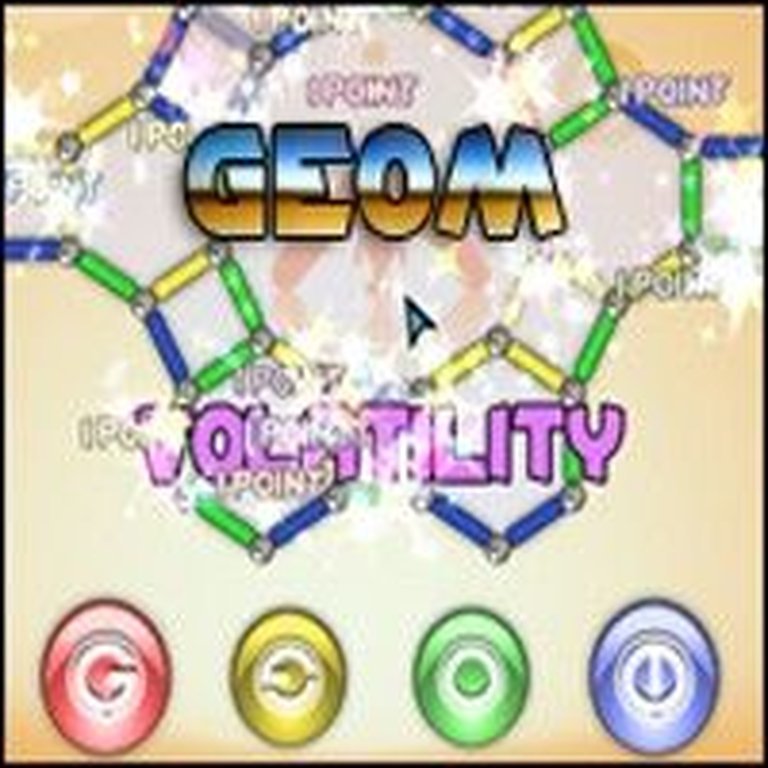
GEOM is a color-matching puzzle game where players rotate geometric pieces to form cohesive single-color shapes. Completing these shapes clears the board, with pieces either disappearing or being replaced depending on the selected mode: Arcade, Classic, or Puzzle. Arcade Mode initially offers 100 levels, expanded further with downloadable level packs and a custom editor in later updates, allowing for creative level design and extended replayability. Developed by Indiepath Ltd, the game emphasizes strategic pattern recognition and spatial manipulation in a minimalist, top-down interface.
GEOM: A Tessellating Puzzle Odyssey
Introduction
In 2005, amid a burgeoning indie game scene fueled by digital distribution, GEOM emerged as a minimalist yet compelling puzzle experience. Developed by the micro-studio Indiepath Ltd, this color-matching tile game captivated players with its elegant mechanics and iterative design. This review examines GEOM‘s legacy as a testament to the power of focused puzzle design and developer-player symbiosis, arguing that while it eschewed narrative grandeur, its systemic purity and post-launch evolution cemented its status as a cult classic for tessellation enthusiasts.
Development History & Context
Studio Vision & Technological Constraints
Indiepath Ltd, spearheaded by the polymathic Tim Fisher, epitomized the solo-developer ethos of the mid-2000s. Fisher single-handedly orchestrated GEOM‘s programming, art, sound, and level design—a feat made feasible by the era’s accessible Windows development tools. The game’s top-down, fixed-screen presentation and simplistic point-and-select interface reflected both Fisher’s resourcefulness and the limitations of targeting low-end PCs, ensuring broad accessibility. With only five credited contributors (including additional ideas from Clayton S. Chan and testing by Adrian Baader), GEOM was a triumph of micro-team efficiency.
The Shareware Ecosystem
GEOM debuted as a shareware title, a distribution model still thriving in 2005 before digital storefronts dominated. This approach allowed Indiepath to offer scaled-down demos while monetizing full unlocks—a strategy mirroring contemporaries like Bejeweled but distinct in its geometric complexity. Fisher’s background in web design (he co-handled GEOM‘s marketing site) proved vital in navigating this fragmented marketplace, leveraging email campaigns and niche gaming forums to build buzz.
Gaming Landscape
Released against AAA titans like God of War and Resident Evil 4, GEOM‘s success hinged on filling the niche for “brain training” puzzles. Its arrival coincided with rising interest in casual-friendly mechanics, presaging the mobile puzzle boom. Yet unlike Flash-based browser games, GEOM‘s downloadable nature prioritized depth over ephemeral engagement. Technologically, it sidestepped the era’s GPU arms race by embracing abstract 2D design, a wise choice that granted it longevity on aging hardware.
Narrative & Thematic Deep Dive
A Silent Symphony of Shapes
GEOM deliberately forgoes narrative, instead weaving its themes through abstract interaction. Its title—a portmanteau of “geometry” and “gem”—signals a clinical obsession with spatial harmony. Players inhabit an unnamed arbiter tasked with resolving chromatic dissonance, evoking the zen of solving a Rubik’s Cube or untangling a knot. Dialogue is nonexistent; the game speaks through its escalating geometric conundrums.
The Subtle Language of Patterns
Each level functions as a logic-haiku. Rotations cascade fractures across grids, demanding players intuit tessellating algorithms. The absence of overt storytelling focuses attention on the emergent poetry of solutions—how a hexagonal cluster’s realignment echoes crystalline growth or cellular mitosis. GEOM‘s themes orbit scientific beauty: the joy of restoring entropy to order through mathematical grace. Its closest kin isn’t other games but M.C. Escher prints—a dance of symmetry and fragmentation.
Gameplay Mechanics & Systems
Core Loop & Rotational Genius
The gameplay loop orbits a singular verb: rotate polygonal fragments to form monochromatic shapes. Unlike match-3 contemporaries, GEOM adds topological strategy—every twist alters adjacency relationships. Three modes diversify the challenge:
– Arcade Mode (100+ levels): Time-sensitive puzzles where cleared tiles vanish.
– Classic Mode: A relaxed pace where tiles reappear as new fragments, emphasizing methodical perfection.
– Puzzle Mode: Curated brain-teasers demanding optimal solutions.
Version 1.3 introduced custom level packs and an editor, enabling players to craft their own devious configurations—a rarity in 2005 that expanded replayability exponentially.
Editorial Empowerment
The level editor democratized design, letting players remix Fisher’s principles into fractalized variants. This feature anticipated later trends in user-generated content (Super Mario Maker, LittleBigPlanet), though constrained by 2005’s limited sharing infrastructure (email swaps vs. cloud uploads).
UI/UX: Functional Austerity
The interface channels utilitarian clarity:
– Point-and-select controls mirror board games, lowering barriers for casual players.
– Tooltips eschew verbosity; tile hues are saturated enough for era-appropriate CRT monitors.
Flaws existed: mouse-only controls ignored keyboard shortcuts, and the absence of undo buttons frustrated perfectionists. Yet this spartan approach focused attention on the board’s hypnotic geometries.
World-Building, Art & Sound
A Chromatic Nexus
GEOM‘s visual identity embraces minimalist futurism. Tiles glow with primary/tertiary insistence against obsidian grids, echoing Bauhaus aesthetics. While lacking bespoke art assets, Fisher’s deliberate use of polygonal diversity—squares, pentagons, asymmetrical fragments—creates a tactile sense of manipulating alien machinery. The fixed-screen perspective roots players in a timeless void, where only the puzzle matters.
Synesthetic Audio Design
Fisher’s soundscape pairs crystalline “click” rotations with bassy resolution thuds. Each action triggers ASMR-like feedback, transforming puzzles into rhythmic instruments. The absence of music sharpens focus—a daring choice that amplifies the player’s internal cadence during contemplative solves. This auditory minimalism mirrors the ambient works of Brian Eno, where silence is as potent as sound.
Reception & Legacy
Launch & Iterative Evolution
GEOM earned an 82% critic score (per Netjak) and a 3.4/5 player rating. Reviewers praised its “satisfying core loop” (Netjak) and Fisher’s responsiveness—he integrated feedback into version 1.2 within months, refining difficulty curves and UI quirks. This developer-player dialogue was visionary for 2005, prefiguring today’s early-access culture.
Influence on Puzzle Taxonomy
While not a commercial juggernaut, GEOM‘s inverted match-3 logic—merging clusters rather than swapping gems—inspired later titles like Lumines and Poly Bridge. Its editor foreshadowed user-generated content paradigms now ubiquitous in games like Mario Maker. The 2014 Wii U port (a curiosity lost in Nintendo’s ecosystem) validated its mechanics’ timelessness, adding touch controls but preserving Fisher’s original vision.
The Indie Precedent
GEOM demonstrated that solo developers could thrive outside studios—a blueprint for future indie darlings like Stardew Valley and Undertale. Its shareware model also presaged freemium mobile games, proving small-scope puzzles could monetize sustainably.
Conclusion
GEOM remains a masterclass in systemic elegance, proving that complexity needn’t stem from convoluted rules. Fisher’s holistic authorship crafted a meditative artifact where every rotation feels weighted with cosmic significance. While later puzzlers expanded on its foundations (Grindstone, Dorfromantik), few matched GEOM‘s purity of purpose—a tessellated relic from an era when “indie” meant handcrafted intimacy with players. Its ethos—responsive iteration, player agency via editors, and abstraction as narrative—resonates in today’s design philosophy. For puzzle archaeologists, GEOM isn’t merely a game; it’s a Platonic form waiting to be aligned.
Final Verdict: A quietly revolutionary title that deserves recognition as a bridge between 20th-century abstract puzzles and 21st-century indie sensibilities. ★★★★☆ (4/5)