
- Release Year: 2008
- Platforms: Windows
- Publisher: Freudenreich & Tollknaepper GbR
- Genre: Compilation
- Game Mode: Single-player
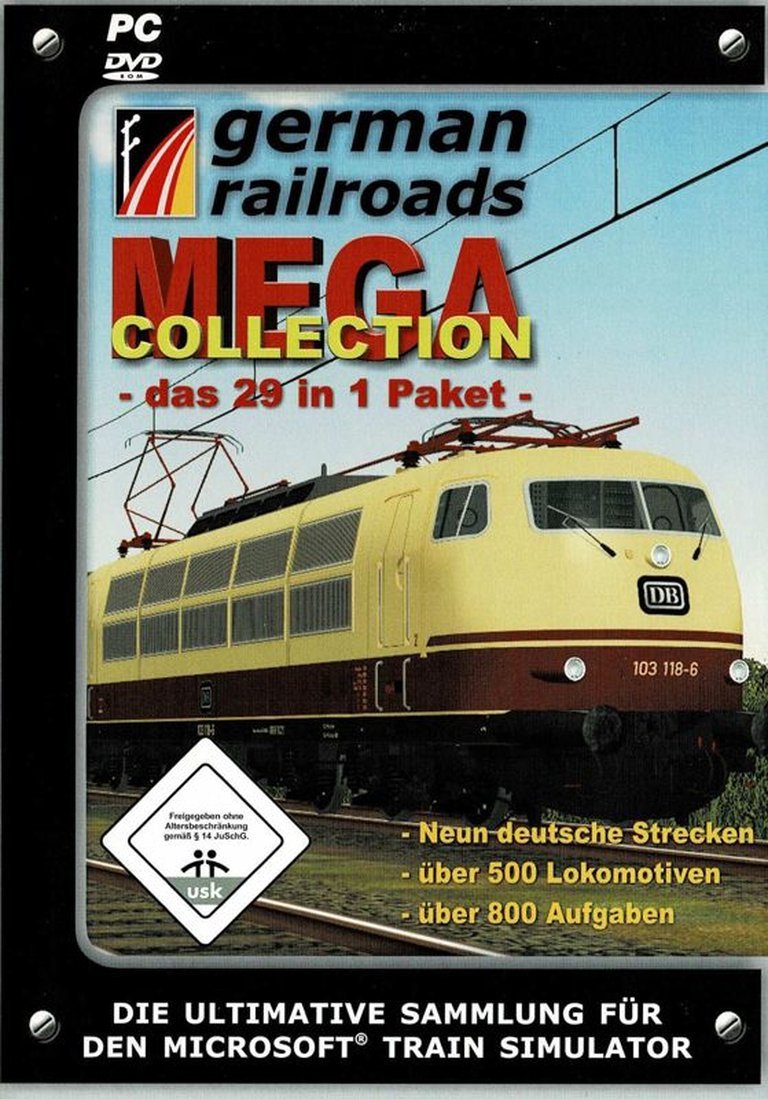
Description
German Railroads: Mega Collection is a comprehensive compilation of train simulation games released in 2008, featuring a variety of titles that focus on different aspects of German railway history and operations. The collection includes multiple volumes of German Railroads and German Trains series, each offering unique scenarios, routes, and locomotives, such as the Mosel Valley route, the Baltic Sea coast, and the Bavarian Forest. Players can experience different eras and types of trains, from steam locomotives to modern electric units, providing a detailed and immersive experience for train enthusiasts.
German Railroads: Mega Collection: A Comprehensive Retrospective
Introduction
Few video game compilations have ever dared to capture the essence of an entire subgenre with the sheer breadth and depth of German Railroads: Mega Collection. Released in 2008 by Freudenreich & Tollknaepper GbR, this monumental anthology is not merely a product of its time—it is a testament to the enduring fascination with railway simulation, a niche yet profoundly dedicated corner of gaming culture. For enthusiasts of Microsoft Train Simulator (MSTS) and its modding community, this collection represents the pinnacle of German railway simulation, bundling nearly a decade’s worth of meticulously crafted routes, locomotives, and scenarios into a single, sprawling DVD-ROM.
This review seeks to dissect German Railroads: Mega Collection with the rigor it deserves, exploring its historical context, gameplay mechanics, artistic achievements, and lasting legacy. At its core, this compilation is more than a sum of its parts; it is a love letter to the golden age of German railroading, a digital museum of locomotives, and a playground for virtual engineers. Yet, it is also a relic of an era when physical media reigned supreme, and when the boundaries between hobbyist passion and commercial enterprise were delightfully blurred.
Development History & Context
The Studio and the Vision
Freudenreich & Tollknaepper GbR, the publisher behind German Railroads: Mega Collection, is a name that may not resonate with mainstream gamers but is revered within the railway simulation community. The studio’s work is deeply rooted in the Microsoft Train Simulator ecosystem, a platform that, despite its age, remained a cornerstone for train enthusiasts long after its official support had waned. The German Railroads series, which began in the early 2000s, was born from a desire to bring the intricate details of German railway operations—from the steam-powered era to the modern Deutsche Bahn—to life in a simulation environment.
The vision was clear: to create an authentic, immersive experience that catered not just to casual players but to hardcore railfans who demanded historical accuracy, operational realism, and an almost obsessive attention to detail. This ethos is evident in the Mega Collection, which compiles 29 individual add-ons released between 2002 and 2009, each focusing on a specific region, era, or locomotive class. The collection is a testament to the studio’s commitment to preserving and celebrating Germany’s rich railway heritage, from the romantic steam locomotives of the Werratal to the sleek electric units of the Reichsbahn.
Technological Constraints and Innovations
The German Railroads series was built upon Microsoft Train Simulator, a platform released in 2001 that, by the late 2000s, was showing its age. MSTS was limited by its engine’s inability to handle modern graphics techniques, its reliance on DirectX 7, and its lack of native support for multi-core processors. Yet, the modding community—of which Freudenreich & Tollknaepper was a prominent member—pushed the boundaries of what was possible. The Mega Collection is a prime example of how creativity and dedication could overcome technological limitations.
Key innovations in the German Railroads series included:
– Highly Detailed Routes: Each add-on in the collection features routes that are not just visually accurate but also operationally faithful to their real-world counterparts. For example, German Railroads: Volume 4 – Entlang der Mosel recreates the scenic Mosel valley route from Koblenz to Trier, complete with the winding river, vineyard-covered hills, and period-appropriate infrastructure.
– Authentic Rolling Stock: The collection boasts over 500 locomotives and wagons, each modeled with painstaking attention to detail. From the iconic Baureihe V100 diesel locomotives to the electric Einheitslokomotiven of the 1990s, the variety is staggering. The German Trains sub-series, included in the Mega Collection, focuses exclusively on specific locomotive classes, offering deep dives into their technical specifications and historical significance.
– ProTrain Integration: Many of the add-ons include ProTrain tasks, a system that allows players to engage in structured scenarios with specific objectives, such as adhering to timetables, managing freight operations, or navigating complex signaling systems. This added layer of gameplay transformed MSTS from a mere sandbox into a structured simulation experience.
The Gaming Landscape of 2008
By 2008, the gaming industry was in the midst of a seismic shift. The seventh generation of consoles—led by the Xbox 360, PlayStation 3, and Wii—was in full swing, and high-definition graphics, online multiplayer, and motion controls were becoming standard. Yet, niche genres like railway simulation remained largely untouched by these trends. The audience for German Railroads: Mega Collection was not the casual gamer but the dedicated enthusiast, often middle-aged men with a lifelong passion for trains.
The release of the Mega Collection was a strategic move to consolidate the studio’s extensive back catalog into a single, accessible package. At a time when digital distribution was still in its infancy (Steam had only begun to gain traction in 2004), physical media remained the primary method of distribution for niche products. The Mega Collection was marketed as a cost-effective solution for both newcomers and veterans, offering a complete library of content at a fraction of the cost of purchasing each add-on individually.
Narrative & Thematic Deep Dive
The Absence of Traditional Narrative
Unlike conventional video games, German Railroads: Mega Collection does not feature a linear narrative, characters, or dialogue. Instead, its “story” is told through the meticulous recreation of historical railway operations, the evolution of locomotive technology, and the changing landscapes of Germany across different eras. The thematic depth lies in the authenticity of the simulation itself, which serves as a interactive documentary of German railroading.
Themes of Nostalgia and Preservation
At its heart, the Mega Collection is a celebration of nostalgia. Many of the routes and locomotives included in the compilation are no longer in service, making the game a digital archive of Germany’s railway history. For example:
– German Railroads: Volume 3 – Dampf im Werratal transports players to the steam era, where they can operate classic locomotives like the BR 52 through the picturesque Werratal region. The add-on is not just a gameplay experience but a historical reenactment, complete with period-appropriate stations, signaling, and even the sounds of steam whistles echoing through the valleys.
– German Railroads: Volume 5 – Die Rollbahn 1963 recreates the Rollbahn (a key freight route) during the early 1960s, a time when dieselization was beginning to replace steam. The add-on captures the transitional period in German railroading, offering players a chance to experience the challenges and charms of both eras.
The collection also explores themes of industrialization and modernization. Add-ons like German Trains: Züge der Zeit Volume 4 – Rheingold 1963 focus on the luxurious Rheingold express train, a symbol of post-war Germany’s economic recovery and technological prowess. The contrast between the opulence of the Rheingold and the gritty, utilitarian freight operations of the Rollbahn highlights the diversity of Germany’s railway network.
The Role of Documentation and Education
One of the most remarkable aspects of the Mega Collection is its commitment to education. Each add-on includes extensive documentation, often in the form of PDF manuals, timetables, track diagrams, and historical notes. These materials are not merely supplementary; they are essential to fully appreciating the depth of the simulation. For instance:
– German Railroads: Volume 6 – Entlang der Ostsee includes detailed maps of the Rostock-Stralsund route, along with historical context about the region’s significance in East Germany during the Cold War.
– German Trains Volume 3: Die V 200 Familie provides technical specifications and operational guidelines for the V 200 diesel locomotives, allowing players to understand the engineering behind these machines.
This educational approach transforms the Mega Collection from a mere game into a tool for preservation and learning. It appeals to railway historians, model railroaders, and anyone with an interest in industrial heritage.
Gameplay Mechanics & Systems
Core Gameplay Loop
The gameplay in German Railroads: Mega Collection revolves around the core mechanics of Microsoft Train Simulator, enhanced by the ProTrain system and the vast array of add-ons. The primary loop consists of:
1. Route Selection: Players choose from a diverse array of routes, each representing a different region, era, or operational challenge.
2. Locomotive and Rolling Stock Selection: Depending on the add-on, players can select from hundreds of locomotives and wagons, each with unique handling characteristics and historical significance.
3. Scenario or Free Roam: Players can either engage in structured ProTrain scenarios, which often involve adhering to timetables, managing freight, or navigating complex signaling systems, or explore the routes in free roam mode.
4. Operation and Execution: The actual driving of the train, which involves managing speed, braking, coupling/uncoupling wagons, and responding to signals and dispatchers.
5. Review and Reflection: After completing a scenario, players can review their performance, consult the included documentation, and plan their next journey.
ProTrain: Structured Challenges
The ProTrain system is one of the standout features of the Mega Collection. Developed as an extension to MSTS, ProTrain introduces structured tasks that add depth and purpose to the simulation. These tasks range from simple point-to-point runs to complex operational challenges, such as:
– Timetable Adherence: Players must operate their train according to a strict schedule, accounting for acceleration, braking, and station stops.
– Freight Management: Some scenarios require players to pick up and drop off wagons at specific locations, often involving shunting (switching) maneuvers.
– Signal and Dispatcher Interaction: Advanced scenarios simulate real-world railway operations, where players must respond to signals, communicate with dispatchers, and navigate busy junctions.
The ProTrain tasks are not just gameplay mechanics; they are educational tools that teach players the intricacies of railway operations. For example, the Halycon Schwarzwald Aufgabenpaket includes scenarios that recreate the challenges of operating in the Black Forest region, with its steep gradients and tight curves.
User Interface and Controls
The user interface of German Railroads: Mega Collection is a direct descendant of Microsoft Train Simulator, which means it is functional but not particularly modern. The UI is divided into several key components:
– Main Menu: Allows players to select routes, locomotives, and scenarios.
– HUD (Heads-Up Display): Displays essential information such as speed, brake pressure, and signal aspects. The HUD can be customized to show or hide various elements.
– Cab Controls: Each locomotive features a fully interactive cab, with controls for throttles, brakes, reversers, and auxiliary systems. The level of detail in these cabs is impressive, with many add-ons including functional gauges, switches, and even animated components.
– Map and Timetable: The ProTrain system includes an overlay that shows the current route, upcoming stations, and timetable information.
While the UI is not as polished as modern simulations like Train Simulator Classic or Derail Valley, it is highly functional and deeply customizable. The inclusion of keyboard shortcuts and support for external controllers (such as USB throttle quadrants) enhances the immersion for hardcore enthusiasts.
Innovations and Flaws
The Mega Collection introduces several innovations that set it apart from other railway simulations of its era:
– Dynamic Weather and Time of Day: Some add-ons include dynamic weather systems that affect visibility and traction, as well as day/night cycles that impact signaling and operations.
– Historical Accuracy: The attention to detail in recreating specific eras is unparalleled. For example, German Railroads: Volume 9 – Mit der Reichsbahn nach Rügen includes period-appropriate infrastructure, such as East German signaling systems and rolling stock.
– Modular Design: The collection is designed to be modular, allowing players to mix and match routes, locomotives, and scenarios. This modularity extends to the ProTrain tasks, which can be customized and shared within the community.
However, the Mega Collection is not without its flaws. The most significant issues include:
– Technical Limitations of MSTS: The underlying engine is outdated by 2008 standards, with limited graphics capabilities, no native support for multi-core processors, and occasional stability issues.
– Steep Learning Curve: The complexity of the simulation, combined with the lack of in-game tutorials, makes it inaccessible to casual players. Newcomers are often overwhelmed by the sheer volume of documentation and the intricacies of railway operations.
– Installation and Compatibility: The Mega Collection is distributed on a single DVD-ROM, but installing all 29 add-ons can be a cumbersome process. Some users reported conflicts between different add-ons, requiring manual tweaking of configuration files.
World-Building, Art & Sound
The Routes: A Journey Through Germany
The Mega Collection is a tour de force of world-building, offering players the opportunity to explore some of Germany’s most iconic and historically significant railway routes. Each route is a meticulously crafted environment that captures the essence of its real-world counterpart. Some of the standout routes include:
– Entlang der Bigge (Volume 1 and Edition 2006): This route follows the Bigge river through the Sauerland region, showcasing the scenic beauty of rural Germany. The 2006 edition includes updated graphics and additional scenarios.
– Die Rollbahn (Volume 2 and 5): The Rollbahn (or “Roll Road”) is a key freight route that has been in operation since the 19th century. The add-ons recreate this route in both its 1963 and modern iterations, offering a fascinating contrast between eras.
– Entlang der Mosel (Volume 4): This route takes players along the Mosel river, one of Germany’s most picturesque wine regions. The add-on includes detailed recreations of towns, vineyards, and the winding river itself.
– Mit der Reichsbahn nach Rügen (Volume 9): This add-on focuses on the island of Rügen in the Baltic Sea, a popular tourist destination. The route includes the famous Rasender Roland narrow-gauge railway, as well as standard-gauge lines operated by the East German Reichsbahn.
Each route is more than just a track; it is a living, breathing environment that reflects the cultural and historical context of its setting. The attention to detail extends to the smallest elements, such as period-appropriate advertisements, station architecture, and even the vegetation along the tracks.
Visual Direction: The Aesthetics of Authenticity
The visual style of German Railroads: Mega Collection is defined by its commitment to authenticity. The graphics, while limited by the MSTS engine, are optimized to convey a sense of realism and historical accuracy. Key visual elements include:
– Locomotive and Rolling Stock Models: Each locomotive is modeled with a high level of detail, including accurate liveries, weathering effects, and animated components (such as moving pistons on steam engines).
– Environmental Textures: The routes feature realistic textures for tracks, ballast, vegetation, and buildings. The use of dynamic lighting (where supported) enhances the immersion, particularly in scenarios set at dawn or dusk.
– Signal and Infrastructure: The signaling systems are faithfully recreated, with each add-on featuring the appropriate signals for its era and region. For example, East German routes use the Hl (Hauptsignal mit Licht) signaling system, while modern routes feature the Ks (Kombiniertes Signal) system.
While the graphics may not hold up to modern standards, they are more than adequate for the intended audience. The focus on authenticity over visual spectacle is a deliberate choice that aligns with the collection’s educational and preservationist goals.
Sound Design: The Symphony of Steam and Steel
Sound design is a critical component of railway simulation, and the Mega Collection excels in this area. Each locomotive features a unique sound profile, with recordings taken from real-world counterparts. The sound design includes:
– Engine Sounds: The distinctive chug of steam locomotives, the throaty growl of diesel engines, and the smooth hum of electric motors are all faithfully recreated.
– Ambient Sounds: The routes include ambient sounds such as birdsong, wind, and distant traffic, which enhance the immersion.
– Operational Sounds: The collection includes sounds for coupling/uncoupling wagons, air brakes, and even the clatter of wheels on rail joints.
The sound design is not just a technical achievement; it is an emotional one. The roar of a BR 52 steam locomotive pulling a heavy freight train up a gradient, or the distant whistle of a Rheingold express train echoing through the Mosel valley, evokes a sense of nostalgia and wonder that is central to the Mega Collection’s appeal.
Reception & Legacy
Critical and Commercial Reception
At the time of its release, German Railroads: Mega Collection received limited coverage in mainstream gaming media, reflecting the niche nature of railway simulation. However, within the railway enthusiast community, the collection was met with widespread acclaim. Forum discussions on sites like the German Railroads Forum and TSSF.eu praised the collection for its depth, authenticity, and value for money. Key points of praise included:
– Comprehensive Content: The inclusion of 29 add-ons, over 500 locomotives, and 800 ProTrain tasks was seen as an unprecedented offering that provided endless hours of gameplay.
– Historical Accuracy: The collection’s commitment to recreating specific eras and regions was lauded by historians and railfans alike.
– Educational Value: The extensive documentation and structured ProTrain tasks were highlighted as valuable tools for learning about railway operations.
However, the collection was not without its critics. Some users reported technical issues, such as installation conflicts and stability problems, particularly on newer operating systems like Windows Vista. Others noted that the MSTS engine was showing its age, with limited graphics capabilities and a lack of modern features such as dynamic weather or advanced physics.
Commercially, the Mega Collection was a success within its niche. Priced at €29.95, it offered exceptional value compared to purchasing the add-ons individually, which would have cost over €750. The collection’s appeal extended beyond Germany, attracting international railway enthusiasts who were drawn to the authenticity and depth of the simulation.
Evolution of the Series and Influence
The German Railroads series did not end with the Mega Collection. Subsequent releases, such as German Railroads XXL (2007) and German Railroads: Volume 8 – Das Emsland (2009), continued to expand the series’ scope. However, the Mega Collection remains the definitive compilation, representing the pinnacle of the studio’s work during the MSTS era.
The influence of German Railroads: Mega Collection can be seen in later railway simulations, such as Train Simulator Classic (formerly RailWorks) and Zusi. These games adopted many of the features pioneered by the German Railroads series, including structured scenarios, historical accuracy, and modular add-on systems. The success of the Mega Collection also demonstrated the viability of niche compilations, paving the way for similar products in other simulation genres.
Preservation and Community
One of the most enduring aspects of German Railroads: Mega Collection is its role in preserving Germany’s railway heritage. The collection serves as a digital archive of locomotives, routes, and operational practices that might otherwise be lost to time. This preservationist ethos has resonated with the railway enthusiast community, which continues to support and expand the collection through fan-made modifications and updates.
The German Railroads Forum remains an active hub for discussion, troubleshooting, and sharing user-created content. Community members have developed patches, new scenarios, and even entirely new routes that build upon the foundation laid by the Mega Collection. This ongoing engagement is a testament to the collection’s lasting appeal and its status as a cornerstone of the railway simulation genre.
Conclusion: A Masterpiece of Niche Gaming
German Railroads: Mega Collection is not a game for everyone. It is a niche product, designed for a specific audience with a deep passion for railway simulation and German history. Yet, within its niche, it is a masterpiece—a comprehensive, authentic, and deeply immersive experience that captures the romance and complexity of railroading.
The collection’s strengths lie in its attention to detail, its educational value, and its commitment to preserving Germany’s railway heritage. While the underlying MSTS engine is outdated, the sheer volume of content and the depth of the simulation more than compensate for its technical limitations. For railway enthusiasts, the Mega Collection is not just a game; it is a journey through time, a celebration of engineering, and a testament to the enduring fascination with trains.
In the broader context of video game history, German Railroads: Mega Collection stands as a remarkable example of how niche genres can thrive through passion, dedication, and community support. It is a reminder that video games are not just about high scores and flashy graphics; they can also be tools for education, preservation, and storytelling.
For those who dare to embark on its tracks, the Mega Collection offers an experience that is as rewarding as it is challenging—a digital odyssey through the heart of Germany’s railway history.
Final Verdict: 9/10 – A definitive compilation for railway enthusiasts, offering unparalleled depth, authenticity, and value.