
- Release Year: 2019
- Platforms: Linux, Macintosh, Nintendo Switch, Windows
- Publisher: Spawn Point Osk., Ultimate Games S.A.
- Developer: Spawn Point Osk.
- Genre: Action
- Perspective: Top-down
- Game Mode: Single-player
- Gameplay: Roguelike, RPG elements
- Average Score: 83/100
Description
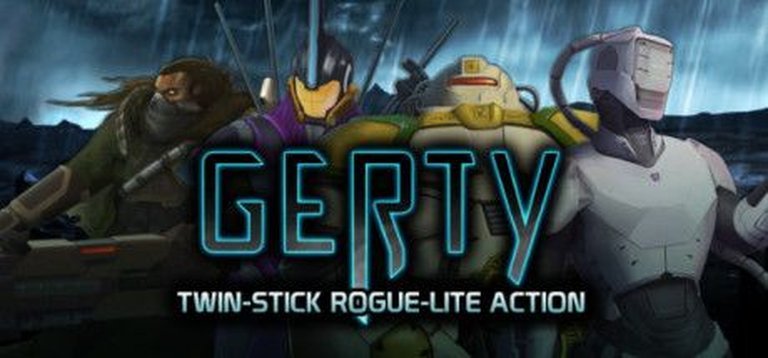
Gerty is a twin-stick rogue-lite action game set in the deep tunnels of a mining colony, where players battle an alien horde in fully destructible environments. With top-down gameplay, RPG elements like leveling up and perk unlocks, and local co-op for up to four players, it emphasizes challenging combat and strategic path-carving in a sci-fi war setting.
Where to Buy Gerty
Gerty Guides & Walkthroughs
Gerty Reviews & Reception
store.steampowered.com (83/100): A very promising game that takes many pre-existing concepts in the roguelite genre, and puts it’s own unique spin on them to produce something truly different.
Gerty: A Underground Revolution in Rogue-Lite Design
Introduction: Digging Up a Gem
In the crowded cemetery of twin-stick roguelites that followed in the wake of Enter the Gungeon and Nuclear Throne, one title quietly carved a distinct niche for itself through a single, revolutionary premise: a world you could utterly demolish. Gerty, released in late 2019 by the Finnish indie studio Spawn Point OSK and published by Resistance Games, is not a game that shouted from the rooftops. Its marketing was contained, its community small but fervent. Yet, for those who discovered it, Gerty offered a potent cocktail of satisfying destruction, tight combat, and rewarding progression that felt both familiar and startlingly fresh. This review argues that Gerty stands as a brilliant, if underappreciated, case study in focused design—a game that traded narrative grandeur and online connectivity for a mastery of its core tactile fantasy: the power to reshape your battlefield with every shot. Its legacy is that of a cult classic, a title whose most ingenious feature, fully destructible environments, would become its defining—and ultimately, commercially limiting—trademark.
Development History & Context: The Small Team’s Big Dig
Gerty emerged from the crucible of the late 2010s indie boom, a period saturated with roguelites and twin-stick shooters. The developer, Spawn Point OSK, was (and likely remains) a very small operation, a fact made abundantly clear by their public, meticulously formatted Roadmap posted on the Steam Community forums in November 2018. This document is a rare, transparent window into a small studio’s disciplined Early Access process. Their stated goal was not feature creep, but a focused delivery: first making the second “world” (or major biome) playable to enable full 1-hour run lengths, then a period of intensive balancing, followed by a final polish phase targeting a mid-2019 full release. This roadmap was largely adhered to; the game exited Early Access on December 19, 2019.
Technologically, Gerty was built in Unity, a common engine for indies, but its star feature—the fully destructible, tile-based terrain—required custom engineering. In an era where many roguelites used pre-made rooms or simple random placement, Gerty’s world was a dynamic, mining-simulator-esque grid where every bullet, explosion, or laser could carve new tunnels, create cover, or cause catastrophic cave-ins. This ambition came at a cost. The game’s scope was deliberately contained: four character classes, a limited but deep perk and weapon pool, and a clear structural endpoint. The gaming landscape of 2019 was dominated by behemoths like Hades (which would redefine narrative in the genre) and Wizard of Legend. Gerty’s无声 (silent) launch positioned it as a purist’s alternative: less about story, more about systemic interaction and skill-based combat.
Narrative & Thematic Deep Dive: Mercenaries, Mines, and Mystery
Gerty‘s narrative is deliberately skeletal, a scaffolding for its gameplay. You are an elite mercenary of the eponymous “Gerty” unit, dispatched to a remote mining colony that has been overrun by a hostile alien force. The goal is simple: descend through the planet’s deep tunnels, reach the source of the infestation, and eradicate it. The lore is delivered in snippets—terminal texts, environmental storytelling, and the names of items and perks—painting a picture of a corporate-styled mining operation (the “Juice” mines) that stumbled upon something ancient and predatory.
The central thematic tension is between human technological exploitation (mining for “Juice crystals,” the game’s primary upgrade currency) and alien organic infestation. The environments are collapsed, engineered tunnels layered with pulsating alien bioluminescence, strange runes, and altars. This creates a potent atmosphere of claustrophobic sci-fi horror. The “Juice” is doubly significant: it is the game’s resource for progression, making the player’s literal act of mining the environment (via the “laser-digger” tool) the core loop of both combat and economy. Thematically, this ties your destructive power directly to the colony’s original sin—resource extraction—creating a subconscious link between the player’s might and the very activity that provoked the alien threat. The narrative’s lack of deep character development or cutscenes is a conscious choice, reinforcing the mercenary’s anonymity and the game’s focus on pure, moment-to-moment tactical survival.
Gameplay Mechanics & Systems: The Architecture of Destruction
Gerty is a top-down, twin-stick shooter with rogue-lite meta-progression. Its genius lies in how its central mechanic—environmental destructibility—permeates every other system.
-
Core Loop & Combat: Each run is a descent through 3-4 procedurally generated “worlds,” each with a theme (e.g., the standard collapsed mines, the organic alien caverns). Combat is fast, skill-based, and brutally unforgiving on higher difficulties. The twin-stick controls are tight and responsive. What elevates combat from standard fare is the terrain. Walls are not obstacles but resources. You can shoot through thin rock to ambush enemies, blast a tunnel behind a powerful foe to flank it, or create a makeshift corridor to funnel swarms. This “carve your own path” philosophy, advertised on the store page, is the game’s heart. It turns every encounter into a spatial puzzle.
-
Character Classes & Progression: Four distinct mercenaries offer varied playstyles:
- The Soldier: Balanced, with a grenade launcher and high HP. The starter class.
- The Preacher: A shotgun/rocket launcher combo specialist, high risk/reward.
- The Tech: Focuses on deployable turrets and mines, a strategic control class.
- The Ghost: Stealth-oriented, with a sniper rifle and abilities for evasion.
Progression within a run is handled via “Juice” mined from the environment and dropped by enemies. This currency is spent at Shop Terminals found between rooms to buy weapons, ammo, armor, and most importantly, Perks. The perk system is robust, with stackable upgrades (e.g., “+10% Damage,” “Bullets pierce 1 enemy”) and powerful, rarer synergies. This allows for potent build-crafting within a single run.
-
Meta-Progression & Permadeath: Upon death, you return to the hub. Permanent unlocks are purchased with a secondary currency (earned based on run performance) at a Perk Tree and Armory. This unlocks new starting weapons, passive bonuses, and eventually, the other character classes. The loop is tight and compelling: a bad run still yields currency for permanent growth.
-
Systems & Flaws: The 5 difficulty levels and “advanced settings” (available early) are a standout feature, allowing players to tailor the challenge—a must for a game this punishing. The UI is clean and functional, though the map can be confusing in fully destructed environments. The primary flaw, echoed repeatedly in Steam community discussions (voting “Is the game dead?” and “Coop Online Possible?”), is the exclusive local co-op. In an era where online co-op is standard, this severely limits the game’s accessibility and potential player base, a business decision likely driven by the small team’s resources and the complexity of syncing destructible environments online. The procedurally generated levels, while conceptually free, can sometimes feel visually repetitive.
World-Building, Art & Sound: Claustrophobic Atmosphere and Tactical Audio
Gerty‘s world is a masterpiece of environmental storytelling through gameplay. The visual direction uses a dark, gritty pixel-art style with stark lighting. The mining colony is a grim, industrial disaster—collapsed corridors, broken machinery, and emergency lights flickering in dust-choked air. The alien infestation is a brilliant contrast: organic, glowing purple and red growths, pulsating egg-sacks, and distorted creature designs that feel less like traditional aliens and more like a biomechanical cancer. The transition from human-made ruins to alien organic hellscape is the game’s primary visual narrative arc.
The sound design is exceptional and integral to gameplay. Weapon sounds are punchy and satisfying, but the audio cues for enemies are crucial. You can hear the skittering of ranged bugs, the distinctive charge-up of a burrowing enemy, or the ominous growl of a boss through walls. This makes the destructible environment a double-edged sword: you can carve sightlines, but you also risk removing the very walls that were muffling approaching threats. The soundtrack is a pulsing, synth-driven score that matches the tension and action, often cited in user reviews (tagged “Great Soundtrack”) as a highlight.
The atmosphere is one of tense isolation. The top-down view makes you feel like a commander on a tactical map, but the narrow tunnels and constant threat of being overwhelmed create a suffocating, survival-horror-adjacent feel. You are not a superhero; you are a small, vulnerable mercenary in a deadly, shifting labyrinth.
Reception & Legacy: The Cult of the Precise Dig
Gerty was never a mainstream success. It holds a “Very Positive” rating on Steam (83% of 30 reviews, aggregating to an 84/100 score on Steambase) from a small group of roughly 1,300 owners. There are no critic reviews on Metacritic, a stark indicator of its niche status. The critical praise it did receive, quoted on its store page (“A very promising game… truly different” – Save or Quit; “Highly playable, polished, and strangely refreshing” – Rock Paper Shotgun), accurately pinpoints its strengths: polish and a unique hook.
Its legacy is two-fold. First, as a design touchstone: it proved that procedural destructibility could be more than a gimmick, that it could be the core strategic layer of a roguelite. Games like Orbital Bullet (listed as related on MobyGames) or Deep Rock Galactic‘s “survivor” mode echo this philosophy. Second, it is a cautionary tale about scope and marketability. Its lack of online co-op, while a principled technical stand, made it a hard sell to a generation raised on Left 4 Dead and It Takes Two. The small team released a complete, polished product but lacked the resources for the ongoing content updates that sustain modern live-service roguelites like Hades or Slay the Spire. Community discussions from 2021-2022 (“Is the game dead?”, “Looking for players for remote play local co op”) confirm a dormant, but still appreciative, community. Its influence is likely felt in the design minds of other indies rather than in broad industry trends.
Conclusion: A Flawed Diamond in the Rough
Gerty is not a perfect game. Its narrative is thin, its visual variety limited, and its decision to forgo any form of online multiplayer is a profound missed opportunity that cements its status as a cult title. Yet, to judge it solely on these points is to miss its extraordinary achievement. Spawn Point OSK delivered a tightly calibrated, mechanically profound rogue-lite where the environment is not a backdrop but an active participant. The act of mining “Juice” is never a chore; it’s a constant, satisfying recalibration of the battlefield. The four classes offer genuine variety, the perk system allows for creative builds, and the difficulty settings welcome everyone from casuals to masochists.
In the grand timeline of video games, Gerty will not be remembered as a best-seller or a trendsetter. Instead, it will be a curator’s secret, a game whispered about in forums as “that amazing twin-stick shooter where you can dig through everything.” It represents a specific, passionate indie ethos: find one brilliant mechanic, build a entire game around its elegant exploitation, and release it with a level of polish that belies your size. For players seeking a challenging, replayable, and intellectually engaging top-down shooter where your wits and your pickaxe are your most valuable tools, Gerty remains an exceptional, underground experience. It is a testament to the power of a single, well-executed idea to elevate a entire genre, if only for those willing to dig a little deeper.