
- Release Year: 2007
- Platforms: Windows
- Publisher: Big Fish Games, Inc, Merscom LLC, Noviy Disk, rondomedia Marketing & Vertriebs GmbH, Tri Synergy, Inc.
- Developer: Cardboard Box Entertainment
- Genre: Adventure
- Perspective: 1st-person
- Game Mode: Single-player
- Gameplay: Puzzle elements
- Setting: Factory, Haunted house
- Average Score: 75/100
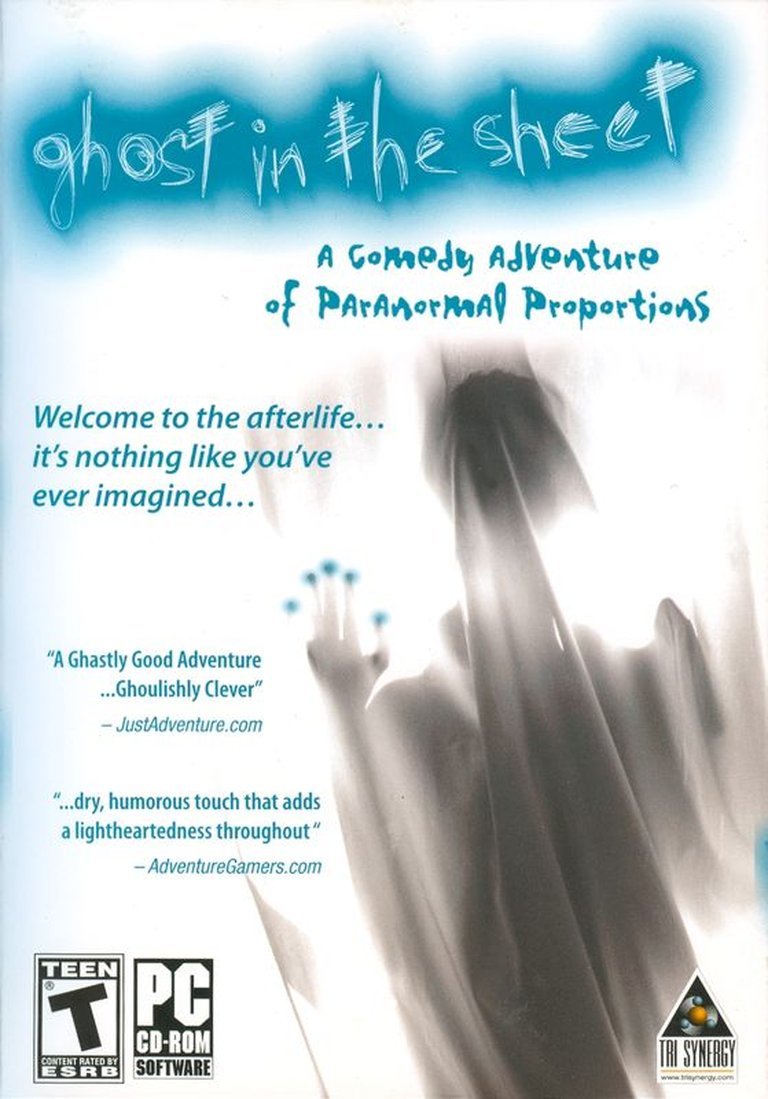
Description
Ghost in the Sheet is a paranormal comedy adventure where players assume the role of a ghost investigating a mystery in the deserted Sector Omega factory. After an unexpected afterlife, the ghost must master unique paranormal skills—such as activating levers and directing light beams—to explore the factory, interact with machines, and uncover written and audio clues while navigating dark humor and a challenging boss.
Ghost in the Sheet Free Download
Ghost in the Sheet Guides & Walkthroughs
Ghost in the Sheet Reviews & Reception
metacritic.com (75/100): Despite its rough spots, GitS is a solid first outing for Cardboard Box Entertainment. By turns, it’s quirky, funny, imaginative, macabre, silly (in a good way) and creepy, with a great showdown at the end. I mean, who could ask for anything more?
adventuregamers.com : Unfortunately, this reading doesn’t really create the atmosphere of mystery and interest it should, because the story just isn’t that engrossing, and it doesn’t answer all the questions it raises.
Ghost in the Sheet Cheats & Codes
PC
| Code | Effect |
|---|---|
| F1 | Change Item Quantity |
| F2 | Give Perks on Components Pickup |
| F3 | Spawn Babies |
| F4 | Mega Score |
| F5 | Increase Diamonds |
| F6 | Change Treasury |
| F7 | Change Earth Gems |
| F8 | Instant Training |
| F9 | Edit: Player XP Rating 5 |
| F10 | Edit: Current Race Time |
| HOME | Disable All |
Ghost in the Sheet: Review
Introduction
In the pantheon of video games, few premises are as instantly beguiling yet as strangely underexplored as that of Ghost in the Sheet. Released in 2007 by Czech developer Cardboard Box Entertainment (later CBE Software), this first-person point-and-click adventure dares to ask: what if the afterlife wasn’t a serene paradise or fiery damnation, but rather a tedious, soul-crushing bureaucratic job? You play as a recently deceased, sheet-clad ghost conscripted into paranormal investigations by a grumpy, long-tailed “Boss,” dispatched to unravel the mysteries of the abandoned Sector Omega factory. This is not a grand epic of cosmic horror, but a darkly comedic, character-driven tale of workplace malaise and spectral sleuthing. While its execution is a fascinating study in ambitious indie development constrained by resources and experience, Ghost in the Sheet carves out a unique niche as a cult favorite among adventure enthusiasts, remembered for its eccentric charm and innovative core concept. This review delves deep into the history, narrative mechanics, artistry, and legacy of this flawed yet fascinating game, arguing that its strengths lie in its unwavering commitment to its bizarre premise and its clever skill-based gameplay, even as its narrative shortcomings and technical limitations prevent it from achieving true greatness.
Development History & Context
Ghost in the Sheet emerged from the burgeoning Czech indie scene in the mid-2000s, primarily the brainchild of two young developers: Jan Kavan and Lukáš Medek. Initially conceived as a freeware project, the game garnered unexpectedly positive feedback within the niche adventure game community. This enthusiastic reception proved pivotal, prompting the ambitious decision to pivot and release it commercially, a significant leap for a small, inexperienced team. The development utilized the freely available Wintermute Engine, created by Jan Nedoma (Mnemonic), which provided a solid foundation for their first-person slideshow adventure vision. However, this reliance on an existing engine also imposed certain constraints on technical ambition and visual polish.
Published under the title S.C.A.R.E. in Germany by Tri Synergy (who also handled the primary English release), the game saw distribution through various publishers across different regions, including Big Fish Games, Merscom LLC, and rondomedia. This patchwork release strategy reflected the global market for smaller indie titles at the time. The core development team was remarkably lean, with Kavan handling programming, screenplay, music, and sound design, while Medek contributed 3D modeling, 2D graphics, and concept art. A cast of voice actors, including Klemens Koehring as the Ghost, Simon Botten as multiple characters, and Andrew Oakland as the Boss, brought the quirky inhabitants of Sector Omega to life. The transition from freeware aspiration to commercial reality within a single development cycle is a testament to the team’s passion but also hints at the compromises that would define the final product. The game arrived in November 2007 amidst a gaming landscape dominated by high-budget AAA titles, yet it carved out its space by offering something genuinely different: a humorously macabre, character-focused adventure steeped in paranormal lore.
Narrative & Thematic Deep Dive
The narrative of Ghost in the Sheet is its most defining and, simultaneously, its most uneven element. It begins with a starkly mundane afterlife. Our unnamed protagonist is abruptly run over by a bus (or car, sources vary), only to find himself conscripted not into eternal rest, but into a spectral bureaucracy. His new “Boss” – a perpetually irate, long-tailed creature with a penchant for verbal abuse – assigns him the task of investigating strange occurrences at Sector Omega, a remote, top-secret factory shrouded in mystery. The protagonist, perpetually referred to as “Ghost in the Sheet” in a slightly awkward title-drop, is a quintessential everyman thrust into an extraordinary predicament. His initial helplessness and gradual adaptation to his ghostly plight form the core of the character arc.
The investigation unfolds primarily through exploration of the decaying factory. Players uncover scattered documents – employee journals, technical schematics, personal letters – that piece together the factory’s dark past. Sector Omega was engaged in bizarre, unethical experiments, including the creation of monstrous creatures and the exploitation of vulnerable beings. This leads to encounters with the factory’s lingering ghosts: the tormented head of Hansen, trapped screaming in a hidden room; the transformed Niels, a once-human engineer now a tentacled creature; the enigmatic shadow Larisa; and the monstrous entity that consumes the Boss’s enforcer, Oozy. The plot thickens as the Ghost’s investigation makes the Boss suspicious, leading to a direct confrontation and a surprisingly action-packed final showdown.
The narrative operates firmly within the paranormal horror comedy genre. The humor is predominantly dark and satirical, targeting corporate absurdity, workplace drudgery, and the sheer pointlessness of malevolent evil. The “Boss” embodies bureaucratic incompetence and petty tyranny, even in death. The game’s themes are potent: the hollowness of ambition, the banality of evil in corporate and scientific pursuits, and the soul-crushing nature of forced labor, even in the afterlife. The factory itself becomes a character, representing a monument to wasted lives and moral corruption. However, the narrative suffers from significant flaws. The central mystery, while intriguing, contains logical gaps and unresolved questions. The Ghost’s motivation is unclear beyond following orders, and the true nature and motives of the “Boss” feel underdeveloped. The dialogue, while occasionally witty, often relies on clichés and forced jokes that fall flat. The story’s pacing can be uneven, with stretches of slow exploration punctuated by moments of sudden, sometimes jarring, action. Despite these shortcomings, the premise itself is strong enough to carry the experience, offering a uniquely bleak yet strangely funny vision of undeath.
Gameplay Mechanics & Systems
Ghost in the Sheet eschews traditional adventure game conventions in favor of a unique, albeit restrictive, first-person point-and-click slideshow presentation. Navigation is node-based, clicking on specific hotspots to move between static pre-rendered views of the factory environment. While the engine allows for static animations (e.g., steam, glowing chemicals, insects), there is no camera panning, no free rotation, and initially, even turning left or right is impossible, creating an early-game sense of claustrophobia that only partially eases as more locations become accessible. Movement can be disorienting, with exits sometimes located far from the visible element they represent, and the player’s orientation after screen transitions is often arbitrary. Hotspot detection can be finicky, requiring precise clicks on small areas, particularly for buttons and levers.
The central innovation lies in the paranormal skill system. As a novice ghost, the player starts with only the ability to push objects via telekinesis. Progression involves learning increasingly esoteric abilities:
* Telekinesis: The basic push/pull function.
* Scary Sound: An auditory tool to startle or distract certain entities.
* Light Beam: Projecting light to illuminate dark areas or activate light-sensitive mechanisms.
* Hearing: Amplifying faint sounds to uncover clues.
* Projection: (Implied or used later in the game) The ability to influence more complex machinery.
Each skill must be activated individually before use via a hotkey or on-screen icon, and then deactivated to return to movement mode. This deliberate limitation, while perhaps intended to create puzzle structure, often feels cumbersome and breaks immersion. The game wisely includes anti-frustration features: two optional arcade mini-games (smashing rats with bricks and a rapid-clicking challenge) can be skipped entirely with a keystroke. There are no inventory puzzles, no mazes, no slider puzzles, and no permanent death (one puzzle has a failure state that simply resets it). Puzzles generally involve environmental interaction using the acquired skills, combining levers, aligning machinery, deciphering diagrams, and solving a sound-based puzzle requiring auditory matching. While varied, they rarely achieve true brilliance, often relying on straightforward application of the current skill or pattern recognition. The non-linear exploration of different factory areas is a strength, allowing players to tackle puzzles in a flexible order, though the underlying mystery progression remains linear.
World-Building, Art & Sound
Sector Omega is the game’s true star. The world-building is meticulous within its limited scope. This is a place of industrial decay – rusted pipes, flickering emergency lights, peeling paint, and the lingering stains of violence and experimentation. The remote mountaintop location accessible only by cable car reinforces its secrecy and isolation. The ghosts and other entities inhabiting it are bizarre and memorable: the transparent blue specter of a fireman, the monstrous tentacled form of Niels, the shadowy Larisa, the trapped screaming head of Hansen, and the hulking, hungry monster that consumes Oozy. These inhabitants provide clues and backstory, painting a picture of a factory rife with abuse, unethical science, and ultimately, catastrophic failure.
The visual direction is a blend of 3D environments and 2D elements. The factory itself, rendered using the Wintermute Engine, effectively conveys a sense of decay and neglect. Textures are gritty and industrial, creating a believable, if oppressive, atmosphere. Character models are intentionally stylized and slightly grotesque, fitting the darkly comedic tone. Animations are subtle but effective, adding life to static scenes: glowing chemicals, shimmering bugs, escaping steam. The most distinctive visual element is the use of static black-and-white comic-style tableaus for cutscenes. These illustrations, initially simplistic in some releases, later received a 3D rendering overhaul in versions licensed by Contendo, but retained their narrative function of depicting key events without full-motion video. While not technically groundbreaking, the art style is cohesive and serves the game’s tone well.
The sound design is a significant strength and a weakness. Voice acting is uniformly excellent. Klemens Koehring delivers the protagonist’s lines with perfect deadpan wit and weary resignation, making the character instantly engaging. Supporting cast members like Simon Botten and Andrew Oakland provide distinct, memorable voices for the ghosts and the Boss. Ambient sound is superb, creating a truly haunting atmosphere: distant moans, scraping metal, dripping water, growls, and unsettling whispers that permeate the factory. These sounds effectively evoke a haunted industrial space. However, the synthesized music is a notable weakness. It’s often looped, unmemorable, and fails to provide a strong thematic anchor. The sound effects for using telekinesis (“glug-glug”) and other actions are charmingly simple but effective. Overall, the audio excels in creating atmosphere and character through voice and ambient noise, but falls short with its musical score.
Reception & Legacy
Ghost in the Sheet received a mixed to lightly positive critical reception upon its release, typified by its Metacritic score of 60% and GameRankings score of 66.29%. Reviews highlighted its unique premise, clever skill system, strong voice acting, effective atmosphere, and black humor. Praise was particularly vocal from outlets like GameZebo (80%), Just Adventure (75%), and GameBoomers (75%), who appreciated its originality, puzzles, and the protagonist’s charm. GameVortex even awarded it 82%, calling it an “interesting offering” from a new company, acknowledging its issues as mainly “polish issues.” The game also garnered an Editor’s Choice Award from Computer Times.
However, significant criticism was also levied. Many critics, including GameSpot (60%) and Adventure Gamers (50%), pointed out its flaws: a weak or confusing narrative, unengaging dialogue, technical limitations (navigation, hotspot issues), and underwhelming music. The arcade mini-games and instances of “pixel hunting” were also common complaints. Notably, reception in the developers’ native Czech Republic was generally negative, with an average score around 45.5%; Games.cz infamously scored it just 30%, acknowledging only its originality and the developers’ enthusiasm.
Commercially, the game achieved only modest success, becoming a niche title rather than a breakout hit. Its legacy is primarily that of a cult classic within the adventure game community. It is remembered fondly for its audacious concept, its successful implementation of the ghostly skill system, and its distinct personality. It stands as an important example of early 2000s Czech indie development, showcasing the potential of small teams with big ideas using accessible tools. While it didn’t spawn a direct sequel, its ending features a clear sequel hook (ladybugs informing the Ghost his work isn’t done), hinting at ambitions beyond the single release. Its influence is less direct and more inspirational, demonstrating that a unique premise and strong core mechanics could overcome significant narrative and technical shortcomings to find an appreciative audience. It paved the way for other quirky, character-driven adventures that embraced dark humor and supernatural themes, even if it didn’t define a new genre.
Conclusion
Ghost in the Sheet is a game of fascinating contradictions. It is a product of remarkable ambition constrained by limited resources and experience. Its core concept – a bureaucratic ghost solving a factory mystery – is brilliant in its simplicity and dark comedy, yet the narrative it delivers struggles to fully realize this potential, hampered by plot holes, underdeveloped characters, and uneven dialogue. Its gameplay, built around a unique paranormal skill system, is innovative and genuinely fun, offering clever puzzles and satisfying progression, yet is bogged down by restrictive mechanics (like the need to constantly toggle skills) and frustrating navigation. Its world, art, and sound design effectively create a haunting and memorable atmosphere, particularly through the excellent voice acting and ambient sounds, though the musical score is a weak point.
Ultimately, Ghost in the Sheet‘s place in video game history is secured not by its polish or perfection, but by its uncompromising eccentricity and its successful core innovation. It is a testament to the power of a strong hook and dedicated execution. While its flaws prevent it from being a universally recommended masterpiece, its strengths – the brilliant concept, the witty protagonist, the unique ghostly abilities, and the genuinely creepy-yet-funny atmosphere – make it a cult gem worth discovering for fans of point-and-click adventures seeking something different. It stands as an admirable, if flawed, debut from a small Czech studio that dared to dream big within the constraints of the Wintermute Engine. Its legacy is one of quiet influence and enduring charm, a spectral reminder that sometimes the most interesting games are those born from the strangest premises.