
- Release Year: 2013
- Platforms: Windows
- Publisher: Ereg H.
- Developer: Ereg H.
- Genre: Action, Horror
- Perspective: Top-down
- Game Mode: Hotseat, Single-player
- Gameplay: Ghost summoning, Guard placement, Mouse-controlled movement, Time-limited gameplay
- Setting: Halloween, Horror
- Average Score: 50/100
Description
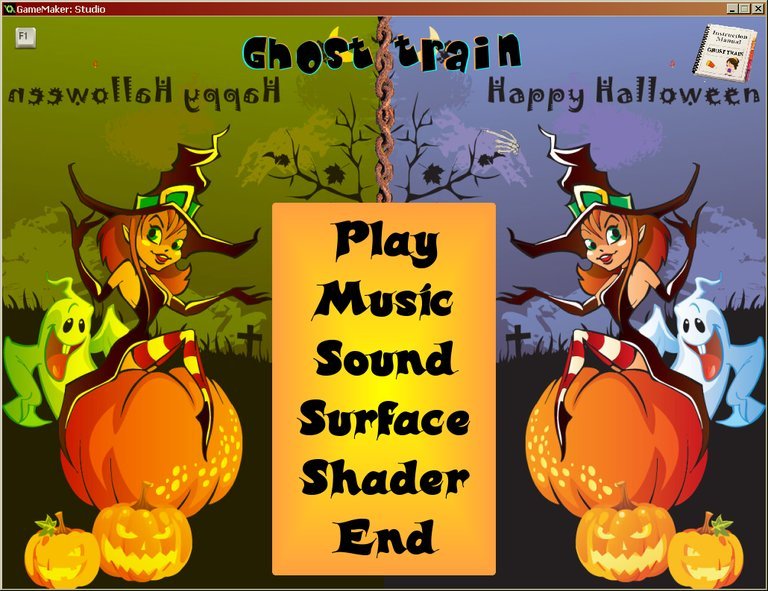
Ghost Train is a Halloween-themed action game where players take on the role of Samhain, the ‘lord of Death,’ tasked with scaring children away from candy on a spooky night. The game supports one or two players, with the second player optionally controlling the children’s house to release kids into the level. Samhain collects ghosts to guard candy and pumpkins, scaring children and earning points, while the kids aim to gather candy for their own score. The game features a top-down perspective, a dark and eerie atmosphere, and a time-limited challenge to determine the winner.
Gameplay Videos
Where to Buy Ghost Train
PC
Ghost Train Cracks & Fixes
Ghost Train Guides & Walkthroughs
Ghost Train Reviews & Reception
imdb.com (30/100): Overall the game has big flaws and it’s clear to see upon playing. But considering the amount of people on this project and the game itself not being boring at all, i will give this game a solid 3/10.
howlongtobeat.com (70/100): This is a short game based on the urba legenc on the KISIRAGI STATION – a mysterious and also finctional train station. I quite enjoyed the playthrough and did all the achievements. You need two playthroughs but the game is quite short! If you like Chilla’s Art games this is definetly for you! Overall a solid 7/10
Ghost Train: A Hauntingly Unique Experiment in Halloween Horror
Introduction
In the vast, ever-expanding landscape of indie horror games, Ghost Train (2013) stands as a curious artifact—a fleeting, experimental title born from the constraints of a Halloween-themed game jam. Developed in just one week by Ereg H. for a contest on the Czech website Velkej Chytrák, this top-down action game pits players against each other in a playful, spooky battle for candy supremacy. While it may lack the polish or depth of more ambitious horror projects, Ghost Train offers a fascinating glimpse into the creativity that thrives under tight deadlines and thematic constraints. This review will dissect the game’s development, mechanics, and legacy, exploring how it fits into the broader tapestry of indie horror and Halloween-themed gaming.
Development History & Context
The Birth of a Halloween Experiment
Ghost Train emerged from a Halloween-themed contest on Velkej Chytrák, a Czech website known for fostering creative challenges. The game was developed in just seven days, a testament to the rapid prototyping and iterative design processes common in game jams. Ereg H., the sole developer, leveraged GameMaker to bring the project to life, a tool well-suited for quick, 2D game development.
The constraints of the contest—both in time and theme—shaped Ghost Train into a lightweight, accessible experience. Halloween, with its rich iconography of ghosts, pumpkins, and trick-or-treating, provided a ready-made aesthetic and narrative framework. The game’s premise, pitting the “lord of Death” against candy-hungry children, is a playful inversion of traditional Halloween tropes, where the supernatural is often the antagonist rather than the protagonist.
The Indie Horror Landscape of 2013
By 2013, indie horror was undergoing a renaissance. Games like Amnesia: The Dark Descent (2010) and Slender: The Eight Pages (2012) had demonstrated the potential of low-budget, high-atmosphere horror experiences. Meanwhile, the rise of game jams and digital distribution platforms like Itch.io and Game Jolt allowed developers to experiment with horror in bite-sized, often free-to-play formats.
Ghost Train fits squarely into this era of experimental horror. It doesn’t aim for the psychological depth of Amnesia or the viral terror of Slender, but it does embrace the playful, almost whimsical side of Halloween horror. The game’s simplicity and two-player mechanics make it a unique entry in a genre often dominated by single-player, narrative-driven experiences.
Narrative & Thematic Deep Dive
A Playful Halloween Showdown
Ghost Train’s narrative is minimalist but effective. On Halloween night, children emerge from a house to gather scattered candy, while Samhain, the “lord of Death,” seeks to scare them away. The premise is straightforward, but it taps into the duality of Halloween—as both a celebration of childhood joy and a night where the supernatural feels tantalizingly close.
The game’s themes revolve around competition and control. Samhain, as the player-controlled entity, must strategically place ghosts to guard candy and pumpkins, creating a dynamic where the supernatural is both a tool and a force of disruption. The children, meanwhile, represent the chaos of Halloween night, their movements unpredictable and their goals simple: collect as much candy as possible.
The Absence of Dialogue and Character Depth
Unlike more narrative-driven horror games, Ghost Train eschews dialogue and character development. There are no cutscenes, no backstories, and no moral dilemmas. Instead, the game relies on its mechanics and visuals to convey its Halloween spirit. The children are faceless, their house a moving silhouette, and Samhain is little more than a spectral symbol dragged across the screen.
This lack of depth isn’t a flaw but a deliberate choice. Ghost Train is a game about atmosphere and gameplay, not storytelling. The absence of dialogue or complex characters allows the player to focus on the core experience: the tension between Samhain’s strategic ghost-placement and the children’s relentless candy-gathering.
Gameplay Mechanics & Systems
Core Gameplay Loop: A Battle for Candy
At its heart, Ghost Train is a competitive action game. The first player controls Samhain, using the mouse to drag a spectral symbol across the screen. By touching the cauldron in the center of the level, Samhain can summon ghosts, which follow the symbol and can be placed near candy or pumpkins. Ghosts near candy scare away children, while ghosts near pumpkins both repel kids and illuminate dark areas.
The second player (or the AI) controls the children’s house, which moves along the screen’s edge and periodically releases new children. The house can be maneuvered with arrow keys, and children are released with the spacebar. The game’s objective is simple: Samhain scores points by scaring children, while the kids score by collecting candy. After a set time limit, the player with the higher score wins.
Strategic Depth and Limitations
The gameplay is deceptively simple but offers a surprising amount of strategic depth. Samhain must balance between summoning new ghosts, placing them effectively, and managing their limited lifespan (ghosts fade over time). The children, meanwhile, must navigate the level efficiently, avoiding ghosts while maximizing candy collection.
However, the game’s mechanics are not without flaws. The ghost-placement system, while intuitive, can feel imprecise, especially when trying to guard multiple pieces of candy simultaneously. The children’s AI, while functional, lacks the unpredictability of a human opponent, making single-player sessions less engaging than two-player matches.
UI and Controls: Simplicity Over Complexity
Ghost Train’s UI is minimalist, with a score display and a timer being the only persistent elements. The controls are equally straightforward: mouse clicks for Samhain, arrow keys and spacebar for the house. This simplicity ensures that the game is accessible to casual players, but it also limits the potential for deeper mechanical complexity.
World-Building, Art & Sound
A Halloween Aesthetic
The game’s visual design is a love letter to Halloween. The top-down perspective and fixed/flip-screen visuals evoke classic arcade games, while the pumpkins, ghosts, and candy create a vibrant, festive atmosphere. The darkness that shrouds parts of the level adds a touch of tension, forcing Samhain to rely on pumpkin-illuminated areas for visibility.
The art style is functional rather than groundbreaking. The ghosts are simple spectral blobs, the children are indistinct figures, and the environment is a basic grid of candy and pumpkins. Yet, the game’s charm lies in its simplicity—the way the ghosts flicker, the way the pumpkins glow, and the way the children scurry about all contribute to a cohesive Halloween vibe.
Sound Design: The Silence of the Night
Sound design in Ghost Train is understated but effective. There’s no music, only the ambient sounds of children’s laughter, the rustling of ghosts, and the occasional eerie whisper. The absence of a soundtrack allows the gameplay to take center stage, but it also means the game lacks the atmospheric depth of more audio-rich horror experiences.
Reception & Legacy
A Niche Experiment
Ghost Train was released as freeware, meaning it didn’t receive the same level of attention as commercial indie horror games. On MobyGames, it holds an average player score of 2.0 out of 5, based on a single rating. This low score likely reflects the game’s limited scope and lack of polish, but it’s also a reminder of how niche experiments like Ghost Train often fly under the radar.
Despite its obscurity, Ghost Train is a fascinating case study in game jam development. It demonstrates how a simple premise, executed quickly and with clear constraints, can still deliver a fun, if fleeting, experience. The game’s two-player mechanics, in particular, make it a unique entry in the Halloween horror genre, where multiplayer experiences are rare.
Influence and the Ghost Train Phenomenon
The name Ghost Train has been used in multiple contexts, from the 2020 psychological horror game by Chilla’s Art to various urban legends and interactive fiction titles. The 2013 Ghost Train by Ereg H. may not have directly influenced these later works, but it’s part of a broader cultural fascination with ghost trains as a horror motif.
The 2020 Ghost Train by Chilla’s Art, for example, is a first-person psychological horror game that explores themes of routine, isolation, and the supernatural. While it shares a name with Ereg H.’s game, the two are vastly different in scope and tone. The 2020 version is a slow-burn narrative experience, while the 2013 version is a fast-paced, competitive action game. This divergence highlights how the “ghost train” concept can be adapted to fit different genres and gameplay styles.
Conclusion: A Fleeting but Fun Halloween Experiment
Ghost Train (2013) is not a masterpiece of horror gaming, nor does it aspire to be. It’s a small, experimental title born from the constraints of a game jam, and it embraces those limitations with playful enthusiasm. The game’s strengths lie in its simplicity, its Halloween aesthetic, and its unique two-player mechanics. While it lacks the depth and polish of more ambitious indie horror games, it offers a fun, competitive experience that captures the spirit of Halloween night.
In the grand tapestry of video game history, Ghost Train is a minor footnote—a fleeting experiment that demonstrates the creativity of indie developers working under tight constraints. It may not have left a lasting legacy, but it’s a reminder of how even the simplest ideas can spark joy, especially when wrapped in the festive, spooky charm of Halloween.
Final Verdict: 6/10 – A fun, if flawed, Halloween experiment that shines in two-player mode but lacks depth in single-player.