
- Release Year: 2020
- Platforms: Macintosh, Windows
- Publisher: Dr. Kucho! Games
- Developer: Dr. Kucho! Games
- Genre: Action
- Perspective: Side view
- Game Mode: Single-player
- Gameplay: Arcade, Platform, Shooter
- Setting: Fantasy
- Average Score: 82/100
Description
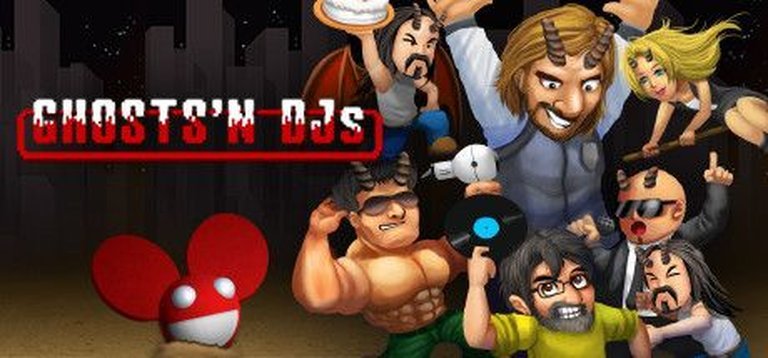
Set in a 16-bit pixelated fantasy universe, Ghosts’n DJs is an arcade platform shooter that satirizes the music industry’s fake DJs and ghost producers. Players control Dr. Kucho! as they battle parody villains like Devil Goata and Paris Sheraton, who use a mystical artifact called THE TEMPLATE to homogenize music and destroy artistic authenticity, all in a challenging gameplay style inspired by the classic Ghosts ‘n Goblins.
Gameplay Videos
Where to Buy Ghosts’n DJs
PC
Ghosts’n DJs Reviews & Reception
waytoomany.games : It is fun to play, feels a lot like it’s GnG inspiration and does make you smile – especially when you see some of the DJs combat moves.
higherplaingames.com (70/100): A very well put together Ghosts N Goblins clone, Ghosts N DJs is fun to play, free to play and showcases some great charitable causes too.
Ghosts’n DJs: A Satirical Symphony of 16-Bit Rebellion
Introduction: Pixelated Passion vs. Plastic Pop
In the sprawling, often homogenous landscape of indie gaming, occasional titles emerge that feel less like calculated market products and more like fervent, personal manifestos. Ghosts’n DJs is unequivocally one such title. Conceived not by a traditional game studio but by Dr. Kucho—a veteran Spanish house music producer with a three-decade career and over 300 releases—this 2020 release is a passionate,像素ated broadside against the perceived commercialization and inauthenticity of modern electronic dance music (EDM). Drawing its core mechanical DNA from Capcom’s notoriously punishing 1985 arcade classic Ghosts’n Goblins, Kucho transmutes its skeletal difficulty and run-and-gun formula into a bizarre, endearing, and often frustrating satire where musical weapons are wielded against caricatures of industry figures like “Devil Goata,” “Paul Douchebag,” and “Paris Sheraton.” This review will argue that Ghosts’n DJs is a fascinating case study in auteur-driven game design: a technically rudimentary and mechanically uneven love letter that succeeds primarily through the unassailable force of its creator’s personal vision and its surprisingly effective synthesis of niche musical passion with arcade reverence. Its legacy is not that of a groundbreaking genre-shaper, but of a cult artifact that perfectly encapsulates a very specific, very combative moment in dance music culture.
Development History & Context: A One-Man Band’s Odyssey
The development of Ghosts’n DJs is a story almost as singular as the game itself. The title was developed and published entirely by Dr. Kucho! Games, a one-person (or very small team) operation helmed by the aforementioned DJ/producer. This immediately places the project within the contemporary “indie dev as auteur” model, but with a radical twist: the primary creative force was an acclaimed figure from another entertainment medium, not a lifelong game developer. According to the official Steam and MobyGames descriptions, Kucho sought to create “a project born from the love of music and a tribute to the arcade games of the 80’s and 90’s.”
Technologically, the game was built in Unity, a standard for indie developers, allowing for relative cross-platform ease (released on Windows and macOS). The constraints were self-imposed aesthetic ones: a deliberate embrace of 16-bit pixel art and a visual style meant to evoke the Super Nintendo / Sega Genesis era. The audio design pays direct homage to the period with “FX sounds based on 8 bit YM2203 and MOS6581 sound chips,” the latter being the famous SID chip from the Commodore 64. This purist approach to retro aesthetics, however, sat in charming tension with the ultra-modern subject matter of EDM culture.
The gaming landscape of early 2020 was mature for indie revivals and genre pastiches. The “Ghosts ‘n Goblins-like” was already a recognized sub-niche, with titles like Volgarr the Viking having modernized the punishing formula with more fairness. Ghosts’n DJs entered this space not to innovate mechanically, but to inject a hyper-specific, insider satire. Its release as a free-to-play title (with prompts for charitable donations to children’s causes, as noted by multiple reviewers) further distinguished it, framing it as a passion project and activism piece rather than a commercial venture. The involvement of deadmau5, a globally renowned electronic artist, was a significant coup, lending the project mainstream credibility within its target community and providing a powerhouse soundtrack.
Narrative & Thematic Deep Dive: The War on “Fake DJs”
The plot of Ghosts’n DJs is its most explicit and polemical component, delivered through the game’s ad blurb and opening text. It posits a “parallel universe where life is in a 16-bit pixelated form” where the music scene is under siege. The antagonists are not mere criminals but archetypal representations of the industry’s criticisms:
-
The Villains: “Devil Goata” (clearly referencing David Guetta), “Paul Douchebag” (Steve Aoki), “Paris Sheraton” (Paris Hilton), “Steve Karaoki” (a blend of Steve Aoki and the general “karaoke” insult for performers without live skill), and “Pete Bullshit” (likely Pete Tong, a long-standing BBC Radio 1 DJ, though the “bullshit” label applies generally). They are empowered by two evils: ghost producers (uncredited artists who make the music) and the literalized mystical force of MONEY from the “Pit of Averno.” Their weapon is THE TEMPLATE—a malicious artifact that “make[s] all of it [music] sound the same and stupid.”
-
The Protagonist & Mission: The player controls Dr. Kucho himself, on a “crusade for the love of music.” The goal is to “fight the fake and avoid cheesy music to poison the weak minds,” destroy THE TEMPLATE, and “send these creatures back to the 16-bit hell they came from using musical supports as weapons.”
Thematically, the game is a straightforward satire of contemporary EDM culture’s commercialization. It rails against the DJ-as-performer-celebrity who relies on ghost production, formulaic sounds, and gimmicky stage antics (represented by homing “pies” from Steve Aoki demons, as noted in the Way Too Many Games review). The satire is intentionally infantile and broad, as critics pointed out. It does not engage in nuanced critique; it is a cathartic, video game-logic fantasy of violently dismantling an industry seen as corrupt. The choice of the “16-bit hell” as their origin is doubly clever: it references the game’s aesthetic, frames the villains as retrograde, and hints that this “fake” music culture is a corruption of the authentic, foundational spirit of electronic music (which itself has roots in 70s/80s synth culture).
The narrative is pure framing device, existing to justify the gameplay loop. There are no dialogue trees, character arcs, or plot twists. The story is the set-up, and the gameplay is the punchline—a relentless, musical assault on the caricatures. This simplicity works for its purpose: it’s a meme given interactive form, with the credibility of its creator shielding it from being dismissed as mere trolling.
Gameplay Mechanics & Systems: Familiar Chains, New Whips
At its core, Ghosts’n DJs is a 2D side-scrolling run-and-gun platformer that lifts the control scheme, physics, and much of the feel of Ghosts’n Goblins. This is its most divisive and defining feature.
-
Core Loop & Controls: Players control Dr. Kucho as he traverses linear stages filled with platforms, pits, and enemies. Movement is weighty. The infamous immutable-jump-in-mid-air mechanic from GnG is present: once you jump, you cannot alter your horizontal trajectory. This creates the signature, often frustrating, precision-platforming challenge. Critics universally noted this. As Leo Faria at Way Too Many Games stated: “the game mistakes Ghosts ‘n Goblins‘ hardware limitations and design hindrances as if they are nostalgic features. We really didn’t need to get another game with those terrible jumping mechanics.” Attacks are performed with the “A” button, and the character can strike in multiple directions while standing or jumping.
-
Progression & Weapons: The weapon system is where the game’s musical theme integrates mechanically. Players start with mixtapes as projectiles. By collecting power-ups (presumably dropped by enemies or in the environment), these can be upgraded sequentially to USB sticks, CDs, and finally vinyl records. The pinnacle is acquiring the deadmau5 head, which serves as both armor (likely granting an extra hit) and a “super weapon” that shoots “rainbow-colored cats” at enemies—a gloriously absurd and specific reference that rewards fans. This creates a clear, satisfying progression curve within each life, encouraging players to seek upgrades to handle increasing enemy density.
-
Difficulty & Structure: The game offers four difficulty levels, which primarily affects enemy count, speed, and damage. A key design choice, praised by reviewers, is the implementation of a health bar (allowing 3 hits) in contrast to the one-hit death of classic GnG. However, as Faria noted, the difficulty selection “does limit the amount of levels you’ll play on,” implying the hardest difficulty truncates the experience. The game is structured into three stages with a final boss against one of the main DJ villains (e.g., Devil Goata). Enemies include walking and flying variants with behaviors like homing attacks (the infamous “homing pies”).
-
Flaws & Innovations: The most commonly cited flaw is enemy swarming and spawn logic. The Gert Lush Gaming review vividly described it: “the flying enemies are way too frequent and difficult to hit… it goes from empty to full in seconds.” This randomness can make the game feel unfair rather than skill-based, undermining the careful platforming the core controls demand. The “innovation” lies entirely in the thematic skin: replacing the classic GnG spear/knight with a DJ throwing records, and enemies with satirical music industry figures. The CRT filter and 8-bit sound chips are stylistic choices that enhance the retro feel but add no mechanical depth. The game is “super fast and fluid” in motion, but this speed often conflicts with the笨拙的 jumps and sudden enemy fills.
In summary, the gameplay is a faithful but flawed homage. It mitigates the most obscene unfairness of its inspiration (better collision, health bar) but sometimes amplifies its other worst traits (enemy spam, unpredictable difficulty spikes). Its true “innovation” is purely aesthetic and narrative.
World-Building, Art & Sound: The Matrix of the Message
Where Ghosts’n DJs transcends its mechanical limitations is in its world-building and audiovisual synergy, which are utterly inseparable from its core thesis.
-
Visual Direction & Setting: The game presents a pixel-art parallel universe where the fantasy setting of GnG (demons, knights, castles) is replaced with a surreal, club-tinged wasteland. Environments are a mix of gothic architecture (a direct nod to the source material) and absurd, music-industry-specific locales. The character and enemy sprite design is where the satire shines. Dr. Kucho is a clear self-insert—a pixelated DJ in headphones. The villains are instantly recognizable caricatures captured in 16-bit form, from Guetta’s spiky hair to Aoki’s energetic pose. The animations are praised as “fantastic” (Way Too Many Games), and the parallax scrolling adds depth to the 2D planes. The overall aesthetic successfully merges medieval platformer tropes with rave culture iconography, creating a world that feels intentionally ridiculous and cohesive.
-
Sound Design & Music: This is the game’s unequivocal masterpiece and its strongest unifying element. The soundtrack is a dual-layered tribute.
- The In-Game Chiptune: The “FX sounds based on 8 bit” chips create a crunchy, authentic retro soundtrack that would fit perfectly in any 90s console game. This grounds the game in its mechanical homage.
- The deadmau5 Score: The inclusion of four original deadmau5 tracks—”Polaris,” “4Ware,” “GG,” and “Three pound chicken wing”—is the game’s killer feature. These are full, modern electronic productions that play over the chiptune sound effects. As Leo Faria astutely observed: “weirdly enough, Kucho himself didn’t compose an electronic soundtrack… he focused on making a really good classical-inspired collection of tunes instead. That doesn’t mean there isn’t a ton of electronic music in here, as Deadmau5 composed original songs.” This creates a bizarre but brilliant audiovisual dissonance: the fast, fluid, melodic progressive house of deadmau5 accompanying the stiff, punishing platforming of a 1985 arcade game. Reviewers consistently stated the music is “excellent” and “a banger,” and that playing with it “on the back” enhances the experience, especially during chaotic enemy swarms. It’s the perfect ironic underscore for a game about “real music” versus “cheesy music”—the soundtrack itself is an argument for authenticity from a master of the form.
The amalgamation of these elements creates a world that is not just themed around a musical feud, but one that feels like the battle is being fought to this soundtrack. The art tells you who to hate; the music gives you the adrenaline to fight them.
Reception & Legacy: Cult Classic with Caveats
Ghosts’n DJs received a mixed but generally favorable critical reception, while achieving a notably stronger response from the player base on Steam.
-
Critical Reception: Aggregating the three critic reviews listed on MobyGames gives an average score of 69%. The consensus was consistent:
- Praise: Its charm, faithfulness to the GnG template (minus the worst fairness issues), excellent soundtrack, and clear passion. “Very well put together” (Higher Plain Games), “fun to play” (all), and a successful translation of the GnG “atmosphere” (Gert Lush Gaming).
- Criticism: The infantile satire, the problematic enemy spam/randomness, and the archaic, frustrating jump mechanics that feel like a design choice rather than a challenge. Gert Lush Gaming summarized it: “the gameplay is the same but the flying enemies are way too frequent… it felt more like I was playing an album over the top of it all.” The satire was seen as either charmingly blunt or crudely simplistic depending on the reviewer’s tolerance for insider industry jokes.
-
Player Reception: The Steam community response was significantly warmer, with a “Very Positive” rating (88% positive from 139 reviews as of the latest data). This divergence suggests the game deeply resonated with its target audience: players who are either fans of Dr. Kucho/deadmau5, appreciate retro arcade challenges, or are sympathetic to its satirical message. The “free-to-play” model likely lowered barriers to entry, allowing curiosity to convert into playtime. Common positive themes in user reviews (visible in the Steam hub snippets) highlight its charm, fun factor, and nostalgia for GnG. Negative Steam reviews often cite the difficulty spikes and occasional bugs (a community discussion thread was titled “Fun game but is somewhat in a crippled state”).
-
Legacy & Influence: Ghosts’n DJs is not a game that shifted industry paradigms. Its influence is niche and cultural rather than mechanical.
- The Auteur-Passion Project Blueprint: It stands as a successful example of a non-game-industry celebrity using modern tools (Unity, Steam) to create a personal, culturally specific game. Its path—from itch.io to Steam, featuring another celebrity for soundtrack synergy—is a potential model for other artists.
- Niche Genre Revival: It contributed to the small resurgence of authentic Ghosts’n Goblins-inspired games, but with a uniquely 21st-century ironic twist. It likely did not draw new players to the subgenre but gave existing fans a novel skin.
- Music Industry Satire in Games: It sits alongside titles like Rez or beatmania IIDX as games intrinsically linked to music culture, but where those are synergistic rituals, Ghosts’n DJs is a polemical cartoon. Its legacy is in proving that a game’s narrative and world can be a direct, aggressive critique of its creator’s real-world profession.
- Cult Status: The combination of obscurity, a beloved soundtrack, and a very specific joke has cemented its status as a cult classic among a small cohort of EDM fans and retro gamers. The fact that it is free and still maintains a “Very Positive” status years after release is a testament to this dedicated niche.
Conclusion: A Flawed but Ferocious Meme in Motion
Ghosts’n DJs is not a great game by conventional metrics. Its controls are archaic by design, its difficulty can feel arbitrary and unfair, its narrative is a blunt instrument, and its content volume is minimal (3 stages). To judge it solely on these axes would be to miss its entire point. It is, first and foremost, a passion project and a piece of cultural commentary. Dr. Kucho used the language of a beloved (and famously difficult) arcade franchise to stage a playful, pixelated war on the “fake DJs” he perceives as plaguing his life’s work.
The genius lies in the integration. The deadmau5 soundtrack isn’t just a加成; it’s the game’s soul and its most persuasive argument. The satire, while crude, is instantly recognizable to anyone familiar with dance music tabloids. For the player who gets the jokes and can tolerate the GnG control scheme, Ghosts’n DJs transforms from a frustrating platformer into a cathartic, hilarious, and oddly moving experience. You aren’t just jumping over pits; you’re using vinyl records to shoot down a demon version of Steve Aoki to a euphoric deadmau5 track. That specificity is its power.
Its place in video game history is that of a notable curio—a successful, self-funded crossover where a music producer’s critique became an interactive artifact. It demonstrates the accessibility of game development tools and the potent combination of personal grievance and artistic homage. For scholars of games as cultural expression, Ghosts’n DJs is a perfect case study: a game where the mechanics are almost secondary to the message and the milieu. It is a flawed, frenetic, and deeply sincere 16-bit manifesto. Its ultimate verdict is not “must-play,” but for those aligned with its frequency, it is a essential, bizarre, and surprisingly resonant download—a testament to the fact that sometimes, the most meaningful games are the ones made not for everyone, but for someone with a very loud, very specific gripe.