
- Release Year: 2022
- Platforms: PlayStation 5, Windows Apps, Windows, Xbox Cloud Gaming, Xbox Series
- Publisher: Bethesda Softworks LLC
- Genre: Compilation
- Game Mode: Single-player
- Average Score: 75/100
Description
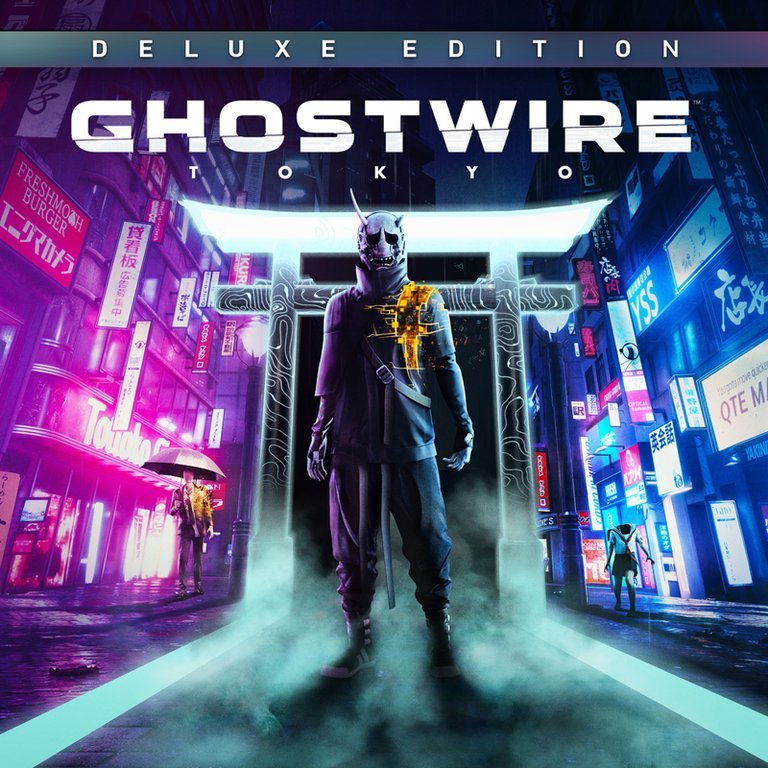
Ghostwire: Tokyo – Deluxe Edition is an action-adventure horror game set in a supernatural version of Tokyo, where the city has been overrun by malevolent spirits after a mysterious occultist’s ritual. Players take on the role of Akito, a young man possessed by a spirit named KK, who grants him supernatural abilities to combat the spectral invaders. The game blends first-person exploration, elemental combat, and a deep narrative as Akito investigates the disappearance of Tokyo’s population while uncovering the truth behind the supernatural catastrophe. The Deluxe Edition includes the base game and additional DLC content, offering enhanced gameplay and extra missions.
Ghostwire: Tokyo – Deluxe Edition Free Download
Ghostwire: Tokyo – Deluxe Edition Cracks & Fixes
Ghostwire: Tokyo – Deluxe Edition Mods
Ghostwire: Tokyo – Deluxe Edition Guides & Walkthroughs
Ghostwire: Tokyo – Deluxe Edition Reviews & Reception
ign.com : Ghostwire: Tokyo is a nightmarish vision, but an absolutely incredible recreation nonetheless.
metacritic.com (75/100): Ghostwire: Tokyo is a beautiful and eerie jaunt through the streets of Japan, coming face to face with lore and legend while fighting for your own quest and purpose.
pcgamer.com : Fun combat and a sophisticated city burdened with the unfulfilled potential of a far scarier experience.
cnet.com : Ghostwire Tokyo is a spellbinding world if you’re patient enough to explore it.
Ghostwire: Tokyo – Deluxe Edition Cheats & Codes
PC (Steam)
Edit the ‘input.ini’ file located at ‘%userprofile%\Saved Games\TangoGameworks\GhostWire Tokyo (STEAM)\Saved\Config\WindowsNoEditor’ to add the following lines:
| Code | Effect |
|---|---|
| [/script/engine.inputsettings] bEnableMouseSmoothing=False bViewAccelerationEnabled=False |
Disables mouse smoothing and view acceleration for improved mouse input. |
PC (Epic Games)
Use the WeMod trainer or FLiNG trainer with the following hotkeys:
| Code | Effect |
|---|---|
| Num 1 | God Mode/Ignore Hits |
| Num 2 | Infinite Health |
| Num 3 | Infinite SP & Ammo |
| Num 4 | Fast Skill Charge |
| Num 5 | Instant Bow Charge |
| Num 6 | Food Won’t Decrease |
| Num 7 | Stealth Mode |
| Num 8 | Set Player Speed |
| Num 9 | Set Game Speed |
| Num 0 | One Hit Kill |
| Num . | Damage Multiplier |
| Num + | Defense Multiplier |
| Ctrl+Num 1 | Infinite Money |
| Ctrl+Num 2 | Infinite Exp |
| Ctrl+Num 3 | Exp Multiplier |
| Ctrl+Num 4 | Enemy Item Drop Multiplier |
| Ctrl+Num 5 | Skill Points Won’t Decrease |
PC (Cheat Engine Tables)
Use Cheat Engine with the provided tables to activate the following cheats:
| Code | Effect |
|---|---|
| Infinite Ammo | Unlimited ammunition |
| Easy Kills | One-hit kills |
| Infinite Skill Points | Unlimited skill points |
| 1 Billion Meika | Sets money to 1 billion |
| Infinite Usable Items | Unlimited consumable items |
| Half Speed | Reduces game speed by half |
| Health Editor | Edit current and max health |
| Synergy Editor | Edit synergy values |
| God Mode | Invincibility |
| One Hit Kill | Instant kills |
| Infinite Resonance | Unlimited resonance |
| Fast Charge | Instant charging |
| Infinite Items | Unlimited items |
| Movement | Edit movement characteristics |
| Money and SP | Unlimited money and skill points |
| Stealth | Stealth (undetectability) |
| Player | Edit character attributes |
PC (PLITCH)
Use the PLITCH software to activate the following cheats:
| Code | Effect |
|---|---|
| Increase movement speed | Increases player movement speed |
| Decrease movement speed | Decreases player movement speed |
| Unlimited energy/ammo | Unlimited energy and ammunition |
| Godmode | Invincibility |
| Easy Kill | One-hit kills |
| Stealth | Enemies cannot detect the player |
| Free skillpoint usage | Skills can be used without cost |
| Free item usage | Items can be used without cost |
| 1k bonus Meika (on collect) | Adds 1,000 Meika when collecting |
| 10k bonus Meika (on collect) | Adds 10,000 Meika when collecting |
| 100k bonus Meika (on collect) | Adds 100,000 Meika when collecting |
Ghostwire: Tokyo – Deluxe Edition: A Hauntingly Beautiful but Flawed Masterpiece
Introduction
Ghostwire: Tokyo – Deluxe Edition is a compelling yet polarizing entry in the action-adventure genre, blending supernatural horror, Japanese folklore, and open-world exploration into a visually stunning but mechanically uneven experience. Developed by Tango Gameworks and published by Bethesda Softworks, the game presents a hauntingly empty Tokyo overrun by malevolent spirits, where players assume the role of Akito Izuki, a young man possessed by the ghostly detective KK. Together, they must unravel the mystery behind the city’s vanishing population while battling the occult forces responsible. The Deluxe Edition bundles the base game with the Deluxe Upgrade DLC, offering additional cosmetics and minor enhancements, but the core experience remains unchanged.
This review will dissect Ghostwire: Tokyo in exhaustive detail, examining its development history, narrative depth, gameplay mechanics, world-building, and legacy. While the game has been praised for its atmospheric presentation and cultural authenticity, it has also faced criticism for its repetitive gameplay and underwhelming combat. By analyzing these elements, we aim to determine whether Ghostwire: Tokyo is a forgotten gem or a missed opportunity in the pantheon of modern action-adventure games.
Development History & Context
The Studio and Vision
Tango Gameworks, founded by Resident Evil creator Shinji Mikami, has carved a niche for itself in the horror genre with titles like The Evil Within series. However, Ghostwire: Tokyo marked a significant departure from survival horror, embracing a more action-oriented approach while retaining supernatural themes. The game was first announced at Bethesda’s E3 2019 press conference, with Mikami and creative director Ikumi Nakamura (who later left the studio) introducing it as an “action-adventure game with horror elements.”
The development team sought to capture the essence of Tokyo, blending its modern urban landscape with traditional Japanese folklore. Combat director Shinichirō Hara, known for his work on Doom (2016), brought a kinetic energy to the game’s combat, describing it as “karate meets magic.” The team drew inspiration from Kuji-kiri, a ritualistic hand gesture system used in Japanese esoteric practices, to create the game’s unique spell-casting mechanics.
Technological and Industry Constraints
Ghostwire: Tokyo was developed using Unreal Engine 4, which allowed for detailed environmental rendering and atmospheric effects. However, the game’s development was not without challenges. The COVID-19 pandemic disrupted the team’s workflow, limiting their ability to conduct on-site research in Tokyo and forcing them to rely on individual contributions rather than collaborative exploration.
Additionally, the game’s release coincided with a shifting industry landscape. Microsoft’s acquisition of ZeniMax Media (Bethesda’s parent company) in 2020 raised questions about the game’s exclusivity, though it remained a timed PlayStation 5 exclusive for a year before launching on Xbox Series X/S in 2023. The Deluxe Edition, released alongside the base game, included cosmetic items like the Shinobi outfit and Kunai weapon, as well as the Streetwear outfit pack, but these additions did little to address the game’s core criticisms.
Narrative & Thematic Deep Dive
Plot and Characters
Ghostwire: Tokyo begins with a supernatural catastrophe: a mysterious fog engulfs Tokyo, causing its population to vanish and leaving behind only their clothes and lingering spirits. Akito Izuki, the protagonist, awakens from a car accident to find himself possessed by KK, a spirit detective with a grudge against Hannya, the masked occultist responsible for the disaster. Akito’s primary motivation is to rescue his comatose sister, Mari, who has been kidnapped by Hannya for a dark ritual.
The narrative unfolds as Akito and KK navigate the desolate city, uncovering the truth behind Hannya’s plan to merge the living and spirit worlds. Along the way, they encounter allies like Rinko, a former colleague of KK, and Ed, a mysterious figure with ties to the supernatural. The story explores themes of loss, grief, and redemption, with Akito and KK’s relationship evolving from mutual distrust to a reluctant partnership.
Themes and Cultural Authenticity
The game’s narrative is deeply rooted in Japanese mythology, drawing from yokai (supernatural creatures) and yurei (ghosts) to populate its haunted version of Tokyo. The Visitors, the game’s primary antagonists, are manifestations of negative human emotions, reflecting societal struggles such as overwork, loneliness, and existential despair. This thematic depth is one of the game’s strongest aspects, offering a commentary on modern Japanese life through a supernatural lens.
However, the narrative’s pacing suffers from the open-world structure. The main plot often takes a backseat to side missions, which, while charming, can feel disjointed. For example, a side quest involving a ghostly pianist interrupts the urgency of Akito’s search for Mari, diluting the narrative’s tension. Despite this, the game’s emotional core—particularly the bond between Akito and KK—provides a satisfying arc, culminating in a poignant resolution that explores the acceptance of loss.
Gameplay Mechanics & Systems
Combat and Progression
Ghostwire: Tokyo’s combat is a mix of elemental spell-casting and melee attacks, with Akito wielding wind, fire, and water-based abilities. The Kuji-kiri-inspired hand gestures add a unique flair to the combat, but the system lacks depth. Enemies are often one-dimensional, with little variation in their attack patterns, and the AI is rudimentary, making stealth kills and fireball spam the most effective strategies.
The game’s progression system is similarly underwhelming. Akito gains experience points (XP) by defeating enemies and collecting spirits, which can be used to unlock new abilities in a skill tree. However, the upgrades feel incremental, and the lack of meaningful combos or advanced techniques limits the combat’s complexity. The Deluxe Edition’s additional cosmetics do not address these issues, leaving the core gameplay loop repetitive and unengaging.
Exploration and Side Content
The game’s open-world design is both its greatest strength and weakness. Tokyo is meticulously recreated, with landmarks like Shibuya Crossing and Tokyo Tower rendered in stunning detail. The city is dense with collectibles, including Jizo statues (which increase ammo capacity), tanukis (which grant passive buffs), and lost spirits (which provide XP). However, the exploration is often marred by repetitive tasks, such as cleansing torii gates to unlock new areas.
Side missions offer glimpses into Tokyo’s folklore but suffer from a lack of variety. Many involve fetching items or defeating waves of enemies, with little narrative payoff. The yokai hunts, while visually impressive, are mechanically simplistic, relying on the novelty of their designs rather than challenging gameplay. The Deluxe Edition’s additional content, such as the “Spider’s Thread” update, introduces new enemy types and side missions, but these additions do little to alleviate the game’s repetitiveness.
World-Building, Art & Sound
Setting and Atmosphere
Ghostwire: Tokyo’s greatest achievement is its atmospheric world-building. The game’s version of Tokyo is a hauntingly beautiful blend of modern urbanity and supernatural decay. Neon signs flicker in the rain, abandoned streets are littered with the remnants of vanished lives, and yokai lurk in the shadows, creating a sense of unease and wonder. The game’s art direction is exceptional, with a color palette that shifts between cyberpunk neon and gothic grays, reflecting the duality of Tokyo’s past and present.
The sound design further enhances the atmosphere, with ambient noises—such as distant whispers and the hum of electrical lines—creating an immersive experience. The game’s soundtrack, composed by Masatoshi Yanagi, blends traditional Japanese instruments with electronic beats, reinforcing the fusion of old and new. The Deluxe Edition does not introduce significant audio or visual upgrades, but the base game’s presentation remains a standout feature.
Technical Performance
The game’s technical performance is a mixed bag. On PlayStation 5, players can choose between Quality Mode (30 FPS with ray tracing) and Performance Mode (60 FPS), but both modes suffer from occasional stuttering and texture pop-in. The PC version, while more customizable, has been criticized for optimization issues, particularly in crowded areas. The Deluxe Edition does not address these technical shortcomings, leaving players to contend with the same performance quirks as the base game.
Reception & Legacy
Critical and Commercial Reception
Ghostwire: Tokyo received “generally favorable” reviews upon release, with critics praising its world-building and cultural authenticity but criticizing its repetitive gameplay. On Metacritic, the game holds scores of 75 (PS5), 78 (PC), and 82 (Xbox Series X/S), reflecting a divisive but ultimately positive reception. Publications like Famitsu awarded the game a near-perfect score, highlighting its atmospheric design, while others, such as PC Gamer, criticized its lack of innovation.
Commercially, the game performed modestly, selling over 6 million copies by September 2023. Its inclusion in Xbox Game Pass in 2023 likely contributed to its late-stage success, introducing the game to a broader audience. However, the closure of Tango Gameworks in 2024, following Microsoft’s restructuring of Bethesda’s operations, cast doubt on the franchise’s future. While a sequel was reportedly in development, the studio’s dissolution leaves Ghostwire: Tokyo’s legacy uncertain.
Influence and Industry Impact
Ghostwire: Tokyo’s blend of Japanese folklore and open-world design has influenced subsequent games, particularly those exploring cultural authenticity in supernatural settings. Its use of Kuji-kiri and yokai lore has inspired other developers to incorporate traditional mythology into modern gameplay. However, the game’s flaws—particularly its repetitive combat and underutilized open world—serve as a cautionary tale for future projects aiming to balance narrative depth with mechanical innovation.
Conclusion
Ghostwire: Tokyo – Deluxe Edition is a game of striking contrasts: a visually stunning world paired with repetitive gameplay, a compelling narrative undermined by pacing issues, and a rich cultural tapestry marred by technical shortcomings. While the game’s atmospheric presentation and thematic depth make it a memorable experience, its mechanical flaws prevent it from achieving greatness.
For players seeking an immersive journey through a supernatural Tokyo, Ghostwire: Tokyo delivers in spades. However, those expecting a deep combat system or innovative open-world design may find themselves disappointed. The Deluxe Edition’s additional cosmetics and minor enhancements do little to address the base game’s core issues, making it a worthwhile purchase only for dedicated fans.
Ultimately, Ghostwire: Tokyo is a flawed masterpiece—a game that excels in atmosphere and storytelling but stumbles in execution. Its legacy will likely be defined by its cultural authenticity and haunting beauty, but its gameplay limitations ensure it remains a niche experience rather than a genre-defining classic.
Final Verdict: 7.5/10 – A hauntingly beautiful but mechanically flawed journey through supernatural Tokyo.