
- Release Year: 1999
- Platforms: Windows
- Publisher: Recreasoft
- Developer: Recreasoft
- Genre: Card, Rummy, Strategy, Tactics, Tile game
- Perspective: Top-down
- Game Mode: Single-player
- Gameplay: Cards, Tiles
Description
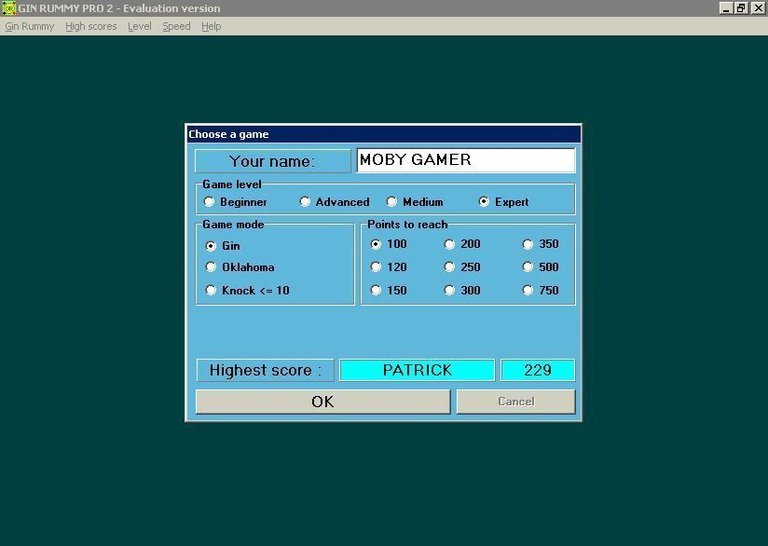
Gin Rummy Pro 2 is a single-player digital card game where players compete against the computer in the classic game of Gin Rummy. The goal is to form sets or runs of cards while minimizing unmelded ‘deadwood’ points. Featuring three variants—Gin Rummy, Oklahoma Gin, and Maximum Knock Gin—the game offers four difficulty levels and customizable point targets. High scores are tracked for each combination, with mouse-based controls and bilingual support for English or French gameplay. Released in 1999 for Windows, it provides a strategic yet accessible card-playing experience.
Gin Rummy Pro 2: Review
Introduction
In the pantheon of card games, few titles carry the cultural weight of Gin Rummy—a cornerstone of 20th-century Americana, beloved by Hollywood stars and algorithmic researchers alike. Released in 1999 by Recreasoft, Gin Rummy Pro 2 emerged during a critical juncture in gaming history: the twilight of shareware CDs and the dawn of digital casual gaming. This review argues that while Gin Rummy Pro 2 is mechanically faithful to its centuries-old inspiration, it ultimately serves as a functional yet unambitious time capsule of late-’90s design—a stepping stone toward the genre’s future dominance in mobile and AI-driven platforms.
Development History & Context
The Studio and Vision
Recreasoft, a now-obscure developer, positioned Gin Rummy Pro 2 as a no-frills adaptation of the classic card game. Founded by programmer Patrick Coscas, the studio leveraged the era’s shareware model, distributing the game via CD-ROM and early internet downloads. The development team consisted of just two credited members—Coscas and artist Carla Mundi, who licensed the Atlantis-themed card designs—reflecting the minimalist scope of late-’90s indie projects.
Technological Constraints
Built for Windows 98-era hardware, Gin Rummy Pro 2 prioritized accessibility over innovation. Its system requirements were negligible (mouse-only input, 640×480 resolution), catering to casual users rather than cutting-edge enthusiasts. The lack of multiplayer functionality—a stark contrast to modern online platforms like GameColony—highlighted the technical limitations of pre-broadband era desktop gaming.
The Gaming Landscape
In 1999, digital card games occupied a niche market. Physical sets still dominated living rooms, while PC titles like Hoyle Card Games provided stiff competition. Recreasoft’s decision to focus exclusively on Gin Rummy—with variants like Oklahoma Gin and Maximum Knock Gin—reflected a targeted appeal to purists rather than the broader “casual gaming” audience that would later fuel Zynga’s $100 million acquisition of Gin Rummy Plus in 2017.
Narrative & Thematic Deep Dive
A Game Without Story, Rich in Subtext
As a traditional card game adaptation, Gin Rummy Pro 2 lacks a narrative framework. Yet its themes echo the tension and psychology inherent to Gin’s design:
– Risk vs. Reward: The knock mechanic—where players risk undercutting—mirrors high-stakes gambling lore immortalized by players like Stu Ungar.
– Isolation vs. Connection: The solitary AI matches evoke the social erosion of pre-online gaming, contrasting sharply with Gin’s historical role in Hollywood gossip circles.
– Tradition vs. Modernity: By including French-language support, the game nodded to Gin’s global resonance while underscoring its Americana roots.
Gameplay Mechanics & Systems
Core Loop and Innovations
The game faithfully replicates standard Gin Rummy:
1. Players draw/discard cards to form melds (sets or runs).
2. The goal: minimize deadwood (unmatched cards) and knock when deadwood ≤ 10 points.
3. Scoring includes bonuses for Gin (25 points) and Big Gin (31 points), per historical rules.
Variants and Customization
– Oklahoma Gin: Adjusts knock thresholds based on the initial upturned card.
– Maximum Knock: Permits knocking with higher deadwood but risks undercutting.
– Four difficulty levels and nine target scores offered replayability, though AI patterns grew predictable.
Flaws and Limitations
– UI/UX: The mouse-driven interface was functional but clunky, lacking drag-and-drop intuitiveness.
– AI Quirks: Higher difficulties occasionally made statistically irrational discards, undermining immersion.
– No Multiplayer: A glaring omission given Gin’s social DNA—relegating it to a solitaire experience.
World-Building, Art & Sound
Visual Design
Mundi’s Atlantis-themed cards injected modest flair, but the overall aesthetic was utilitarian:
– Top-down perspective with barebones menus.
– Static backgrounds and rudimentary card animations.
– A stark contrast to lavish contemporaries like Microsoft Solitaire.
Sound Design
Minimalist to a fault:
– Clicks and shuffles provided basic feedback.
– No ambient music or voice cues—a missed opportunity to evoke smoky backroom games.
Reception & Legacy
Critical and Commercial Impact
Upon release, Gin Rummy Pro 2 garnered little attention. MobyGames records no contemporary reviews, and its MobyScore remains unrated. As shareware, it likely circulated among enthusiasts but failed to disrupt the market.
Long-Term Influence
Its legacy lies in foreshadowing trends:
– AI Research: Though primitive by modern standards, its CPU opponents presaged Gin’s later role in imperfect-information AI studies (e.g., AAAI Conference algorithms).
– Digital Preservation: By codifying niche variants like Maximum Knock Gin, it archived rules that might otherwise have faded.
– Bridge to Mobile: Its failure to innovate multiplayer underscored the demand that would drive apps like Gin Rummy Plus to 50M+ downloads.
Conclusion
Gin Rummy Pro 2 is neither a masterpiece nor a failure—it is a diligent scribe of gaming’s transitional era. For historians, it encapsulates the shareware period’s ethos: accessible, earnest, and unpolished. For players, its AI-driven matches remain a competent primer on Gin’s strategic depth, though overshadowed by modern platforms. In video game history, it earns a footnote—a humble precursor to the genre’s digital zenith, but one that honored the game’s 90-year legacy with mechanical integrity. For purists and archivists, it’s worth revisiting; for the broader audience, its successors render it obsolete.