
- Release Year: 2005
- Platforms: Windows
- Publisher: dtp digital tainment pool GmbH
- Developer: REVOgames GbR
- Genre: Action
- Perspective: 1st-person
- Game Mode: LAN, Online PVP
- Gameplay: Arcade, Shooter
- Setting: Futuristic, Sci-fi
- Average Score: 47/100
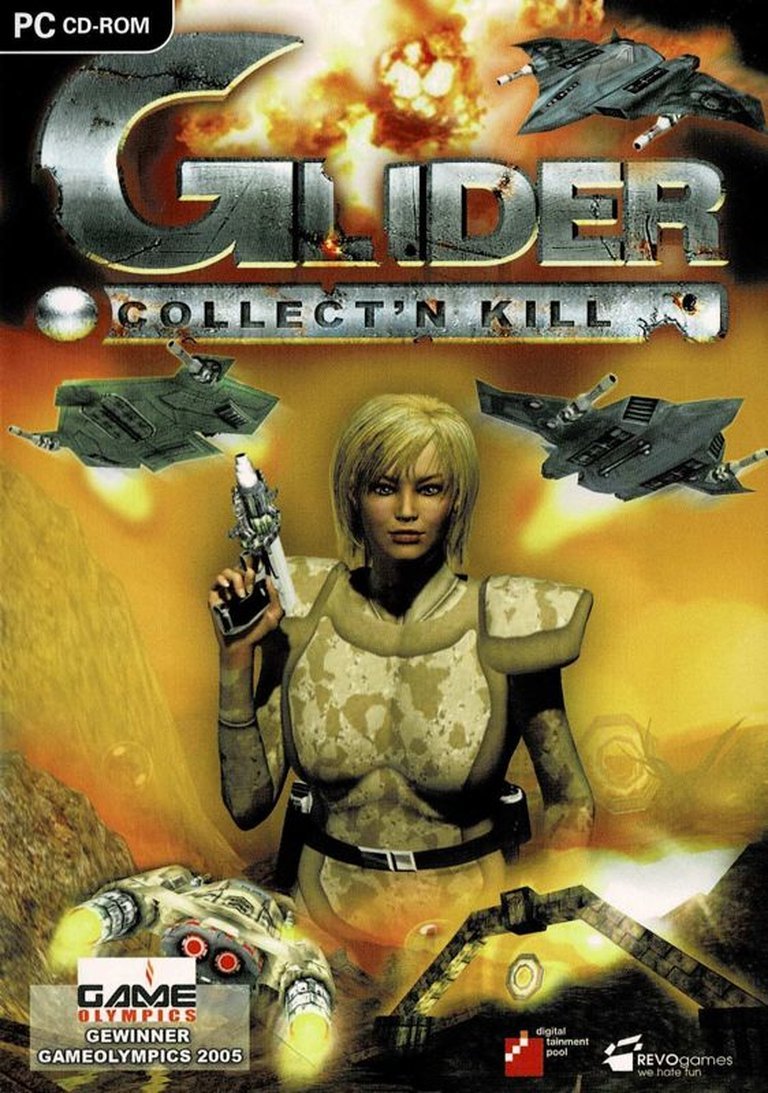
Description
In the year 2259, the Alliance, a galactic governing body, established the Official Glider League to foster safe competition among planets. In ‘Glider: Collect’n Kill’, players pilot one of five gliders through various arenas, including Sunset Valley and Green Valley, to chase down and eliminate up to eight opponents. The game features fast-paced, arcade-style shooter gameplay with a sci-fi setting, offering both single-player and multiplayer modes.
Gameplay Videos
Glider: Collect’n Kill Reviews & Reception
gamepressure.com (42/100): A high speed flight shooter with addiction potential!
mobygames.com (57/100): Average score: 57% (based on 5 ratings)
retro-replay.com : Glider: Collect’n Kill delivers a high-octane, zero-gravity combat experience that instantly immerses you in frantic dogfights.
gamepressure.com (42/100): A high speed flight shooter with addiction potential!
Glider: Collect’n Kill Cheats & Codes
PC
Open the ‘menu.ini’ file with a text editor and change the line ‘debug=0’ to ‘debug=1’. A ‘Debug’ option will now appear in the main menu containing cheats.
| Code | Effect |
|---|---|
| debug=1 | Enables the cheat menu in the main options. |
Glider: Collect’n Kill: A Forgotten Arena Shooter’s Quest for Relevance
Introduction
In 2005, as blockbuster shooters like Quake 4 and F.E.A.R. dominated headlines, German studio REVOgames quietly launched Glider: Collect’n Kill, a modest multiplayer arena shooter with a peculiar blend of futuristic lore and arcade simplicity. Positioned as a fast-paced “collect and kill” experience, the game aimed to carve a niche in a saturated market but ultimately became a footnote in gaming history. This review interrogates Glider: Collect’n Kill’s fleeting appeal, its technical ambitions, and why it remains a curious time capsule of mid-2000s indie experimentation.
Development History & Context
Studio Vision & Constraints
REVOgames, a small German developer, envisioned Glider: Collect’n Kill as a fusion of Descent’s 360-degree movement and Unreal Tournament’s competitive chaos. With a core team of 14 members—including Managing Director André Weinhold and Creative Director Jürgen Rabe—the studio prioritized accessibility over complexity, simplifying controls to attract casual players while retaining a skill ceiling for veterans.
Technological Landscape
Released on October 10, 2005, the game emerged during a seismic shift in PC gaming. High-spec titles like Battlefield 2 demanded cutting-edge hardware, but Glider targeted mid-tier systems with scalable graphics, running smoothly on Pentium III CPUs and 32MB GPUs. This decision broadened its potential audience but limited visual innovation.
The Shadow of Predecessors
Critics noted its resemblance to Clusterball (2000), another indie arena shooter. REVOgames iterated on that formula by streamlining flight mechanics and introducing a “collect-and-kill” scoring system. However, lacking the budget or marketing of AAA competitors, Glider struggled to escape obscurity.
Narrative & Thematic Deep Dive
A Flimsy Galactic Backdrop
Set in 2259, Glider’s lore revolves around “The Alliance,” a utopian coalition of planets that replaces war with gladiatorial glider battles. The Official Glider League serves as the game’s narrative pretext, though storytelling is relegated to loading screens and arena descriptions.
Arenas as Storytelling
Each map hints at world-building:
– Sunset Valley: A desert battleground with Star Trek’s crashed Enterprise as an Easter egg.
– Green Valley: A medieval-themed arena celebrating the League’s 50th anniversary, juxtaposing futuristic combat with archaic architecture.
– Sewerage: Industrial pipelines littered with explosive barrels labeled “Sodium” and “Bantium.”
While imaginative, these details lack narrative payoff, reducing the setting to decorative fluff.
Gameplay Mechanics & Systems
Core Loop: Chaos Over Depth
The gameplay prioritizes frenetic dogfights across five gliders, each with distinct speed, armor, and handling stats. Pilots collect glowing orbs (“balls”) to score points while eliminating rivals with seven weapons, including railguns, homing missiles, and mines. Matches end via timer or score limit, emphasizing rapid decision-making.
Progression & Customization
Unlockable skins and weapon upgrades provide marginal incentives, but the progression system feels underbaked. With no single-player campaign, replayability hinges on multiplayer, which suffered from low adoption.
Controls: Accessibility vs. Mastery
REVOgames simplified controls to lower the barrier to entry:
– Auto-lock missiles for newcomers.
– Advanced maneuvers (barrel rolls, boost rams) for veterans.
Yet, the lack of nuanced physics (compared to Descent) left hardcore players wanting.
Modes & Missed Opportunities
Standard deathmatch and team battles are functional but forgettable. The absence of objective-based modes beyond “collect-and-kill” limited long-term engagement.
World-Building, Art & Sound
Visual Design: Functional Futurism
Glider’s art direction blends metallic gliders with vibrant arenas:
– Sunset Valley’s orange glow contrasts with Sewerage’s grimy green palette.
– Particle effects (explosions, missile trails) are serviceable but lack polish.
Optimization Over Spectacle
The game’s lightweight engine prioritized performance, rendering smoothly on low-end PCs—a prudent choice for 2005 but uninspiring compared to contemporaries.
Sound Design: Techno & Tinnitus
Dennis Kühn and Pierre Gerwig Langer’s techno soundtrack energizes matches but grows repetitive. Weapon SFX (clanking lasers, booming explosions) are competent yet unremarkable.
Reception & Legacy
Mixed Critical Response
Critics praised its accessibility but criticized shallow content:
– Softonic (80%): “Fast-paced, action-packed, and fun.”
– Out of Eight (75%): “Needs more maps and modes.”
– PC Powerplay (24%): “A failed fusion of Descent and Magic Carpet.”
Player reviews averaged 2.2/5, citing repetitive gameplay and a barren multiplayer scene.
Influence & Obscurity
Glider’s legacy is negligible. While REVOgames iterated on Clusterball’s blueprint, the game’s lack of innovation or community support relegated it to abandonware status. Its sole contribution? A cautionary tale about balancing ambition with scope.
Conclusion
Glider: Collect’n Kill is a quintessential “what if?” game—a shooter with flashes of charm hamstrung by limited resources and a crowded market. Its accessible controls and varied arenas hinted at potential, but without depth or longevity, it faded into oblivion. For historians, it’s a fascinating relic of indie tenacity; for players, a forgettable skirmish in gaming’s endless arena.
Final Verdict: A noble misfire, best remembered as a footnote in the annals of arena shooters.