
- Release Year: 2011
- Platforms: Windows
- Developer: Jan Willem Nijman, Jonathan Barbosa Dijkstra, Laurens de Gier, Paul Veer, Rami Ismail, Rutger Muller
- Genre: Action
- Perspective: Side view, Top-down
- Game Mode: Single-player
- Gameplay: Bomb, Coin Collecting, Combo Building, Dashing
- Average Score: 76/100
Description
GlitchHiker is a single-screen action game developed for Global Game Jam 2011 on the theme of ‘extinction,’ where players control a character dashing through a glitch-filled world to collect coins, convert nearby grey blocks into more coins for combos, and deploy bombs to clear screens, while evading deadly black blocks that spawn explosive disturbances capable of ending the game. It originally featured a metagame ‘system’ with shared global lives—increased by collecting 100 coins and depleted by deaths—affecting glitch intensity across players, leading to the game’s real extinction when lives hit zero; now playable locally with adaptive music responding to gameplay.
Gameplay Videos
Where to Buy GlitchHiker
PC
GlitchHiker Reviews & Reception
cdm.link : With gorgeous, elemental visuals and a lovely adaptive music soundtrack, it’s a game you might well feel motivated to try to save.
pcgamesn.com : The moment where we understood GlitchHiker was different was the first time someone sincerely apologised for not scoring 100 points.
ubergizmo.com : I think it would greatly improve your skills in the game, knowing that if you failed too many times you wouldn’t be able to play it anymore.
GlitchHiker: Review
Introduction
Imagine a video game that doesn’t just challenge your reflexes—it begs for your mercy. GlitchHiker, born from the frenetic 48-hour crucible of Global Game Jam 2011, isn’t merely a title you play; it’s one you can kill, forever. Released on January 30, 2011, as freeware for Windows, this ephemeral action game captured lightning in a bottle by literalizing the jam’s theme of “extinction.” What began as a single-screen coin-collecting arcade experiment evolved into a communal tragedy, its central “SYSTEM” depleting to zero lives just hours after launch, rendering the full experience extinct. As a game historian, I see GlitchHiker as a watershed moment in indie design: a provocative fusion of mechanics, meta-narratives, and emotional manipulation that forced players to confront their own agency in a digital ecosystem’s demise. This review argues that GlitchHiker transcends its game-jam origins to claim a permanent spot in gaming history as the ultimate experiment in player-driven mortality.
Development History & Context
GlitchHiker emerged from the Dutch Game Garden in Utrecht during Global Game Jam 2011 (GGJ11), a worldwide 48-hour event organized by the International Game Developers Association (IGDA), Dutch Game Garden, Microsoft, and others. The theme—”extinction”—demanded creativity beyond clichés like dinosaurs or zombies. A supergroup of six talents, many affiliated with the nascent Vlambeer studio, coalesced around composer Rutger Muller’s glitch-music fascination. Rami Ismail served as project lead, backend, and website developer; Jan Willem Nijman handled game design lead, development, and VFX; Laurens de Gier covered game design, visualization design, and development; Jonathan Barbosa Dijkstra contributed design and art; Paul Veer led game and website art; and Muller crafted audio and SFX.
This Vlambeer-adjacent team—prefiguring hits like Luftrausers and Nuclear Throne—leveraged GameMaker’s rapid-prototyping strengths amid severe constraints: no sleep, limited tools, and a focus on interdisciplinary synergy. Brainstorming distilled “a dying world” into “a dying game,” splitting tasks between core mechanics (Nijman, Veer, Muller) and the self-destructive backend (de Gier, Dijkstra, Ismail). The result was an arcade cabinet demo that hooked players with 8-bit charm before revealing its mortal coil.
The 2011 indie landscape was ripe for such boldness. Post-Braid and World of Goo, game jams like GGJ were incubators for innovation, emphasizing themes over polish. GlitchHiker rejected traditional progression for a shared, server-tied “SYSTEM,” pioneering live-service mortality in an era before battle royales or permadeath MMOs. Technological limits—keyboard input, 2D scrolling in GameMaker—forced elegance, birthing a critique of digital fragility amid rising Flash-game ephemerality.
Narrative & Thematic Deep Dive
GlitchHiker eschews scripted plots, voiced characters, or branching dialogue for a narrative embedded in its mechanics: you pilot the nameless GlitchHiker, a pixelated doctor-like figure “bravely digging into the system to repair it,” per Muller’s recollection. The “story” unfolds in real-time across a global playerbase, with no cutscenes but profound emergent drama. Launch at 15:00 with 100 lives; by 21:41, extinction. Players created in-game accounts to track a communal life pool, fostering a meta-narrative of collective guardianship.
Core themes revolve around extinction as inevitability and agency. The GlitchHiker embodies futile heroism against systemic decay—grey blocks tempt combos but risk turning black and deadly, mirroring environmental collapse. Empathy and guilt dominate: players apologized for low scores, one enduring six hours to “nurse” the game, as Ismail recounted. This inverted failure state—your avatar’s death drains the game’s life—flips ludonarrative dissonance into harmony. Fragility of digital life critiques software permanence; the SYSTEM’s glitches (shifting blocks, freezes) escalate with low lives, creating a feedback loop of despair.
No deep lore, but subtle motifs abound: the protagonist as “hiker” navigating glitchy terrain evokes exploration’s peril; bombs (50 coins) offer cathartic resets, symbolizing desperate interventions. Dialogue is absent, yet the SYSTEM’s status updates (“ERROR: The SYSTEM is EXTINCT”) deliver poetic finality. Thematically, it’s existentialism gamified—Sartre meets Tetris—questioning player responsibility in shared virtual spaces.
Gameplay Mechanics & Systems
At its core, GlitchHiker is a tight, single-screen action loop: guide the GlitchHiker (arrow keys) in a side-view/top-down arena to collect coins amid procedurally spawning blocks. Key mechanics:
- Coin Chains/Combos: Coins spawn randomly; proximity to non-solid grey blocks converts them to collectibles, chaining massive scores. Ignored greys solidify to black blocks, which flash red and unleash disturbances—horizontal/vertical beams that obliterate all in their path, including you.
- Dash (X key): Momentum-based burst in one direction until solid collision; high-risk navigation tool for combos.
- Bomb (50 coins): Screen-clearing nuke, ideal for escaping disturbances or resetting threats.
- Death: Instant game over if hit; deducts 1 SYSTEM life.
The metagame elevates this to genius: Starting a session costs 1 life; every 100 coins adds 1. Net positive requires 200+ points—demanding mastery. Low SYSTEM lives amplify chaos: more glitches, audio stutters, shifting blocks, screen freezes. UI is minimalist—score, lives counter, account login—but brutally effective, displaying global health.
Progression is absent; high scores fuel survival. Flaws: unforgiving dash (no mid-air stop), bomb economy favors experts. Innovation shines in adaptive feedback: disturbances scale with SYSTEM decay, punishing communal failure. Locally playable today (sans metagame), it loses punch, but the loop remains addictive, evoking Super Crate Box with extinction stakes.
| Mechanic | Controls | Risk/Reward |
|---|---|---|
| Movement | Arrows | Precise positioning for chains |
| Dash | X | Combos vs. wall-crash suicide |
| Bomb | 50 Coins | Clear threats vs. opportunity cost |
| Disturbances | Auto (red blocks) | Dodge or die; intensifies with low lives |
World-Building, Art & Sound
The “world” is a claustrophobic, single-screen arena: a vibrant grid of colorful blocks against elemental backdrops—stark pixels evoking a corrupted OS. Visual direction (de Gier, Veer, Dijkstra, Nijman) starts pristine: bold primaries, smooth 2D scrolling. As SYSTEM health wanes, glitches accumulate—screen tears, obscuring distortions, lurching freezes—mirroring decay. VFX disturbances pulse ominously, red beams slicing like digital lightning. Art is “gorgeous and elemental,” per CDM, visceral in its minimalism.
Sound design is revolutionary: Muller’s adaptive music layers three independent tracks (no loops), with volumes glitching in sync to visuals and skill. High combos swell beats; deaths stutter rhythms; low lives warp into noise. This obviates SFX, delivering “direct musical feedback”—a music game in action-game clothing. Noisy 8-bit breakbeats charm initially, devolving into chaos, heightening tension. Together, art and sound forge immersion: the arena feels alive, then mortally wounded, pulling players into empathetic panic.
Reception & Legacy
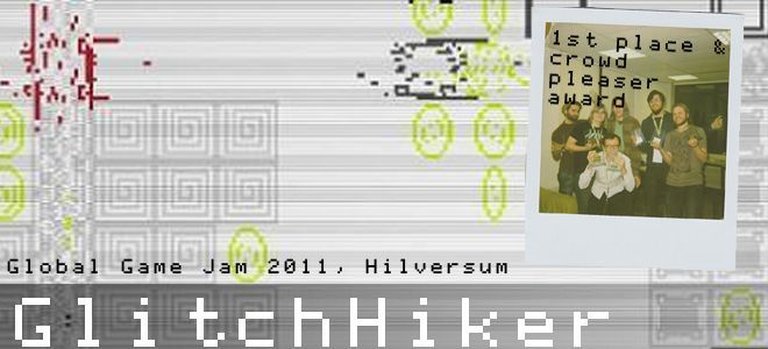
Launch reception was electric. At GGJ11 Hilversum (Netherlands site), GlitchHiker claimed #1 Jury Award, Crowd Pleaser (public vote), and Gamesauce’s “best GGJ games” nod (with Casual Connect perks). IGF 2012 bestowed a Nuovo Award Honorable Mention. MobyGames logs a lone 3.8/5 player score; no critic reviews, but media exploded: PCGamesN, CDM, Ubergizmo, Shacknews hailed its empathy engine. Players’ guilt—”sincere apologies,” per Ismail—proved its emotional hook; a “drunk Canadian” allegedly dealt the final blow.
Commercially “free,” its “success” was extinction—mirroring the theme. Legacy endures: preserved in videos/articles, it influenced ephemeral experiments (Upsilon Circuit), live-service permadeath, and indie empathy designs (Papers, Please). The team’s Vlambeer trajectory (Luftrausers, etc.) amplified its mythos. In 2020s terms, it prefigures blockchain “dying” games or FOMO metas, but purer—teaching that true extinction breeds legend.
Conclusion
GlitchHiker is no conventional masterpiece; its unplayable heart defies scores. Yet as a 48-hour jam triumph, it masterfully wove extinction into mechanics, visuals, sound, and meta-responsibility, evoking guilt where others evoke frustration. Flaws—replayability sans SYSTEM, steep curve—pale against innovations in adaptive audio, communal stakes, and thematic purity. In video game history, it stands as an iconic artifact: the game that died to live forever in discourse, cementing Vlambeer’s vanguard status and proving jams birth revolutions. Verdict: Essential experimental landmark. Play the local version; mourn the ghost. 9.5/10 for audacity alone.