
- Release Year: 2005
- Platforms: Windows
- Publisher: IncaGold plc, media Verlagsgesellschaft mbH
- Developer: Mission Failed
- Genre: Action, Aviation, Flight, Vehicular
- Perspective: Third-person
- Game Mode: Single-player
- Gameplay: Combat, Flight, Mission-based
- Setting: Modern, Wasteland
- Average Score: 40/100
Description
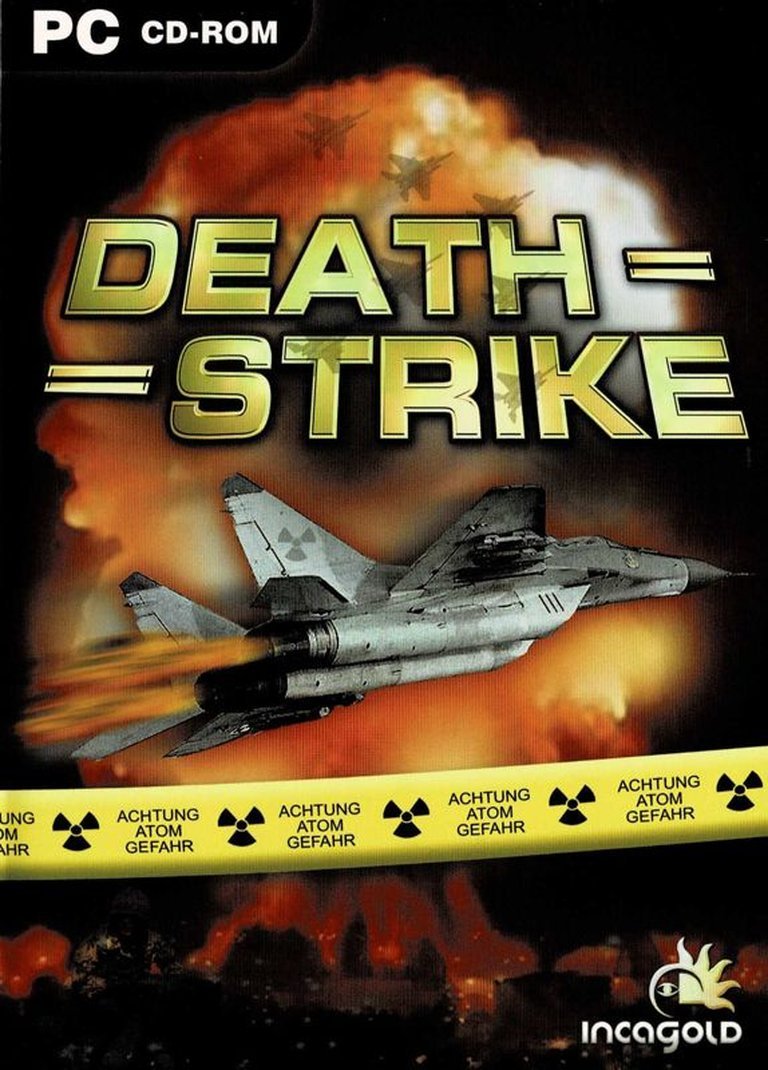
Global War on Terror: Death Strike is a 2005 Windows action flight simulation game where players pilot a jet fighter in a ten-mission campaign to eliminate terrorist leader Samo Al Robi, founder of the NWO organization responsible for atrocities like fake medicine distribution and atomic bomb attacks. Set in the wastelands of Northern East, missions involve navigating from point A to B to bomb ground targets while evading or destroying enemy planes and tanks, with fuel serving as a time limit. Gameplay features mouse-controlled movement and primary weapon firing, keyboard commands for secondary weapons, and a zoom function to enhance targeting accuracy.
Global War on Terror: Death Strike Guides & Walkthroughs
Global War on Terror: Death Strike Reviews & Reception
mobygames.com (24/100): The player fights against Samo Al Robi, founder of the terror organization NWO.
vgtimes.com (55/100): Global War on Terror: Death Strike is a third-person action game with flight simulator elements from the developers at Mission Failed studio.
rawg.io : The game is rated as “Skip” on RAWG.
mobygames.com (24/100): Average score: 24% (based on 2 ratings)
Global War on Terror: Death Strike: Review
Introduction
In the turbulent landscape of early 2000s gaming, few titles embody the era’s geopolitical tensions and budget-driven design quite like Global War on Terror: Death Strike. Released on December 17, 2005, by IncaGold plc, this German-developed action flight simulator promised a high-octane, topical experience capitalizing on the post-9/11 “War on Terror” zeitgeist. Yet, despite its ambitious premise—a ten-mission campaign against the terrorist organization NWO and its founder, Samo Al Robi—the game has since become a cautionary tale of misguided execution. Its legacy is not one of innovation but of infamy: a cautionary relic of an era when topical themes often outpaced technical competence. This review deconstructs Death Strike through the lens of its development, narrative, gameplay, and reception, revealing how its flaws coalesced into one of the most critically reviled yet culturally fascinating flight simulations of its time.
Development History & Context
Global War on Terror: Death Strike emerged from Mission Failed, a small German studio helmed by Thomas Bittrolff. Bittrolff wore every critical hat—concept, code, sound, and 2D/3D design—a testament to the team’s minuscule scale and shoestring budget. The project was backed by IncaGold plc, a British publisher specializing in mass-market “impulse-purchase” titles priced at a modest €14.99. For IncaGold, Death Strike was the flagship of its new “Global War on Terror” series, a cynical bid to ride the wave of contemporary military anxieties. CEO Richard M. Holmes touted it as an “ideal mass-market impulse-purchase title,” emphasizing accessibility over depth—a philosophy that would doom its potential.
Technologically, the game was shackled by its era. Released in 2005, it competed with titles like JetFighter V: Homeland Protector (2003), yet its third-person perspective and rudimentary flight mechanics felt archaic even then. Mission Failed’s reliance on a single developer for core systems resulted in glaring oversights: the control scheme was “unlogisch” (illogical), the physics “nicht vorhanden” (nonexistent), and the overall package felt rushed to capitalize on the “War on Terror” narrative. The gaming landscape of 2005 was dominated by polished AAA titles and niche simulators; Death Strike occupied neither space, landing squarely in the purgatory of budget shovelware.
Narrative & Thematic Deep Dive
The plot of Death Strike is a blunt instrument of geopolitical propaganda. Players assume the role of an unnamed pilot tasked with eliminating Samo Al Robi, the shadowy founder of NWO, a terrorist organization responsible for atrocities ranging from distributing fake medicine (causing neural disorders) to orchestrating atomic bomb drops. The narrative unfolds across ten missions set in the “wastelands of the Northern East,” a vague, thinly sketched locale presumably modeled after Central Asian or Middle Eastern conflict zones. The dialogue is nonexistent beyond perfunctory mission briefings, reducing characters to cardboard cutouts—Al Robi as a one-dimensional “evil mastermind,” the player as a faceless instrument of state power.
Thematically, the game weaponizes the “War on Terror” for low-stakes thrills. Its portrayal of terrorism is devoid of nuance, reducing complex geopolitical conflicts into simplistic binaries: “free world” vs. “dark forces.” The inclusion of WMDs (specifically nuclear materials) and rogue nations like “Monigeras” echoes real-world anxieties but treats them as window dressing for repetitive bombing runs. The absence of moral complexity—no interrogation of surveillance ethics, civilian casualties, or the ethics of preemptive strikes—relegates the narrative to jingoistic spectacle. What could have been a timely exploration of modern warfare instead becomes a hollow, propagandistic shell.
Gameplay Mechanics & Systems
Death Strike’s gameplay loop is defined by its punishing monotony and systemic failures. Each mission tasks players with flying from Point A to Point B to destroy ground target C, with fuel acting as a crude time limit. Combat is equally simplistic: players engage enemy jets and tanks using a mouse-driven primary weapon (with keyboard controls for secondary ordnance). A “zoom function” projects a circle onto the screen, magnifying targets—but as PC Action noted, this “kleines Scharfschützen-Zielfensterchen” (small sniper scope) obstructs visibility, turning aerial dogfights into frustrating guesswork.
The control scheme is arguably the game’s greatest failing. The mouse-centric aiming creates a disconnect between the player’s movements and the jet’s responsiveness, resulting in “trage Steuerung” (laggy controls) and “lahme Tempo” (slow-paced gameplay). The third-person camera, offset from the center of the craft, further disorients pilots during evasive maneuvers. Mission variety is nonexistent; objectives rarely deviate from “destroy X” or “reach Y,” with enemy patterns rehashed ad nauseam. Progression is nonexistent beyond unlocking the titular “Death Strike” attack—a flashy but underwhelming superweapon. The system’s one redeeming feature is its brevity; the ten-mission campaign can be completed in under two hours, sparing players prolonged agony.
World-Building, Art & Sound
Death Strike’s world-building is impressively barren. The “wastelands of the Northern East” are rendered as flat, textureless plains with sparse, low-polygon structures. As GameStar lamented, the “detailarme Umgebungsgrafik” (lacking environment graphics) resembles “etwas an mit Blattwerk garnierte Kotze” (something with foliage-decorated feces)—a damning metaphor for its aesthetic laziness. The jet models are equally uninspired, with four fighters differentiated only by color palettes. Explosions are flickering sprites, and terrain deformation is nonexistent, making bombing runs feel weightless and detached.
Sound design fares marginally better but fails to redeem the experience. Phil Homes’ soundtrack is a generic “rocking” amalgam of electric guitars and drums, serving as sonic wallpaper rather than atmosphere. Weapon effects are tinny and underwhelming, and the absence of cockpit audio or radio chatter strips the simulation of any sense of immersion. In a game where player feedback is crucial, the audio-visual presentation is actively hostile, exacerbating the core gameplay frustrations.
Reception & Legacy
Global War on Terror: Death Strike was met with near-universal derision upon release. German publications led the charge: GameStar awarded it a 33%, calling it a “perfektes Lehrbeispiel, für jede Menge eklatante Designfehler” (perfect textbook example of glaring design flaws). PC Action was even harsher, giving it 15% and branding it “Vorsicht Schrottspiel!” (Warning: junk game!). Critics savaged its controls, graphics, and pacing, with one memorably advising players to “Fliegen, ballern, Rechner runterfahren!” (Fly, shoot, shut down the computer!). Commercially, the game vanished into obscurity, its multiple re-releases as Jet Simulator (2007, 2009) failing to resurrect its fortunes.
Yet, Death Strike has endured as a cult curiosity. It is frequently cited in “worst games” lists, celebrated for its unintentional humor and audacious failure. Its legacy lies in its cautionary status: a case study in how topical themes cannot salvage fundamentally broken design. While it influenced no subsequent games, its infamy persists in retro gaming circles, where its screenshots and reviews serve as a reminder of the perils of rushed, theme-first development. In an era of increasingly nuanced war games, Death Strike stands as a dark mirror—a monument to what happens when ambition outstrips execution.
Conclusion
Global War on Terror: Death Strike is less a game and more a historical artifact—a flawed, fascinating window into the intersection of geopolitics and shovelware. Its narrative, while thematically resonant, is drowned by simplistic gameplay and catastrophic technical execution. The controls are unresponsive, the graphics abysmal, and the experience so brief it borders on insulting. Yet, to dismiss it entirely would be to overlook its cultural value: as a monument to the “War on Terror” era’s commercial excesses and as a testament to the importance of polish in game design.
For historians and masochistic gamers alike, Death Strike is a morbidly compelling experience. It offers no joy, no challenge, and no innovation—only a relentless, 90-minute lesson in failure. In the pantheon of infamous games, it holds a unique place: a relic that embodies the hubris of topicality and the danger of underestimating player expectations. Verdict: A historically significant but unredeemable failure.